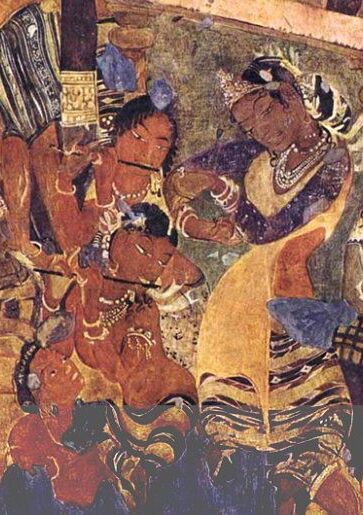
«In the court of Master Tillay, a mystical dance takes place—what is this, my dear?»
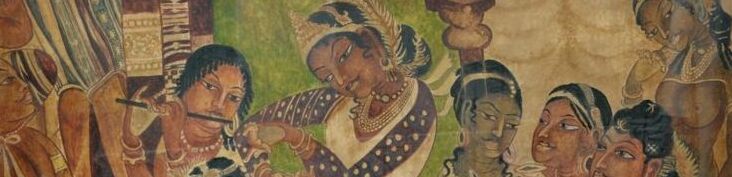
Indian Dance as an Early Manifestation of Semiotics

CATEGORIZATION
1. Concept
2. A Return to Roots: The Bhimbetka Caves
3. Original or Boldly Borrowed? Dravidian and Aryan Cultures
4. The Genesis of Embodied Language: Vedic Culture of India
5. The Post-Vedic Period and Epic Texts
6. Treatises on Dance Law: Natyashastra
7. Conclusion
8. Sources
CONCEPT
At the start of my first year, I was introduced to semiotics during history lectures. It studies signs and symbols, uncovering meaning in the smallest details. Signs can be more than just letters; they can include graphic symbols, colors, gestures, and movement. It was this core thesis that intrigued me and guided me toward studying variations in sign systems beyond conventional letters.
For example, the human body is capable of conveying information through hand gestures, facial expressions, body posture, and interaction with space. Furthermore, all of this developed before the advent of written language and served as a form of communication. Dance can also be viewed as one of the earliest forms of nonverbal communication, where movement becomes the carrier of meaning. However, there is a style of dance that possesses one of the most intricate geometries, mathematical precision, and its own alphabet. And this style of dance is Indian.
My interest in this topic stems from a desire to understand how the body acquired its own alphabet within Indian dance arts, and to trace the development of its ritualistic and divine components. This topic offers an opportunity to study the history of symbolic system development, as well as to analyze the reasons why dance in Indian culture attained the significance of a key means of spiritual self-discovery and devotion to deities for maintaining cosmic order. Special attention is paid to the codification of body language, the interpretation of mudras (hand gestures), adavus (foot positions), drishti (gaze), and other elements. It is important to trace how this established alphabet was reflected in artifacts—sculptures, rock carvings, and seals—and what symbolism each depicted.
Central Research Question
How did dance become a symbolic system in India—a means to represent speech, worship deities, and maintain cosmic harmony?
HYPOTHESIS
Body movements gradually transformed into a coded system of symbols governed by strict geometric canons, which gives us the reason to read dance as a semantic system. Ultimately, the analysis of primitive traditions, sculptures, runes, epic texts, and meanings leads to the assertion of specific rules and the final codification of body language. The alphabet of dance itself is complex and profound. It consists of numerous elements for each body part, allowing for the complete and sincere interpretation of a particular story into a clear sequence of movements and coding it in its own way. Thus, we can consider that the structure of Indian plastic art is an independent semantic system that served as a common and understandable language even before the full development of writing.
OBJECTIVE
To trace how the dance art of India developed its own iconic language. To analyze how the «bodily» alphabet is structured and how its semantics are demonstrated. Through this research, to prove that Indian dance is an independent sign language and constitutes a complete semantic system.
A Return to the Source: The Bhimbetka Caves
To fully grasp the nature of Indian dance semiotics—to find answers to multiple questions, especially to the queries, «why does the wellbeing of this eastern country literally depend on dance?» and «where do so many complex schemes originate for seemingly simple elements?”—one must turn to a distant past, specifically the period beginning in the Upper Paleolithic era.
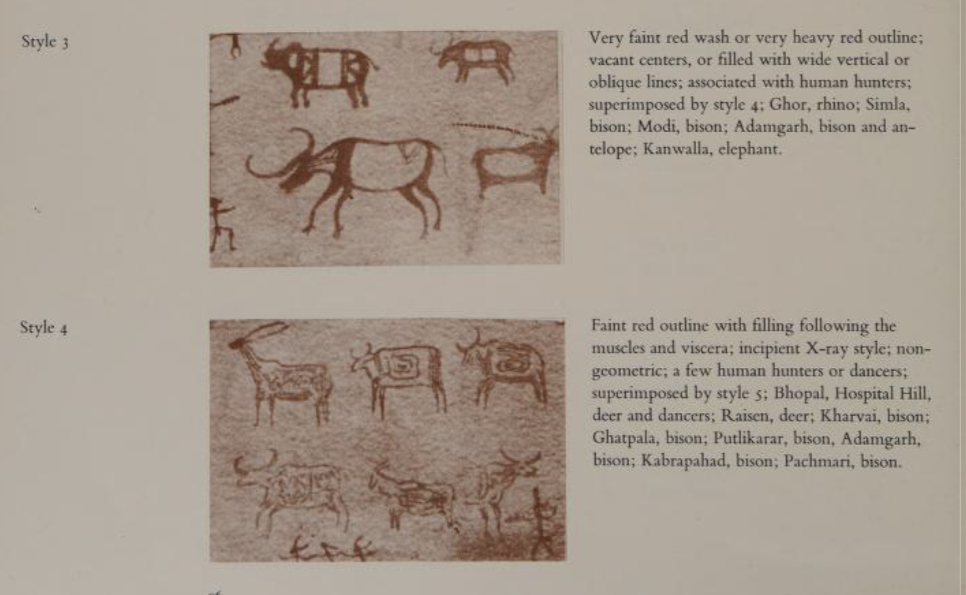
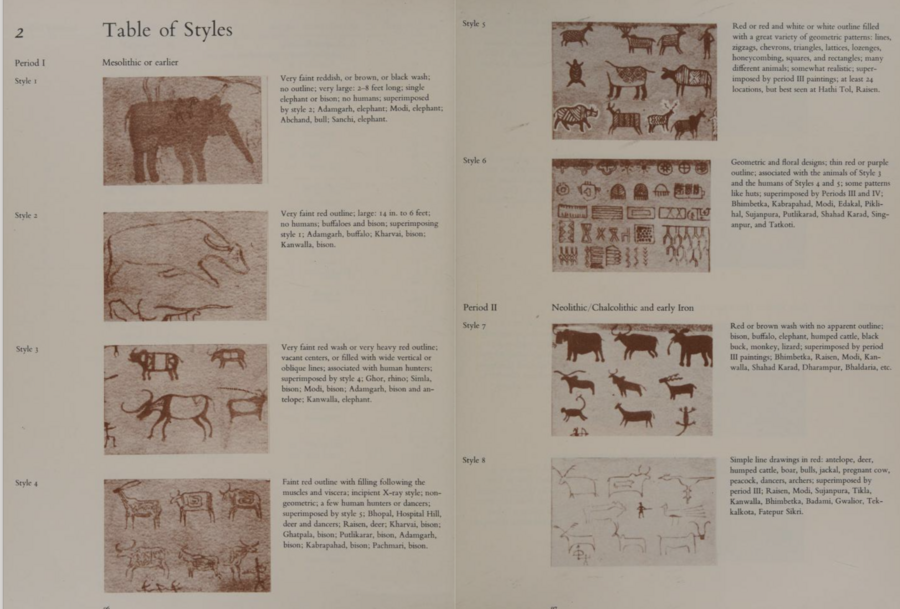
We know that most traditions and features of ancient people’s daily life were recorded in rock art. The most common images included Indian bison, buffalo, cattle, antelopes, deer, elephants, rhinoceroses, wild boars, and dogs. However, at the intersection of the 3rd and 4th drawing styles, images of people also began to appear.