INDEX
[1] Description [2] Early Manifestations [3] [4] [5] [6] [7] [8] [9] [10] [11]
DESCRIPTION
I spent almost my entire life in Belarus from birth. During my time studying and living there, based on my personal experience, I can observe that we were not always sufficiently immersed in the artistic development of my native country. Certain achievements and perspectives on them were frequently repeated in the school curriculum year after year. Within the «History of Illustration» course, I intend to examine the emergence and growth of this field in Belarus.
At first glance, the history of Belarusian illustration presents a peculiar impression. It features sharp and vibrant bursts of engraving and miniature work, yet between these flashes are gaps that are difficult to attribute to simple «backwardness» or «lack of talent.» Belarusian book graphics did not develop along the same smooth trajectory as Western European or Russian book arts. Its path was a process of constant adaptation to changing historical contexts and an active blending of artistic traditions.
The perceived «modesty» of Belarusian illustration during certain periods is not a lack of development, but rather a logical consequence of technological and cultural upheavals that involved the loss of experience and the necessity of partial reconstruction. Its distinctive quality lies not in grand creative revolutions, but in a sincere desire to preserve traditions and its own visual folk language. The changing of eras did not mean the disappearance of traditions, but rather required artists to possess a memory of genres, technical skills, and immersion in ethnographic material.
The national style itself is, in part, the result of conscious artistic construction. Twentieth-century Belarusian illustration demonstrates how masters purposefully turned to folklore and ethnography to forge a unique visual national language.
The chronological scope of this research will span from the earliest petroglyphs to contemporary illustration. The geographic scope will extend from prehistory to the current Republic of Belarus, including works by Belarusian illustrators who emigrated or worked abroad, as cultural tradition does not always adhere to national borders.In this study, I plan to trace the evolution of the visual language of the Belarusian book, examining key stages and techniques. It is important to demonstrate how the artistic character of the publication changed under the influence of objective cultural and technological processes, and how Belarusian illustration has maintained its deep-seated distinctiveness despite all historical transformations. This will allow me to present the development of graphic art not as a discontinuous process, but as a continuous search for a national style.
INITIAL MANIFESTATIONS
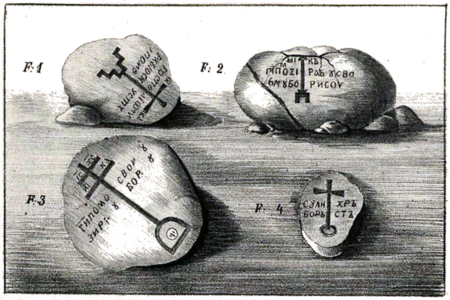
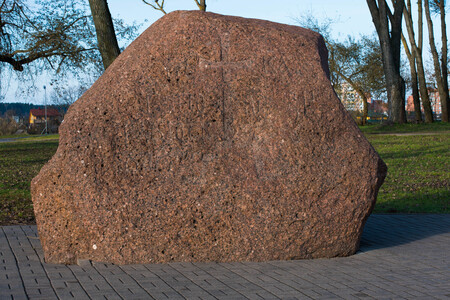
Dvin Stones (based on illustrations published in the February issue of «Rubon» in 1842)
Dvinskaya, or Borisov Stones. Six stones, each inscribed with the phrase «Lord, help your slave Boris, ” whose appearance and the purpose of the crosses and inscriptions remain unknown. However, based on the inscriptions on the Rogvolod Stone, dated to 1171, it can be reasonably assumed that Rogvolod Borisovich was the patron. Attribution on the other stones continues to be a matter of dispute. In 1896, A. P. Sapunov published information regarding the last Borisov Stone. The stones are primarily located in the Dvina River basins, specifically within the territory of the former Polotsk Principality. In the 1960s, historian B. A. Rybakov made an interesting hypothesis: that these boulders were considered sacred and were carved during times of famine to gain God’s blessing for a good harvest.
11th–15th Centuries — Manuscript Illumination
The Gospel of Tournes, 11th Century