Research Concept
WHY VIDEOGAMES?
I chose this research topic because of my gaming experience. I spend a lot of time in Counter-Strike 2, and sooner or later, any attentive player notices that the maps Anubis and Ancient are constructed in such a way that you want to explore their locations rather than just rush past them.
The relevance of this topic is visible in the scope of the phenomenon. Competitive CS2 draws over a million players daily, and matches on these two maps are broadcast at esports tournaments with massive audiences. The virtual Anubis and Ancient are visited far more frequently than the real Luxor or Tikal, which is precisely why it is important to understand how closely they correspond to their «originals.»
My material selection principle is paired: for each gameplay scenario, there is a real architectural prototype. For Anubis, I used Egyptian temples from the Nile Valley (Karnak, Luxor, Edfu), and for Ancient, I used Mayan cities and the broader Mesoamerican tradition (Chichen Itza, Tikal, Palenque). The gameplay aspect is covered by screenshots from CS2 that I took.
Key research question: How accurately do the Anubis and Ancient maps in CS2 correspond to real historical prototypes?
Hypothesis: The realism of both maps is achieved not by copying specific monuments, but by selective stylization—recognizable silhouettes and materials are combined with game simplifications and compositional inventions.
Part 1. Ancient
1.1. Game Map
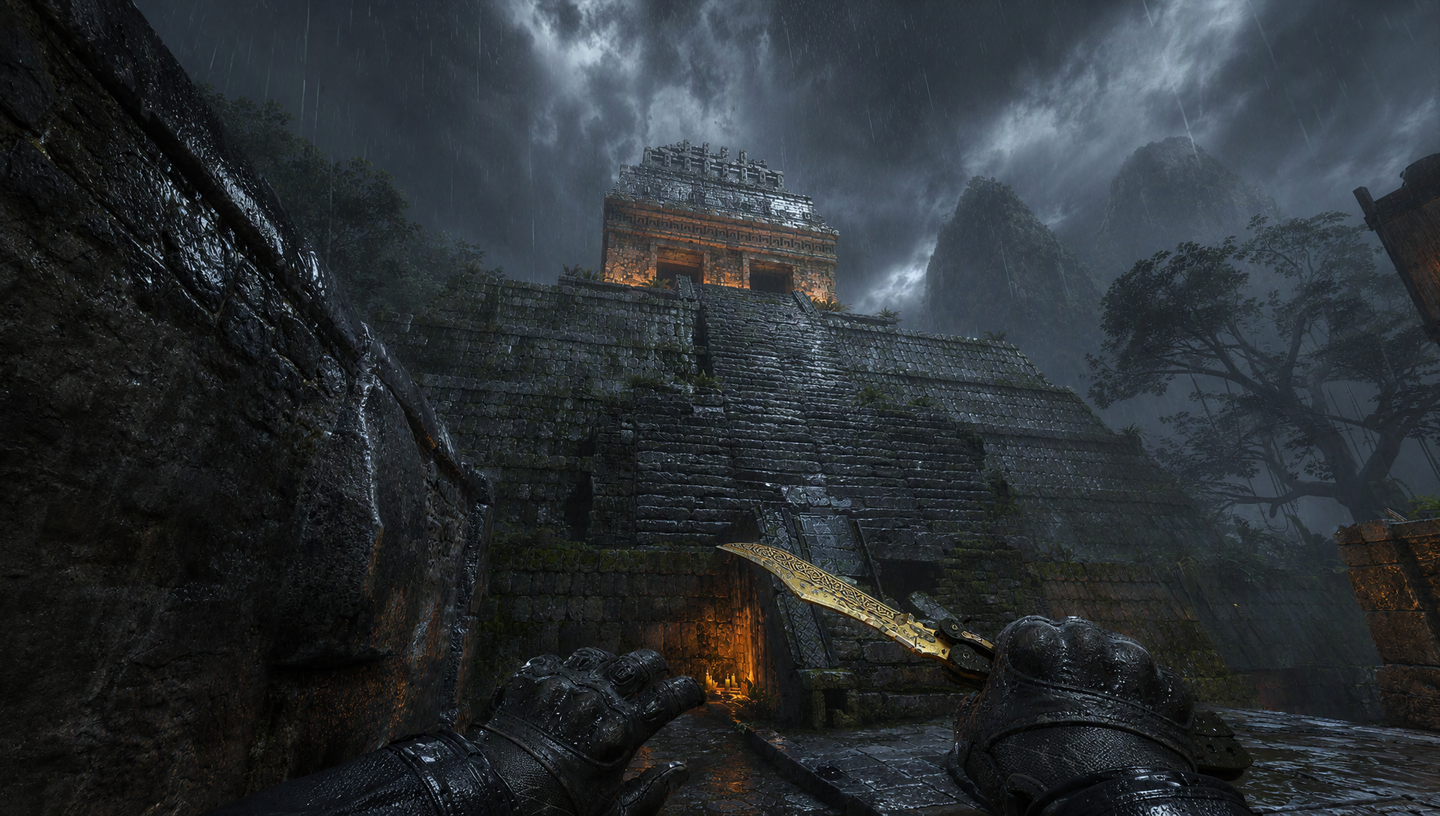
The map’s setting is an excavation in the Central American jungle—a stylized Mexico. In the storyline, the location is a living archaeological camp: an ancient city that is simultaneously being unearthed and inhabited. Thus, two worlds surprisingly coexist on the map. The first is ancient: massive stone platforms with steps, temples featuring ornate friezes, stelae carved with human faces, and ruins draped with vines and moss. The second is modern and utilitarian: wooden scaffolding, plywood panels, tarp tents, archaeological crates, and generators with speakers. Because of this contrast, the location doesn’t look like an open-air museum—it looks like a place where people are actively working right now—and I think that is what makes it convincing.
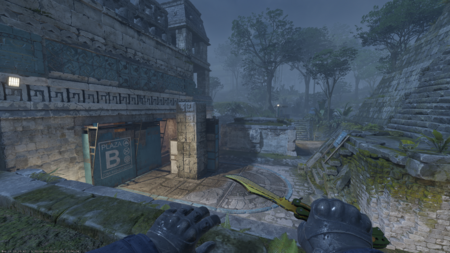
Game screenshots from personal archives
Game screenshot from personal archives
1.2. Real-Life Analogues
1.2.1. The Quetzalcoatl Pyramid.
The primary architectural genre the map adopts is the stepped pyramid topped with a temple. This is the calling card of all of Mesoamerica. The most recognizable example is the Kukulkan Pyramid, also known as El Castillo, in Chichen Itza on the Yucatan: nine tiers, four staircases of 91 steps each (together with the top platform, this equals exactly 365—matching the days of the solar year), and a temple at the summit approximately 30 meters high, including the base. It was built around 1050–1300, during the late period when Maya culture was merging with Toltec influence.
El Castillo (Kukulcán Pyramid) in Chichén Itzá
Daniel Schwen. Original Work
1.2.2. Temple I
The second example is Tikal in Guatemalan Petén: Temple I, erected around 732 CE as a mausoleum for the ruler Jasaw Chan Kʼawiil, rises 47 meters above the Great Plaza.
View of Temple I (Tikal) from the central plaza
Dave Jimison. Original work
1.3. Similarities Between Play and the World
1.3.1. Pyramid with Temple.
The similarity begins with the silhouette: a stepped mass, a central stairway, a temple with a ridge on top—it is unmistakably a Mesoamerican motif, impossible to mistake for Egyptian or anything else. The actual stairs of Maya pyramids are brutally steep—at Temple I in Tikal, the ascent angle is about 45 degrees, and the steps are narrow; tourists are regularly asked not to step off the wooden ladders placed over the stone ones. This can also be observed in the game.
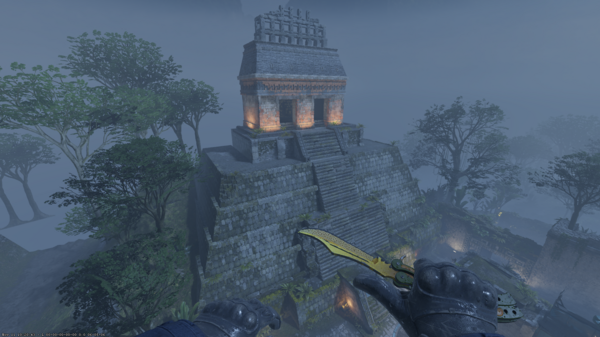
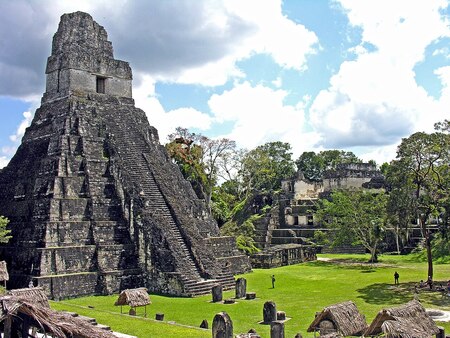
Left—a screenshot from a personal archive. Right—a view of the church from the northwest, from the Northern Acropolis. Credit: Dennis G. Jarvis
1.3.2. Stelae.
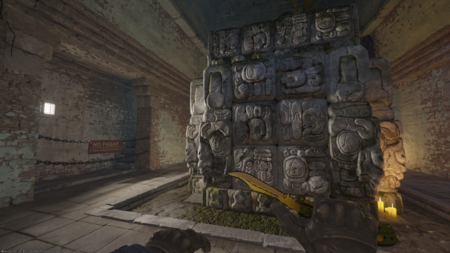
The stela on plan B features carved faces—a miniature yet recognizable Copan stela. One deviation: actual stelae were placed in rows along plazas, they were taller than a person, and they never served as shelter—they were objects of admiration. There is only one play stela.
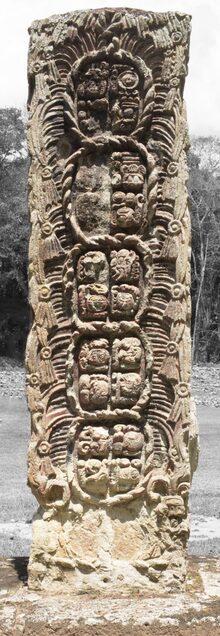
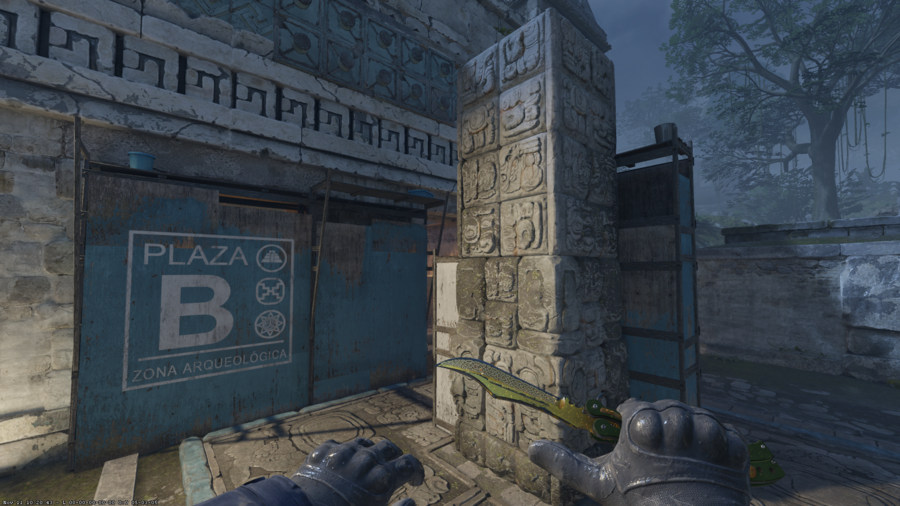
Left — the Kopansk late-classical stele (author not specified, image from https://mayagodsoftime.com/). Right — a game screenshot from a personal archive.
1.3.3. Card Material
The gray, bare stone in Ancient is an exact replica of how the ruins look today. However, the game does not show how they looked when they were alive—the facades were plastered and painted in crimson, blue, and ochre, and the stelae and cornices bore polychrome sculptures of rulers. Ancient shows not the ancient city, but its ruins eight hundred years later—the state in which Stevens and Carterwood found Chichen Itza. And this, one must admit, is visually honest: the green moss on the blocks, the water-darkened masonry around the moat, the trees sprouting through the walls—all of this is copied from real photographs of the ruins, not fabricated.