Categories:
/1/Concept
/2/Benetton Clothing in Advertising
/3/Advertising Without Product
/4/How Reportage Became Advertising
/5/Object as Statement
/6/The Role of the Benetton Logo
/7/Conclusion

concept
When you see apparel advertising, you usually expect to see the product itself. The photograph shows the clothing in its entirety—how it looks, how it is worn, and how you might see yourself in it. However, in some United Colors of Benetton campaigns, this expectation is broken. The space typically reserved for clothing advertising is instead occupied by a statement on racism or HIV/AIDS. The brand name remains below the image, which creates a strange sensation. The company is selling clothing, but the conversation it initiates with the photograph is entirely different. What is the advertisement promoting in such a case?
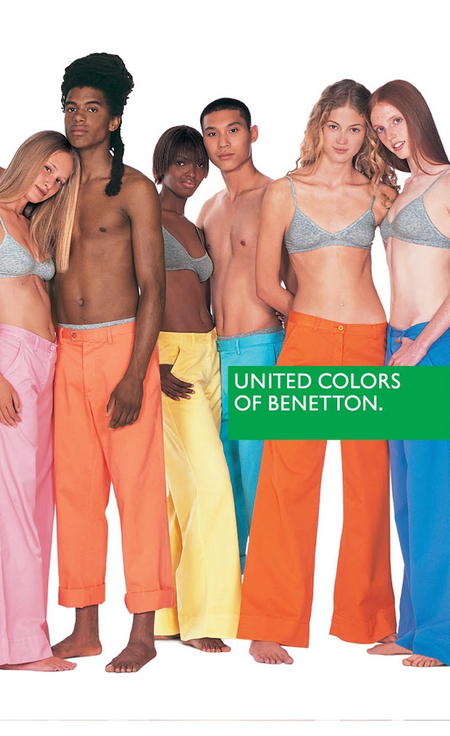
The DNA of the Benetton brand is formed around the idea of unity in diversity. The diversity of colors in the brand’s visual identity can be linked to its aspiration to unite people from different cultures, nationalities, and viewpoints. This idea is also reflected in Benetton’s advertising campaigns: differences are not hidden, but become the foundation of a shared message. Therefore, color, much like the photograph, functions not only to ensure brand recognition but also to convey the brand’s values—openness, diversity, and unity.
This approach is tied to Benetton’s collaboration with Italian photographer Oliviero Toscani, which began in the 1980s. He shot for the brand and developed advertising concepts. For some campaigns, Toscani selected pre-existing journalistic photographs. At that time, his work included selecting the image and deciding whether or not to use it in an advertisement. This is a crucial detail for this study. The photograph acquires a different meaning and a new function the moment it is published, appearing alongside the company’s name.
The core of this research is the dissonance between the product the consumer expects from an advertisement and the social issue the advertisement addresses. It is easy to label such advertising as provocative. More interesting is to understand where this tension originates. It might be created by the theme itself, the choice of photograph, or the fact that the clothing brand is speaking about it. How does the role of the photograph change when it is tasked with presenting a social issue?
Interest in such advertising can easily be reduced to whether it was scandalous or effective. What occupies my attention is different: to what extent the commercial context influences the meaning of a social theme. If the photograph is perceived as a message on behalf of Benetton, the question of what role the shot and its presentation played in this relationship remains open. Similarly, the mere presence of a social theme does not allow us to judge the company’s motivations or the audience’s reaction. Such conclusions are only possible where there is specific evidence to support them.What role does the photograph take when clothing moves out of the center of the advertisement? How does a social statement become part of the Benetton image?
Hypothesis: In certain campaigns, Benetton generates tension because the clothing brand uses advertising to issue a statement on a social issue. The photograph introduces this theme, and the Benetton caption connects it to the brand. Thus, the photograph can shape the public image of the brand even where clothing is not shown.
Clothing in Benetton Advertising
«All the Colors in the World» 1984 Photo — Oliviero Toscani.
Every sweater has its own design, but the repetition of red and dark blue runs through the entire group. This allows for two ways to view a single frame. Up close, individual items and their patterns are discernible. At poster scale, a band of color reads across the image, holding the individual figures together.The phrase «Tutti i colori del mondo» embodies both the palette of the sweaters and the group of people beneath them. A second reading emerges due to the tight arrangement of the figures and the diversity of their appearances. The photograph connects the abundance of color in the clothing with the idea of a shared presence among people of different races and genders.
«Flags» 1985 Photo — Oliviero Toscani.
A red, elongated sweater unites two figures, and between their faces, the flags of the USA and the USSR are placed side by side. In the mid-1980s, the juxtaposition of these symbols could have been read as an image of rapprochement across the Cold War. A 1986 report confirms that a friendly combination of national symbols is possible. Both characters merge into a single silhouette, holding hands, telling us that we are all human, regardless of country.
«Globes» 1986 Photo by Oliviero Toscani.
The hands of both figures meet around a small globe, and this connection is more significant than its scale. The object already carries meaning accessible to the general viewer. It frames the encounter between two people within the context of the wider world. In «Flags, ” the symbols are embroidered on a sweater, but here, a separate object conveys the theme. This creates a semantic focal point capable of functioning independently of clothing.
Advertisement Without Product
«Handcuffs» 1990 Photo — Oliviero Toscani.
focus on meaning
The brushes are shown in similar scale and position, but the connection between them is compulsory. It is difficult to assign roles from the shot, so the equality of position conflicts with the gesture of restriction itself. The handcuffs are unexpected in the jeans advertisement. For a story about lack of freedom, this is the main detail.
Two denim cuffs frame the image. Hands are oriented downward, and a short chain crosses the bright space between them. It is worth noting the chain as a compositional element. Its placement explains why the wrists are brought close together in the frame, allowing a small detail to become a focal point of meaning. A study by Peters and Vedel on magazine advertising shows that the image effectively captures attention, and brand mark recognition occurs subsequently.
«Breastfeeding» 1990 Photo — Oliviero Toscani
Care is visible in their hands.
Palms support the child, though the adult’s face remains out of frame. The gesture allows one to read care without expression. In studies by Aviezer and colleagues, body posture altered how people recognized intense facial emotions. In this poster, the gesture functions even more autonomously. The archival card indicates an anti-racist theme. This creates a sense of closeness between two bodies with different skin tones.
«Blanket» 1990 Photo — Oliviero Toscani.
the fusion of cultures under one medium
When three are sheltered under a single blanket, the edge of the fabric connects the broad field of color to the poses of the people. The object provides a physical form of intimacy—this is what differentiates it from a flag, where the connection is established by an already recognizable symbol. Even if the blanket belonged to a specific collection, which the archival photo does not specify, its role in the composition is evident. The viewer is invited to consider how vastly different individuals hold themselves together beneath one piece of fabric.
«Angel and Devil» 1991 Photo by Oliviero Toscani.
Embracing defiance against prescribed roles
The hairstyles recall the golden curls of an angel and the horns of a demon, while the embrace unites two figures to whom these details assign opposing roles. Toscan spoke about the racial stereotype played out in the staging. A complexity emerges that his explanation only underscores. To see the critique of the stereotype, the audience must first learn the stereotype itself. Therefore, the gesture can be read as its subversion, and the distribution of roles as a repetition of a familiar racial schema.
«Priest and Nun» 1991 Photo — Oliviero Toscani.
love is contrastive
A large black hat and a light headpiece allow for the identification of religious roles. The contact between the profiles conveys a different message. If we mentally remove the costumes, only the kiss remains, and the tension between the intimate gesture and the expectations associated with these roles lessens. Thus, clothing continues to be an essential part of the image, but now it establishes a conflict. The power of this reading depends on how familiar the reader is with the religious symbols and norms engaged here.