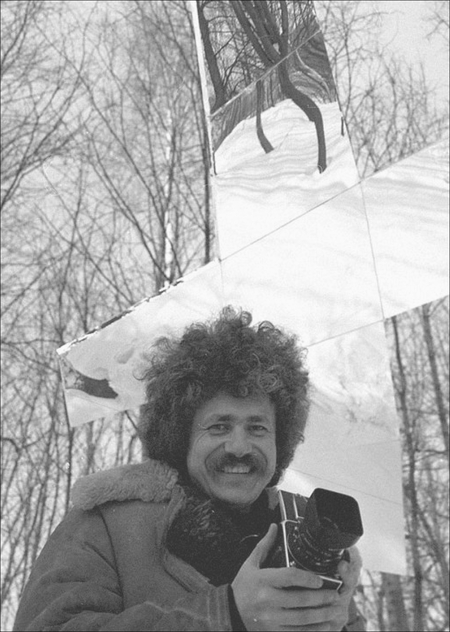
Photography is one of Francisco Infante’s primary mediums and his main tool.
When examining the practice of Francisco Infante, it is difficult not to notice that the artist frequently uses photography. Infante is sometimes referred to as a photographer, which is not entirely accurate, as photography is merely one component of his own methodology—a methodology he has reinvented the meaning of photography within art.
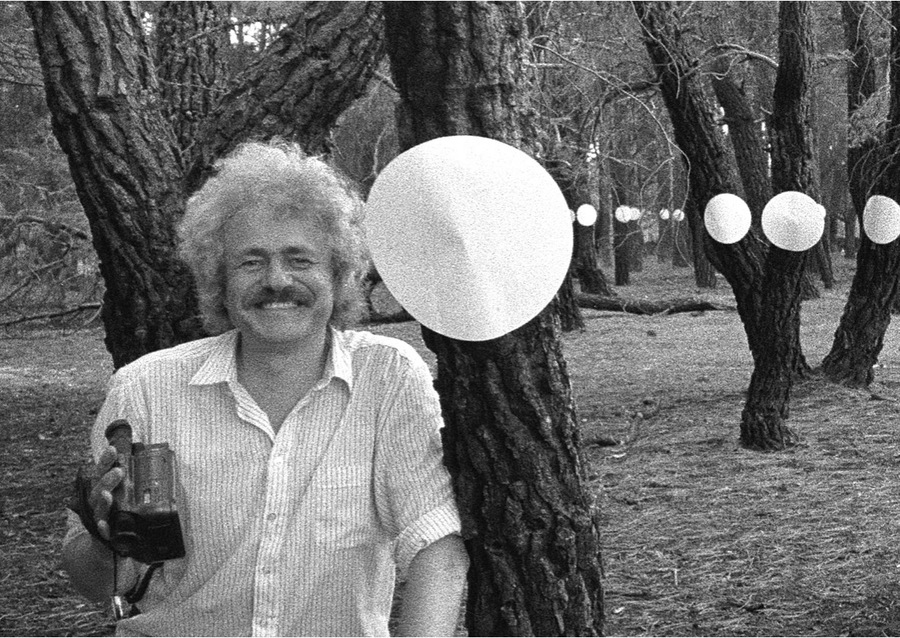
Francisco Infante on artifact shoots / Tretyakov Gallery Press Service
First and foremost, the artist uses photography to display artifacts, yet it simultaneously functions as a «third dimension» that allows the human eye to capture the fleeting state of union between nature and an artificial object. Photography serves as a link between temporal modalities—it is a lacuna within the interval of past, present, and future. Francisco does not use photo montage in his works, preferring instead to rely on the will of chance in his projects. His artifacts always exist in a momentary state that cannot be reproduced, but which can be captured through photography. The variability and elusiveness in his work demonstrate a rejection of precise reality replication. It undergoes transformation—a discrete shift reflecting an individual perception of the world. The accidents that arise during these transformations are significant: improvisation and the flexibility of concept are integral parts of Infante’s artistic practice.
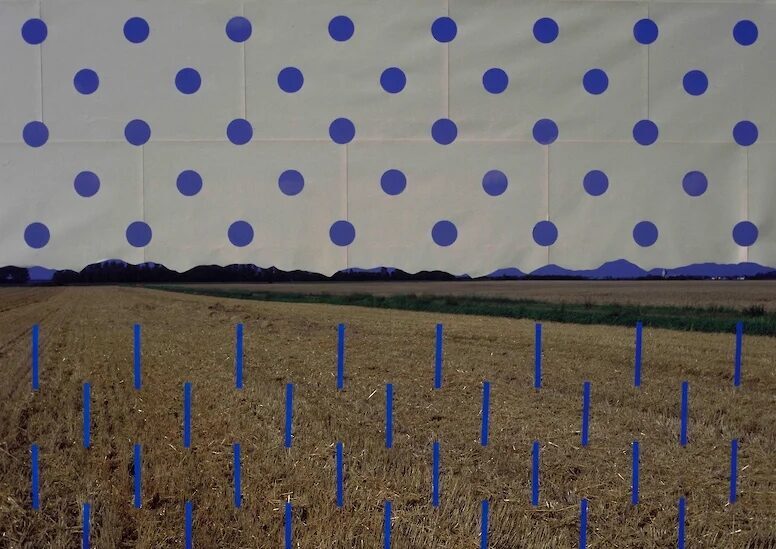
FRANCISCO INFANTE AND NONNA GORYUNOVA, FROM THE «REVERSE INSTALLATIONS» SERIES, 1997
In Infante’s practice, the concept of discreteness frequently appears. Discreteness is the concept of dividing objects into separate fragments. For Infante, discreteness, or discrete displacement, is linked to reflection, which is interpreted not as an exact reproduction of reality, but as its alteration. Discreteness incorporates Infante’s crucial categories: «SUDDENLY, ABRUPTLY, INSTANTANEOUSLY,» as well as «CHANCE.» It is precisely because of this discreteness that the artist uses photography to make it accessible to the human gaze.
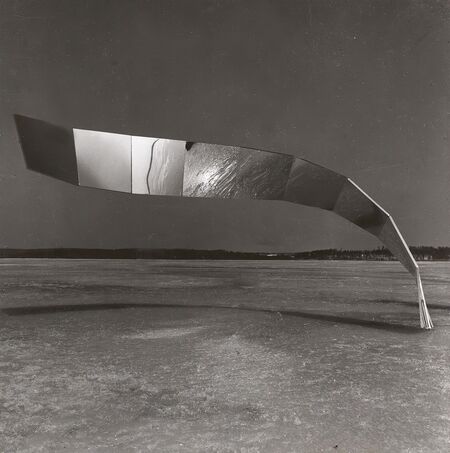
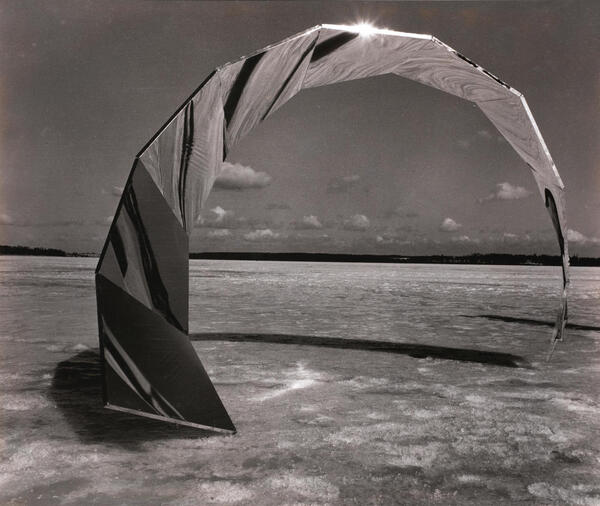
Artifacts from the «Focal Points of Curved Space» series, 1979
Photography for Infante serves as a tool for documenting created artifacts.
He did not employ photography as a technology for capturing a conventional representation of the environment; rather, he created a «third dimension» through photography—one that depicts the fleeting state of integration between nature and an artificial object. Infante reveals and emphasizes the specific quality of photography when capturing artifacts. The realization of his concept, visualized through photography, represents the artist’s unique perspective on the world. Photography is not the art of Francisco Infante; his art (artifacts and metaphors) is merely conveyed through photography, residing in a unique vision of the world that transforms the surrounding environment into metaphors and artifacts.


Artifacts from the «Geometric Horizons» series, 1992 Artifacts from the «Landscape Dictates» series, 1997
Boris Groys’s text from Francisco Infante’s self-published book is also, to some extent, focused on the role of photography in the artist’s work: «In Infante’s photographs, nature remains nature. There is no indication of a new object of contemplation, a new domain of visual experience that has been mastered as art. The essence of these photographs lies in indicating a new interpretation of already existing artistic experience—a different, and deeper, understanding of it. The phenomenon of art itself becomes an event and is photographed.» For Francisco Infante, the camera became a means of extending thought; photography transformed into a third dimension. The artist maintains a unique position that continues the theme of technological pathos. Francisco’s characteristic theme of indisputable infinity collides with the idea that the world changes every moment, a moment that allows the technological medium—in this case, the camera—to be captured.
Francisco Infante often talks about the devices that helped him realize his ideas, and sometimes even influenced them: «At first, a friend gave me an FED, but I didn’t like the format. It was too narrow. Someone told me, ‘Hey, there’s a very good camera that costs 10 rubles, ’ called the ‘Lyubitel.’ I went and bought it. I already liked this square format. Why did I like it? Because I intuitively reasoned that the subject I was trying to shape shouldn’t be forced into some spectacular composition within the frame. It should be at the center of our attention, and the center of our attention is best formed by a square. All sides are equally distant from the center—from the physical center, from the geometric center. Therefore, everything I do must correspond to that. It can be shifted, but the center—its existence is perceived in the square format. That is why I used the Lyubitel camera.»
The photographic function used by Infante can be broadly divided into five parts.
- Documentation of Artifacts and Installations: In the 1970s, Infante, together with his wife Nonna Goryunova, began creating «artifacts"—temporary installations in natural environments, often incorporating mirrors, geometric forms, and reflections. Photography captured these ephemeral objects, transforming them into autonomous works of art.
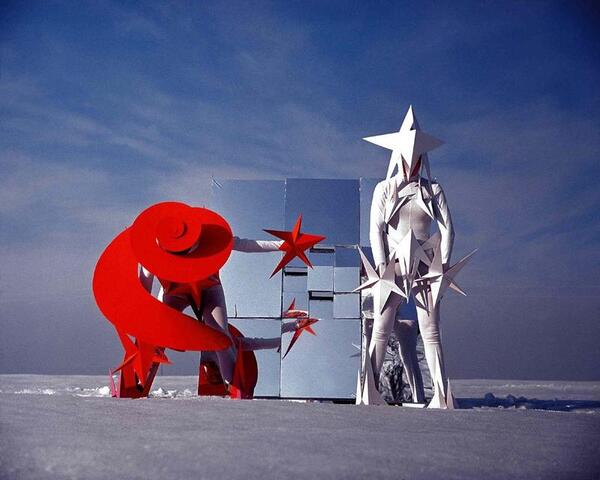
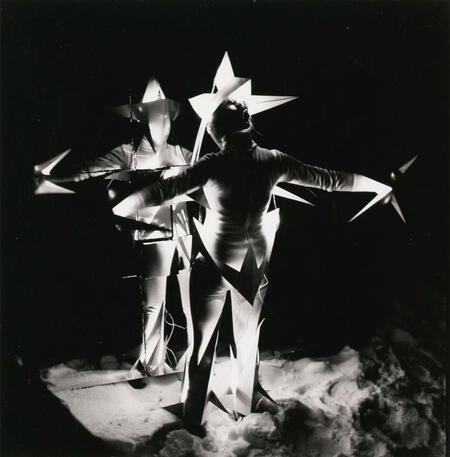
Artifacts from the «Gesture Games» series, 1977
- Play with Reality and Illusion: In the series «Starry Sky Reconstruction Projects» and «Alpine Snow,» Infante uses photography to create optical illusions, where artificial objects interact with nature, altering the perception of space.
Work from the series «Stellar Sky Reconstruction Project»
- Documenting Performative Actions Many of his works relate to movement and time. Photography allows one to capture the moment of interaction between an object and its environment, emphasizing dynamics and transformation.
Work from the «Gesture Games» series
- Photography as Autonomous Art: Although Infante frequently works with installations and objects, his photographs are not mere documentation—they are complete visual statements. They explore the theme of «art in nature, ” where the human becomes a co-author of cosmic order.
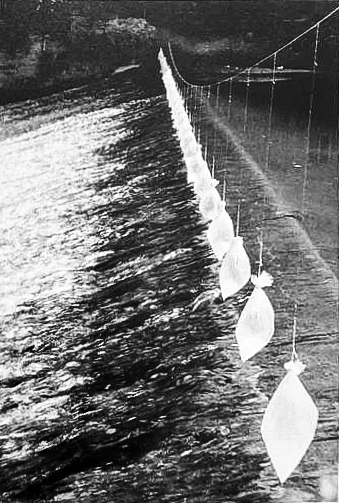
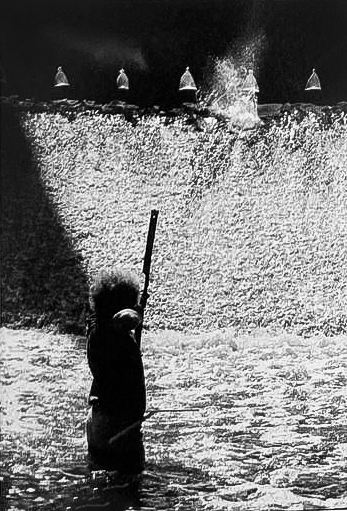
Installation «On the River»
- Photography as a Tool for Inquiry Infante uses photography to reflect on the relationship between art and reality. His works often resemble scientific experiments, where photography serves as evidence for an artistic hypothesis.
Artifacts from the «Foci of Warped Space» series, 1979
Monograph / Francisco Infante; State Collection of Contemporary Art, State Center for Contemporary Art. — Moscow, 1999. — 271 p.
Journal of Unofficial Russian Art / Boris Groys / Moscow Romantic Conceptualism. — Moscow, 1979. — pp. 9–15.
Francisco Infante / Auto-album. Continuation. Art and Family. — Moscow, 2024. — 416 p.
Francisco Infante photographing artifacts / Tretyakov Gallery Press Service / URL: https://rg.ru/2025/01/22/geometriia-na-snegu-pochemu-nuzhno-idti-na-vystavku-francisko-infante-v-novuiu-tretiakovku.html / Accessed: 03/26/2025
Artifacts from the series «Focal Points of Curved Space, ” 1979 / URL: https://deniscollection.com/francisco-infante-arana/ochagi-iskrivlennogo-prostranstva / Accessed: 03/26/2025
Artifacts from the series «Focal Points of Curved Space, ” 1979 / URL: https://vladey.net/ru/lot/4176 / Accessed: 03/26/2025
Artifacts from the series «Geometric Horizons, ” 1992 / URL: https://vladey.net/ru/artwork/8739 / Accessed: 03/26/2025
Artifacts from the series «Landscape Dictates, ” 1997 / URL: https://vladey.net/ru/artwork/9063 / Accessed: 03/26/2025