Concept.
The Statue of Zeus is not merely a lost colossus, but a programmatic work in which Phidias formulated the visual theology of Classical Greece. With a height of 12.4 meters, its chryselephantine technique, and its throne serving as a mythological atlas—all of this makes it an ideal model for analyzing how an image constructs divine presence. The study allows us to observe the transition from archaic statuary to the classical «Olympian serenity» and to understand how Phidias synthesized sculpture, architecture, and painting into a single iconic image.Structure.
Visual analysis of reconstructions, coinage, and Roman copies.
Comparison with Pausanias’ text as the primary «visual protocol.»
Testing the hypothesis through the structuring of the imagery, from the general silhouette to the throne’s details.
The Key Question.
How did visual elements—scale, material, the iconography of the throne, and facial expression—shape the depiction of divine presence in the statue of Zeus, and why did this image become canonical for ancient Greek culture?
Conceptual Conclusion.
The research will demonstrate that the lost original continues to exist as a visual construct assembled from fragments of text, coins, and reproductions, and that its «absence» has become part of its artistic status.
Chapter 1. Material and Form: The Chryselephantine Construction.
«The Ivory Body, the Gold Garb: The Matter of the Divine»
Pausanias. Description of Ellada. Book V, Chapter 11, 1–2. — Cited in: Pausànias. Descripció de l’estàtua de Zeus a Olímpia. (Date accessed: 10.11.2026).
The statue is crafted using chryselephantine technique: a wooden armature, ivory plaques for the skin, and gold leaf for the clothing, hair, and attributes. This is not merely a material choice, but a visual metaphor for immortality and royalty.
Reconstruction of the Statue of Olympian Zeus (cross-section view of the temple cella). Original artist: Phidias (c. 435 BCE). The graphic reconstruction was based on measurements and excavation data from F. Adler (1935). Original technique: chrysoplastic (wood, ivory, gold). Source: Perseus Digital Library, Tufts University. (Accessed: 10.11.2026).
This reconstruction shows not only the statue itself but also its spatial relationship with the temple’s interior, which is important for understanding the visual effect. The viewer would have looked up at Zeus, against the backdrop of an oil pool that created an illusion of light and dampness.
Height and Scale.
The statue stands about 12.4 meters tall; if Zeus were standing, it would reach 18 meters. The scale created the effect of the god’s physical presence within the temple cella.
Scale Comparison «Le Jupiter Olympien ou l’art de la sculpture antique.» Engraving by Quatry de Kensky, 1814. Source: Wikimedia Commons. (Accessed: 10.11.2026).
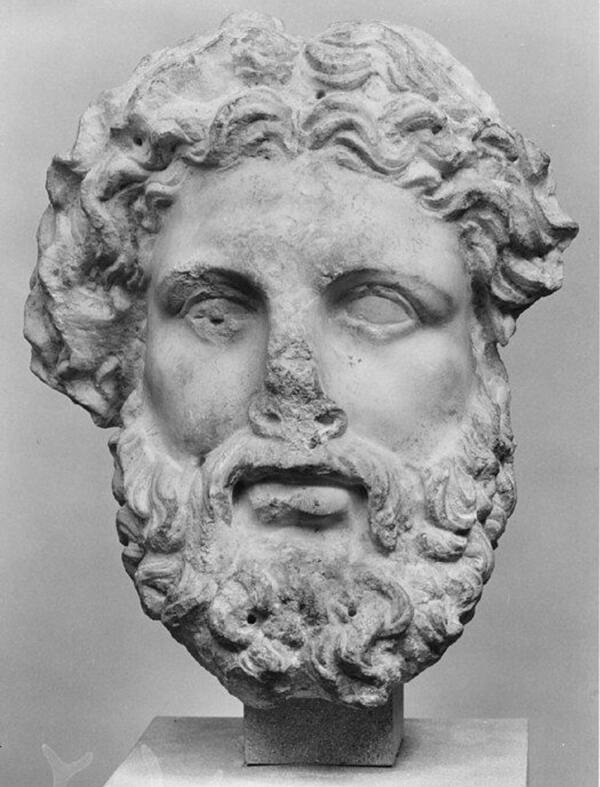
In the chrysophene technique, the face is the most critical element. It is assembled from numerous ivory plaques, and the seams must be invisible. Therefore, the facial expression here is not «mimicry, ” but a structure: soft brow lines, slightly parted lips, and a tranquil gaze. This is the „Olympian composure”—a visual marker that the deity is not subject to passion. Unlike archaic statues with their frozen „smile, ” the face here represents an ethical ideal, not a mask.
Pausanias does not describe the facial expression, but the ancient tradition unanimously speaks of an «Olympian serenity.» Zeus is presented not as a fearsome figure, but as a wise and paternal figure. This represents a visual shift from the archaic, terrifying mask to the classical ethos.
Marble head of a god (likely Zeus). Hellenistic period, 3rd–2nd century BCE. Metropolitan Museum of Art, New York (Open Access). (Accessed: 10.11.2026).
This is a marble copy from the 2nd–3rd centuries CE (approximately 105 cm tall), considered the most accurate and complete reproduction of Phidias’ lost original. The original (c. 438 BCE) was created using the same chrysoplastic technique as Zeus. It stood in the Parthenon.
This statue is key evidence that Phidias created a universal visual system for major cult statues. Athena, like Zeus, holds Nike (a winged figure of victory) in her hand. This proves that Nike is not merely an embellishment but an obligatory iconographic attribute that underscores the divinity’s status. By comparing the best-preserved copy of Athena with reconstructions of Zeus, you can illustrate how the chryselephantine technique functioned: heavy drapery, symmetry, a frontal pose, and golden attributes. This confirms your hypothesis that material and attributes served as a tool of «visual theology.»
«Athena Varvachion.» Roman copy, 2nd–3rd centuries CE, of a lost chryselephantine statue of Athena Parthenos by Phidias (c. 438 BCE). Marble, 105 cm high. National Archaeological Museum, Athens (inv. 129). Source: museum official website. (Date of access: November 12, 2026).
«Elide Coin with Portrait of Zeus Olympios.» Silver, 4th century BCE. Source: Wikimedia Commons (Category: Coins of Olympia). (Accessed: November 12, 2026).
The coin depicts the profile of Zeus wearing an olive wreath. This is a key detail, as the olive wreath is one of the principal attributes of Olympian Zeus, as described by ancient authors.
Since the original statue by Phidias is lost, we cannot see it with our own eyes. But these coins are not just money. They are ancient «photographs» of the statue, created by artisans who saw the original. The head of Zeus on the coin from Elida is considered the closest to the facial type Phidias created. Therefore, these coins are a crucial part of the visual evidence, proving that the chrysophoenic Zeus indeed existed and looked exactly like this.
«Temple of Jupiter. Cross-Section» (Temple of Jupiter. Cross-Section). (Victor Laloux). 1883 (published in the publication «Restauration d’Olympie» in 1889). Source: Wikimedia Commons (Public Domain). (Accessed: November 14, 2026).
The golden robe features images of animals and field lilies. The ornamentation is not merely decorative; it marks Zeus as the ruler of the natural world. The sandals are also made of gold. Even the lowest point of the figure is incorporated into the system of precious materials.
The chryselephantine technique creates a dual visual effect: from a distance, the statue appears as a golden radiance; up close, it resembles living ivory flesh. The material becomes an instrument of theophany.