Navigation
— The emergence of the strong and independent heroine in American comics;— Romantic ideals and traditional conceptions of femininity;— Reinterpreting the female image in feminist and underground comics;— Hypersexualization and the idealization of the female body;— The diversity of female archetypes in contemporary American comics;— Conclusion: The female image as a reflection of cultural and social shifts.
Concept
The topic was chosen to examine how the depiction of women in American comics evolved from the 1940s to the 2010s, and how these changes related to societal perceptions of femininity, beauty, and independence. The study focuses on the visual aspects of female characters: body proportions, costumes, poses, facial expressions, image composition, and methods of conveying character. Special attention is paid to the conflict between a woman’s narrative role and her outward appearance, given that the heroine’s independence was not always accompanied by a rejection of traditional idealization and sexualization of the female body.Throughout the 20th and early 21st centuries, American comics developed under the influence of cultural shifts, genre traditions, commercial interests, and artistic trends. Female characters capable of making independent decisions and facing danger emerge in superhero and adventure comics of the 1940s, yet their appearance continues to adhere to ideals of attractiveness. Romantic comics of the late 1940s and 1950s present a different model of femininity, where emotional experiences, relationships, and societal expectations take center stage. In feminist and underground comics of the 1970s, these perceptions are reexamined through satire, grotesquerie, and a rejection of mandatory bodily idealization. In mainstream superhero and science fiction comics of the 1990s, conversely, the hypersexualization of female characters becomes prominent, evident in exaggerated anatomical proportions, revealing costumes, and provocative poses. In early 21st-century comics, these approaches continue to coexist with more diverse ways of depicting female appearance and individuality.
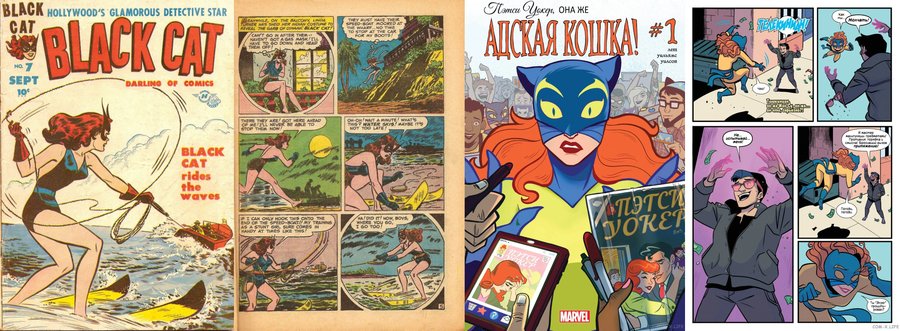
1. «Black Cat Comics» No. 7 — Lee Elias, 1947.
2. «Patsy Walker, A.K.A. Hellcat!» No. 1 — Brittney Williams, 2015.
The material for visual analysis is selected based on the works’ capacity to demonstrate various models of femininity and the artistic ways in which they are embodied. The study incorporates American superhero, adventure, romance, feminist, underground, and independent comics. Among the examples examined are «Wonder Woman, ” „Miss Fury, ” „Phantom Lady, ” „Young Romance, ” „Girls' Love Stories, ” „Negro Romance, ” „It Ain’t Me Babe Comix, ” „Wimmen’s Comix, ” „Pudge, Girl Blimp, ” „Witchblade, ” „Lady Death, ” „Gen¹³, ” „Fun Home, ” „Ms. Marvel, ” „Lumberjanes, ” and „Bitch Planet.“ This selection allows one to trace the evolution of the female image not only chronologically but also by comparing different genres and artistic approaches. Primary attention is paid to the comic covers and individual pages where the depiction of the female body, character, and social role is most distinctly manifested.The study’s structure is organized around the sequential examination of different ways of portraying women. The first section is dedicated to the emergence of the strong, independent heroine in 1940s American comics, where physical activity and the character’s self-reliance are combined with idealized appearances. The second section examines the romantic ideal and traditional notions of femininity, focusing on the depiction of emotional experiences, romantic relationships, and societal expectations. The third section analyzes the feminist and underground comics of the 1970s, where female artists reinterpret conventional female roles and beauty standards through satire, grotesque imagery, and alternative body representations. The fourth section addresses the hypersexualization and idealization of the female body in 1990s mainstream comics, where exaggerated proportions, revealing costumes, and unnatural poses become entrenched visual tropes. The fifth section explores the diversity of female figures in contemporary American comics, examining works that foreground individuality, personal experience, diverse body types, and a critique of traditional aesthetic norms.
1. «Catwoman» #1 — Jim Balen, 1993. 2. «The Unbeatable Squirrel Girl» — Erica Henderson, 2015.
In selecting and analyzing sources, the focus has been placed on studies of American comic book history, the representation of women in popular culture, gender stereotypes, and the artistic conventions of comic narration. Particular attention is given to works that examine the interplay between the visual idealization of the female body, character autonomy, and cultural expectations. Comparing historical materials with specific imagery allows for the consideration of the female figure not merely as an artistic choice, but as the result of the interaction between genre traditions, the author’s perspective, and societal perceptions.
The key research question is: How has the visual depiction of women in American comics changed from the 1940s to the 2010s, and why did the development of the independent heroine’s image not always lead to a rejection of the idealization and sexualization of the female body?
The hypothesis advanced is that the transformation of the female image in American comics did not occur as a sequential replacement of traditional notions with new ones, but rather through the coexistence and collision of various models of femininity. The expansion of female characters' autonomy did not always lead to a change in how their appearance was depicted: heroines might possess physical strength, power, and their own character, yet remain within the confines of an idealized visual canon. Simultaneously, the evolution of feminist, underground, and independent comics facilitated the emergence of alternative images where individuality and diversity of appearance became more important than conforming to a single standard of beauty. Thus, the changing female image reflects not a linear movement from dependence to freedom, but a constant interaction between character autonomy, artistic traditions, and societal conceptions of womanhood.
The Evolution of the Strong and Independent Heroine in American Comics
The emergence of female heroic characters in American comics during the early 1940s marked a significant stage in the evolution of perceptions of femininity in mass culture. Women increasingly took center stage in adventure narratives, independently confronting adversaries and possessing qualities traditionally associated with male characters: physical strength, decisiveness, and the ability to act in dangerous circumstances. However, the appearance of the autonomous heroine did not signify a rejection of established ideals of female beauty. Her physique, costume, and appearance continued to play a vital role in shaping an attractive image. As a result, a contradictory model of femininity emerged in the comics of this period, where independence and strength were intertwined with the idealization of appearance.
«All-Star Comics» No. 8 — William Marston, Harry Peter, 1941.
One of the most iconic examples of the new heroine archetype is Wonder Woman, who first appeared in All-Star Comics #8 in 1941. Created by William Moulton Marston and artist Harry Peter, she embodied a figure capable not only of physically confronting men but also of acting as an independent defender of justice.Wonder Woman’s visual persona is built upon a fusion of strength and idealized femininity. Her costume accentuates her physique, while her open arms and legs make her body a prominent element in the image. Crucially, the heroine is not presented solely as an object of admiration. In combat scenes, she actively engages with her surroundings, reflects attacks, and directs the action. Her poses convey movement and physical dominance, and the composition often sets her apart from other characters.
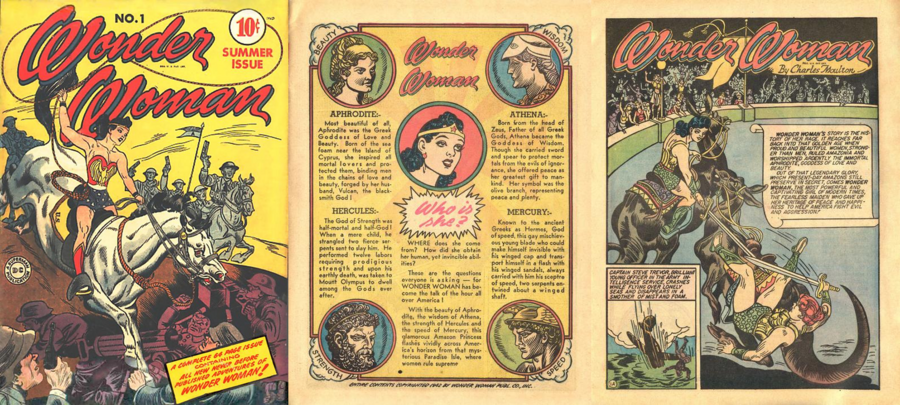
«Wonder Woman» #1 — William Moulton Marston, Harry Peter, 1942.
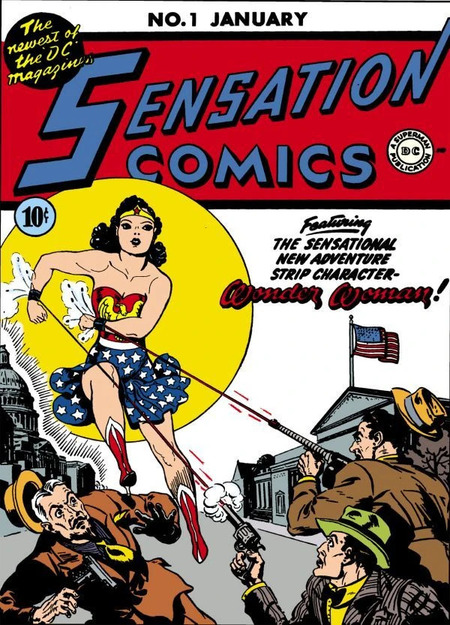
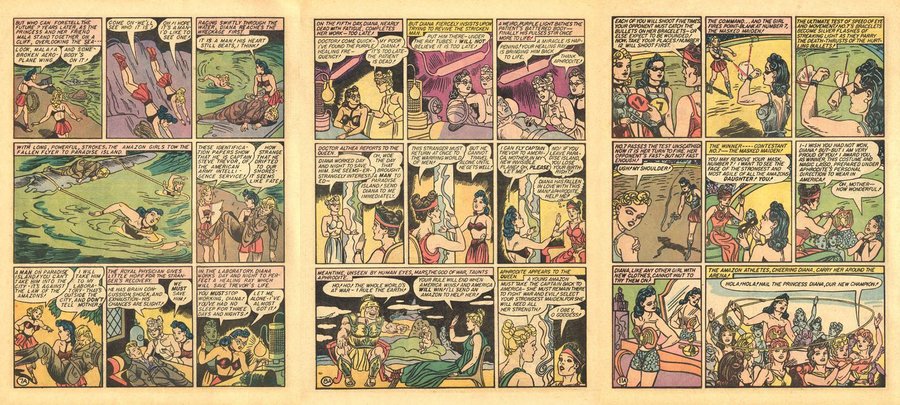
This is particularly evident on the cover of Sensation Comics #1 (1942), where Wonder Woman deflects bullets using her bracelets. Male characters, armed with firearms, are unable to harm her. Here, the conventional power dynamic is reversed: the woman becomes the central figure of the confrontation, while the men lose control of the situation. Simultaneously, her appearance remains distinctly attractive, and her costume retains elements of theatrical and decorative imagery.Wonder Woman demonstrates that the concept of the strong woman in the American comic book began to form by merging self-sufficiency with traditional visual markers of female allure.
«Miss Fury» — June Tarpe Mills, 1941.
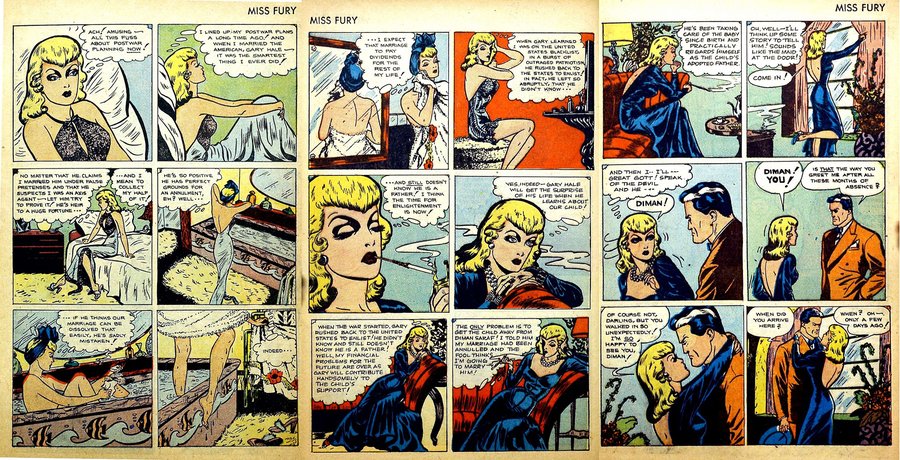
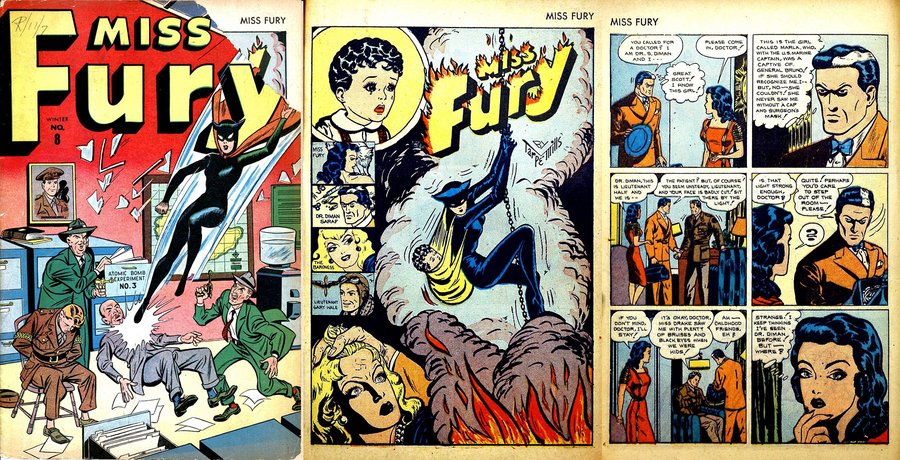
A different take on the independent heroine is presented in the comic Miss Fury, created by artist June Tarpe Mills. The character first appeared in the newspaper strip The Black Fury in April 1941. Unlike Wonder Woman, who possesses superhuman strength, Marla Drake acts as an ordinary woman who becomes involved in dangerous adventures.
Visually, Miss Fury combines elements of adventure comics, fashion illustration, and the image of an enigmatic heroine. Her form-fitting black suit emphasizes her silhouette, yet it simultaneously functions as a disguise and becomes part of her dual identity. In her daily life, Marla is portrayed as an elegant socialite, while in the guise of Miss Fury, she adopts determination and physical dynamism.
A distinctive feature of Mills’s art is that the heroine’s femininity is preserved not only in her costume but also in the plasticity of her movements, facial expressions, and physical details. Furthermore, her actions extend beyond the traditional role of a passive character. Marla makes her own decisions, engages in conflicts, and finds herself in situations where she must rely on her own abilities.
Unlike Wonder Woman, Miss Fury’s strength is not rooted in a fantastical origin. Her self-reliance is demonstrated through the actions of an ordinary woman. This example allows us to see how a heroine’s image could be shaped not just by superpowers, but also by reinterpreting conventional ideas about female conduct.
«Phantom Lady» No. 17 — Matt Baker, 1948.
The image of Phantom Lady, first appearing in Police Comics #1 in August 1941, demonstrates another way to combine female autonomy with outward appeal. The main character, Sandra Knight, leads a double life: while maintaining her status in high society, she simultaneously fights crime.
In her early depiction, Phantom Lady’s costume consisted of a short yellow ensemble, a green cloak, and high boots. The revealing nature of the outfit accentuates her female form, while the cape, mask, and specialized weaponry establish her as a recognizable adventure genre hero. On the first page of Police Comics #1, Sandra is shown in an active pose with a device that allows her to confront opponents. Her body simultaneously serves as a medium for conveying motion and an important component of the character’s visual appeal.
In contrast to Miss Fury, whose everyday and heroic appearances create a noticeable contrast, Phantom Lady merges elements of fashionable feminine silhouette and attributes of a crime fighter even in her superhero costume. Her image suggests that the character’s independence could exist within a relatively traditional system of depicting the female body.
In the following years, Phantom Lady’s appearance became increasingly sexualized, especially in Matt Baker’s drawings from the late 1940s. This evolution makes the character an important subject for study: even a heroine capable of acting independently and confronting criminals could be depicted primarily through emphasized attractiveness.
Thus, the emergence of strong female characters in American comics in the early 1940s was not accompanied by a complete overhaul of traditional notions of femininity. Wonder Woman, Miss Fury, and Phantom Lady demonstrate different ways of portraying an independent heroine, yet in all three cases, her strength is paired with idealized appearance. The woman is given the opportunity to be an active participant in the narrative, but her visual representation continues to rely on artistic and cultural ideas of attractiveness. This contradiction becomes a persistent feature in the depiction of women in American comics and develops further in the decades that follow.
The Romantic Ideal and Traditional Concepts of Femininity
While women in 1940s superhero and adventure comics gradually gained autonomy through physical strength and active participation in events, their representation in the romance genre was shaped differently. In this genre, personal relationships became the primary setting, and the heroine’s appearance, facial expressions, and gestures were chiefly used to convey emotional states. Romance comics, which emerged in the late 1940s, addressed themes of love, jealousy, marriage, and societal approval. Women were often central figures in the narrative, yet their desires and actions were frequently judged in relation to a man. Furthermore, the romance genre did not preclude the heroine’s independence; in fact, many stories centered on her choices, her doubts, and her attempts to understand her own feelings. The inherent contradiction lay in the fact that even the woman’s independent decisions were often framed by the need to maintain or achieve a romantic relationship.
«Young Romance» No. 1 — Joe Simon, Jack Kirby, 1947.
The comic Young Romance, created by Joe Simon and Jack Kirby in 1947, was one of the first and most influential publications in the new romantic genre. Unlike adventure stories, where plot development was dictated by external events, the focus here shifted to the characters' personal experiences and the complexities of human relationships.The cover of the first issue depicts a scene of emotional conflict. A young woman in a bright red dress stands next to a man who is turning away from her, while another girl watches the scene unfold in the background. The setting resembles a film set, but the main element of the composition is not the environment, but the tension between the characters. The red dress sets the heroine apart from the other figures, and her expressive posture underscores her desire to capture the man’s attention.The woman here is not passive, but her actions are confined to the space of romantic conflict. She attempts to influence the relationship, while the man visually maintains distance. Thus, the positioning of the characters in the frame conveys an uneven distribution of emotional power: the female figure becomes the primary bearer of emotion, and the male figure is the source of the resulting tension.This example demonstrates how in a romantic comic, female activity moves from physical action into the emotional sphere. The heroine remains the central figure of the image, yet her autonomy is closely tied to love and the need to be chosen.
«Girls’ Love Stories» #32 — DC Comics, 1954.
In the series Girls' Love Stories, which has been published since 1949, romantic relationships serve as the foundation for depicting female experiences, doubts, and societal expectations. The cover of Issue No. 32, released in 1954, is particularly illustrative.The composition revolves around two women connected to the same man. In the foreground, a fair-haired heroine is depicted looking down at an object in her hands. Her posture is closed off, and her expression conveys melancholy and insecurity. In the background, within a separate spatial segment, a man embraces another woman. This compositional division allows for the simultaneous depiction of the heroine’s inner state and the source of her distress.Unlike in adventure comics, where body positioning often expressed strength, the plasticity of the female figure here emphasizes emotional vulnerability. Her lowered head, restrained gestures, and lack of direct interaction with other characters create the image of a woman in a situation of uncertainty. Her emotional experience becomes the primary content of the image, yet it depends on the man’s actions and the presence of a rival.It is noteworthy that both women are presented through different emotional roles: one is experiencing doubt and anxiety, while the other is close to the man. Their relationship is defined not by a direct conflict between them, but by the overarching romantic situation.This example demonstrates how the romantic comic cemented the idea of love as a vital space for female self-determination. The woman remained the emotional center of the story, but her inner world was often revealed through the fear of losing the relationship or yielding to another woman.
«Negro Romance» No. 1 — Fawcett Publications, 1950.
Negro Romance, published by Fawcett in 1950, offers a more complex view of the romantic ideal. Unlike most popular romance comics of the era, its protagonists were Black Americans. Yet, the publication retained the recognizable genre conventions: love stories, emotional conflicts, appealing characters, and the pursuit of romantic happiness.
The cover of the first issue features a photograph of a young couple. In contrast to the illustrated covers of Young Romance and Girls' Love Stories, the photographic image creates an impression of closer proximity to everyday life. The characters’ neat clothing, hairstyles, and outward composure establish the image of a prosperous and attractive couple. The woman is presented not through physical strength or dramatic exaggeration, but through alignment with aesthetic and social ideals of the romantic ideal.
Within the comic, the female protagonists are also involved in love stories, confronting doubts and making decisions that shape the development of their relationships. Their depiction largely adheres to the conventional language of the romance genre: expressive facial expressions, emotional dialogues, and attention to the characters' appearance.
The significance of Negro Romance lies in how it expands the pool of heroines featured in American mass-market comics. However, changing the characters' appearance and social context does not involve a complete overhaul of the genre model of femininity. Love, attractiveness, and romantic recognition remain central to the narrative. This example illustrates that expanding representation does not necessarily equate to altering the ways in which the female figure is constructed.
1. «Girls’ Love Stories» No. 12 — cover artist unknown, 1951. 2. «Young Love» No. 1 — Jack Kirby, Joe Simon, 1949. 3. «Negro Romance» No. 2 — Fawcett Publications, 1950.
Thus, romantic comics of the late 1940s and 1950s established a distinct model of femininity, prioritizing emotional expressiveness, attractiveness, and relationships with others. Unlike the heroines in adventure genres, the women here rarely demonstrated physical superiority; instead, they became the primary carriers of psychological conflict. Their emotions and decisions drove the narrative development, even though the storytelling itself often remained constrained by traditional notions of love and marriage. A comparison of Young Romance, Girls' Love Stories, and Negro Romance reveals that the female archetype could become more varied while still adhering to established genre limitations. These very limitations later became a subject of critique within feminist and underground comics.
Reinterpreting the Female Image in Feminist and Underground Comics
Following the romantic comics of the 1950s—where the female character was often defined by her attractiveness, emotional experiences, and relationship with men—a significant shift occurred with the development of feminist and underground comics in the United States during the late 1960s and early 1970s. Female artists began exploring themes rarely featured in mainstream publications: female autonomy, rejection of imposed standards of beauty and sexuality, and everyday lived experience. Furthermore, these changes affected not only the content of the stories but also the visual language itself. Instead of idealized figures and conventional romantic archetypes, the medium embraced caricature, grotesque, intentionally unappealing characters, and diverse ways of depicting the female body. The woman gradually ceased to be solely an object of representation, gaining the agency to define how her image should be perceived.