Communication theory: Veresk

Veresk
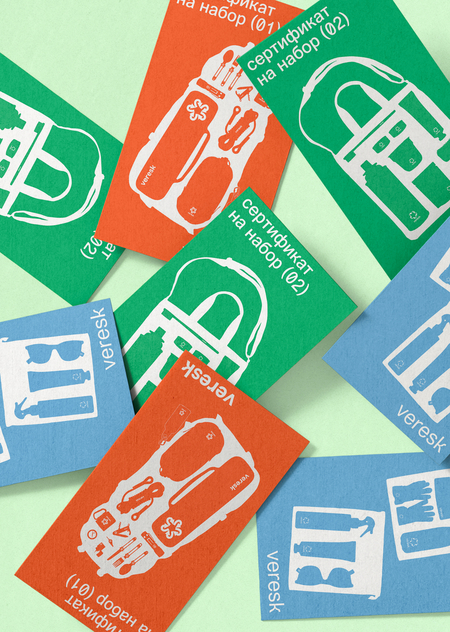
About brand: Products for zero-waste camping that help to travel without leaving unnecessary waste and organize belongings using eco-friendly traditional tools for storing and transporting utensils and gear.
Positioning: A zero-waste camping kits brand that includes items necessary for comfortable and eco-friendly camping, promoting respect for nature and helping to preserve its resources.
Message is more than words
Sender → Encoding → Channel → Decoding → Receive
Mission: (1) To reduce the waste people leave behind while enjoying nature; (2) To help tourists rethink their lifestyle and inspire them to make positive changes in their routines; (3) To help tourists develop habits that will make their lives more conscious and environmentally friendly; (4) To draw people’s attention to the importance of caring for nature and following the practice of zero-waste consumption.
Visual hierarchy in advertising materials and packaging helps to emphasize and focus the consumer’s attention on the important features and tasks of the product, helping to avoid mistakes when choosing the needed item.
Communication theory
Design is a communication system: a sender encodes certain meanings into visual form, and a receiver decodes it through context. In branding the «message» is constructed through careful choice of graphic layouts and typography, as well as physical characteristics of objects such as tactile feeling, smell or weight. Conditions under which people encounter the brand also play a huge role in the overall impression of the audience. This sender-receiver logic is central to the cybernetic tradition described in the course: communication is goal-oriented information processing, where what is decoded may differ from what was originally intended.
Feedback turns communication from linear into self-regulating: we observe user reactions and make adjustments to the channel and the message to reduce misunderstanding. Theory here has a practical value: it helps describe, explain, and predict how messages work in real life.
Lens: cybernetic
To analyze communication in design, we use Robert Craig’s «7 traditions» as lenses: — cybernetic — socio-psychological — socio-cultural — critical — rhetorical — phenomenological — semiotic
Each lens highlights a different «problem» of communication and therefore points to different design solutions and tactics.
The five lenses applied to Veresk: • Cybernetic: information hierarchy, noise reduction, feedback loops; • Rhetorical: persuasion and the structure of arguments for different audiences; • Socio-cultural: meaning is shaped by cultural practices and situational context; • Semiotic: signs and symbols create meaning through stable visual cues; • Critical: language and ideology are embedded in media and consumer culture.
Lens: semiotic
Lens: socio-cultural
Lens: critical
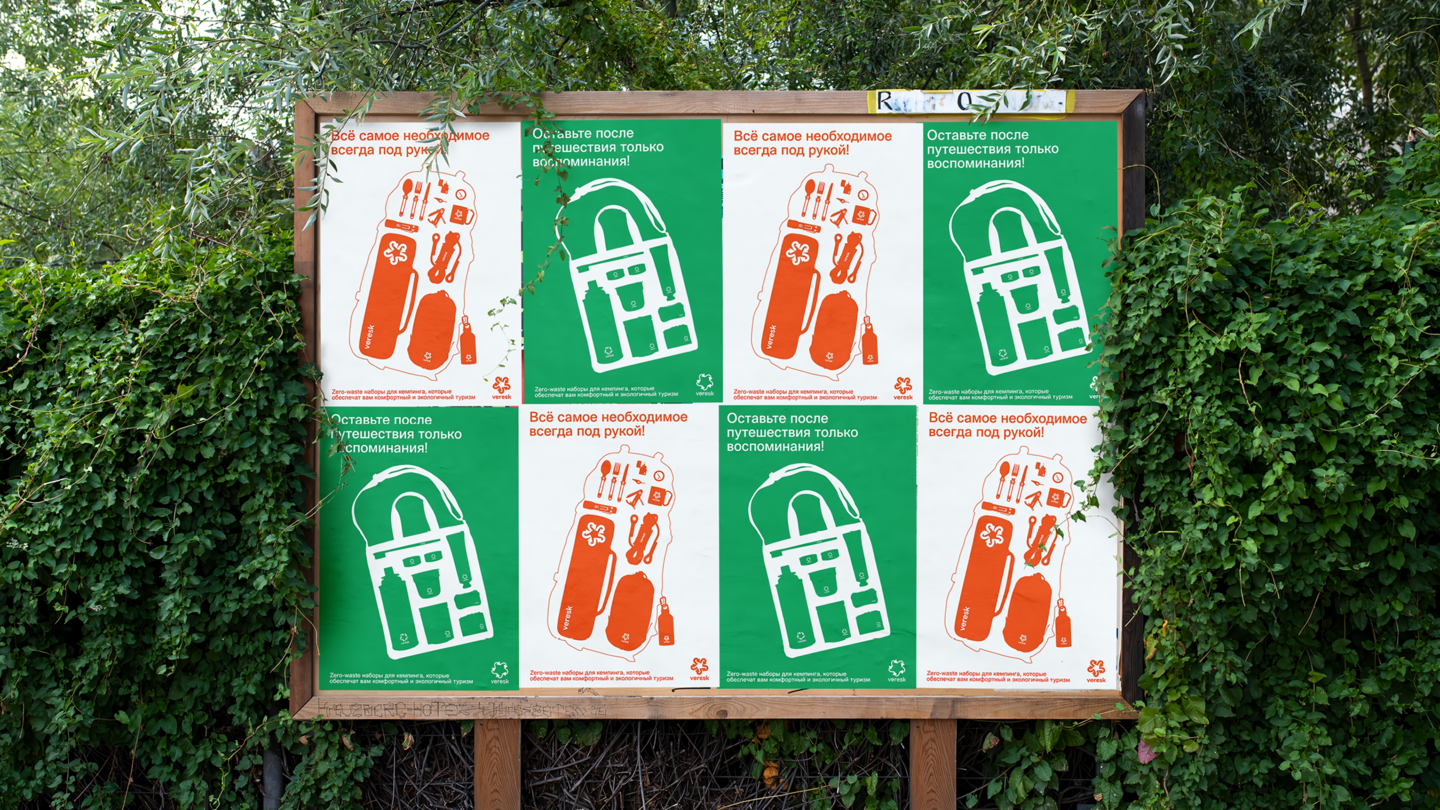
We also apply Media Ecology: following «the medium is the message,» idea of McLuhan, we treat packaging, retail, outdoor, and digital as different attention environments. The course materials emphasize that the choice of «hot» vs «cool» media changes how people perceive the content, so the brand idea must be adapted accordingly to the specifics of the channels.

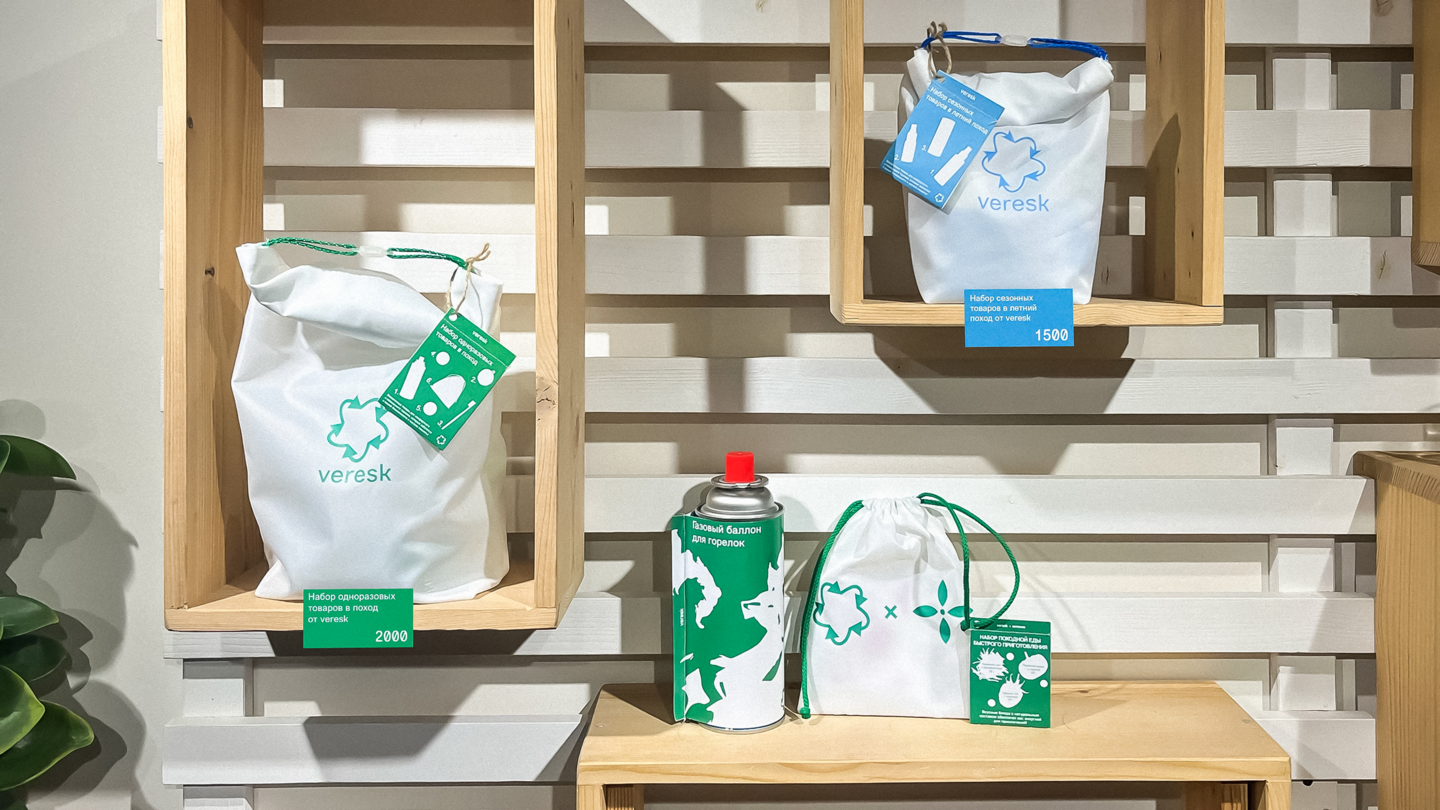
Media ecology
The collaboration between Veresk, a zero-waste camping brand, and Kotomka, a café focused on traditional Russian cuisine, creates a ready-to-eat hiking food kit that unites sustainability and cultural authenticity. By aligning shared values and symbolic meanings, the partnership strengthens brand communication, reinforces a common worldview, and helps audiences co-create meaning around conscious consumption and local identity.
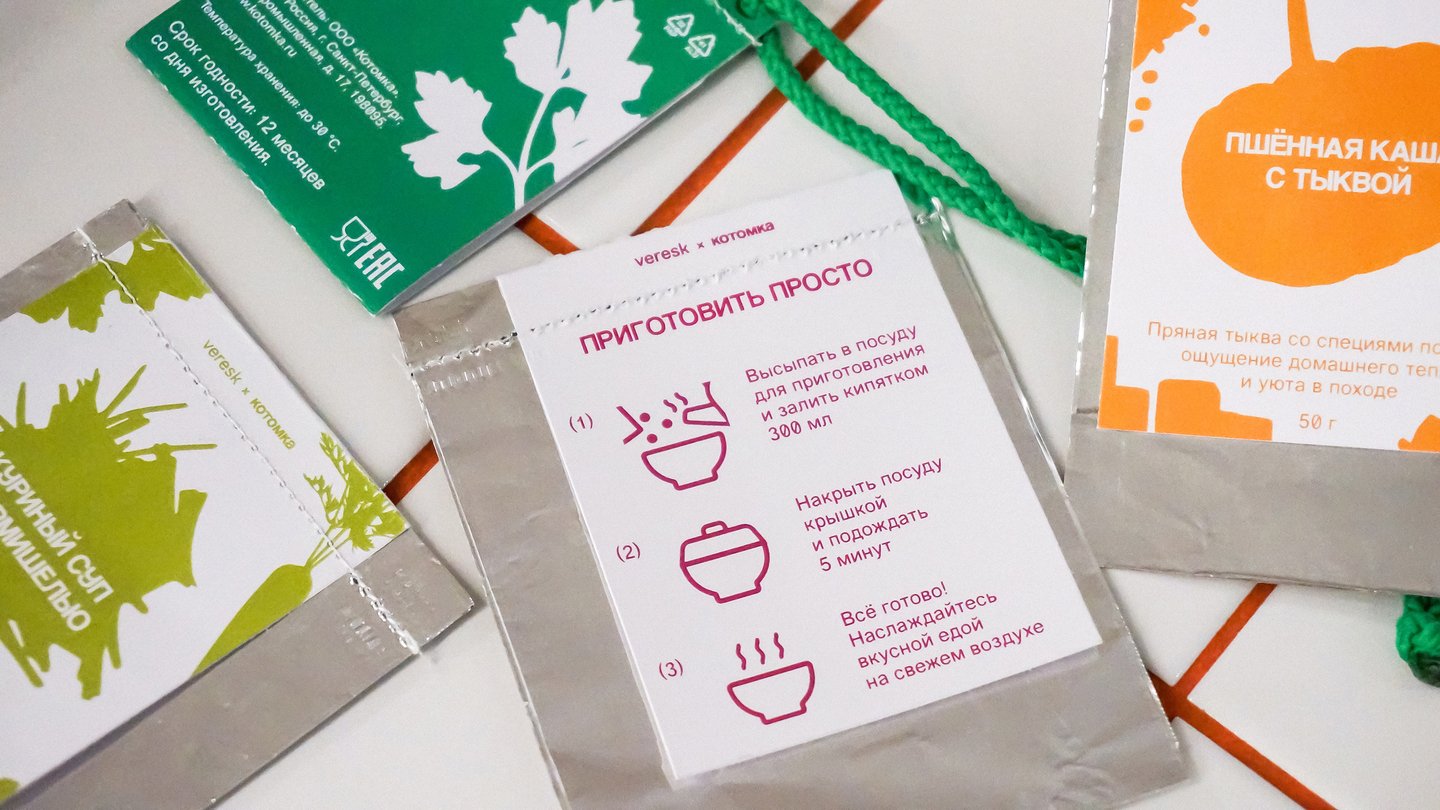

Collaboration between Veresk and Kotomka
Finally, we rely on narrative theories used in the example project: Narrative Paradigm (trust is built through meaningful stories) and Symbolic Convergence Theory (shared narratives form collective identity). In our case, these theories help frame Veresk not only as products, but as a shared practice of «responsible travel».
General audience
General audience
Veresk is an eco and functional packaging system for hiking kits. It is designed for people who want to travel responsibly: stay functionally equipped while keeping the planet safe. The brand promise is practical: less stress during preparation, easier use on the route, no unnecessary waste.
Young and middle-aged people who practice a healthy lifestyle, travel frequently, are ecologically conscious, and are ready to change their habits to become more environmentally friendly
The everyday problem is simple: hiking requires many items (hygiene, protection, cutlery), and common packaging creates clutter, which becomes noise, slowing decoding, increasing the chance of forgetting essentials, and generating more waste.
Veresk turns preparation into a clear ritual. The kit structure reduces decision fatigue: instead of building a set item by item, users choose a ready-made system that stays consistent across categories. The minimal packaging and inserts guide users with clear instructions, so the products can be used without excessive explanation.

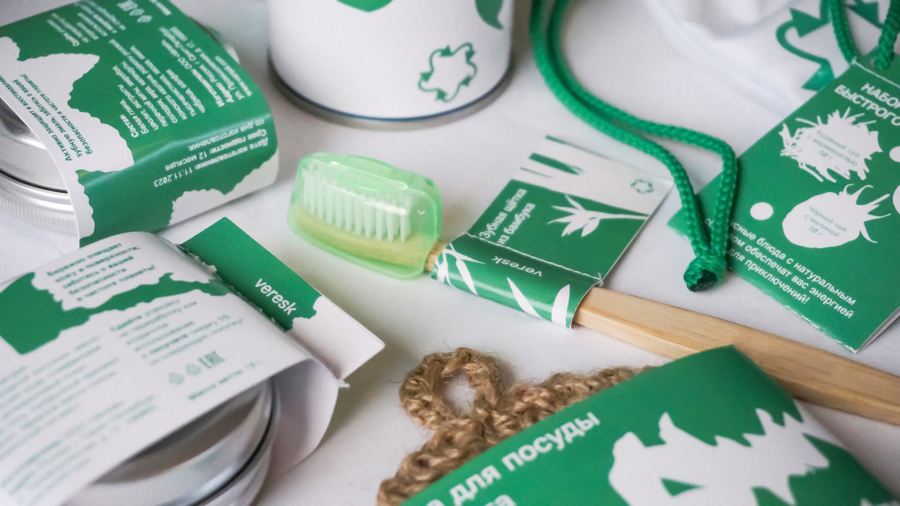
Problem: waste left in nature by tourists while traveling Solution: kits with essential products for eco-friendly tourism
There is no space for bulky and inconvenient packaging on hikes, and there is no way to properly dispose of it. The ideal eco-friendly packaging is recyclable or reusable, saves space on hikes, considers the needs of tourists, and cares for the planet’s natural resources.
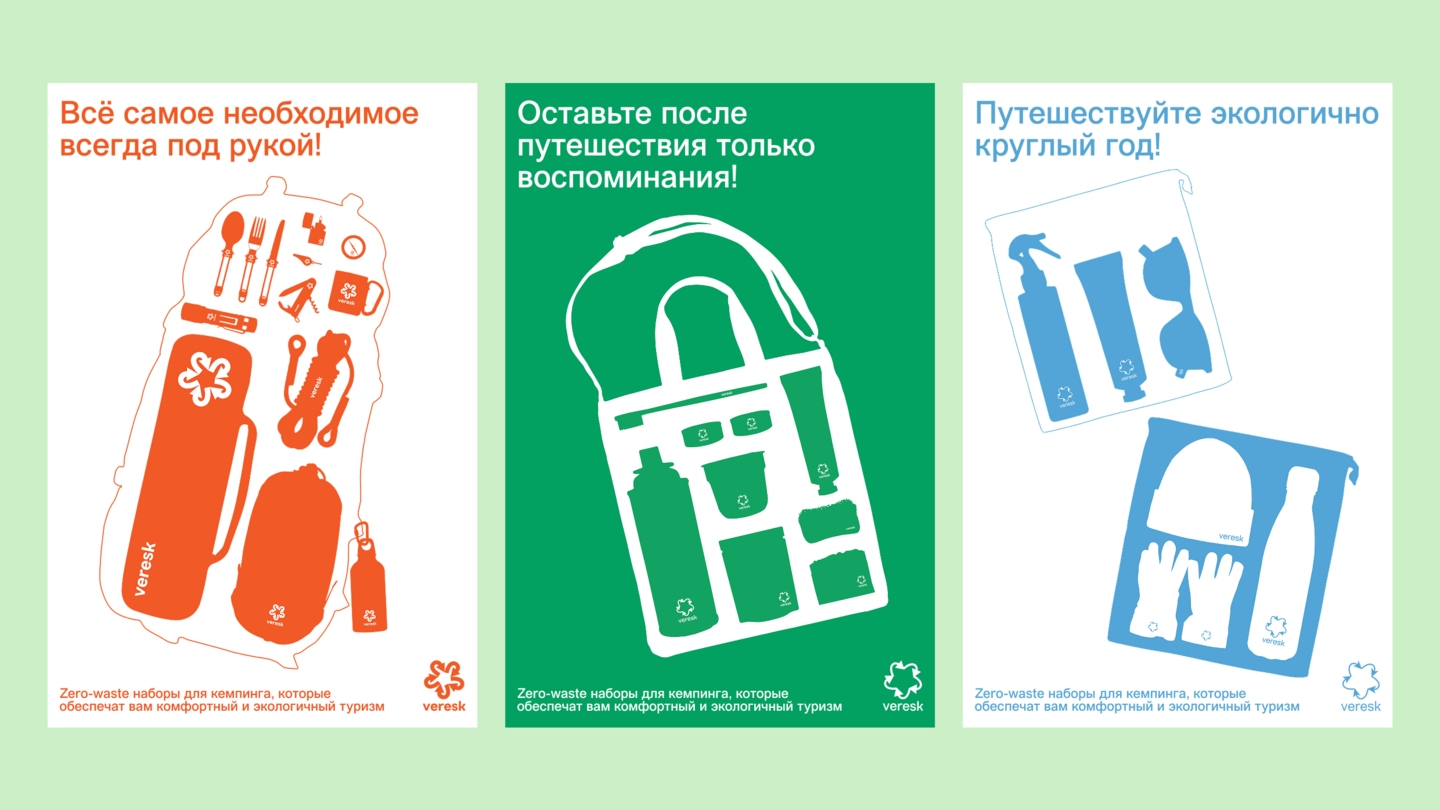
Three kit types: reusable products, single-use items, and seasonal goods
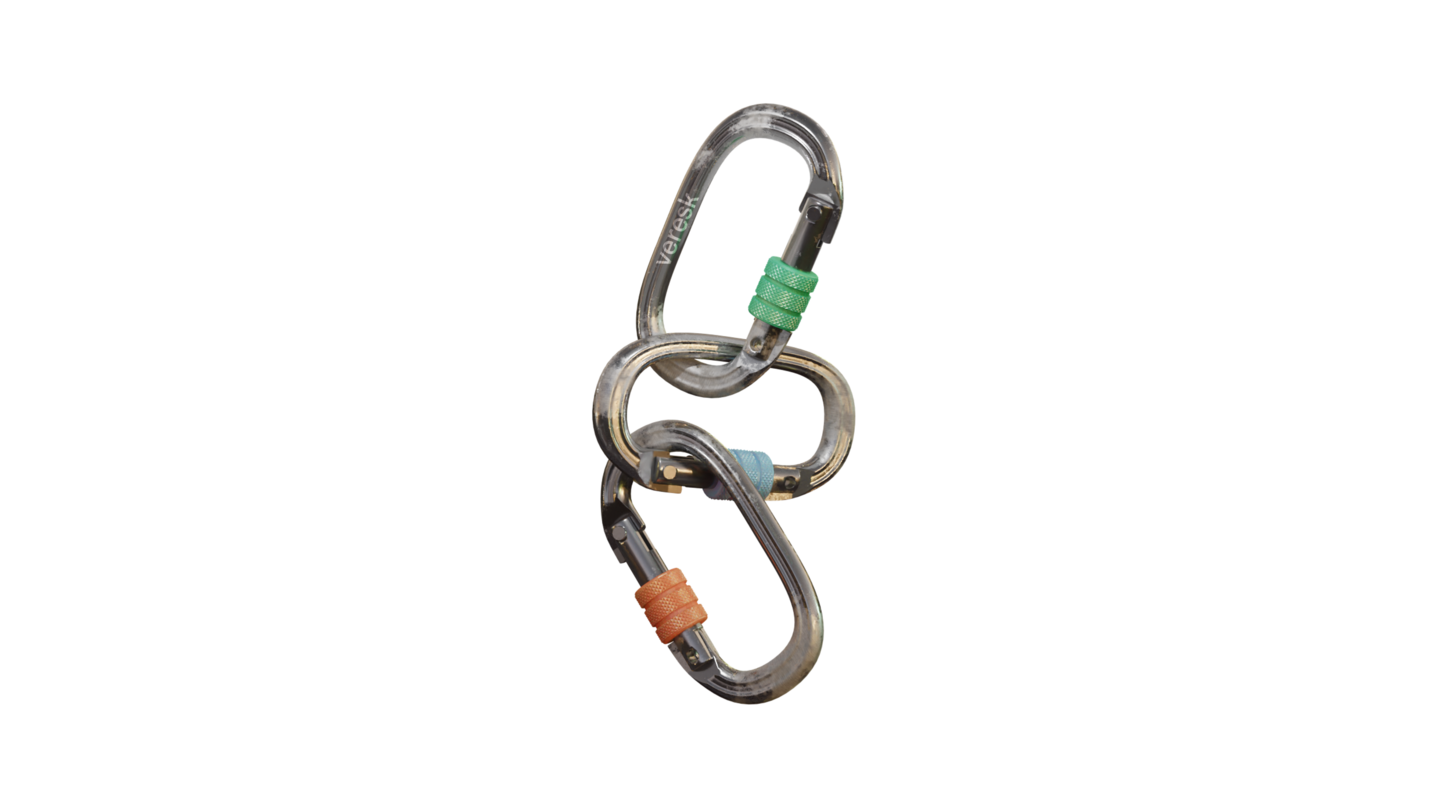



Veresk
Veresk supports consistent eco-responsible habits through a «return packaging → receive discount» feedback loop, linking values with visible action and reward. This aligns with Social Exchange Theory (people maintain behaviors when perceived rewards outweigh costs), as the brand reduces the «cost» of responsible actions and increases benefits through clear motivation. The program translates values into repeatable actions, establishing a structured norm for sustainable practices.
Feedback loop
Certain products require precautions when using them. The information should be visible and easy for reading to help prevent injury and accidents.
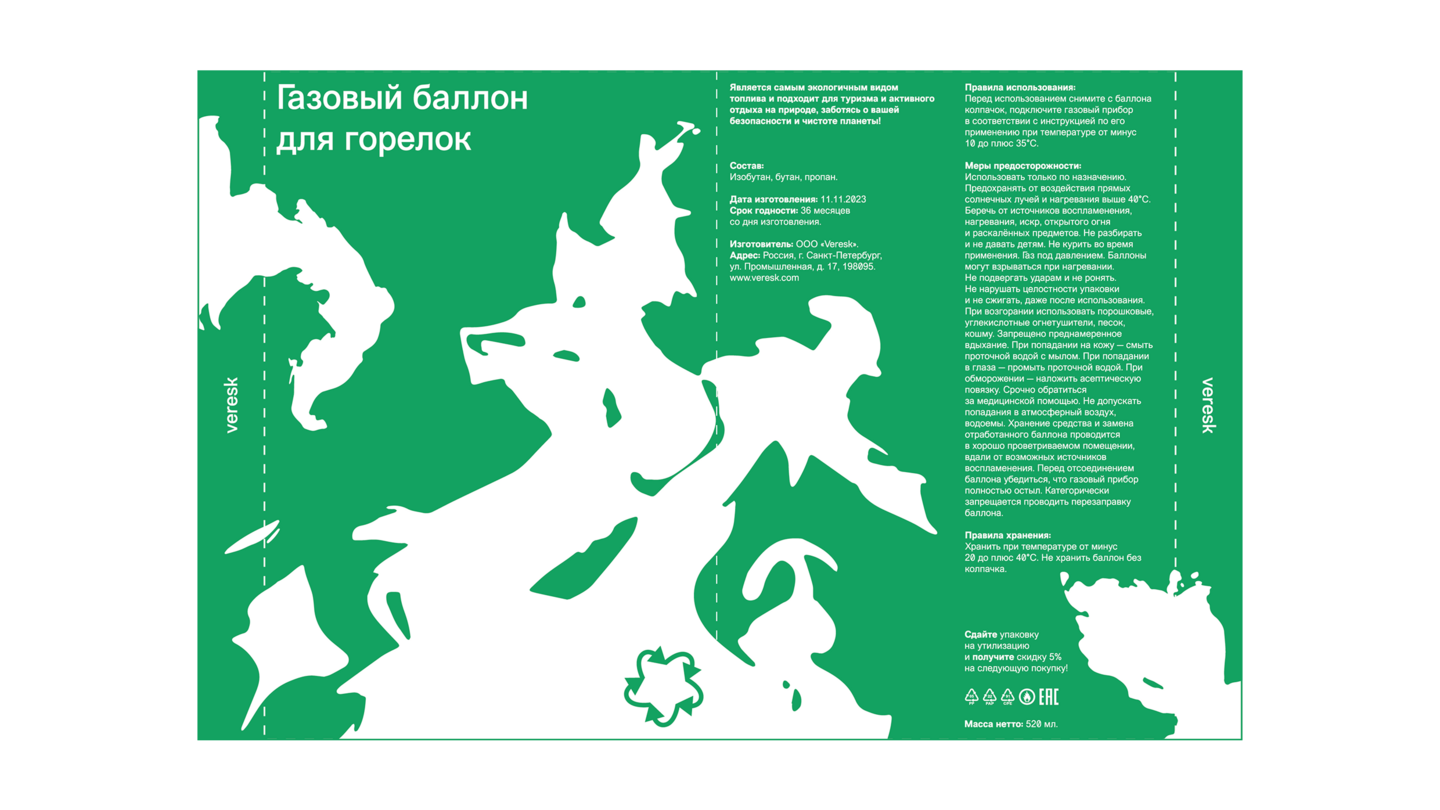
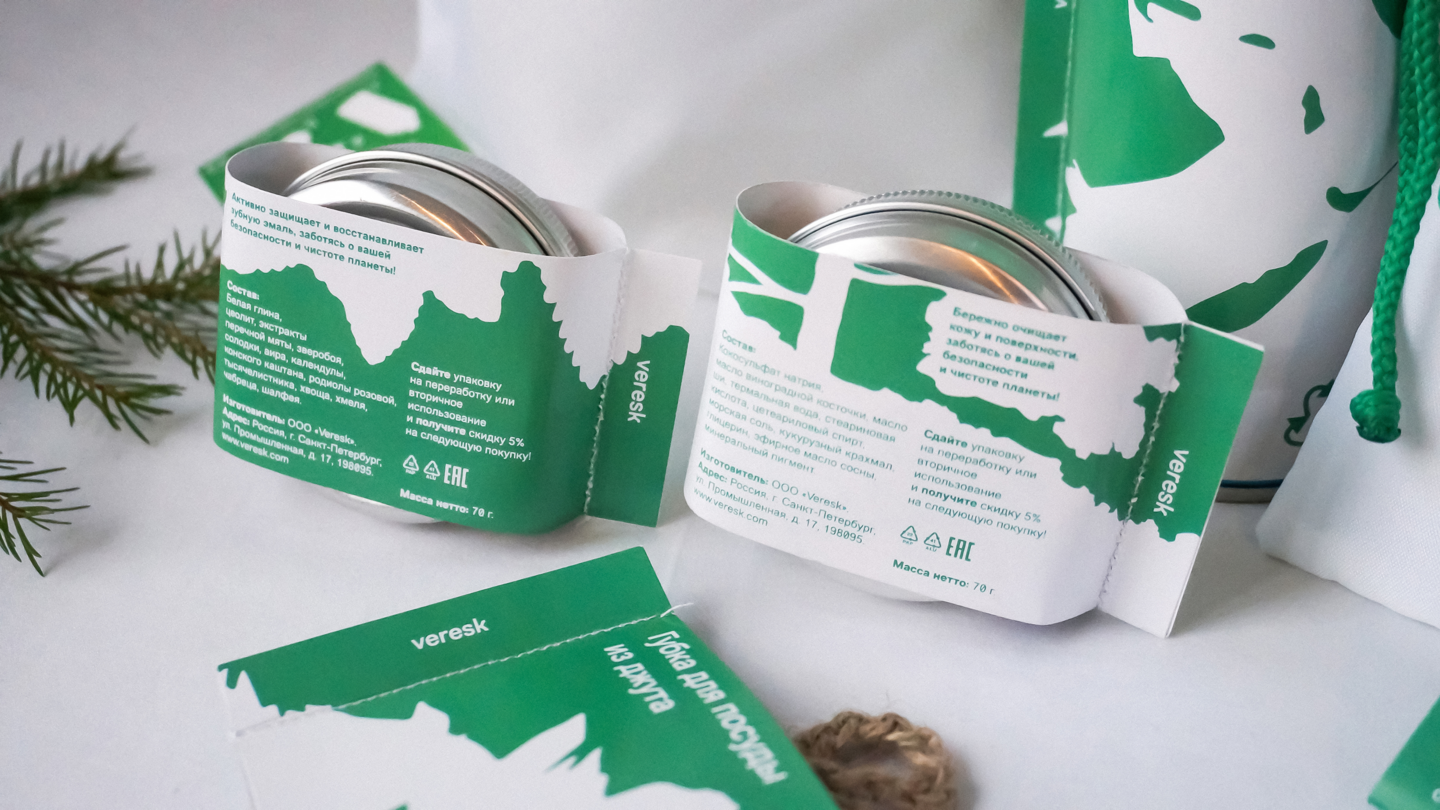
Instructions on the packaging
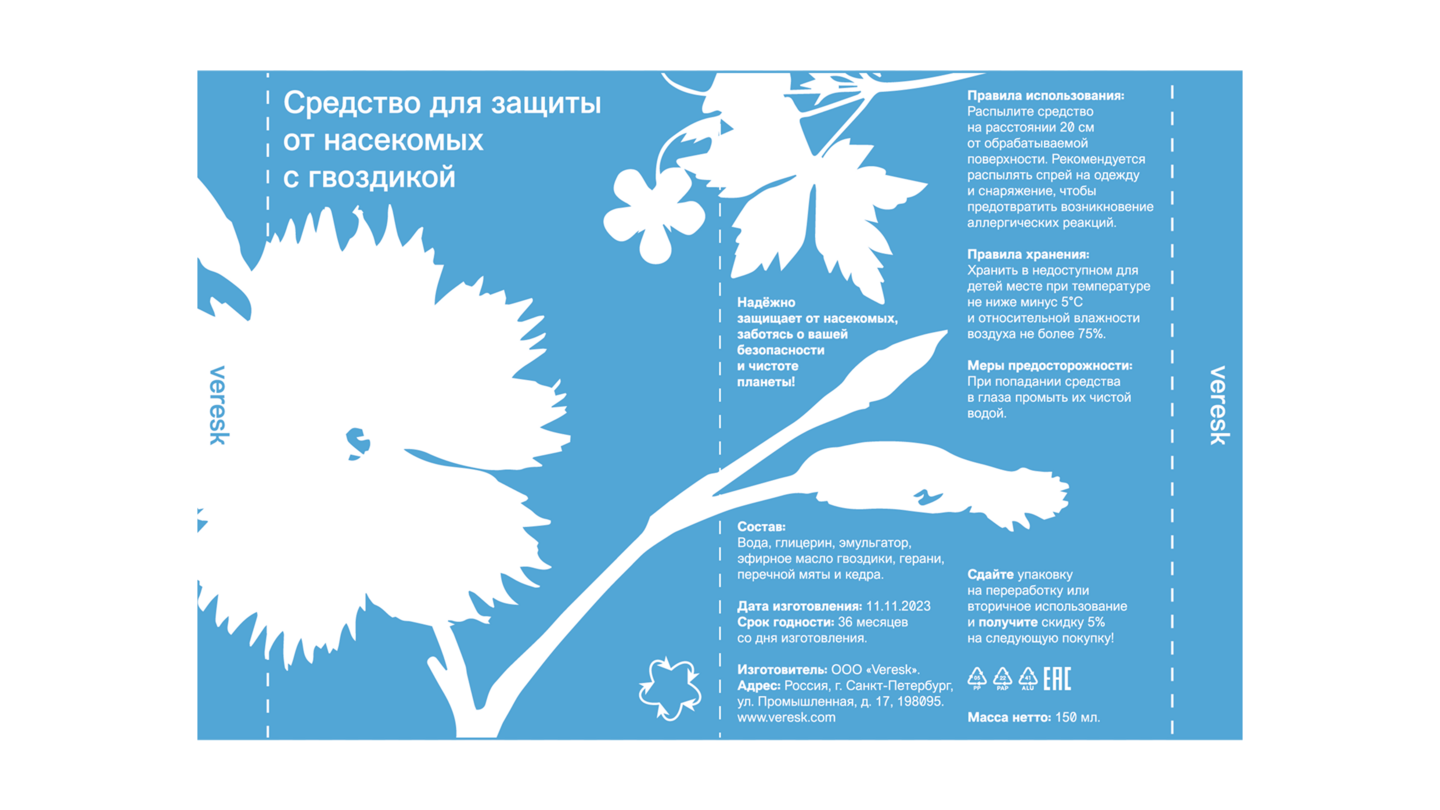

Instructions on the packaging
Professional audience
Designers and brand strategists; they have high visual culture, experience with eco-friendly brands, and evaluate projects for conceptual rigor, brand alignment, and audience impact
Design brief: create a scalable packaging system for hiking kits that communicates responsible travel and works under real life conditions (limited time and packing space, stress, etc.). The system must reduce decoding errors (noise), remain consistent across product categories, and function across touchpoints: packaging, retail, outdoor, and digital.
The graphics and colors of the identity take inspiration in natural colors and motifs; the logo uses a symbol reminiscent of the recycling sign, which supports the metaphor of caring for nature and the importance of waste minimization through recycling, especially during hiking trips.
From a cybernetic perspective, packaging is an information interface. We built a stable hierarchy (brand → kit → function → instruction) to optimize decoding, as the receiver’s context can easily distort the message.
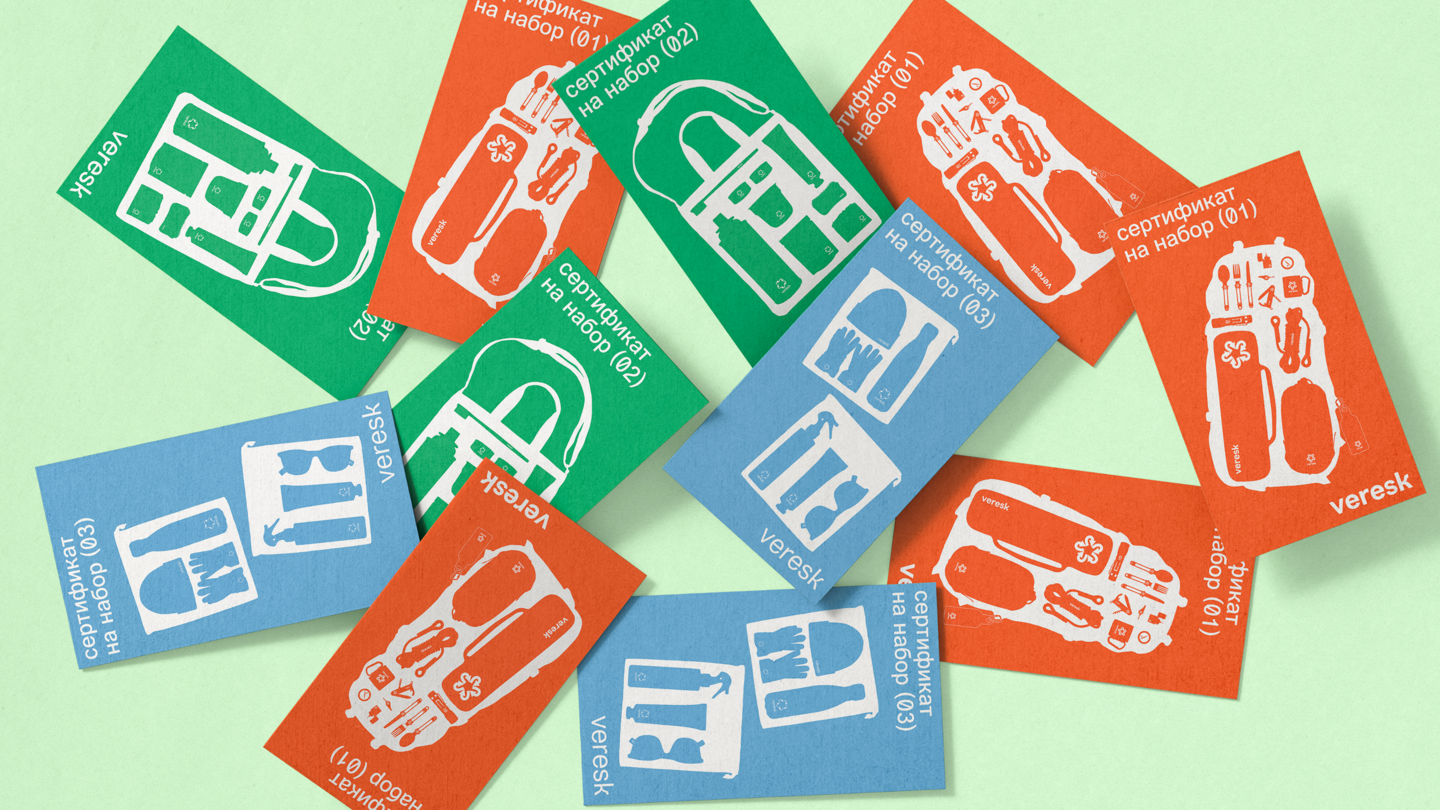
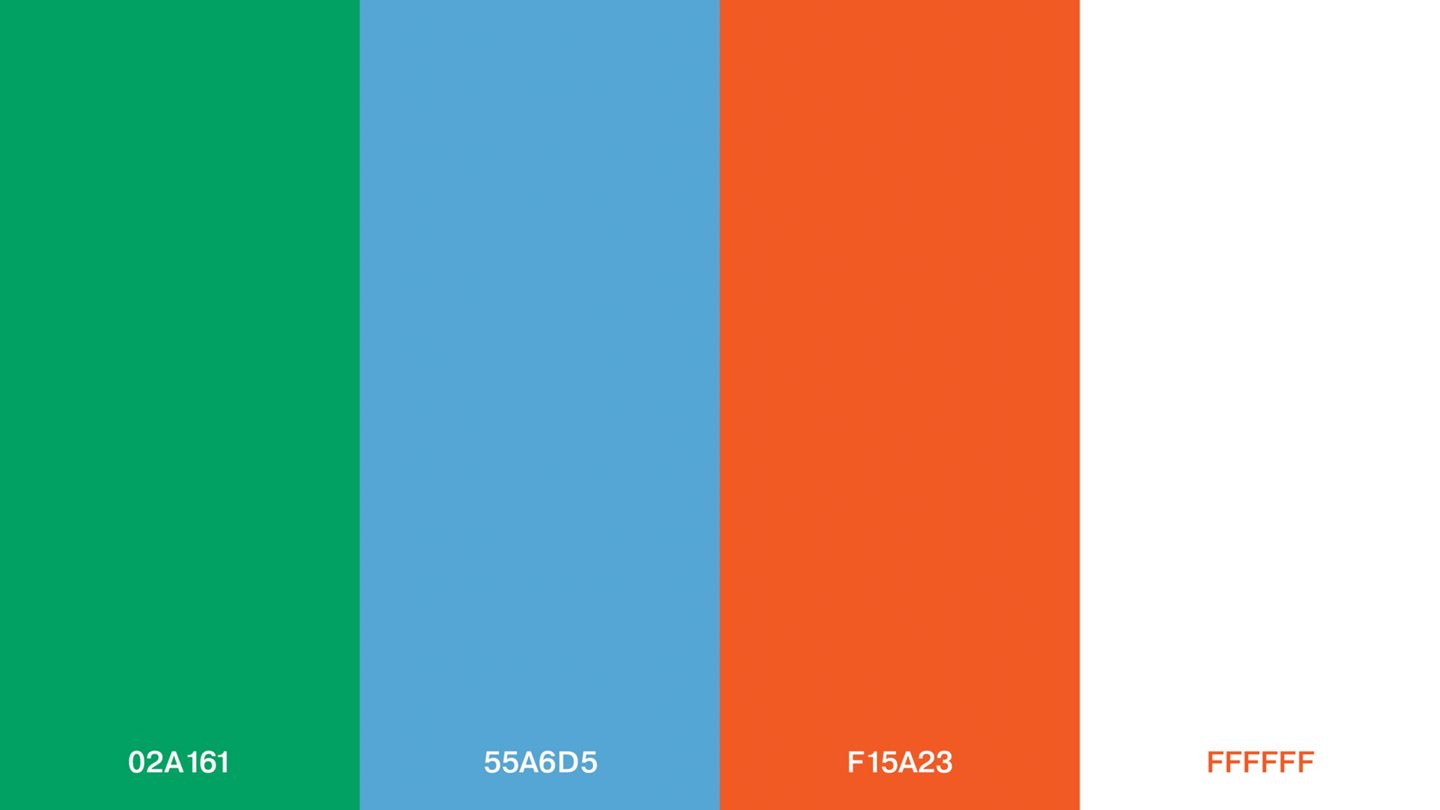
Identity colors and graphics
Theory lens → Design decision
From a media ecology perspective, we adapt the message to various attention environments: close reading (packaging), distance scanning (retail), single-action clarity (outdoor), and fast fragments (digital). The critical lens helps us avoid «greenwashing»: using the «eco» label simply as an attention word.
Close reading (packaging)
Distance scanning (retail)
Single-action clarity (outdoor)
Fast fragments (digital)
Conclusion
Veresk
From a rhetorical perspective, the project has two modes of persuasion. The general-audience presentation uses functional benefits and emotional message, while the professional-audience presentation uses specialized terminology and objective argumentation (system logic, choice of communication channels, media ecology, and measurable behavioral mechanisms).
Course contributions to our work
The course helped us to translate abstract theory into design decisions and create a convincing presentation structure. First, Craig’s traditions gave us a vocabulary to explain why we chose certain tools: hierarchy as cybernetic noise reduction, symbols as semiotics, and «responsible travel» as a socio-cultural practice rather than an isolated product claim.
Second, Media Ecology (McLuhan) helped us design touchpoints as different environments, not «the same layout everywhere». We justified why packaging must be maximally simple, why outdoor must be one message and one action, and why digital can rely on short narrative fragments.
Third, narrative theories strengthened our brand meaning. Narrative Paradigm guided us to keep the story coherent («preparedness + care»), while Symbolic Convergence explained how repeated symbols and shared narratives can build a community of like-minded users around the brand.
Finally, the course’s persuasion block (rhetorical tradition) and behavior-change logic (Theory of Planned Behavior: attitudes, subjective norms, and perceived control) informed the recycling-return message and its framing. We designed it as a simple, doable action that feels socially supported and personally beneficial.
Communication Theory: Bridging Academia and Practice // edu.hse.ru. 2025. [Электронный ресурс]. URL: https://edu.hse.ru/course/view.php?id=133853 (дата обращения: 10.12.2025).
Craig, R. T. Communication Theory as a Field // Communication Theory. 1999. Vol. 9, no. 2. P. 119-161. DOI: 10.1111/j.1468-2885.1999.tb00355.x. URL: https://academic.oup.com/ct/article-abstract/9/2/119/4201776 (дата обращения: 13.12.2025).
McLuhan, M. The Medium is the Message // Understanding Media: The Extensions of Man. 1964. Ch. 1. [Электронный ресурс]. URL: https://web.mit.edu/allanmc/www/mcluhan.mediummessage.pdf (дата обращения: 13.12.2025).
Ajzen, I. The theory of planned behavior // Organizational Behavior and Human Decision Processes. 1991. Vol. 50, iss. 2. P. 179-211. DOI: 10.1016/0749-5978(91)90020-T. URL: https://www.sciencedirect.com/science/article/pii/074959789190020T (дата обращения: 13.12.2025).
Fisher, W. R. The Narrative Paradigm: In the Beginning // Journal of Communication. 1985. Vol. 35, iss. 4. P. 74-89. DOI: 10.1111/j.1460-2466.1985.tb02974.x. URL: https://academic.oup.com/joc/article-abstract/35/4/74/4282872 (дата обращения: 13.12.2025).
Bormann, E. G. I. Fantasy and rhetorical vision: Ten years later // Quarterly Journal of Speech. 1982. Vol. 68, no. 3. P. 288-305. DOI: 10.1080/00335638209383614. URL: https://www.tandfonline.com/doi/abs/10.1080/00335638209383614 (дата обращения: 13.12.2025).
Adorno, T. W.; Horkheimer, M. The Culture Industry: Enlightenment as Mass Deception // Dialectic of Enlightenment: Philosophical Fragments / ed. by G. Schmid Noerr; trans. by E. Jephcott. Stanford: Stanford University Press, 2002. P. 94-136. [Электронный ресурс]. URL: https://monoskop.org/images/9/99/Adorno_Theodor_Horkheimer_Max_1947_2002_The_Culture_Industry_Enlightenment_as_Mass_Deception.pdf (дата обращения: 13.12.2025).
Stafford, L.; Kuiper, K. Social Exchange Theories: Calculating the Rewards and Costs of Personal Relationships // Engaging Theories in Interpersonal Communication: Multiple Perspectives / ed. by P. Schrodt, K. M. Scharp, D. O. Braithwaite. Routledge, 2022. P. 379-390. DOI: 10.4324/9781003195511-33. URL: https://www.taylorfrancis.com/chapters/edit/10.4324/9781003195511-33/social-exchange-theories-laura-stafford-kimberly-kuiper (дата обращения: 13.12.2025).
Pronina Kristina, veresk (branding) [Электронный ресурс] // Portfolio HSE. URL: https://portfolio.hse.ru/Project/188891 (дата обращения: 12.12.2025).
Pronina Kristina, veresk (package) [Электронный ресурс] // Portfolio HSE. URL: https://portfolio.hse.ru/Project/195324 (дата обращения: 12.12.2025).