In 1887, Vincent van Gogh transferred a Japanese woodblock print onto canvas almost line by line. A year later, he wasn’t copying—he was viewing Provence as if it were Japan. This exploration investigates what transpired between those two steps.
Japonism is the term used for the fascination in Europe with Japanese art, which researchers typically date to the 1860s–1910s [1, p. 130]. The term itself was coined by the French critic Philippe Burty in 1872 [7]. Much has been written about this influence, but it is most often reduced to a list of exotic objects: kimono, fans, and screens. As a designer, I am more interested in something else: how a foreign graphic system—framing, localized color, contour, series—reshapes European painting and poster art. Ukiyo-e were mass-produced prints, and it is through printmaking that their lesson most profoundly reached 20th-century design.
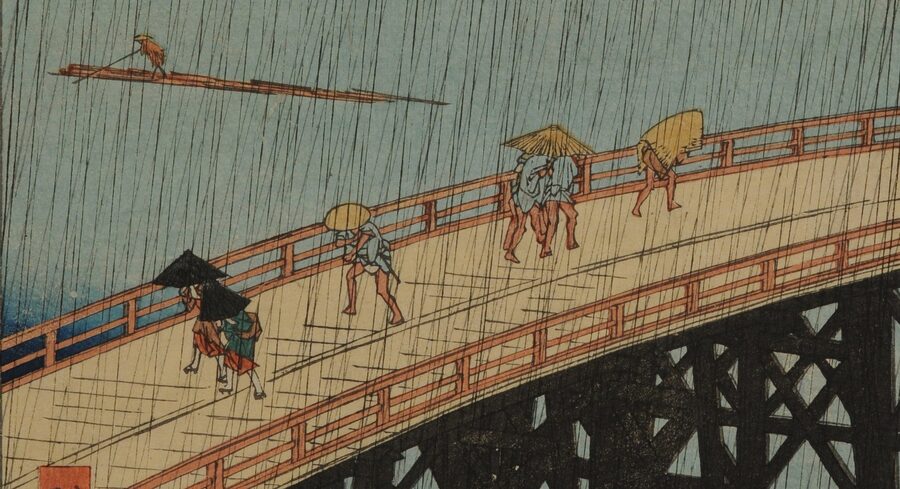
Utagawa Hiroshige. Sudden Shower over the Shin-Ohashi and Atake Bridge. 1857 / Vincent van Gogh. Bridge in the Rain (after Hiroshige). 1887
Hypothesis: Japonism evolved from mere costume to a fundamental grammar. Initially, Japan appears in paintings as a discrete object—a kimono, a fan, a woodblock print on the wall. Then, it recedes from the narrative and moves into the structure of the image: a foreground cropped by the frame’s edge, flat color devoid of shading, dark contour lines, diagonals, and repeated views of a single motif. The more mature the adoption, the fewer «Japanese» elements remain in the artwork.
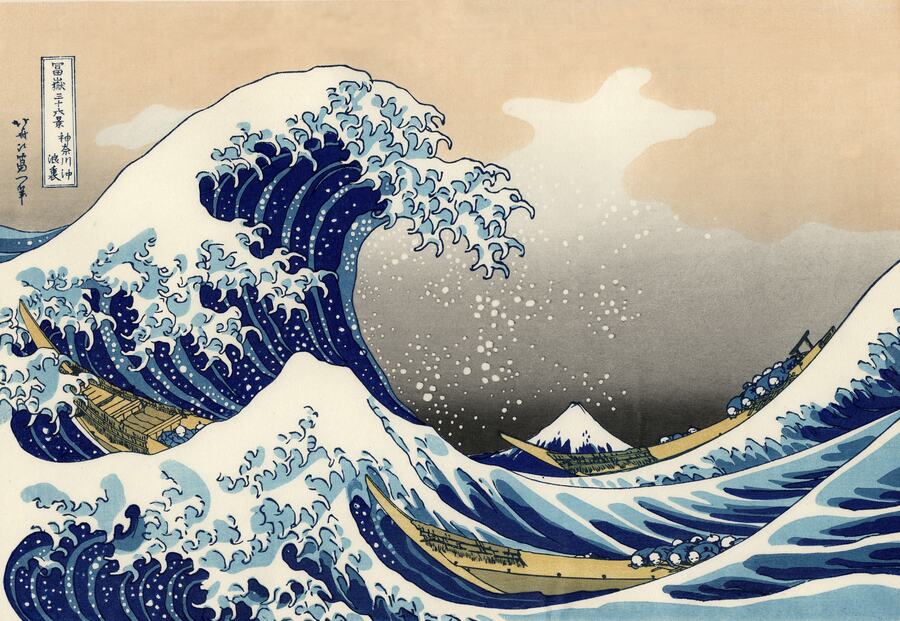
Katsushika Hokusai. The Great Wave off Kanagawa. c. 1830–1832
Floating World
Ukiyo-e—the «pictures of the floating world» [1, p. 131]. This is a cheap, color woodblock print that was bought in Edo like a poster or postcard today: views of famous places, actors, and beauties from tea houses. This section highlights five techniques from three masters—which are then compared with European counterparts.
Katsushika Hokusai. The South Wind, Clear Sky (Red Fuji). Circa 1830–1832
Katsushika Hokusai. Sazai Hall in the Temple of Five Hundred Arhats. Circa 1830–1832
The series, «Thirty-six Views of Mount Fuji, ” is built around a single motif, which is presented each time from a new perspective and in a new state. In „Red Fuji, ” the mountain dominates the entire sheet; in „The Great Wave, ” it is compressed into a small triangle within the ridge groove [12]. In „Zasai Garden, ” Fuji is shown through horizontal bands of terraces and plains, allowing the viewer to gaze upon it alongside the figures on the platform. Here, two future borrowings can already be seen: the series concept and an unexpected viewpoint.
Katsushika Hokusai. Under the Wave off Kanagawa (excerpt: the crest of a wave). Circa 1830–1832. In September 1888, Van Gogh wrote to his brother that Hokusai worked with line and drawing, echoing Theo’s own words: «these waves are claws; the boat is caught in them—you can feel it» [5, Letter 676; translated by author].
Utagawa Hiroshige. Plum Garden at Kameido. 1857
Utagawa Hiroshige. Plum Garden in Kameido (fragment: trunk in the foreground). 1857 The trunk is enormous, cut both at the top and bottom, and the garden with people is visible through the branches, like looking through a lattice. The foreground here doesn’t frame the scene; it obstructs it.
Utagawa Hiroshige. Inside the Kameyodo Tenjin Shrine. 1856
«One Hundred Famous Views of Edo”—this is Hiroshige’s last major series, and in it, he constantly places the foreground right against the background. Clusters of wisteria hang from the upper edge, and the arched bridge deep within the shrine [18] looks toy-like. Color is applied in localized patches, and the sky and water are rendered with a gradient, devoid of chiaroscuro. It is Hiroshige who will become Van Gogh’s master teacher of composition.
Kitagawa Utamaro. Courtesan from a Tea House. Circa 1795
Utamaro Kitagawa. Woman relaxing after a bath. 1790s
Kitagawa Utamaro. Young Woman Reading a Letter. 1790s
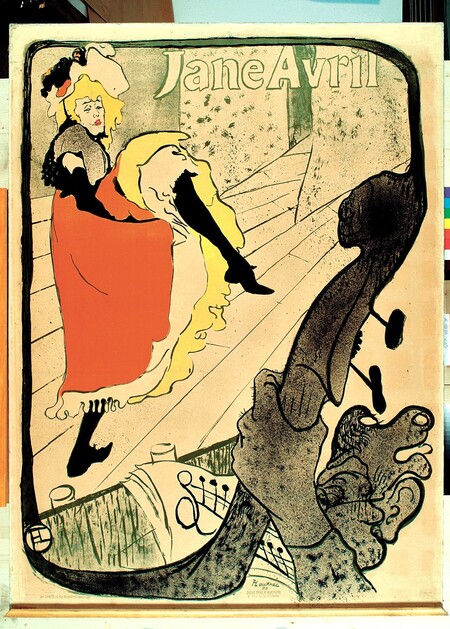
Utamaro was the first to depict women in the okubi-e format—a large bust portrait [13]. The figure is posed closely to the viewer, the background is bare, and character is conveyed through the gesture of the hands, the tilt of the head, and a single profile line. It is also important that Utamaro portrays women in everyday moments: after bathing, while reading, or working. A century later, Toulouse-Lautrec would capture this very tone.
Five Ukiyo-e Techniques
1. The edge of the frame cuts the foreground subject.
2. Local color without chiaroscuro.
3. Dark outline.
4. Diagonal composition and an unexpected point of view.
5. Series of views of a single motif.
Utagawa Hiroshige. Pine «Moon» in Ueno. 1857
The edge of the frame cuts into the foreground. A pine branch is twisted into a circle, and through this circle, as if through a lens, a pond with a distant shore is visible. The tree does not fit within the canvas: the trunk extends beyond the bottom edge, and the canopy extends beyond the top. Traditional European academic painting attempted to present the subject entirely and place it at the center, but here the main subject is the frame through which we look at the most interesting part. The viewer finds themselves almost flush with the branch—this is the position of a person, not an artist with an easel at an appropriate distance.
Utagawa Hiroshige. Kanbara. Evening Snow. c. 1833–1834
Local color without chiaroscuro. Night is rendered here not through shadows, but by a dark band of sky above, and the snow is depicted as unprinted paper. There is no light source, nor are there cast shadows: the houses, mountains, and figures of travelers are composed of several flat shades of gray. The silence and cold are created not by imitating air, but by the relationship between flat planes. This very method—conveying mood through flat color—is what Van Gogh would later apply to his bedroom in Arles.
Katsushika Hokusai. Hokusai Manga, Volume 1 (Spread). 1814
Dark Contour. «Manga» is not a comic in the contemporary sense, but rather an album of quick sketches: people, animals, gestures, tools. Each figure is supported by a single line that varies in weight, conveying both form and movement. There is no background; the figures are freely dispersed across the page. For a European accustomed to wash and cross-hatching, this was a revelation: the contour can be a finished image, not just a draft for painting. From this line, the contours of Van Gogh and the graphic style of Toulouse-Lautrec will emerge.
Katsushika Hokusai. The Great Wave off Kanagawa. c. 1830–1832
The wind tears hats from the travelers and scatters sheets of paper, while Mount Fuji in the background is drawn with a single, thin line. The mountain is almost imperceptible here, and that is the point of the series: the protagonist is the same, but the sheets tell the story of what happens around him—wind, fog, human activity.
Katsushika Hokusai. View of the Kai Province from Kadzikazawa. Circa 1830–1832