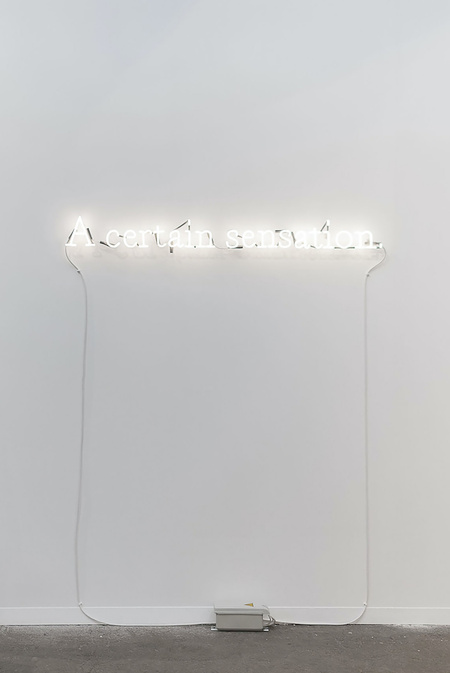
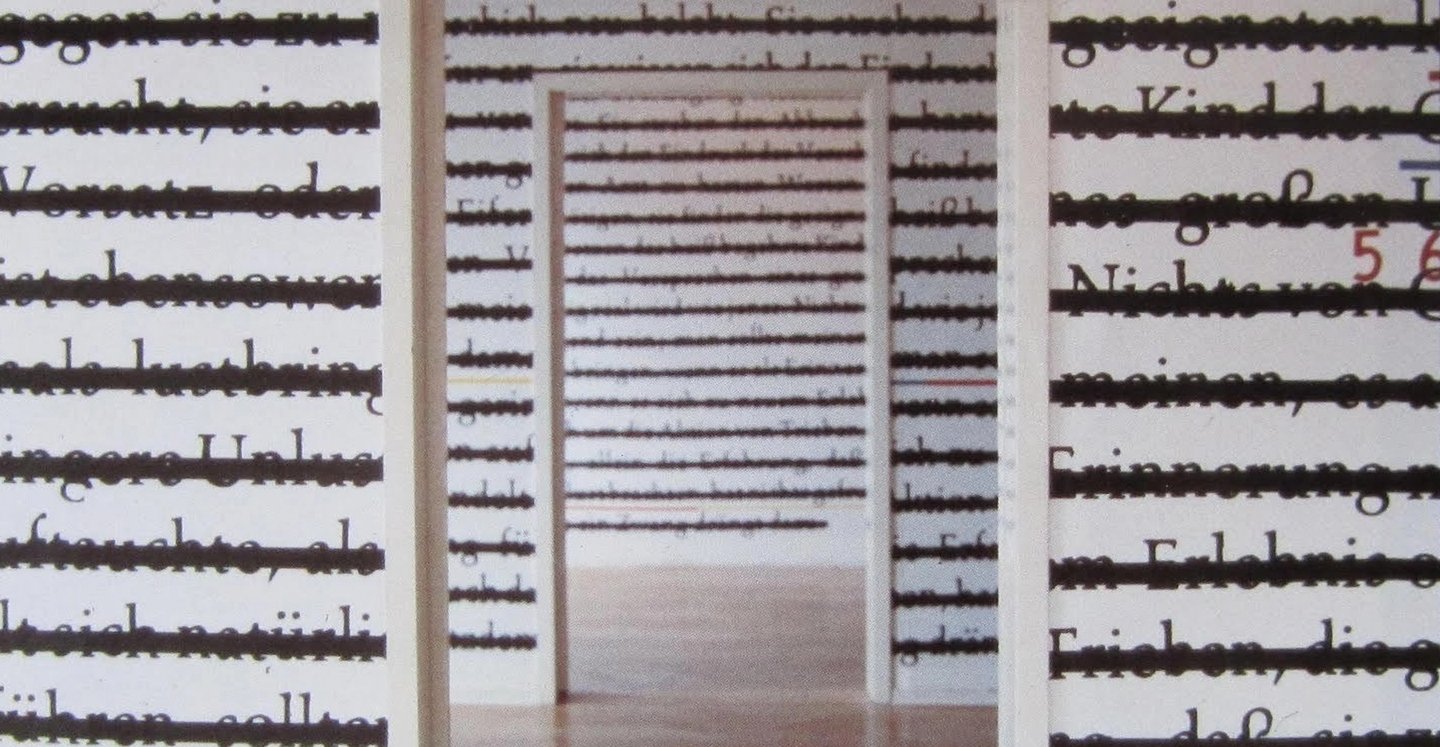
Joseph Kosuth, installation «One and Nothing, ” 1986
I. Concept. Textuality in the 20th Century II. Text as Gesture, Sign, and Medium III. Conceptualists and Text IV. Continuity and Mass Production V. Conclusion VI. Bibliography VII. Image Sources
I. Concept. Textuality in the 20th Century
In the 20th century, attempts were made to define the relationship between text and art. Artists turned to the question of naming and defining objects, and of imbuing art with meaning through words. The question was posed: «Can text be art?»
The aim of this study is to explore different ways artists interact with text and trace how the perception of this element has evolved in 20th-century art. By highlighting both the most prominent artists who incorporated text into their works and less obvious representatives, I investigate the techniques employed by various artists—techniques that brilliantly address the relationship between language, imagery, meaning, and the viewer. In line with the diverse methods and directions, the research is divided into distinct sections.
The visual component features the major works of artists that reflect their relationship with language and the word. The artists selected to explore the theme of textuality were chosen to examine this phenomenon within the context of various art movements.
The textual sources for this research include websites of contemporary art galleries, literary works by artists and art critics, and articles dedicated to 20th-century movements and the biographies of the artists examined in this study.
Theo van Doesburg, «Dadaist Evening Poster, ” 1922 // Natalya Goncharova, „Cyclist, ” 1913
Textuality in 20th-century art is tied to the use of language and typography as a visual element within art. In traditional art, texts were often secondary or supplementary to the visual elements of the work. Textuality as a practice emerged in the early 1900s within avant-garde movements, such as Dadaism and Futurism, which employed fragmented texts and non-traditional printing techniques to create chaos and absurdity. Cubists and Futurists, sometimes collaborating with poets, utilized words not merely as additions to the image, but as the foundation for expressing artistic thought.
In Georges Braque’s work, «Still Life (Bach), ” both letters and images function as signs—relationships between which the artist clarifies. Here, the inscription is as significant an expressive element as the collage cutouts.
In early 20th-century works, text served as communication, declaration, and an expressive element; however, it gained its full development as a medium in the latter half of the century.
El Lissitzky, «Red Wedge» (Клином красным бей белых), 1919–1920 // Georges Braque, «Still Life (Bach)», 1912
II. Text as Gesture, Sign, and Medium
Although experiments with image and text became relevant even to the Cubists and Futurists, most of the research focuses on the artists of the 1960s and their perception of language. It was during this time that it became insufficient for the viewer to be merely an observer to comprehend art—they adopted the role of a reader.
Jasper Johns' non-mimetic work, «Map,» sits on the border between abstraction and recognizable state silhouettes. This piece can be considered a premonition of Conceptualism, because here the text is what captures the viewer’s attention, and it is from those words that we perceive and interpret the work.
Jasper Johns, «Map, ” 1961
Jasper Johns' renowned work, «Flag, ” bridges the gap between Abstract Expressionism and Pop Art, illustrating the evolution of the artist’s practice, which encompasses both verbal and visual symbols. The color of the lettering and the named color do not align, resulting in a cognitive dissonance between the act of reading and the act of viewing. The incessantly repeated inscriptions, which lose correlation with their meaning, lead to a complete erosion of sense—akin to repeating a single word until only its sound remains.
The monochromatic piece, „Periscope, ” renders the color names utterly meaningless due to the absence of color on the canvas; here, the geometry of the letters is examined on a formal level.
In Johns’ paintings, letters and numbers become the protagonists—signs divorced from their original meaning and semantics, forming new, autonomous constructions and structures within the canvas.
Jasper Johns, «False Start,» 1959 // «Periscope (Hart Crane),» 1962
The dematerialization of letters is not limited to Jasper Johns. On the canvases of Say Twombly, viewers attempt to decipher the words (and sometimes succeed), but this text does not communicate with them; rather, it is an image of itself. In Twombly’s work, we discuss the act of writing, the text as an artistic gesture—this becomes the central theme of the author’s creativity.
In a Twombly canvas titled «Virgil, ” the words establish a mythological context that the viewer subconsciously registers. However, the relaxed, nonchalant character of the lettering causes a momentary pause due to the dissonance between the „theme-title“ and the feeling evoked by the handwriting, thereby altering the perception of the word itself. It is also noteworthy that the word is written twice, as if it were rehearsed (a technique that will appear later in the work of other artists).
Sai Twombly «Virgil, ” 1973
«Olympia»: here the text has such a light and whimsical quality that it loses its function as language, and the letterforms dissolve into other lines (resembling either flowers or butterflies). Yet, within these flower-butterflies, the word «Olympia» is sometimes intuitively caught repeatedly: this blurs the line between a line purely serving an artistic function and a word carrying meaning. It seems to me that this effect is similar to that produced by Jones’s «False Start”—multiple repetitions that leave behind only the aftertaste of the word, the lingering thought of it.
Sai Twombly «Olympia, ” 1957
Tvombl depicts not just text, but rather an intertextuality: «The Athenian School,» «Orpheus' Veil"—all of this is a game with the viewer based on associations. We are delighted that we considered the concept and the theme, but then, unable to find anything resembling this «theme» and noticing the discrepancy between it and the character of the lines, we forgo attempts to intellectually interpret the work. The artist forces us to perceive the canvas intuitively, to notice the resulting absurdity, and to see beauty precisely in the synthesis of meaning, text, and form.
The way Jones and Tvombl shift the viewer’s attention between the materiality of the work and the meaning of the words is a kinship and another distinctive feature of their work with text.
Sai Twombly, «Orpheus Veil» (excerpt), 1968 // «The Athenian School, ” 1964
III. Conceptualists and Text
«We can speak of conceptualist strategies in all cases where the opposition between image and text, between object and language, is dissolved.» Boris Groys
This section is dedicated to conceptual artists, who explored the relationship between objects and language. Documentation, references, and instructions accompanying artworks were examined both as elements that generate meaning, as art objects in themselves, and as context and description for that art.
Conceptualists use text to elicit a response—whether emotional or intellectual—prompting the viewer to engage with the art not solely through its visual components. They employ the polysemy of language to create novel and unexpected associations, inviting viewers to question their own perception of language and its role in art.
«If words are used and they stem from ideas about art, then they are art, not literature; numbers are not mathematics.» Sol LeWitt, «Conceptual Art Essay»
Yannis Kounellis, «Bar, ” 1965
Sol LeWitt’s quote resonates powerfully with Kunellis’s work, «Bar.» The word coined by the artist creates a reality: we simultaneously see the art object—composed of black letters on a background—and register the bar’s sign. The relationship between the named and the existing, interwoven with the text-object of art—that is what the conceptual artist contemplates.
For conceptualists, the idea underlying a work of art is considered more important than the physical object or its aesthetics. Joseph Kosuth, inspired by the work of Ludwig Wittgenstein, creates objects composed of inscriptions that name and describe themselves. Meaning = visualization. Neither form nor presentation can disrupt this identity—it results in a kind of illustration of the concept of truth.
Below are two of Kosuth’s works, from 1990 and 1965. The earlier piece serves as an illustration of the aforementioned concept, but the 1990 work comments on the 1965 neon piece, discussing the subjectivity of color perception (in this case, yellow).
Joseph Kosuth «267 (Color) [Yellow]», 1990 // «Neon Electrical Light English Glass Letters Yellow Eight», 1965
Kosuth’s famous student work, «One and Three Chairs,» perfectly illustrates the importance of text in 20th-century art. It serves as a commentary on the nature of representation: the viewer is prompted to consider the relationship between the object, its image, and its linguistic definition. What constitutes an object when we think about it? How significant is the process of naming itself?
Joseph Kosuth, «One and Three Chairs,» 1965