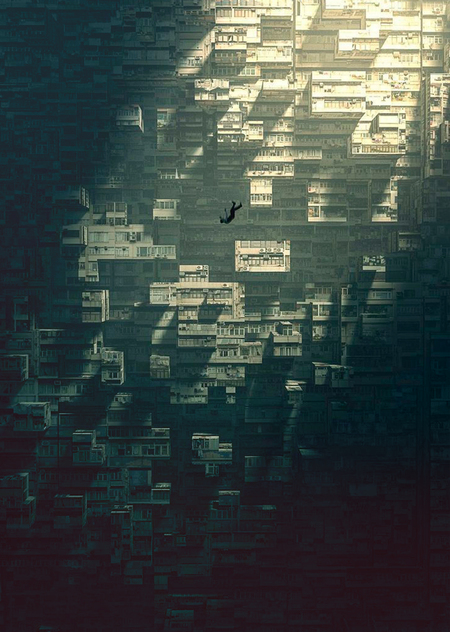
Concept
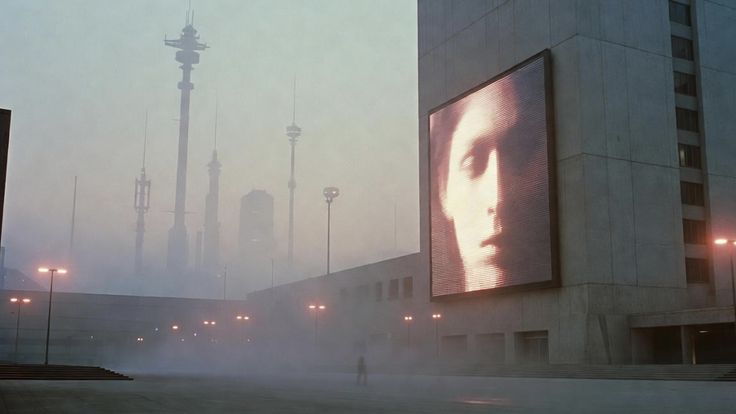
A scene from Ridley Scott’s film Blade Runner (1982)
This visual study is dedicated to analyzing mechanisms of control in dystopian worlds. Based on the artistic imagery from certain works in this genre, I will examine the techniques used in their architecture, the populace’s clothing, symbolism, and space as a whole—elements that shape the image of a society restricted in freedom. Examples used include films, series, books, and video games, where the visual organization of the environment functions as a tool of power and influences human behavior.The choice of this topic is driven by the growing societal concern regarding issues of social control worldwide, as well as my personal interest in studying how visual environments can reflect and reinforce a system’s tenets. Dystopia allows one to trace the gradual transition from external pressure to internalized control, where established restrictions become routine, and the individual begins to follow the system’s rules autonomously, without prompting. I will specifically explore how these mechanisms are expressed through the visual language of these works.
Dystopias depict societies where the pursuit of order, security, universal well-being, and happiness takes precedence over individual freedom. Control becomes an inherent part of daily life—a system of subtle yet profound restrictions that affect people’s appearance, social standing, the surrounding environment, and behavior.
This study focuses on how the sensation of control is constructed in dystopian worlds through visual techniques. Using examples from literature, cinema, and video games, I will examine how uniformity, color symbolism, and architecture function as tools of power.I hypothesize that internal conformity is impossible without external pressure, so I will pay special attention to the transition from external coercion to internalized control—the point at which an individual begins to willingly adhere to established norms and perceive limitations as a natural part of life.
The foundation of the work was pieces from the dystopia genre across different periods and geographical settings where the visual organization of society plays a significant role. Material was selected based on expressive examples of control, demonstrated through the external appearance of individuals, certain social markers, surveillance technologies, and spatial design.
The study includes both classic monochromatic dystopias and vibrant, visually engaging, yet unfree worlds, allowing for an examination of various methods of depicting control.
The work is divided into five main parts:
• The first section discusses how standardization can visually transform individuals into a unified mechanism or segment them by caste.
• The second section examines how power asserts itself daily and becomes integrated into people’s inner worlds.
• The third section explores external surveillance systems that transition into self-monitoring.
• The fourth section focuses on architecture, which functions as an element of control.
• The final section presents an image of an authorial dystopian world that combines elements of control.
The research question is: How does the visual organization of all the social facets of the dystopia genre transform into a tool of societal control, and how does external pressure gradually shape an individual’s internal submission?
Assessment
To begin, the essence of any dystopia as a genre is to present a cautionary world where technological advancement or social inequality acts as a force suppressing resistance, thereby structuring a society that runs contrary to human feeling, freedom, and nature itself.Control occupies a crucial place in this system, as it is one of the primary mechanisms of dystopian existence. It allows authority to maintain the established order, regulate citizen behavior, and restrict the possibility of deviating from accepted norms.Its goal is not merely to suppress open resistance, but to mold society into an «ideal» state by limiting and sacrificing individual interests—especially human freedom.
Control does not always manifest through direct violence or prohibitions; it can take the form of established rules, social norms, appealing images of prosperity, and daily rituals that eventually become an inseparable part of one’s worldview. Gradually, external coercion transforms into internal compulsion: the individual begins to voluntarily adhere to established requirements, perceive limitations as a natural facet of life, and regulate their own behavior.The visual environment, however, becomes one of the primary instruments of this process. Standardization shapes collective identity; color and symbolism denote social status and power; surveillance mechanisms cultivate a sense of constant presence; and the architecture and organization of space define the boundaries of human freedom. Consequently, control permeates not only societal structures but also the individual’s daily experience, shaping a world where even the familiar surrounding environment becomes part of an idealized system.
Man as part of a system
One of Us, Not One of Us
In dystopian societies, individuality is often perceived as a source of instability. Differences among people impede the formation of a unified—and primarily reliable—system, so power seeks to reduce them to common standards of appearance, behavior, and social status. Unification becomes one of the first methods of control: the individual ceases to be viewed as an autonomous person and transforms into an element of a machine devoid of human factor.
In dystopias, clothing becomes more than just a way to signal belonging to a society; it becomes a tool for forging collective identity. Uniformity erases distinct characteristics and subordinates a person’s external appearance to a single archetype. Simultaneously, this practice can not only equalize people but also solidify their place within the social structure.
Consider the film Equilibrium (2002) as an example: the residents' strict clothing underscores the society’s discipline and emotional restraint.
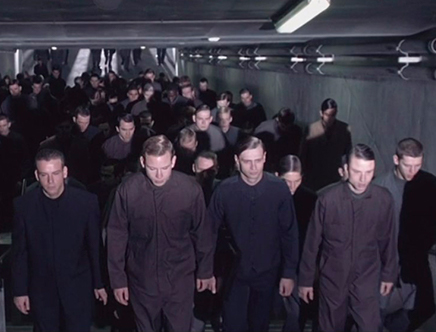
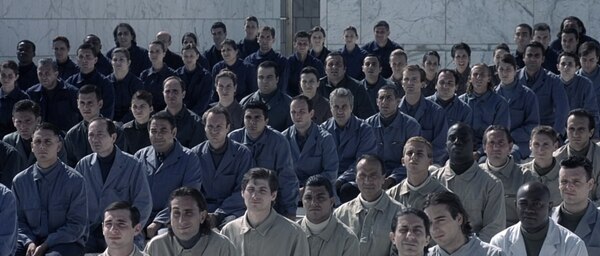
Stills from Kurt Weimer’s film «Equilibrium» (2002)
The black suits of the clerics—representing the state apparatus responsible for maintaining order—are particularly striking. Their appearance becomes an extension of the state’s ideology, within which any deviation from the norm is perceived as a threat. Clothing functions on a similar principle in «1984» and «We.»
Nevertheless, the series The Handmaid’s Tale (2017) presents a second approach to the population’s appearance, one that operates in diametrically opposite ways: uniformity there is selective, and the clothing does not hide social differences—rather, it makes them obvious—as representatives of different groups wear only attire that reflects their social standing.
Servants wear red, the wives of commanders wear blue-turquoise, and the Marfa wear green. Thus, a person becomes a recognizable representative of their «league» even before speaking a single word. We will also touch upon how in dystopian novels, control extends to the very concept of what a person should be—in Huxley’s novel Brave New World, for instance, the world’s population is divided into castes that differ in health metrics, appearance, and height. The social chasm between them is maintained by the different colors of uniform assigned to each caste, allowing an Alpha to be distinguished from a Gamma or, even more so, an Epsilon from a distance.
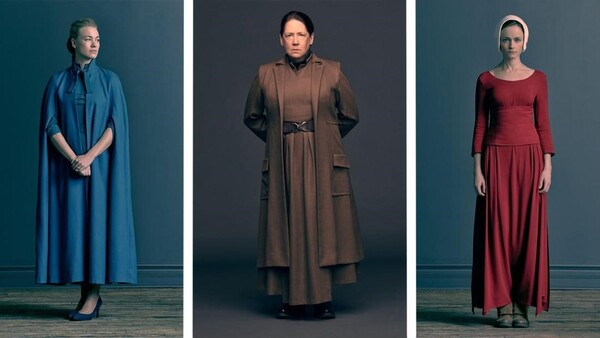
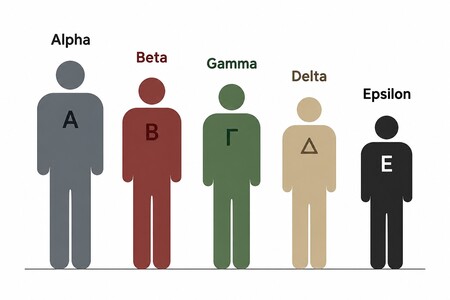
Hierarchy of Social Inequality in «The Handmaid’s Tale» and «Brave New World»
Let’s pause for the film «Gattaca» (1997): people born through genetic selection, much like in «The Wonderful World,» are granted the status of «valids,» while others find themselves in a less desirable position. Biological traits transform into a kind of social passport, predetermining a person’s potential.This concept is reinforced by the film’s visual language—corporate employees wear nearly identical, severe suits, and the interiors are characterized by emptiness, clean surfaces, and geometric order. Even the outward appearance of the space seems sterile and subservient to the idea of perfection.
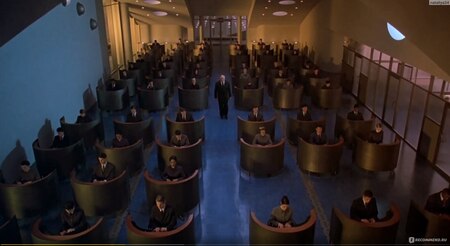
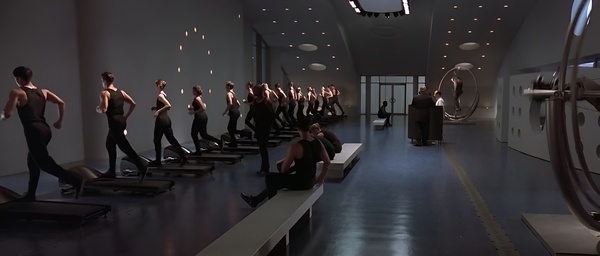
Stills from Andrew Niccol’s film Gattaca (1997)
It turns out that standardization in «Gattake» becomes not only a public requirement but also an ideal toward which one should strive. Any deviation from the standard is perceived as a deficiency.
Another way individuality is curtailed is through a change in the attitude toward the person themselves. A name, a very personal thing for any individual that traditionally connects them to their family, often becomes merely an identifier of group affiliation, ownership, or is reduced to a number in dystopias.
This is particularly evident in «The Handmaid’s Tale.» The main character’s name—Offred—literally points to her belonging to Commander Fred. Personal identity is erased by social status: the protagonist is defined not by her own name, but by her position within someone else’s home.
The examples illustrate that the system seeks to control not only how a person looks but also how they are perceived by others and how they perceive themselves. This standardization allows the dystopian system to eliminate individual characteristics, which aligns perfectly with a policy of collectivity and uniformity. Clothing, biological traits, and even a name—especially a name—become instruments of classification and a set of numbers.