Introduction—Concept This work examines ancient Egyptian imagery not as illustrations for a single, pre-determined myth, but as diverse visual modes of speaking about time, death, and renewal. The selected corpus integrates royal funerary architecture, inscriptions, representations of cosmic order, the sequence of the nocturnal journey, and the idealized landscape of the afterlife. This juxtaposition allows us to see that the concept of «eternity» within Egyptian material does not solely denote infinite duration. It can be connected to the preservation of name, the recurrence of the solar cycle, the successful navigation of a perilous path, and the resurgence of fertile life. The chronological scope of the research spans approximately the 24th to 11th centuries BCE. The lower boundary is linked to the Pyramid of Unas at Saqqara, where the «Pyramid Texts» were first placed in a royal pyramid known to us. The upper boundary encompasses monuments of the New Kingdom, primarily the royal tombs of Thebes and the tomb of Sennejem in Deir el-Medina. The research question is: how do ancient Egyptian monuments transform concepts of time and eternity into visible forms—through text, architecture, the heavens, the movement of the solar barge, and the image of the fertile field? The working hypothesis is that the selected monuments are unified not by a single schema, but by several interrelated models: the preservation and ritual action of the text, cosmic order, the procedural passage of the night, and the stable landscape of post-mortem existence. The comparison must also demonstrate the differences between royal and private funerary contexts.
The methodology involves describing observable visual features followed by careful interpretation. Observing that «stars are positioned on the ceiling» does not equate to concluding that «Egyptians viewed the sky as a map in the modern sense.» Therefore, factual information is separated from interpretation, and popular or promotional phrasing is not accepted as evidence without museum or archaeological support.
- Theme, Chronology, and Geography The temporal sequence of the corpus is intentionally non-linear. The Pyramid of Unas dates to the late Fifth Dynasty of the Old Kingdom, approximately the 24th century BCE; the official resource Discover Egypt’s Monuments names it the first known monument featuring «Pyramid Texts» carved into the walls of the burial chamber. The tomb of Thutmose III, KV34, dates to the Eighteenth Dynasty, during the reign of about 1479–1425 BCE; it documents an early complete version of the «Amduat.» The tomb of Seti I, KV17, belongs to the Nineteenth Dynasty, during the reign of approximately 1294–1279 BCE; its official museum-archaeological resource describes astronomical scenes on the vault of the burial chamber. Senneferu’s tomb, TT1, in Deir el-Medina is dated to the Nineteenth Dynasty, around the reign of Ramesses I–Ramesses II, approximately 1295–1213 BCE; this is supported by the Metropolitan Museum of Art object card for a facsimile of the «Field of Iaru» scene. The Ani Papyrus is generally dated to around 1250 BCE, during the Nineteenth Dynasty. The corpus geographically includes Saqqara, West Thebes, and Deir el-Medina. These locations differ in function. Saqqara is an Old Kingdom royal necropolis; the Valley of the Kings is the area of New Kingdom royal tombs; Deir el-Medina is a settlement of artisans who served the royal tombs and possessed their own private tombs. This distinction is crucial: the depiction of the afterlife in Senneferu’s tomb cannot be uncritically seen as a direct mirror of royal ideology.
2. Research Question and Hypothesis Research Question: How do text, architecture, imagery of the sky, night routes, and landscape transform the idea of continued existence into a visible form? Hypothesis: The chosen monuments do not form a single, immutable formula, but rather a set of interconnected models—preservation through text, cosmic order, sequential transition, and renewable fertility.
- Monument Complex and Visual Analysis 3.1. «Pyramid Texts» in the Unas Pyramid The Unas Pyramid in Saqqara is the earliest structure in the selected complex. The interior walls of its burial chamber and adjacent rooms are covered with hieroglyphic formulas traditionally known as the «Pyramid Texts.» The official page on Egyptian monuments emphasizes that this is the first known example of such a royal funerary text; its function was related to the deceased pharaoh’s transition into the afterlife. Observed features: The text is not separated from the architecture nor placed on a portable medium. Vertical columns of hieroglyphs form a rhythmic surface on the walls, alongside alabaster paneling of the burial chamber and a starry ceiling. The chamber becomes not just a container for the sarcophagus, but a space where the inscription, the body, and the ritual path are unified. Interpretation: In this monument, time is expressed not through a sequence of images, but through the repetition of formulas and the ritual act of speech. One cannot claim that the inscription itself «completely explains the Egyptian understanding of time.» However, it reveals an important principle: a preserved and correctly placed text must continue to function after the pharaoh’s death. Eternity here takes on an architectural and ritual form. For the analysis, the document utilizes a general view of the burial chamber and a close-up of the texts. A photograph of Vincent Brown’s chamber shows the sarcophagus, starry ceiling, and inscriptions; a photograph from the Brooklyn Museum shows a wall with the «Pyramid Texts» and is available in the public domain.
3.2. Astronomical Ceiling of KV17, Tomb of Seti I The Tomb of Seti I KV17 in the Valley of the Kings is a specific example of celestial order within the mortuary architecture of the New Kingdom. Seti I reigned approximately from 1294–1279 BCE. The official page Discover Egypt’s Monuments describes the tomb as containing the «Litany of Ra, ” the „Amduat, ” the „Book of Gates, ” the „Book of the Celestial Cow, ” and astronomical scenes on the ceiling of the burial chamber that imitate the night sky. Observable features include the vault surface being filled with rows of figures, symbols, and celestial motifs. The ceiling differs from the wall because it not only tells a story but also literally places cosmic imagery above the burial site. A section of the ceiling composition is visible in a supplementary 19th-century engraving by Richard Lepsius. Interpretation: the tomb transforms into a model of the cosmos not just because of the stars, but also due to the architectural orientation of the image. The deceased is placed in a space where celestial order and the funerary journey are connected. This allows us to speak of eternity as the king’s inclusion in a stable cosmic order, but it does not permit attributing modern scientific significance, such as a „star chart, ” to all the depictions. The main photograph of the ceiling was taken by Carol Raddat and published on Wikimedia Commons under the CC BY-SA 2.0 license. They are used here as modern documentary images of the monument; the author of the ancient painting should be considered an unknown royal workshop, not the contemporary photographer.
3.3. A Night Journey Through KV34, the Tomb of Thutmose III The Tomb of Thutmose III, KV34, offers an alternative way to visualize time: not as a static celestial order, but as a passage through the successive hours of the night. Thutmose III reigned approximately from 1479–1425 BCE. KV34 contains one of the early complete versions of the «Amduat”—a text detailing the nocturnal journey of the sun god through the Duat. The chosen illustration of the „11th Hour of the Amduat“ shows fragments of the composition featuring figures and text. The original file description states: Tomb KV34, Thutmose III, 11th hour Amduat; photo taken by Hajor in December 2002, CC BY-SA license. This level of specificity—including the tomb, the hour of the night, and the photographer—is more valuable than a vague label like „Egyptian fresco.“ Observable features: The composition is divided into registers and is accompanied by hieroglyphic texts. The scenes must be read as part of a sequence, not as isolated images. The second illustration—a plan of KV34—is not an Amduat scene, but it helps reveal how the burial chamber and corridors organize movement deep into the earth. Interpretation: The night becomes an ordered process. The sun’s journey traverses a perilous space and culminates in renewal, meaning time here is neither simply linear nor simply cyclical; it is cyclical, but it demands the proper progression through stages. The transition from one hour to the next is articulated through the organization of the imagery and text. This represents the most explicitly processual model within the selected corpus.
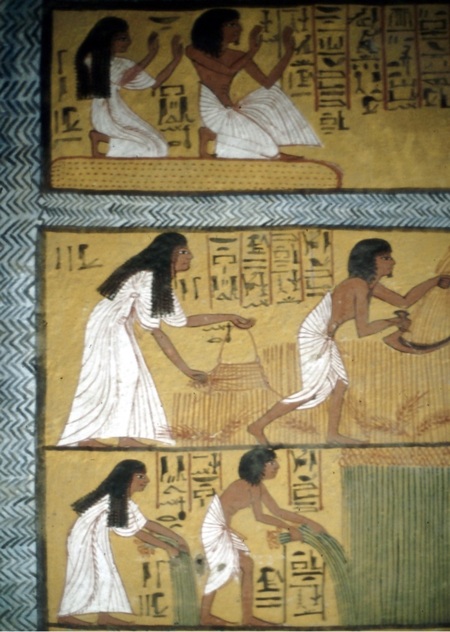
3.4. Iaru Fields in the Tomb of Sennedjem TT1 The tomb of Sennedjem TT1 in Deir el-Medina transitions the theme of eternity from royal tombs to a private funerary context. Sennedjem was associated with a community of craftsmen who worked for royal necropolises. His tomb presents scenes from the afterlife’s fertile world—the Fields of Iaru/Ialu. The main illustration is an open facsimile from the Metropolitan Museum of Art, «Sennedjem and Iineferti in the Fields of Iaru.» The museum card credits the facsimile’s author as Charles K. Wilkinson, the facsimile date as 1922, the original as the New Kingdom, 19th Dynasty, during the reign of Ramesses I–Ramesses II, originating from TT1, and public domain status. The second photograph shows the tomb’s actual painting and is attributed to Gerda Eichman, CC BY-SA 4.0. Observed characteristics: figures work in the field; nearby are placed water, plants, tools, and animals. Agricultural activities are repeated, creating a rhythm. The space of the afterlife does not appear empty or abstract: it is structured as a fertile landscape where activity can continue. Interpretation: eternity here is presented as the preservation of a desired way of life. This does not necessarily mean infinite physical labor in a literal sense; the imagery articulates the ideal of renewed well-being through familiar earthly actions. Comparison with royal tombs shows a shift in scale: instead of the pharaoh and a cosmic journey, a private couple and a sustainable landscape take center stage.
3.5. Ani Papyrus and the Trial Procedure The Ani Papyrus introduces a portable, book-like format to the corpus. The papyrus was created around 1250 BCE during the 19th Dynasty and is housed in the British Museum. In the scene of the heart weighing, Anubis compares the deceased’s heart to the feather of Ma’at; Thoth prepares the record of the verdict, while Ammit awaits the result. The scene relates to the deceased’s passage through judgment and the possibility of continued existence. Observable features: The composition reads from left to right as an assembly of characters and actions, yet it simultaneously features textual columns, scales, and divine figures. The scales establish a visible axis of balance. This is not a representation of «time» as depicted by a clock, but it transforms the passage into a procedure with conditions and outcomes. Interpretation: The papyrus demonstrates that eternity, within Egyptian material culture, depended not only on the preservation of the body or name but also on correctly navigating the cosmic and moral order. Furthermore, one must avoid generalizing a single papyrus scene into a universal «Egyptian morality system”—it is a specific funerary manuscript for a particular individual, and its composition evolved within the long tradition of funerary texts.
- Comparison of Monuments Comparing the corpus allows us to identify four models. The first is the ritual-architectural model. In the Unas pyramid, the text is incorporated into the wall and connected to the burial site. Its repetition and precise placement support the post-mortem actions. The second is the cosmic model. In KV17, the dome of the burial chamber imitates the sky; the stars and celestial motifs link the pharaoh to an enduring order that surpasses human life. The third is the procedural model. In KV34, the night journey is organized as a passage through sequential hours. Time moves, but this movement leads to the renewal of the sun. The fourth is the landscape model. In TT1 and the Metropolitan Museum facsimile, the afterlife is depicted as a fertile world where agricultural activities continue. The Ani Papyrus adds the condition of successfully passing judgment. These models are related but not identical. We cannot conclude based on these four monuments that the ancient Egyptians possessed a single, immutable concept of eternity. A more precise conclusion is that different mediums and different social contexts allowed for varied visualizations of preservation, order, transition, and renewal.
5. Conclusion
The working hypothesis is partially confirmed. In the selected monuments, the link between eternity and renewal, the preservation of order, and the continuation of life is indeed repeated, but the visual solutions themselves differ noticeably. The «pyramid texts» render eternity as a ritual act of inscription; the ceiling of KV17 depicts cosmic order; KV34 represents the nocturnal process passing through the hours; TT1 is a fertile landscape; and the Ani Papyrus is a trial and a record of the outcome. Therefore, the Egyptian depiction of time cannot be reduced merely to «cyclicity.» The sun’s cycle, the constancy of the sky, the repeatability of agricultural actions, and the procession of the funerary barge function as different forms of ordered continuity.
7. Illustrations and Sources:
Fig. 1. Burial chamber of the Unas Pyramid, Saqqara. Photograph by Vincent Brown, 2011. Original monument: end of the 5th Dynasty, circa 24th century BCE; source: Wikimedia Commons, File: Burial chamber in Unas’ pyramid.jpg, CC BY 2.0, https://creativecommons.org/licenses/by/2.0/. Observation: the sarcophagus, star ceiling, and inscriptions form a unified architectural space.
Fig. 2. «Text Panels» on the Pyramid of Unas. The original author is an unknown royal workshop; photographic source: Brooklyn Museum, 1900, Wikimedia Commons, File: UnasPyramidentexte.jpg, public domain. Original: Saqqara, late 5th Dynasty. Observation: The vertical text columns transform the wall into a ritually active surface.
Fig. 3. Astronomical ceiling of the burial chamber KV17, Tomb of Seti I. The author of the ancient frescoes is an unknown royal workshop; photograph by Carole Raddato, 2020. Original: 19th Dynasty, circa 1294–1279 BCE. Wikimedia Commons, CC BY-SA 2.0, https://creativecommons.org/licenses/by-sa/2.0/. Observation: Celestial figures occupy the vault above the burial site.
Fig. 4. The 11th Hour of Amduat, KV34, Tomb of Thutmose III. The author of the ancient painting is unknown; Photographer: Hajor, December 2002. Original: 18th Dynasty, reign of Thutmose III, circa 1479–1425 BCE. Wikimedia Commons, CC BY-SA 2.0 as per the original file page; the file description indicates the photograph by Hajor (December 2002) and the 11th Hour of Amduat. Observation: the registers and texts establish the sequence of the night journey.
Fig. 5. Plan and isometric view of KV34, the tomb of Thutmose III. R. F. Morgan, 2013, Wikimedia Commons, CC BY-SA 3.0,
https://creativecommons.org/licenses/by-sa/3.0/. This is an architectural diagram, not an ancient fresco; it is used to analyze the movement path deeper into the tomb.
Fig. 6. Sennedjem and Iineferti in the Fields of Iaru. Charles K. Wilkinson, facsimile 1922; original—tomb of Sennedjem TT1, Deir el-Medina, 19th Dynasty, c. 1300–1213 BCE. The Metropolitan Museum of Art, object 548354, CC0/Public Domain. https://www.metmuseum.org/art/collection/search/548354. Observation: The afterlife space is depicted as a fertile field with repetitive activities.
Fig. 7. Detail of a facsimile of the scene of Jaru’s fields from TT1. Charles K. Wilkinson, 1922, The Metropolitan Museum of Art, object 548354, CC0/Public Domain. The image depicts specific actions, plants, and animals, rather than an abstract symbol of eternity.
Fig. 8. Photograph of the Sennjedem Tomb TT1 mural. Photographer Gerd Eichmann, 1982, Wikimedia Commons, CC BY-SA 4.0, https://creativecommons.org/licenses/by-sa/4.0/. Original: Deir el-Medina, 19th Dynasty. The caption and authorship refer to contemporary photography; the author of the ancient mural is unknown.
Fig. 8. Photograph of the Senegem tomb painting TT1. Photo by Gerd Eichmann, 1982, Wikimedia Commons, CC BY-SA 4.0, https://creativecommons.org/licenses/by-sa/4.0/. Original: Deir el-Medina, 19th Dynasty. The caption and authorship pertain to modern photography; the artist of the ancient painting is unknown.