Concept
In religious painting, death is often depicted not merely as the end of earthly life, but as a moment of encounter between the individual and the sacred realm. In this context, the artistic means used by the artist to convey an invisible event—the appearance of a divine figure or the reception of the deceased or their soul—take on particular significance.In the Japanese Buddhist tradition, this motif is embodied in depictions of raigo—the descent of Amida Buddha to a dying believer. A similar situation is presented in ancient Russian painting through the scene of the Dormition of the Theotokos, where Christ receives the soul of His Mother.Despite differences in religious content, both narratives address a similar representational challenge.
How do the depictions of a sacred figure meeting a dying person or their soul differ in 13th–14th century Japanese and Old Russian painting?
It is hypothesized that in Japanese raigo, the transmission of the afterlife occurs predominantly through the movement of sacred figures toward the human, while in Old Russian scenes of the Dormition, it occurs through the compositional emphasis on the moment Christ receives the soul.
To test this hypothesis, the study compares Japanese depictions of raigo with Old Russian icons of the Dormition of the Theotokos from the 13th–14th centuries. Particular attention is paid to composition, the direction of movement, the characters' gestures, and the methods used to organize earthly and sacred space.
The research is built upon the principle of sequentially comparing these visual features. This approach will allow us to determine which artistic solutions unify the two subjects, what the differences between them are, and how closely they correspond to the proposed hypothesis.
Chapter 1. Composition and Movement
In depictions of the Harrowing of Hades and the Dormition, the meeting of the sacred figure with a human being becomes the central event, yet it can be presented in various ways—either through movement toward the meeting point or by emphasizing the moment of the soul’s reception. This chapter examines how the placement of characters, primary compositional axes, and direction of movement dictate the viewer’s perception of the event. How does composition guide the viewer’s attention to the event of meeting across two iconographic traditions?
(1) Raigo: Descent as a Compositional Action
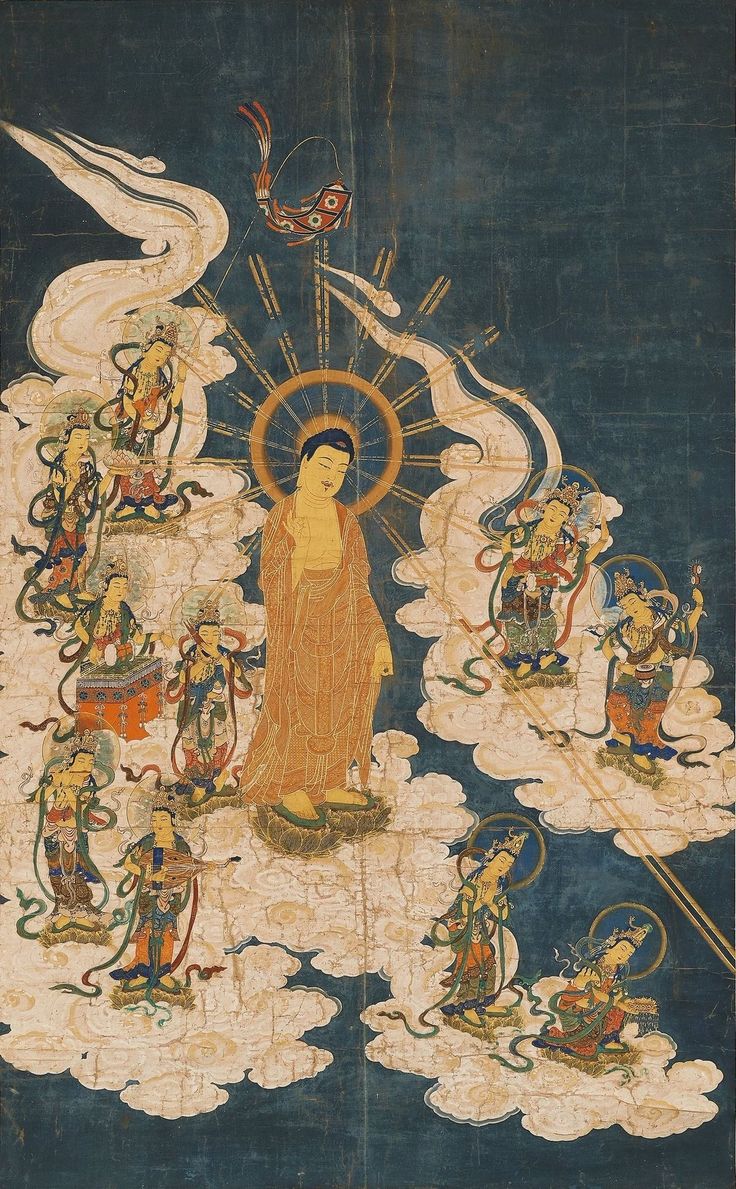
In the Japanese painting «Rapid Paradise,» Amida and the bodhisattvas accompanying him descend on clouds above a mountainous landscape. The figures are unified in a procession, whose movement unfolds diagonally from the upper left to the lower right of the image.
The session begins with movement.
The downward trajectory is emphasized by the placement of the figures and the elongated contours of the clouds, which connect individual groups into a single flow. The mountain slopes create a sense of spatial expanse, and the descending compositional axis allows the viewer to trace the path of the celestial procession.
Amida Descent with Twenty-Five Attendants («Quick Paradise»). Japan, 14th Century. Tion-in Temple, Kyoto
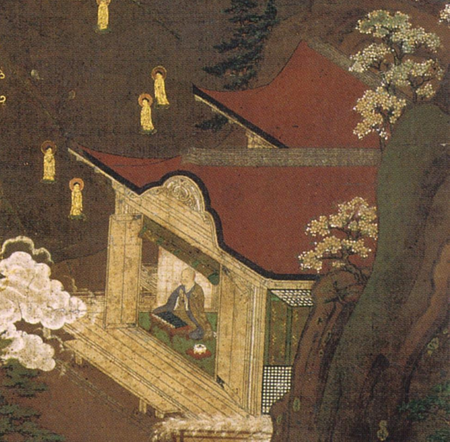
Diagonal composition doesn’t just organize the arrangement of shapes—it gives the composition direction. The viewer’s eye follows the procession, making the approach of sacred figures feel like unfolding action rather than static presentation.But movement doesn’t always follow a single diagonal.
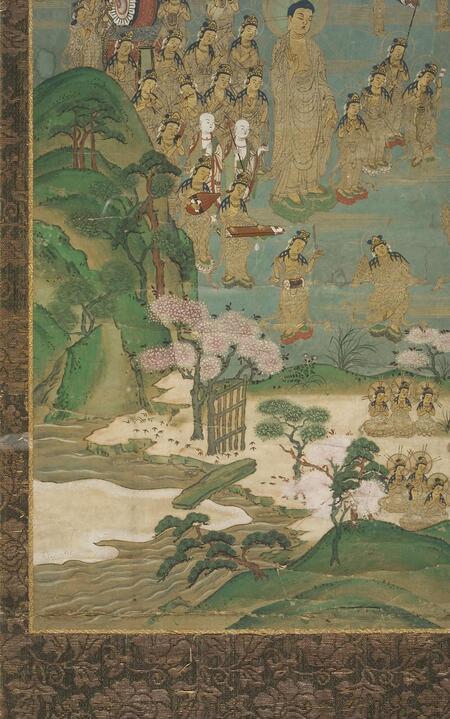
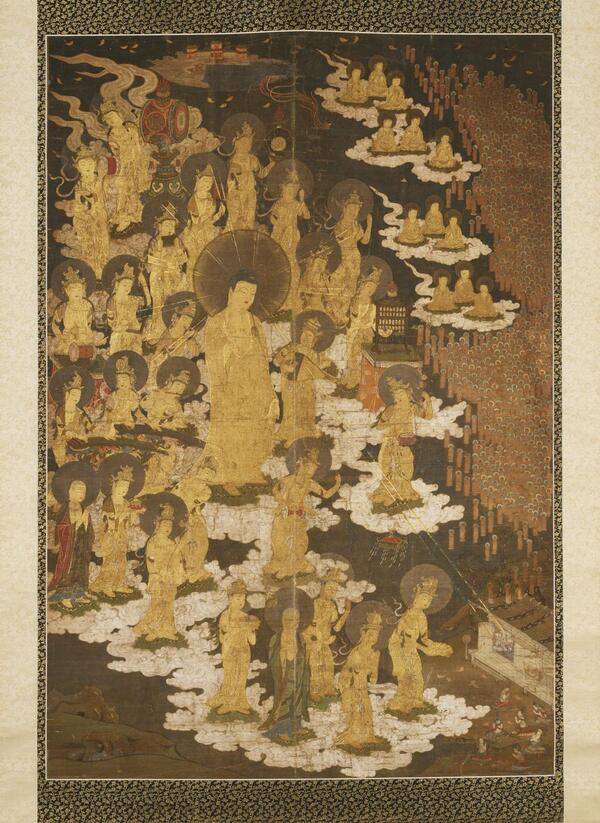
On the left: «Descent of Amida with celestial attendants.» Japan, 13th century. Nara National Museum.
On the right: «Descent and return of Amida to the Pure Land of the West with the soul of the believer» («Gosho Mandala»). Japan, c. 1300. Metropolitan Museum of Art, New York.
In the work from the Nara National Museum, Amiḍa and his attendants descend from the upper right quadrant on clouds. This orientation is unusual for Japanese raigō iconography, where the procession more often appears from the upper left. Despite the shift in direction, the composition retains a distinct sense of the sacred group approaching.
A different approach is presented in the «Gosō Mandara.» Here, the celestial procession traces a winding path, and the composition includes not only Amiḍa’s descent but also the return with the soul of the believer. In this way, the viewer sees several sequential stages of the event within a single image.
The difference between the works lies in the organization of movement:
In the first case, it is presented as a directed descent, while in the second—as a sequence of arrival and return. The comparison shows that movement within the sacred space can alter direction and spatial organization. Consequently, for the works under consideration, the presence of a single mandatory diagonal is not as significant as the role of the figures' movement in constructing the encounter.
(2) Assumption: The Compositional Manifestation of Soul Acceptance
In the Novgorod church of the «Assumption of the Theotokos» from the early 13th century, the composition is built around the horizontal line of the Virgin’s bier and the vertical line of the Christ figure positioned behind her. Unlike the examples previously discussed, the approach of the main sacred figure here is not presented as a singular action. Christ is already beside the Theotokos, holding her soul in the form of a swaddled infant.
«Assumption of the Theotokos.» Novgorod, early 13th century. State Tretyakov Gallery.
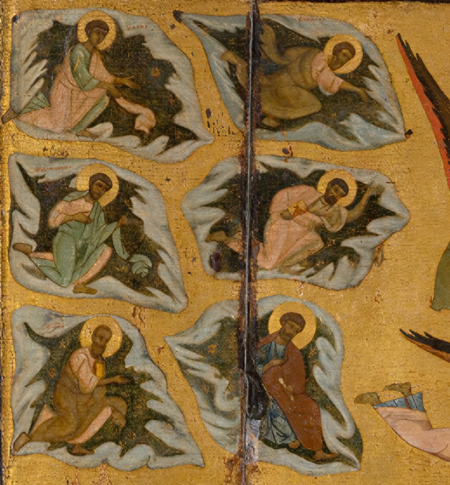
The central positioning of Christ highlights the moment of the soul’s reception amidst the other events. The horizon of the Jordan River organizes the lower part of the composition, while the verticality of Christ’s figure connects it to the heavenly register.
However, the composition is not static. In the upper section of the icon, the apostles are depicted flying on clouds. Their bent poses, flowing robes, and the arrangement of the cloud groupings create an impression of swift movement toward the Dormition.
The movement unfolds around the central scene without displacing its compositional focus.
The movement surrounds the meeting point, but does not displace its compositional center.
(3) Composition Variations of the Dormition
The Novgorod «Cloud Dormition» from the early 13th century unites the central scene of the soul’s acceptance with several additional episodes. However, in other Old Russian depictions of the same subject, the composition can be more compact.
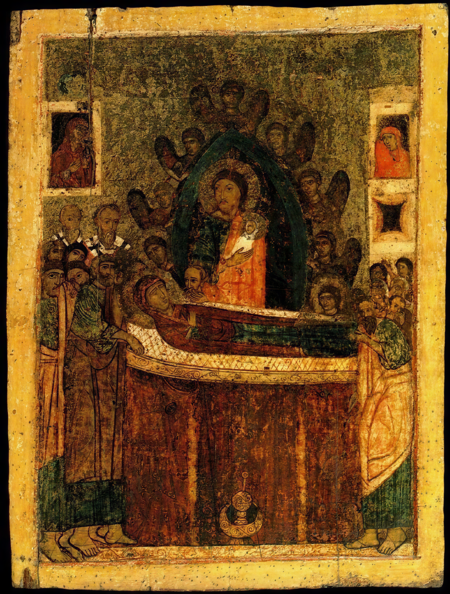
Left: «Assumption.» Pskov School, 13th century. State Tretyakov Gallery, inv. 28764.
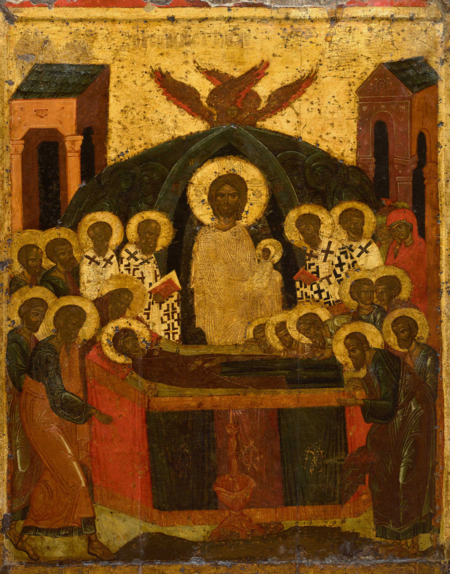
Right: «Assumption of the Mother of God.» Novgorod, late 14th century (1390s). From the Assumption Church in the village of Kuritsko. Novgorod Museum-Reserve, inv. 11163.
In the 13th-century «Dormition» at Pskov, the figure of Christ is highlighted by a pointed halo, while the apostles and saints form dense groups flanking the Virgin’s couch. In the Novgorod icon from the village of Kuritsko, late 14th century, the composition is more balanced: Christ also occupies a central position, but the surrounding figures are organized differently—around the couch and along its sides.Despite differences in character grouping and the rendering of the halo, both works maintain the central focus on the scene of the soul’s acceptance.
The composition changes—the meeting point remains.
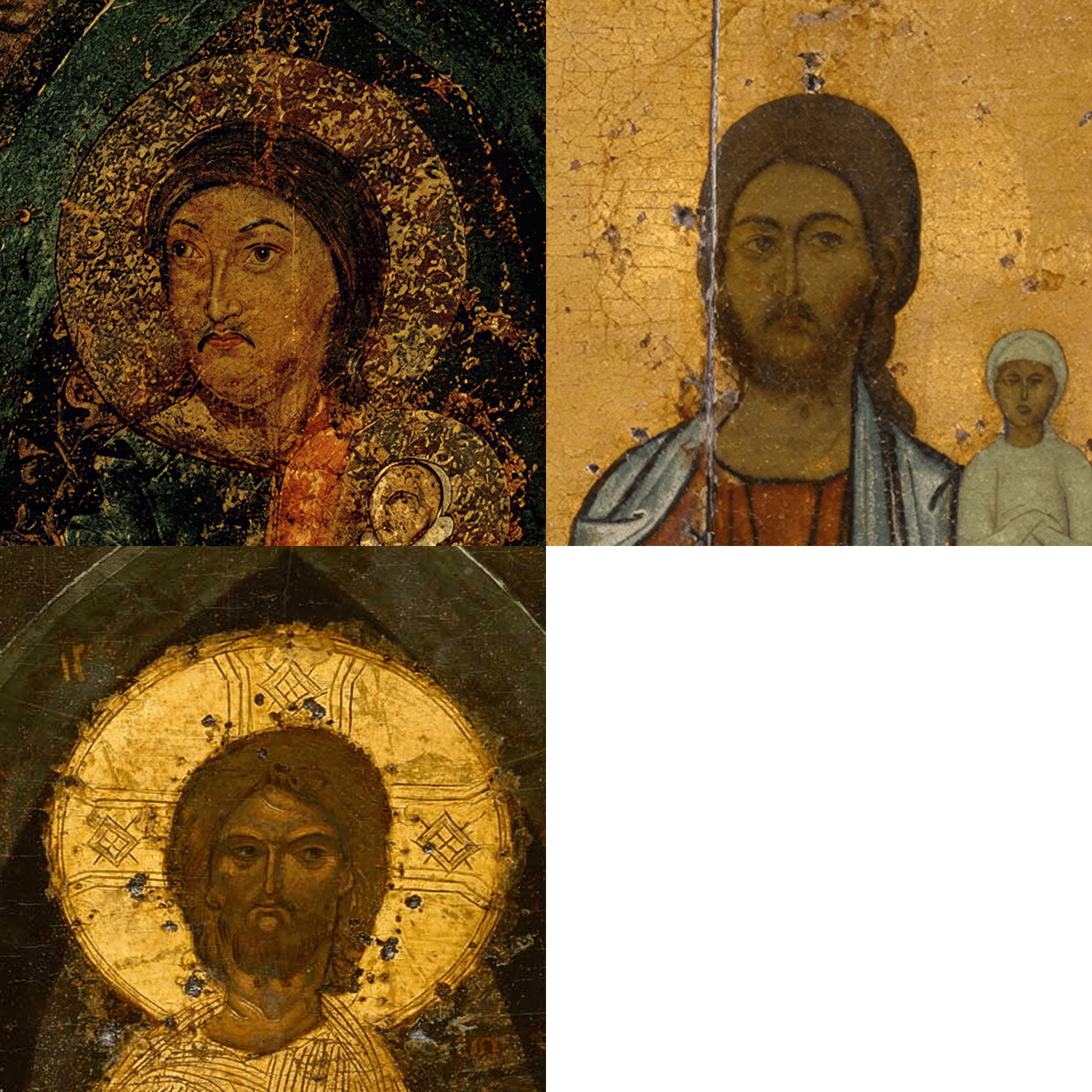
Comparing these monuments with the previously discussed Novgorod «Clouded Dormition» from the early 13th century shows that the apostles' movement may become an independent episode or be absent. In all three works, however, the central compositional focus remains Christ receiving the soul of the Theotokos.
(4) Comparison of Compositional Principles