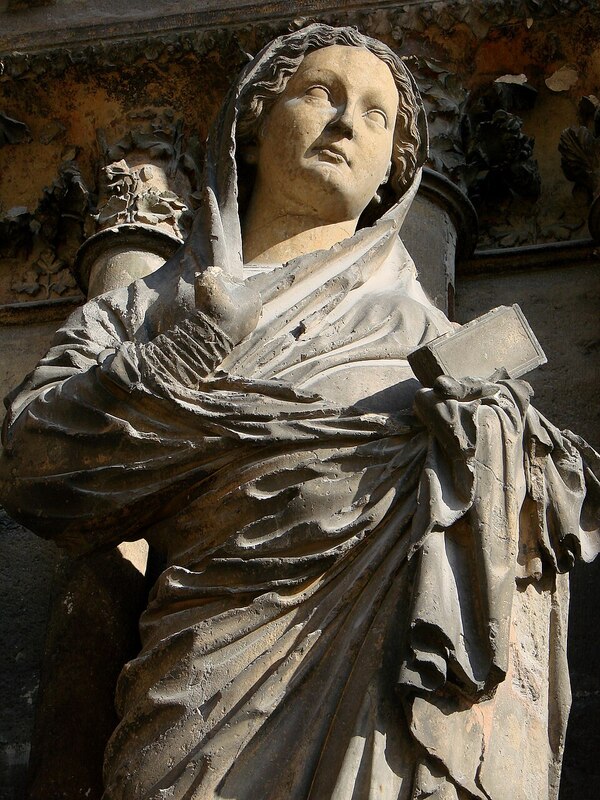
Concept
In Gothic sculpture, drapery often has a more commanding presence than the body itself. It can completely subordinate the figure to the portal’s verticality, or conversely, begin to express volume, weight, and curve. This is especially noticeable in female statues. Sometimes, beneath long, parallel folds, the body almost disappears entirely. At other times, the fabric softly clings to the hips and waist, allowing the form to emerge. In later examples, the drapery actively sculpts volume.
I found it fascinating to trace precisely this process—how the depiction of the female body under clothing evolves in French sculpture from the 13th to the early 15th century. Not through nudity or iconography, but through the way the sculptor interacts with drapery.
Key research question: How does the treatment of drapery interact with the volume of the female body in 13th–early 15th-century French Gothic sculpture—shifting from an almost complete subordination of the figure to the vertical axis toward an active articulation and plastic definition of the form?
Hypothesis: In French Gothic sculpture from the 13th to early 15th centuries, the drapery of female figures evolves from a means that almost entirely subordinates the body to the verticality of the portal to an instrument that actively models and reveals its volume, weight, and curve.
Material Selection Principle. For the visual study, I selected stone and wooden sculptures from the portals and tombstones of French cathedrals and museums. The main selection criterion was the presence of expressive drapery, which allows for a clear tracing of evolution—from the planar graphic quality of early Gothic to the sculptural volume of the later period.
The principle of chunking. The visual narrative of the longform article is structured chronologically. This allows for a clear, step-by-step demonstration of the «shift» posited in the hypothesis—from the complete subservience to architecture in the 13th century, through the emergence of the first curves in the 14th century, to the triumph of volume at the beginning of the 15th century.
Principle for Selecting Textual Sources. For the textual database, I searched for current articles and monographs on medieval sculpture. I needed texts where art historians analyze form and volume, rather than just subject matter. This helped me view the drapery from a different angle and understand which terms and approaches are currently used to describe Gothic plasticity.
Navigation
1. Concept
2. The Body under the Vertical
3. Initial Curves
4. Form Complication
5. Conclusion
6. Bibliography and Image Sources
Body under the vertical
When looking at a 13th-century sculpture, it seems as if there is no body beneath the drapery at all. The fabric falls downward in strict parallel lines, and the figure is perceived as an extension of the stone column. It was important to begin my research at this specific point to understand the masters' starting assumptions. In this chapter, we will examine how the drapery «concealed» volume and why architecture was more important than anatomy at that time.
Chartres Cathedral, west facade. c. 1145–1155.
At first glance, we see just a facade. But look closely at the portal: the statues do not stand before the columns; they are literally an extension of them. The 13th-century sculptor thinks architecturally. The figure does not have its own plastic will—it is integrated into the overall vertical rhythm of the cathedral.
Chartres Cathedral, Royal Portal. c. 1145–1155
This becomes clear here. Look at the female figure on the left: the drapery creates a dense «curtain» of straight, falling lines. The folds do not cling to the body; instead, they conceal it. We feel neither the weight of the hips nor the roundness of the abdomen beneath the fabric. The body is completely subjugated to the geometry of the stone.
Unknown artist. Statues from the portal of Chartres Cathedral (fragments). Drawing/engraving. France, 19th century. Bibliothèque nationale de France (BnF), Paris.
The antique engraving reveals this graphic quality. The artist renders the folds as crisp parallel lines, emphasizing that at this stage, the clothing is not «soft material» but a rigid, almost ornamental structure. It is from this point of «hidden volume» that we will track future changes.
Unknown artist. Statues from the cathedral portal of Chartres. 19th century. BnF, Paris.
I added this engraving because it perfectly illustrates something that is difficult to convey when looking at a photograph. Here, the figures appear maximally restrained. The artist deliberately emphasizes rhythm: the folds of the garments drop strictly downward, reminiscent of column fluting. The body beneath them is barely discernible—there is no waist, no curve to the hip. This serves as a strong visual example of how sculpture in the 13th century was not yet striving for autonomy. The drapery here functions not to convey bodily volume, but to articulate architecture.
Unknown sculptor. Queen (Queen Savska?). France, circa 1175–1200. Louvre, Paris.
This column statue from the Louvre is a perfect example of where Gothic architecture began. Look at the drapery: it is completely flat and graphic. The folds of the clothing fall strictly parallel to one another, reminiscent of the fluting on an ancient column. There is not the slightest hint of body volume here—the sculptor seems to be «cutting out» the figure from the stone column, subordinating it to the portal’s architecture. The fabric here is not soft material, but a rigid stone framework that conceals any plasticity. This is the very point of «hidden volume» from which we will begin measuring further changes.
Concluding the first chapter. Looking at these column statues, it becomes evident: in the 13th century, the sculptor primarily thought like an architect. The body, for them, was not an independent volume but merely a framework hidden behind the graphic rhythm of the drapery folds. The drapery here functions as a stone «curtain»: it does not clothe the figure but dissolves it into the portal’s verticals. This is the starting point of our research—the era of the «concealed volume.» However, this static harmony was not the final state. We will next see how the masters begin to seek new ways to work with stone, and how the fabric gradually ceases to conceal the body, beginning instead to express its plasticity.
Initial curves
In the 14th century, the situation begins to change. Sculpture remains tied to architecture, but an imperceptible shift occurs within this vertical framework. Masters cease to view the body merely as a «framework» for clothing. The fabric becomes softer, the lines smoother. That distinct, gentle S-curve emerges, lending the figure movement and life. Beneath the weight of stone or wood, the plasticity of the female body begins to reveal itself. This is not yet the full triumph of volume, but the first attempts to express it.
Unknown sculptor. Mother and Child. France, c. 1300–1325. Louvre, Paris.
This wooden Madonna is a fine example of how, in the 14th century, sculptors began to «experiment» with volume. The drapery here no longer falls in flat, parallel lines like in Chartres. Instead, it gathers into deep folds at the knees and forms a «cascade» down the back. However, wood is a capricious material—it is difficult to achieve very fine, flowing drapery with it. Consequently, the folds are dense, almost graphic. The body beneath is already discernible, but the fabric remains quite heavy and monumental.
Unknown sculptor. Madonna and Child. France, c. 1325–1350. Louvre, Paris.
Here is how the same task is solved in stone. A sculptor from Burgundy works with limestone, which grants him greater freedom. The folds of the cloak become deeper and more fluid. Look at how the fabric softly wraps the figure around the abdomen and knees—it is no longer merely «hanging»; it is shaping itself. The drapery here ceases to be a stone curtain; it becomes a sculptural mass that accentuates the curves.
Unknown Sculptor. Unknown Lady (Tomb Sculpture). France, Île-de-France, c. 1350–1400. Stone, alabaster. Louvre, Paris (Inv. LP 434).