Concept
Often, the frescoes of Akrotiri on the island of Thera pique the interest of researchers and historians for in-depth study of Minoan society. This research, however, takes a different approach—it analyzes frescoes where nature or the animal kingdom forms the compositional center, rather than human figures or evidence of human life. The key question of the study is how the human figure is replaced as the compositional focus in the Akrotiri paintings when it is not depicted, and how color and dynamism render nature an autonomous subject. For an artist working with the image of the environment and its inhabitants, these paintings serve as an early case study in depicting the living world without the conventional hierarchy of «human in the foreground, nature in the background.» The theme also allows for an examination of how color functions not merely as a copy of nature, but as a system of signs. Furthermore, Akrotiri provides a rare opportunity: the frescoes survived directly on the walls of rooms, allowing us to consider not a single artwork, but an entire space in which the viewer stands amidst the depicted scene.
Hypothesis
The hypothesis of the visual study is as follows: «The composition’s center shifts from figure to environment, color functions as a visual code, and the dynamism in illustrations is built upon gesture and body posture, plant growth, and the continuity of line.» This suggests that a painted room immerses the viewer in the narrative, making them the sole person in the scene. This answer is tested using three murals across three contrasting examples. If the hypothesis is correct, the rooms without people must contain a substitute for a center—for example, repetition, spatial coverage, or a line. If it is incorrect, a hidden figure will be present in the frescoes toward which all lines of sight converge.
What does «Nature Without Humans» mean in the context of visual research?
The core premise of this visual study is not that humans were absent from the Akrotiri frescoes. The objective of the research is to identify patterns in examples of frescoes where the human figure is not the central focus. For instance, in Room B1, boxers occupy one wall, while the other three are dedicated to depictions of antelopes. The work questions how the fresco replaces the human figure as the focal point to which the gaze converges.
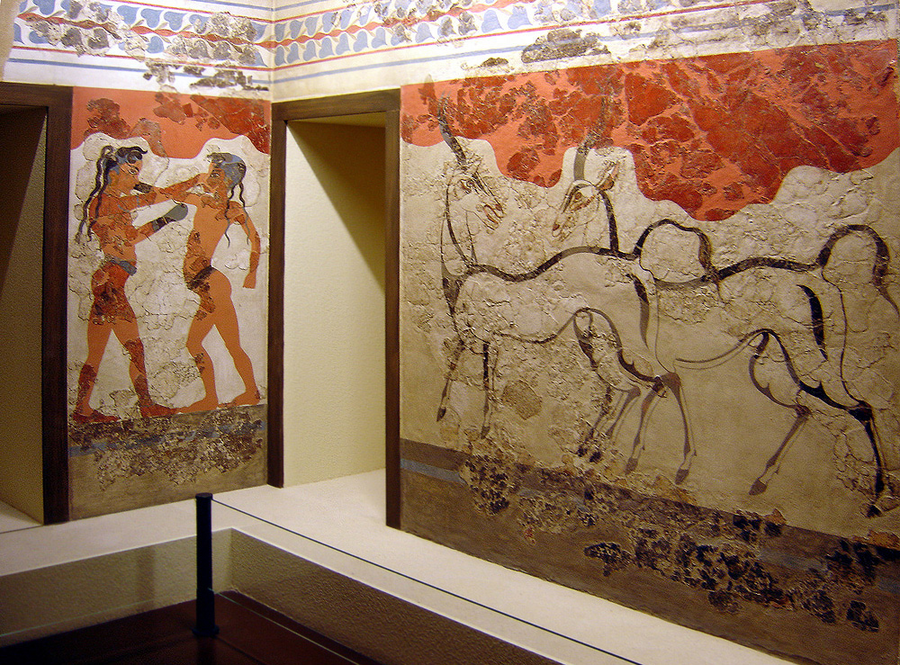
Unknown master. «Boxers, ” „Antelopes.“ Fresco from Room V1, Acroterion VII BCE. National Archaeological Museum, Athens.
Color doesn’t copy—it creates code.
On the frescoes of Akrotiri, color follows convention rather than nature. A dark gray is rendered as blue, a light green as yellow, and a dark green as dark blue. This code is unique for depicting the living world. Consequently, the viewer reads the color as a material designation, and nature appears conventional, yet recognizable.
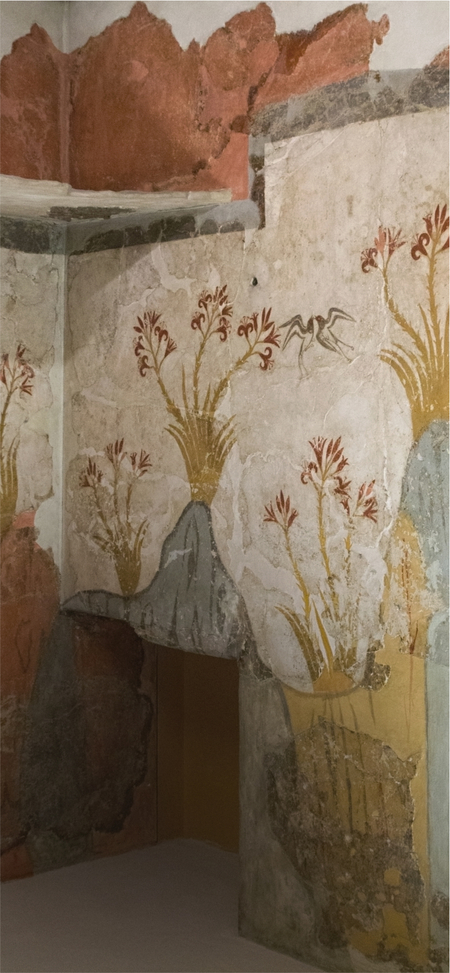
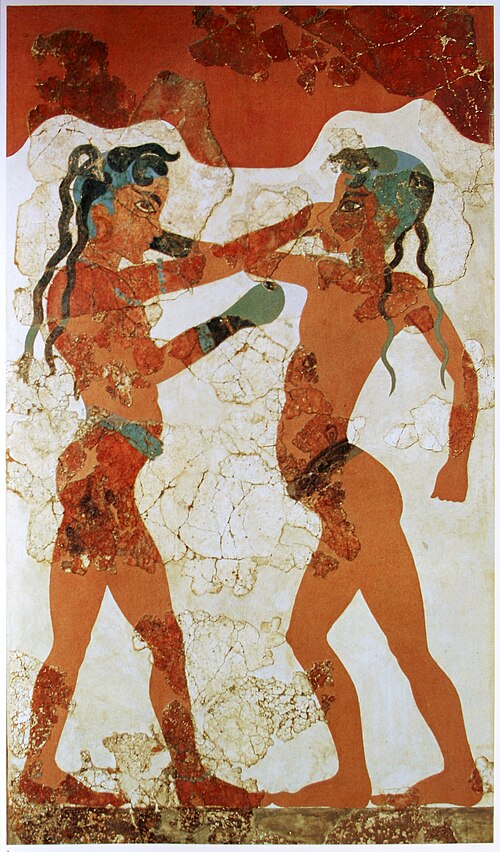
Unknown master. «Spring» («Lilies»). Fresco from Room Delta 2, Akrotiri, Thera. Dating varies: from the 17th century BCE to approximately 1550–1500 BCE. National Archaeological Museum, Athens. Unknown master. «Boxers» (detail). Fresco from Room B1, Akrotiri. 17th century BCE. National Archaeological Museum, Athens.
Blue was used to depict the dark gray color of birds, hides, fish scales, and the shaven heads of young men [6]. On the boxers, the shaved areas on the heads were colored blue [7]. The same technique applies to humans, animals, and fish.
Dark blue represented the dark green of ivy, papyrus, lilies, reeds, and palms [6]. Papyrus in the Women’s House is a special case: the plant, which did not grow in the Nile Valley, is depicted according to Egyptian iconography [2]. The color code is applied here to a borrowed image.
Yellow conveyed the golden fur of lions and the skin of young men, and it also replaced light green for plants, such as myrtle [6]. In «Spring,» the red lilies stand on yellow stems [7]. The stem is not green, and this is sufficient—the viewer recognizes the plant by its form.
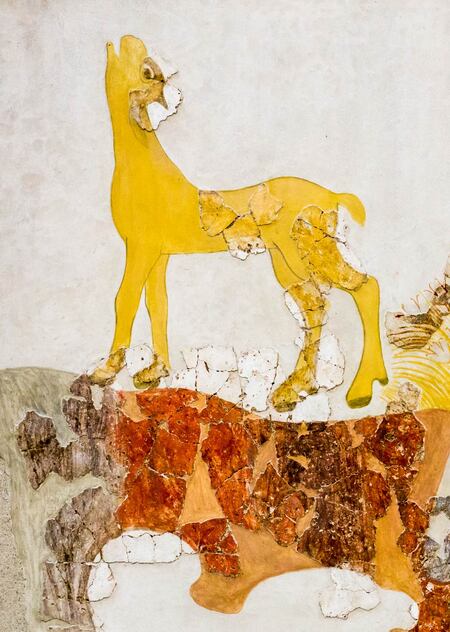
Unknown master. Fragment of an early fresco. Acrotiri, Thera. 17th century BCE.
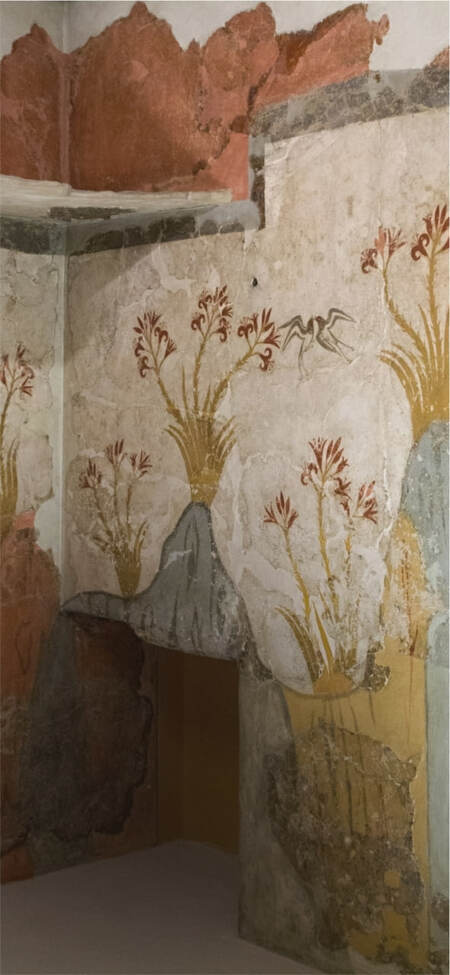
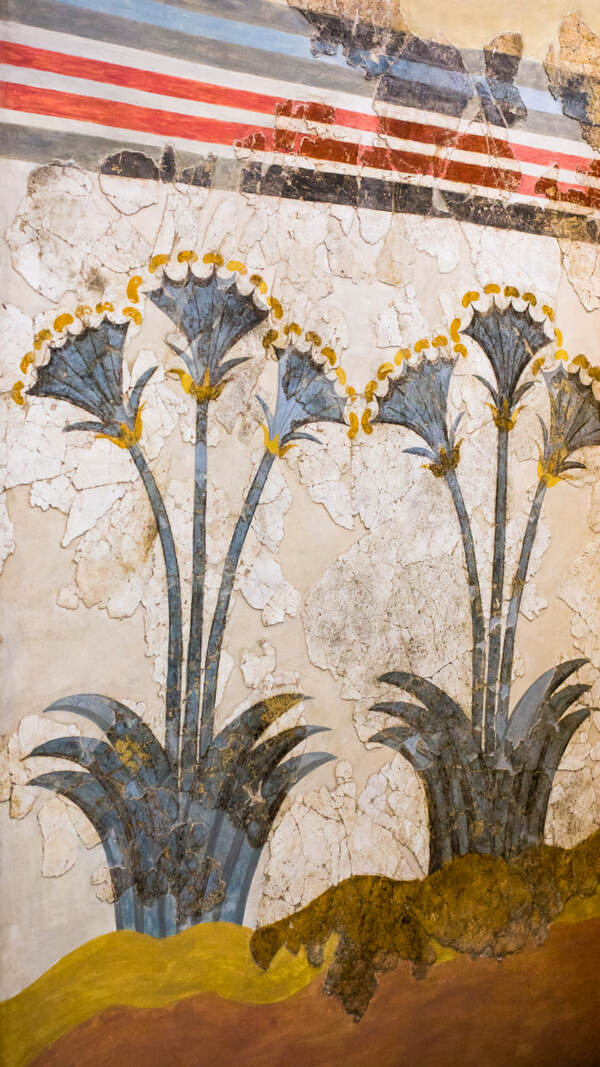
Unknown master. «Spring» («Lilies»). Fresco from Room Delta 2, Akrotiri, Thera. Dating varies: from the 17th century BCE to approximately 1550–1500 BCE. National Archaeological Museum, Athens. Unknown master. Papyrus fresco. House of the Ladies, Akrotiri. 17th century BCE. Museum of Prehistoric Thera.
Unknown master. «Spring» («Lilies»). Fresco from Room Delta 2, Akrotiri, Thera. Dating varies: from the 17th century BCE to approximately 1550–1500 BCE. National Archaeological Museum, Athens.
Unknown Master. Fresco with Papyrus. House of the Ladies, Akrotiri. 17th century BCE. Museum of Ancient Phere.
White as negative space
In «Antelope,» black outlines rest against a white background [7]. This background does not depict land or sky. Instead, it grants the animal space on the fresco and elevates the line to the primary expressive element. For comparison: in «Spring,» a colored rock replaces the white field, giving the space a sense of density.
Unknown master. «Antelopes.» Fresco from Room V1, Acroterion VII BCE. National Archaeological Museum, Athens.
Body Color: Differences in Human and Animal Pigmentation
In frescoes, skin color carries social meaning: tanned male bodies, for example, on the previously mentioned «Boxers» fresco, are contrasted with the pale skin of the saffron gatherers [7]. Animals and plants do not have such a contrast. This is another difference between scenes with people and scenes without people: there, color describes a human being; here, it describes living material.
Unknown master. «Saffron Gatherers.» Fresco from Xeste 3, Akrotiri. 17th century BCE. Museum of Prehistoric Phira.
Blue monkey color as abstraction
The fur of vervets and baboons in nature is grayish-olive, but on the frescoes, the monkeys are consistently blue. One possible explanation for choosing this shade is the theory that such a tone is a color abstraction. Thus, grayish-green is rendered as blue [1]. Blue also appears in Minoan art on metal surfaces and on fish scales [1].
A second explanation for the blue relates to the Egyptian context. Thus, the Egyptians used blue in divine contexts, and peacocks were already revered in Egypt. The Minoans may have borrowed the blue for monkeys as the color of exotic animals [1]. The two explanations do not exclude each other: blue could simultaneously be an abstract designation for gray and a reference to another culture.
Unknown master. «Blue Monkeys.» Fresco from Room B6 of the Beta Complex, Akrotiri, Thera. 17th century BCE. Museum of Prehistoric Thera, Fira.
Room B6 and monkeys on the rocks
The fresco was discovered in Room B6 of the «Beta» complex and is preserved in fragments [2][8]. It dates to the 17th century BCE and is housed in the Museum of Prehistoric Phere [8].
Unknown master. «Blue Monkeys.» Fresco from room B6 of the Beta complex, Akrotiri, Thera. 17th century BCE. Museum of Prehistoric Thera, Fira.
The rocks in the fresco, in shape and color, resemble the landscape of Tera Island [8]. This is an important clarification, as the exotic beast is now situated in a recognizable location. The painting unites the strange, foreign creature and its home island within a single image.
Most monkeys are depicted in profile, while one is shown frontally—a rarity for Aegean wall paintings [8]. This frontal figure breaks the rhythm of the profiles. It is the only figure whose face is visible to the viewer, yet there is no human on the fresco for it to address.