Categories
— Concept — Animated Poetry in the Film «My Green Crocodile» — The Image of the Creator in «The Legend of Grigory» — Painting in «The Master from Clamsy» — Conclusion
Concept
This study is dedicated to the creative work of the distinguished Soviet director and animator Vadim Vladimirovich Kurchevsky.
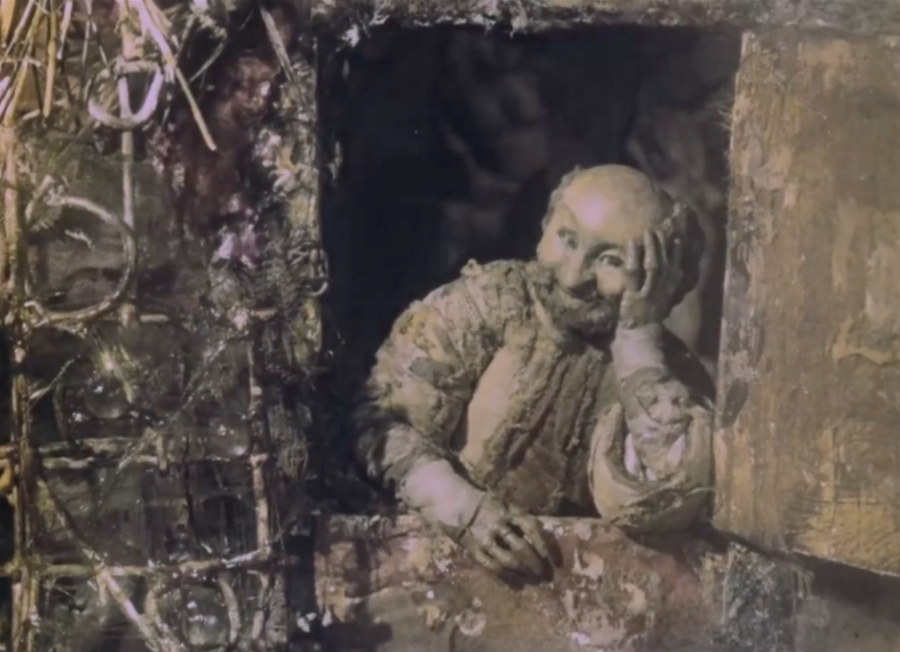
«Master from Klamsi, ” Vadim Kurchevsky, 1972
The development of domestic puppet animation as a cinematic genre began in the early 20th century. Among the pioneers are Alexander Shiryaev, a choreographer who aimed to perfect dance composition with puppets [6], and Vladislav Starevich, a director best known for his insect animation works. Several puppet films were released at Mosfilm studio in the 1930s, but production soon paused due to the war. This genre truly flourished at Soyuzmultfilm studio, which opened a puppet film workshop in 1953 [4]. In the 1960s, many creators of puppet animation emerged: Roman Kachanov, Vladimir Degtyaryov, and Nikolai Serebryakov.However, in this study, I wanted to focus on the figure of Vadim Kurchevsky. His work is distinguished by a unique visual aesthetic, a painterly quality, and expressiveness that he brings to the language of puppet animation, along with his own poetry and philosophy.Vadim Kurchevsky studied at the Moscow Institute of Decorative and Applied Arts under Alexander Deinyek. [3] His artistic education profoundly influenced his approach to animation—his films are like living canvases, which is particularly notable within the puppet genre, a medium distant from fine art.His experiments with form, color, and content represent a major contribution to the genre and creative inspiration for subsequent generations of animators.
The objective of this study is to examine the visual language of Vadim Kurchevsky’s puppet animation, to analyze his philosophy, and to determine the painterly and poetic traditions he embodies in his work.
To explore this topic, I would like to look at several animated films by Kurchevsky, analyze his ideological and visual inspirations, and discover what he took from various masters of the past.
The following animated films were selected for analysis: «My Green Crocodile,» «The Legend of Grigue,» and «Clamsy’s Master.»
The categorization is structured according to the distinctive stylistic elements of Kurchevsky, illustrated through selected animated works. When selecting material, the following principle was employed: the author’s puppet films were chosen for analysis, allowing for an examination of various aspects of his cinematic language. Visual inspirations drawn from various painters who influenced the director’s style have been highlighted. In selecting textual sources, attention was paid to their reliability, relevance, and the trustworthiness of the information presented; only vetted articles and books were used throughout the project.
Animated Poetry in the Film «My Green Crocodile»
«My Green Crocodile» is filled with visual metaphors and inspiration drawn from various works of art.
«My Green Crocodile, ” Vadim Kurchevsky, 1966
«I am deeply convinced that animated film in cinema is like poetry in great literature. We share a common building material with poets—laconicism, precision of concept, hyperbole, metaphor, and rhythm. Metaphor can become the source of dramaturgical construction; at the very least, one must consider the possibility of realizing poetic metaphor through the means of animation—‘sparks from the eyes, ’ ‘a sea of tears, ’ and so on.» [1] — Kurchevsky on his approach to creating films.
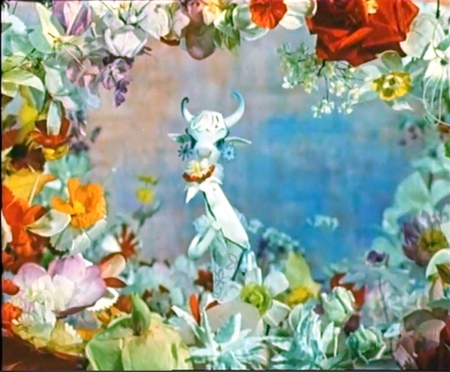
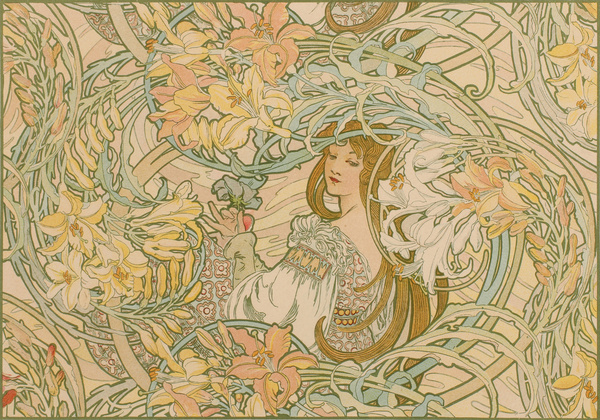
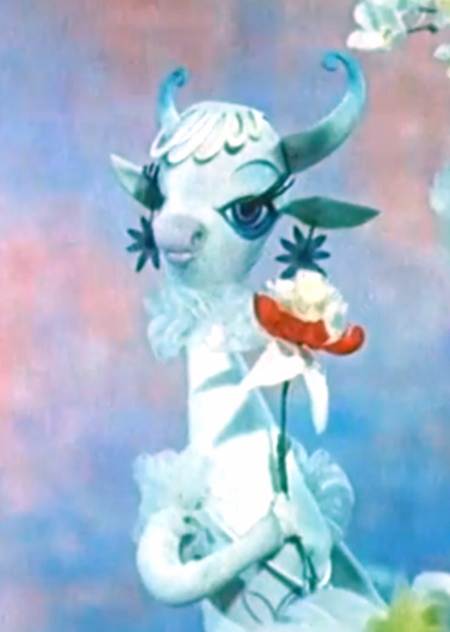
«My Green Crocodile, ” Vadim Kurchevsky, 1966 // „Language of Colors,“ Alphonse Mucha, 1900
The image of the beautiful Cow in colors alludes to the delicate feminine figures of Alphonse Mucha.
In ten minutes of screen time, you need to immerse the viewer in a specific aesthetic world of the film, make them remember and love the characters. Most importantly, you must make the viewer believe in the story being told. To achieve this, you probably need to disrupt their usual way of thinking and perceiving—to find something unexpected, something extraordinary. For instance, in one of my first films, «My Green Crocodile, ” the crocodile fell in love with a beautiful cow. This is complete illogic unless the characters possess precise grotesque traits and the crocodile’s sacrificial love is rooted in the great classical drama of unrequited affections.”[1]
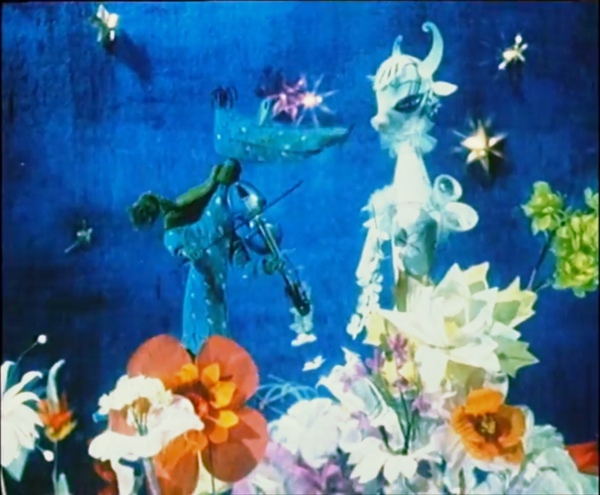
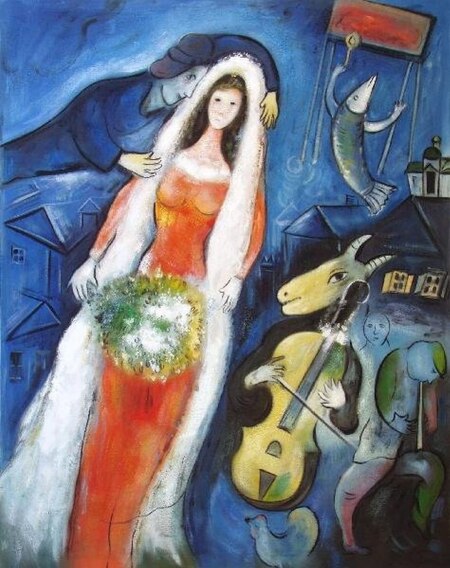
«My Green Crocodile,» Vadim Kurchevsky, 1966 // «The Bride,» Marc Chagall, 1950
The romantic flight of the film’s lovers evokes the symbolism of Marc Chagall.
«My Green Crocodile, ” Vadim Kurchevsky, 1966
«Adam and Eve», Lucas Cranach the Elder, 1526
When Crocodile reads poems to Cow under the tree, the frame compositionally resembles Adam and Eve by the Tree of Knowledge—the characters in the film seem surrounded by a beautiful paradise garden.
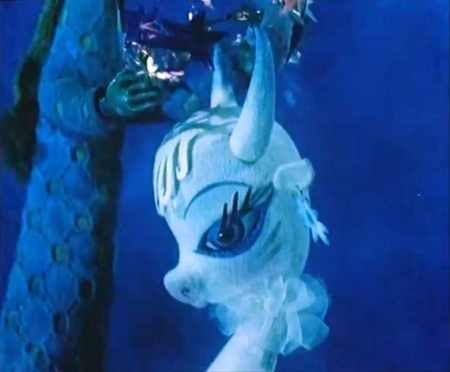
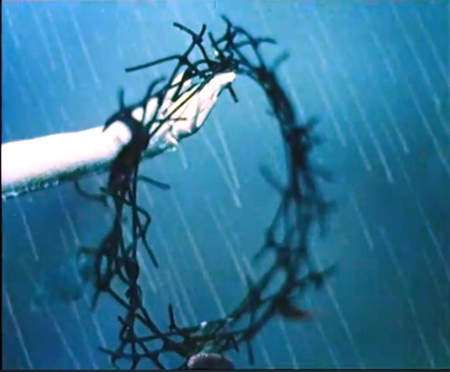
«My Green Crocodile, ” Vadim Kurchevsky, 1966
Continuing the religious motif—the wreath from which all flowers have fallen, and which the Cow offers the Crocodile—it has taken on the appearance of a crown of thorns, foreshadowing his torment and sacrifice.
«My Green Crocodile, ” Vadim Kurchevsky, 1966
The film features a distinct color drama, transitioning from the bright, joyful colors of spring to the dusky, somber tones of autumn.
The Creator’s Image in «The Legend of Grig»
S. Asenin, while examining the work of V. Kurchevsky, wrote that the latter «leans toward painterly qualities and musicality.» [2]
«The Legend of Grigue, ” Vadim Kurchevsky, 1967
The avant-garde influences of Kurchevsky are very clearly discernible in this film.