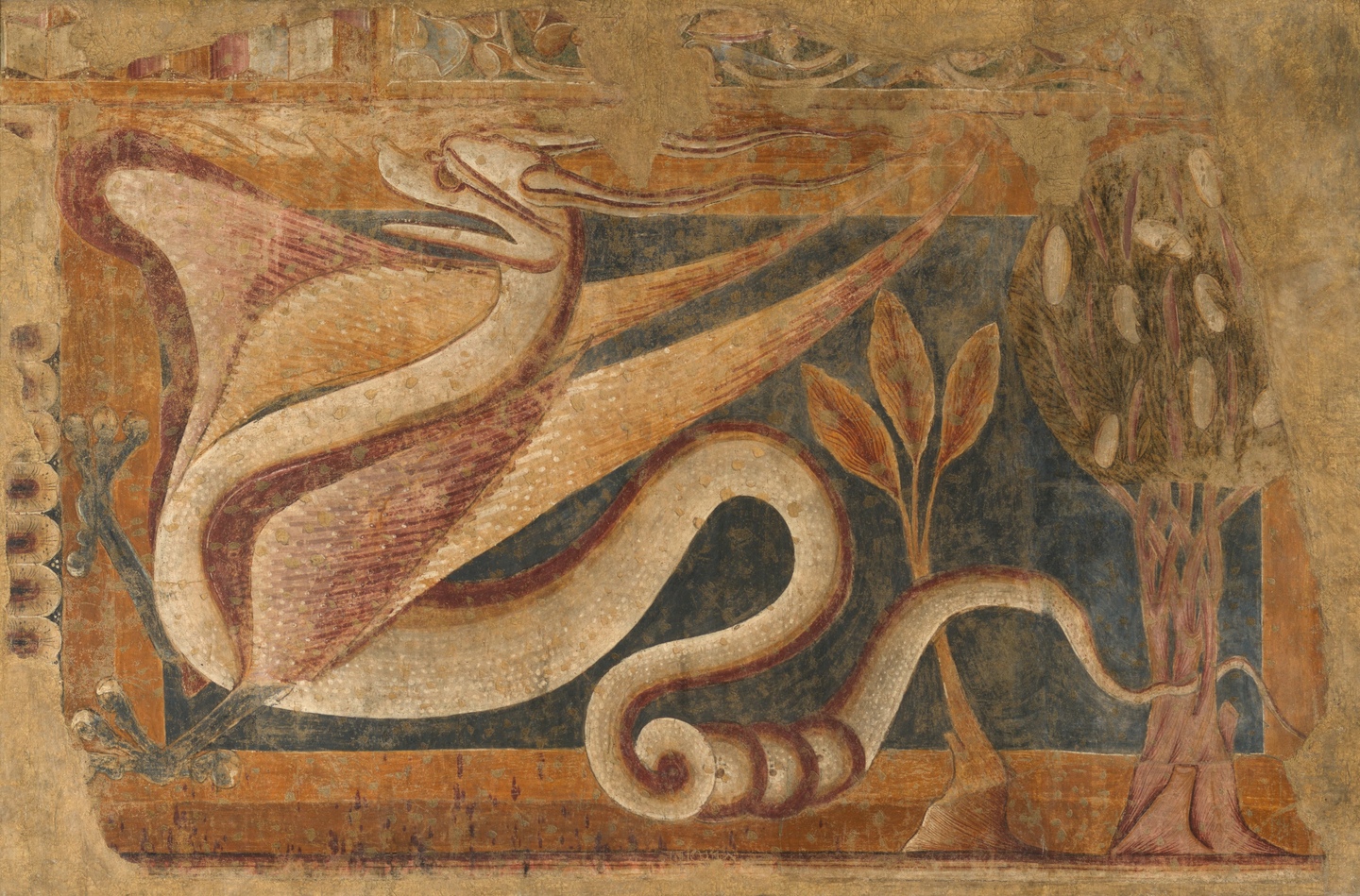
Змей: стабильность формы и значения знака
Образ змея в визуальной культуре пяти эпох
Concept
Why has the same serpent motif changed its meaning across millennia, yet barely changed its form? And what does this stability suggest about how humanity negotiates fear?
The same figure has been traced across five epochs: in Egypt, in antiquity, in early Christianity, in Romanesque, and in Gothic art. My research is divided into five chapters, each answering the core question of the study. Hypothesis: the snake’s form remains stable, but the symbolism changes. I propose that throughout history, humanity has not altered the image of its fear, but its status—fear has been crowned, exiled, judged, tamed, or enlisted in service, yet it has been consistently depicted by the same line: a spiral, a curve. This hypothesis can only be tested chronologically: from the earliest preserved depictions of the Uraeus to the Gothic miniatures of the 14th century.
My hypothesis has a scholarly foundation: Aby Warburg, the creator of the iconological method, introduced the concept of Nachleben—"afterlife"—suggesting that ancient forms do not die with the belief system that spawned them, but instead continue to live on within culture, changing their meaning and owners.
The lightning in the sky was imagined by Indigenous peoples as a giant snake, and many American nations revered the rattlesnake as a sacred and mighty being.
Warburg’s 1923 essay was dedicated precisely to the snake: the ritual of the Pueblo Indians, where a live rattlesnake served as an intermediary between humans and the elemental forces. Gombrich, Warburg’s biographer, described his atlas «Mnemosyne» as an attempt to compile a «vocabulary of the most ancient words of human passion.» The snake is one of the oldest words in this vocabulary. In my work, I examine how this word was pronounced across five European epochs.
Chapter 1.
Египет: урей на короне
XXIII–VIII CENTURIES BCE.
GOLD, FAIENCE, LIMESTONE
SYMBOL: THE GODDESS’S POWER AND PROTECTION
Egypt—the first place where the serpent figure attained statehood. Uraeus: the coiled cobra on the brow of a royal crown is an image of the goddess Wadjet, the «Mistress of Lower Egypt, ” poised to incinerate her foe with fire. Centuries later, the Greeks would name this symbol with the word ouraios—from oura, meaning „tail.“ Western science would label the sacred serpent by its most discordant part. The meaning a culture invests in the figure may be further removed from it than a tail is from a head. The Egyptian name for the goddess, however, meant „green, ” „flourishing“: the venomous cobra was named with a word used to describe vegetation and life. Both form and meaning are codified by canon: the curved body, the flared hood, the readiness to strike. It is also worth noting that the snake is depicted on the forehead of a person, situated between the king and the world. Fear is not observed here from the outside nor is it driven away—it is crowned.
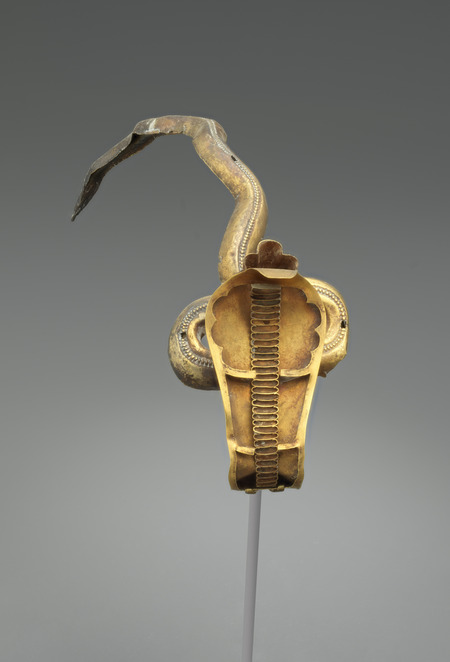
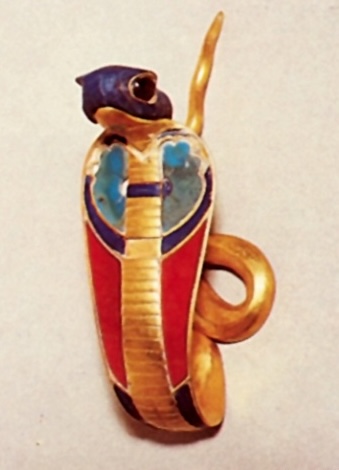
Left image: Uraeus. Egypt, c. 945–721 BCE. Gold and electrum; artist unknown. Metropolitan Museum of Art, New York. Right image: Uraeus of Senusret II, artist unknown, gold, precious and semi-precious stones. Egyptian Museum, Cairo.
The form appears here in its purest state: the body loop and the open gold hood.
The symbol represents the protection of Wadjet and the legitimacy of pharaonic power. The serpent is tamed by the crown; fear is elevated to the rank of the sacred and therefore serves the authority.
Cobra Head. Egypt, 1386–1347 BCE. Faience; artist unknown. Metropolitan Museum of Art, New York.
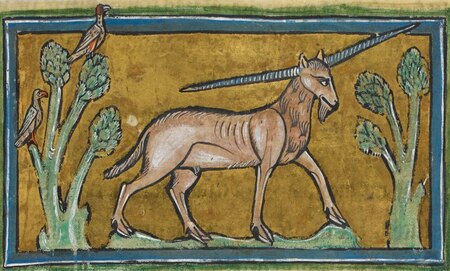
The fragment that I found particularly interesting: the open hood reads as a second crown. Half a millennium later, this silhouette reappears in medieval bestiaries—on the basilisk, the «king of snakes, ” who is depicted wearing a crown on his head.
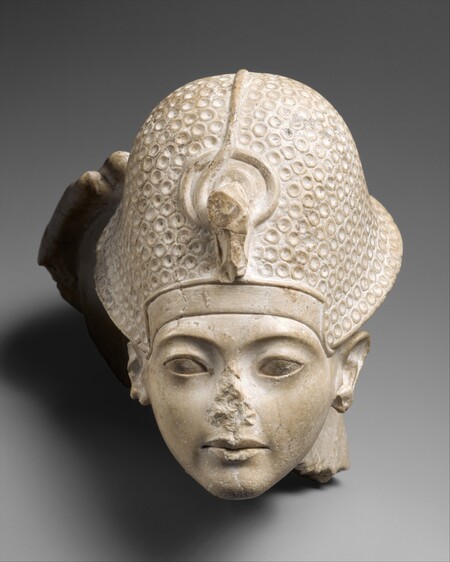
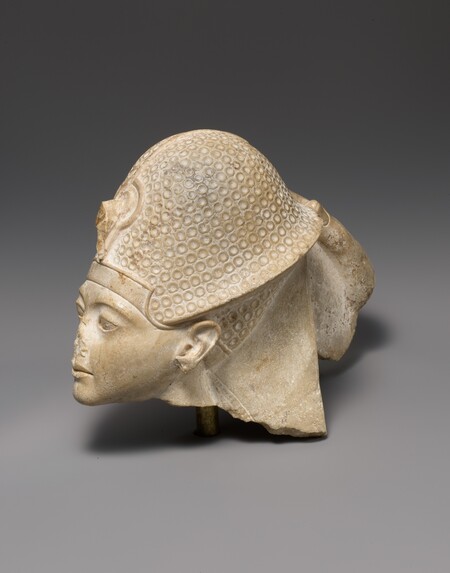
Tutankhamun’s head wearing a nemes headdress. Circa 1328–1318 BCE. Limestone; maker unknown. The Metropolitan Museum of Art, New York.
On the young king’s brow, above the weave of the nemes stripes, is the same uraeus: the serpent woven into the very being of the god-king. On Tutankhamun’s famous funerary mask (Egyptian Museum, Cairo), there are two of them: the cobra Wadjet and the vulture Nekhbet, the serpentine and avian symbols of Lower and Upper Egypt. The spiral here became the state emblem, instantly recognizable, much like a flag today. In Egypt, the serpent does not represent power—it is power itself.
The style of Ancient Egypt was formed based on a code of laws that every artist studied from an early age… the appearance of each deity was predetermined. Thus, Horus, the god of the sky, was depicted as a falcon or with a falcon’s head; Anubis, the god of the funerary cult, was depicted as a jackal or with a jackal’s head.
Chapter Summary
Egypt gave the serpent a state form: the coiling body and the hood were cast in gold and became a symbol of divine protection.
It was here that the main mechanism of the entire subsequent history was born—apotropaic: fear harnessed to serve against fear, dread guarding against dread.
Chapter 2.
Античность: граница миров
VII BC — II AD
TERRACOTTA, GOLD, MARBLE
THE DUAL SYMBOL: HEALING AND RUIN
Antiquity separates the snake into the «one’s own» and the «other’s.» On the staff of Asclepius, the snake signifies healing: sacred snakes in the Epidauros temple slithered among the sick, and their touch was considered a cure. The snake sheds its skin and thus conquers death—not by killing it, but by evolving beyond it. In the Laocoön marble, the same spiral constricts an innocent priest, and this execution is considered the justice of the Olympians.
Vase in the shape of a Ketos (sea monster). Greece (Crete) or Southern Italy, second half of the 7th century BCE. Terracotta; artist unknown. Metropolitan Museum of Art, New York.
The serpentine body of Ketos is a monstrous entity at the intersection of two elements—one that can be grasped as a mug, a boundary between worlds settled and set upon the table. The symbol: danger beyond the map. The form is the same spiral as Uraeus, only without the crown. The snake, stripped from a royal brow, is free once again, and therefore, terrifying once more.
Antefix with Medusa head. Western Greece, 6th century BCE. Terracotta; artist unknown. Metropolitan Museum of Art, New York.
The Gorgoneion is key to my entire thesis on ancient invention. Medusa’s hair is made of venomous snakes. Her gaze turns things to stone. And it is her—the most terrifying face of the Greek world—that is placed on the edge of roofs, on vessels, on shields: warding off evil with evil. The covenant with fear is established here, analogous to the pharaoh’s crown, and we will see it again on the cornice of Notre Dame: fear is crowned so that it may serve as a guardian. The snakes of the Gorgon are the uraeus, lowered from the king’s head to the edge of the temple roof.
Snake Ring. Roman Empire, 1st century CE. Gold; artist unknown. Metropolitan Museum of Art, New York.
The ouroboros—a serpent coiled into a circle and biting its own tail—is a symbol of eternity and healing: poison and medicine are contained within a single body. A contract with fear is reduced to a miniature, intimate gesture, worn on the hand like a talisman. Twelve centuries later, this gesture will be repeated by a knight wearing a basilisk medallion on his chest (see Chapter 5).
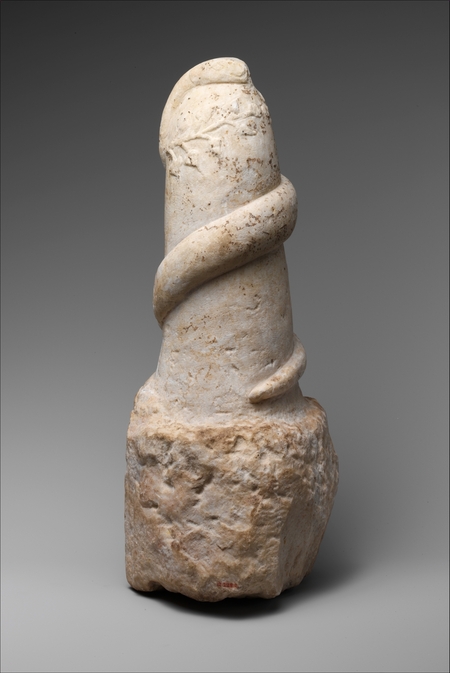
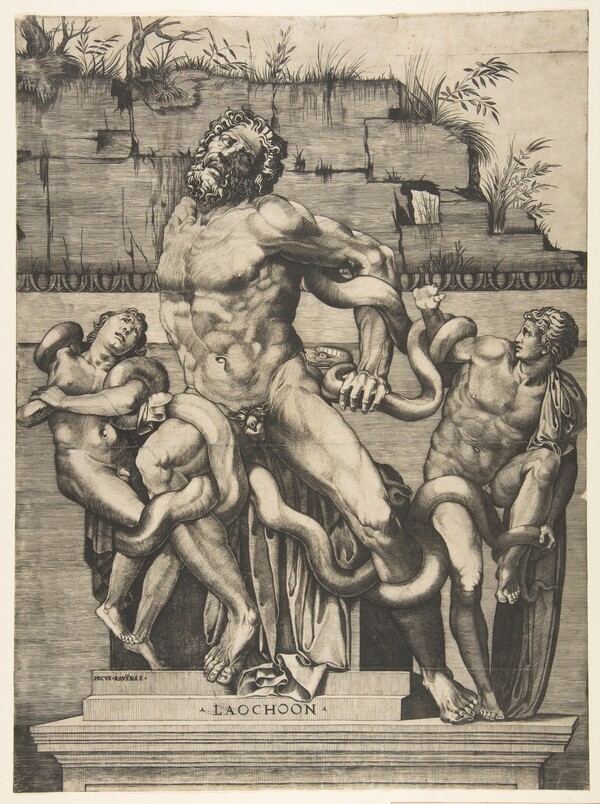
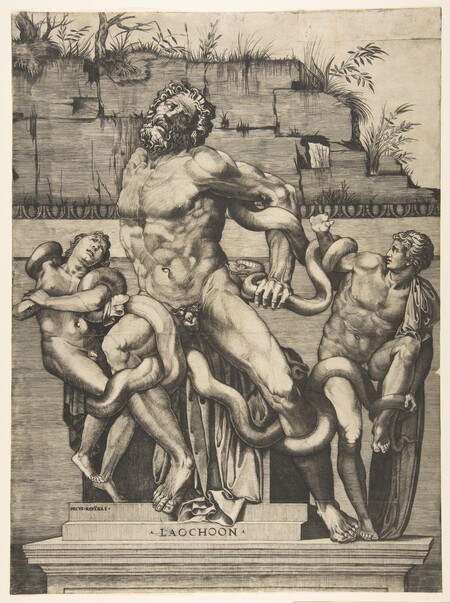
Left image: Marble column with a snake and a wreath. Roman Empire, 1st–2nd centuries CE. Marble; unknown artist. The Metropolitan Museum of Art, New York. Right image: Marco d’Antè. Laocoön and His Sons, Attacked by Snakes. c. 1515–1527. Engraving after the ancient group. The Metropolitan Museum of Art, New York.
A serpent coils around a short column adorned with a wreath. Such imagery is associated with the cult of patron heroes of a place and the world of healers—whose emblem, the Rod of Asclepius with a snake, has survived to this day on pharmacy signs. Sign: protection and healing. Form: a vertical spiral. It is worth noting this silhouette; in Chapter 4, it reappears as Moses' copper serpent raised on a staff, revealing that the healing serpent in the vertical form has awaited its strangest incarnation for twelve centuries.
In January 1506, a marble group was excavated at Esquiline, a piece known from Pliny: a priest and two of his sons encircled by sea serpents. The find was immediately recognized as the highest example of tragic sculpture and was swiftly reproduced. Marco d’Ante’s engraving, taken from the group in the early years, disseminated the Laocoön group throughout European workshops: the spiral form became a commonplace motif, a pedagogical model of suffering. The symbolism here is maximally ominous: the snakes execute the innocent at the whim of the gods, yet the depiction of their bodies is indistinguishable from the snakes that heal on the staff of Asclepius. Antiquity holds both meanings within the same line.