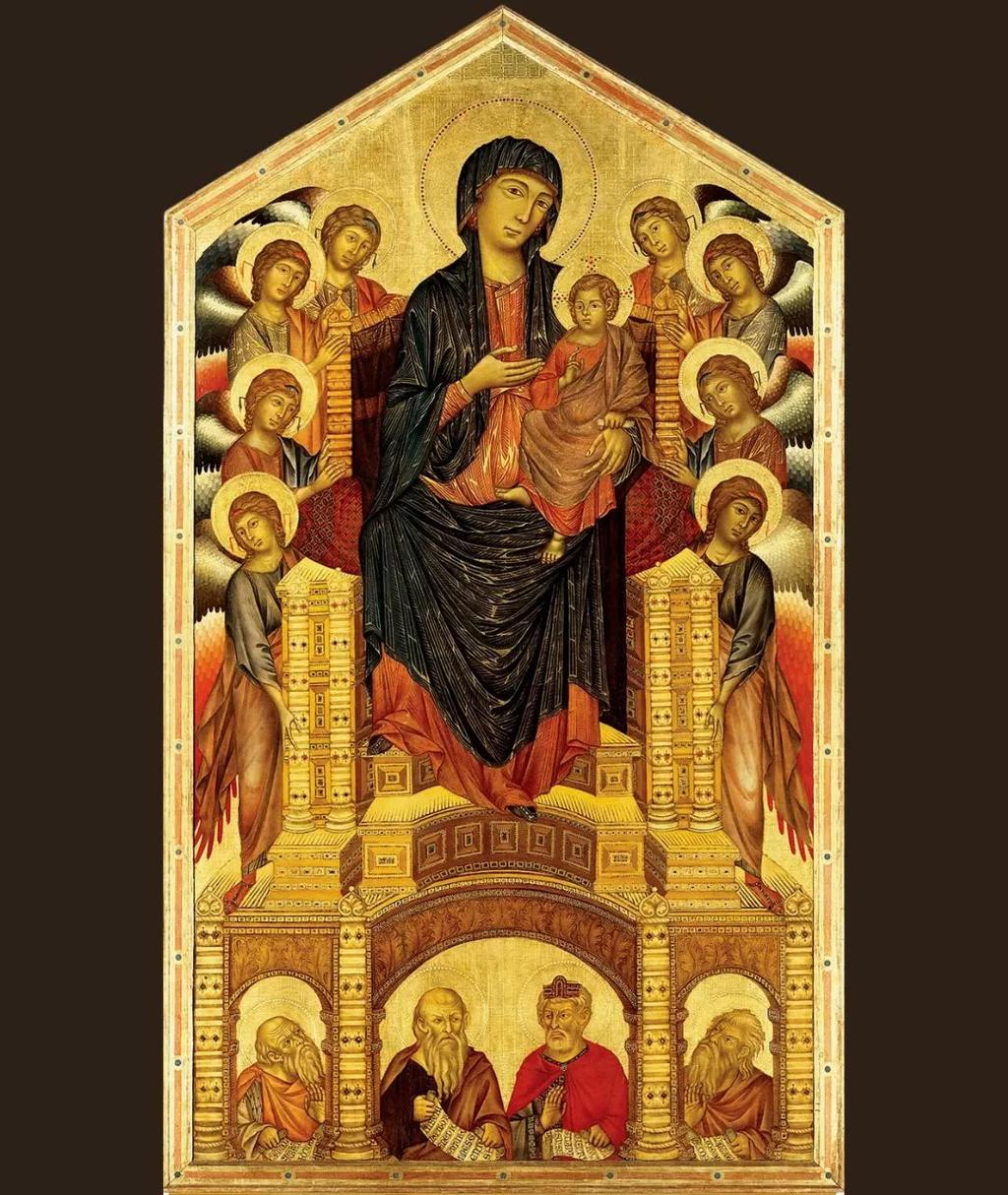
Periods of Study: 6th–14th Centuries Main Art Forms: Byzantine mosaic, medieval painting, Italian altarpiece painting. Primary Material: Works by Byzantine masters and Italian Proto-Renaissance artists.
Concept
I am researching the gilded background as an autonomous artistic element that shapes space in medieval and proto-Renaissance art. I am studying how the role of the gold background evolved and how artists used gold to construct the representation of space. The main goal is to demonstrate that the gold background was not merely a decorative element, but a vital tool for constructing the artistic image and organizing the space of the work as a whole.
The central research question is: How did the role of the gold background evolve in visual arts from the Byzantine artistic tradition through the Italian Proto-Renaissance, and how did artists create a sense of space using this gold ground? The main thesis is that the gold background gradually ceased to be merely a conventional setting for the image and became part of a more complex spatial system where traditional symbolism interacted with new artistic methods.
Gold as a space of the divine
Byzantine Art of the 6th–12th Centuries. In Byzantine art, the gold background becomes one of the primary means of creating a distinct space for religious imagery. It does not imitate the natural environment but rather contrasts the depicted world with everyday reality. Gold is perceived as a visual expression of light, solemnity, and divine presence.
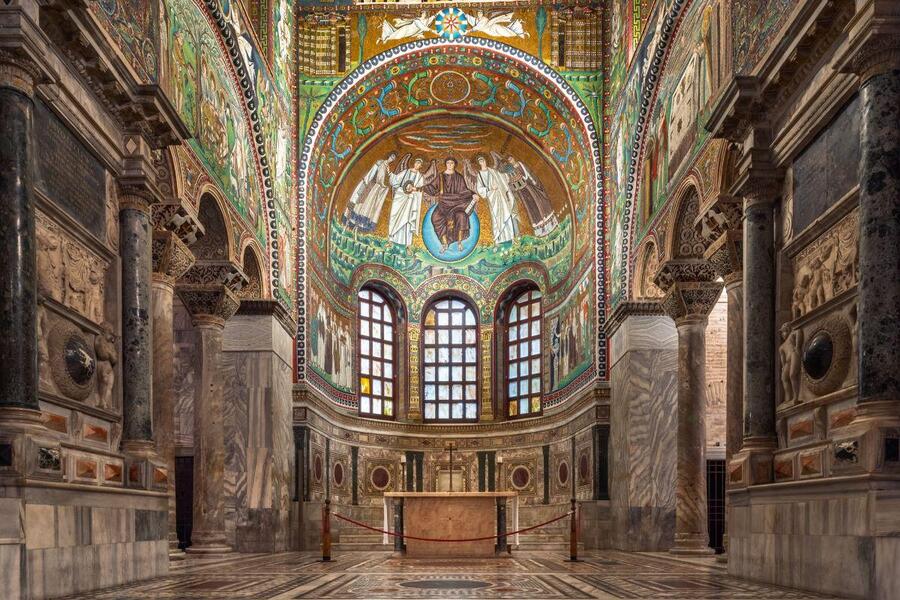
Interior of the Basilica di San Vitale, Ravenna, 6th Century
Mosaics as a Method for Creating Light Space
The mosaic allowed for the creation of a surface that shifted depending on the lighting. Golden smalti reflected light, creating the impression of a shimmering space. Because of this, the image was not perceived as an ordinary flat painting, but became an integral part of the temple’s architectural environment.
Golden interior mosaics of the Basilica di San Vitale.
Christ on a golden background
Artwork: «Christ, Saint Vitaly, and Bishop Ecclesius, ” mosaic in the apse of the Basilica di Sant’Ambrogio, circa 540–547.
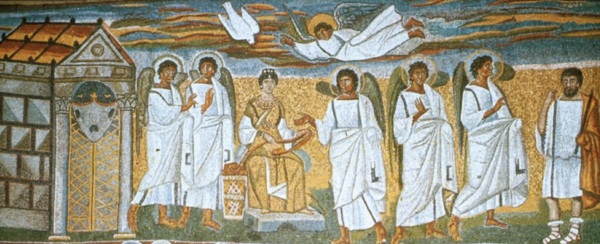
At the center of the composition, Christ bestows a martyr’s crown upon Saint Vitaly. The figures are set against a gold background that bears virtually no resemblance to a real landscape. This effect presents the characters as participants in a sacred event transcending ordinary earthly space.
Gold and Figure Hierarchy
Artwork: «Empress Theodora with her retinue, ” mosaic from the Basilica of San Vitale, circa 547.
Emperor Justinian is depicted in the center of the group, surrounded by members of the clergy and courtiers. The golden background unifies all the figures into a single composition, and the frontality of the figures and the absence of deep perspective amplify the sense of solemn stillness. The characters are predominantly shown frontally; their figures barely overlap one another in accordance with natural perspective. The golden background prevents any determination of the distance between them, making the symbolic significance of the figures, rather than their physical placement, the main focus.
Gold as a symbol of light
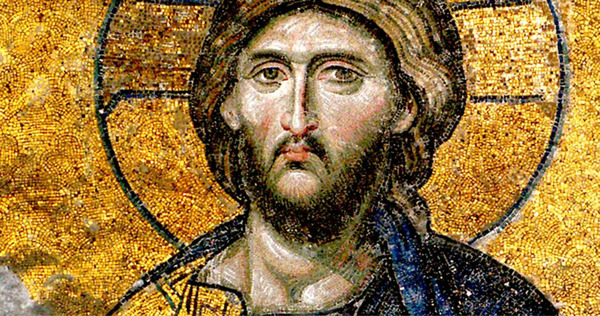
Artwork: «Christ Pantocrator,» Montreal Cathedral, 12th Century.
The golden halo around Christ is perceived as a unified field of light. It does not depict a conventional light source but rather evokes a sensation of radiance emanating from the sacred image itself.
Golden Ratio and Figure Placement
Work: «The Mother of God with Child,» Apse of Hagia Sophia, 867.
The Mother of God with Child is presented against a gold background that does not create a separate environment around the figures but visually sets them apart from the architectural space of the church. Due to the mosaic’s placement in the apse, the image is perceived as a depiction existing above the earthly realm and turned toward the worshippers. The gold background here interacts not only with the depicted figures but also with the architecture of the church itself.
Gold in Byzantine Icon Painting: Surface and Materiality
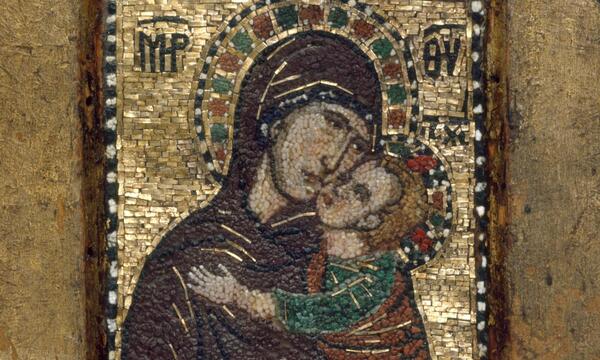
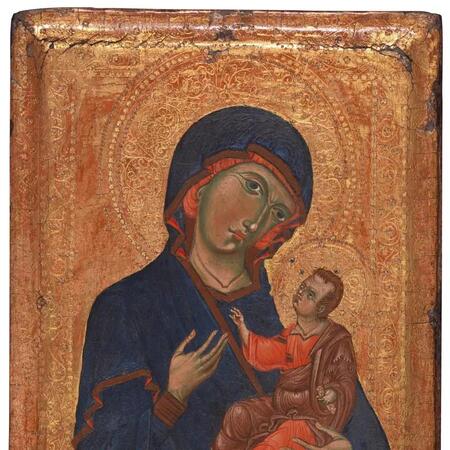
«Portable Icon of the Mother of God Eleousa,» early 14th century, Constantinople. «Theotokos Hodigitria,» Byzantine icon, 13th century.
In the icon on the left, the golden surface is composed of small elements of mosaic and precious materials. Because of this, the gold becomes not just a color, but a physically palpable texture that reflects light differently and emphasizes the material value of the image. In the icon painting on the right, the golden background transfers the principles of monumental mosaic into the format of a standalone painted panel. It surrounds the figures of the Mother of God and the infant, forming an independent space within the image that is not connected to a specific architectural or natural setting.
Comparison of Byzantine Works
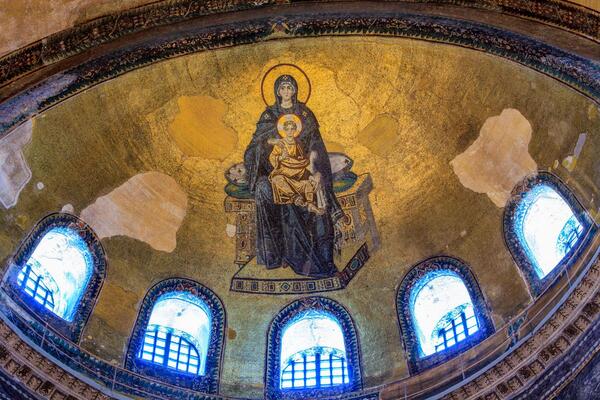
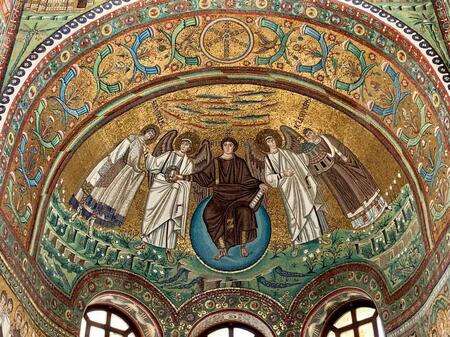
The Mother of God in Hagia Sophia, 9th century; Christ in the apse of San Vitale, 6th century.
In both works, the golden background establishes a conceptual environment that does not adhere to the laws of earthly perspective. However, in the San Vitale mosaic, it unites several figures into a ceremonial composition, while in the Hagia Sophia, it becomes the spatial setting for the central image of the Theotokos.
In Byzantine art, the gold background serves as the primary means of creating a timeless space. It eliminates the depiction of a conventional natural environment and emphasizes the special status of sacred figures. Furthermore, gold is closely connected to architecture, light, and the material of the mosaic. Space is formed not through perspectival depth, but through the symbolic significance of the image, its placement, and its scale.