Navigation
- Concept.
- Image as a technical signal.
- Error as a website component.
- Deconstruction of familiar space.
- Desktop and loss of control.
- Computer memory as an image material.
- Video between recognizability and decay.
- One portrait—various modes of disruption.
- Conclusion
Concept
The research topic is transforming a technical glitch into an artistic device. I am interested in how digital errors alter an image and why artists choose not to correct them—but rather to preserve, reproduce, or intentionally create them. At first glance, glitch might appear to be a random corruption of the image. However, when comparing works, it becomes apparent that different intentions may lie behind the external chaos: to reveal the structure of a file, disrupt the expected behavior of an interface, alter the perception of motion, or prompt the viewer to question the stability of the digital world.
The choice of theme is linked to how the digital screen is usually perceived as a reliable and understandable surface. From a website, we expect intuitive navigation; from a photograph, we expect recognizable imagery; and from video, we expect continuous motion. Glitch disrupts these expectations. Because of this, it allows us to view familiar technologies differently—not just as tools, but as systems with their own rules, limitations, and potential.
In my view, this topic is particularly significant for the history of net art, as the internet can be more than just a venue for displaying a work. The website itself, the browser, the software code, and user interactions can all become artistic material. Therefore, in my research, I am examining not only distorted images but also projects where a sense of glitch arises through interaction with the digital environment.
The central research question is: In what way does the disruption of the conventional appearance and behavior of a digital image become an independent artistic statement?
The research hypothesis is that the artistic value of glitch is not related to the quantity of distortions, but to the properties of the digital medium they allow us to perceive. A glitch can draw attention to the file structure, the rules of the interface, or the image’s dependence on software processing. Consequently, glitch not only disrupts the familiar image but also helps reveal the conditions of its existence.
One of the main selection criteria is that the works must allow for a comparison of different modes of intervention in the image: signal alteration, interface transformation, unconventional data interpretation, and video processing.
The research foundation is built upon Rosa Menkman’s book, «The Glitch Moment (um), ” materials from the Rhizome network art archive, authorial webpages, and museum descriptions of the works. These sources are essential for verifying the dates, creation methods, and exhibition circumstances of the pieces.
Image as a technical signal
Even before the advent of digital art, artists explored disrupting the function of electronic devices. As an example, I chose Lee Ufan’s «Magnet TV, ” created in 1965. The work consists of a television set with a magnet placed above it. Its influence alters the image on the screen, transforming it into an abstract form. This is not damage to a digital file, but an intervention in an analog electronic signal.
By Joon Park. «Magnet TV.» 1965.
I would like to highlight this work as a precursor to the artistic use of technical disruption. Pike shows that the device can be used not only according to its intended function—intervening in its operation becomes a means of creating a new image. Later, a similar approach will be applied to websites, programs, and digital files, although the technical means will differ.
Error as a web page device
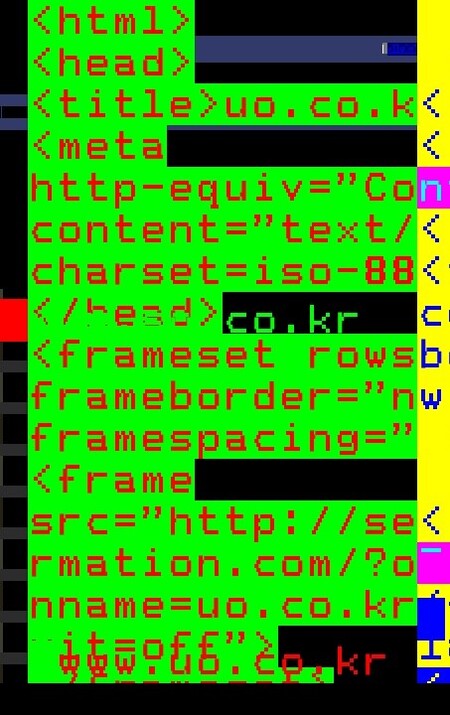
In net art, the subject of the artwork is not merely an individual image, but the web page itself. Artists can manipulate the layout of text, impede navigation, and disrupt the conventional browsing order of a site. This approach was employed by the duo JODI in their 1995 project, «wwwwwwwww.jodi.org.» The page appears as if the information is displaying incorrectly. This demonstrates another way to create a glitch aesthetic: the sense of failure arises not from image corruption, but from an unfamiliar organization of screen space.
JODI. «wwwwwwwww.jodi.org». 1995.
On a black background, dense rows of green characters are displayed. They resemble computer code, but they do not form a coherent message. The repeating symbols, lines, and the spaces between them create a graphic composition. Instead of a familiar page with headings and clear links, the viewer sees a screen that might appear malfunctioning. The sense of error arises from a mismatch with conventional expectations. The user tries to read the page, but the arrangement of the symbols forces perception toward treating it more like an image. Attention shifts from the meaning of the message to the density of the lines, the repetition of symbols, and the distribution of negative space.
This example demonstrates that the impression of a digital error can be created not only by image corruption. Sometimes, it is enough to disrupt the familiar organization of the website. As a result, the webpage itself becomes the subject of attention, rather than merely a medium for transmitting information.
Deconstructing the Familiar Space
In the 1999 project «SOD, ” the artistic duo JODI reworked the computer game Wolfenstein 3D. The familiar visual language of the game world was replaced with contrasting geometric forms. The space became almost abstract, though it retained traces of corridors, passageways, and individual objects. The alteration in graphics hinders orientation—the viewer finds it more difficult to understand what is before them and how the surrounding environment is structured.
JODI. «SOD.» 1999.
This collection allows for the comparison of different states within a single game environment. In some frames, depth is indicated by rectangular outlines that converge toward the center. In others, the space is filled with vertical stripes, small dots, or large black-and-white planes. These elements simultaneously help viewers perceive perspective while obstructing the image from being understood as a coherent space. The corridor transforms into a geometric pattern, and individual objects begin to resemble abstract symbols.
The difference between the main screen area and the bottom interface bar is particularly noticeable. While the in-game world image changes, the panel maintains a consistent arrangement of elements. It serves as a reminder that what we are looking at is not a set of independent abstract compositions, but rather a space designed for interaction. The final screenshot showing the menu also brings attention back to the underlying programmatic structure of the work.
In the context of the «SOD» investigation, this work serves as an example of a deliberate disruption of conventional visual order. The piece does not document random failure; rather, the artists consciously transform the game’s graphics. Therefore, its connection to glitch primarily lies in the sensation of instability and the loss of discernible landmarks. The imagery no longer facilitates action in the accustomed manner; instead, it compels the viewer to pay attention to how the digital space is constructed and presented to the user.
Desktop and Loss of Control
In the 2002 work «MyDesktop,» the duo JODI addresses the familiar computer interface. The desktop, which usually helps organize files and actions, becomes a space of visual chaos. Familiar icons and labels remain, but their arrangement hinders perception.
JODI. «My%Desktop.» 2002.
The image displays a desktop cluttered with folders, icons, and numerous labels. The names overlap, making them difficult to read. However, individual elements remain recognizable: one can distinguish folders, the trash bin, and the top menu bar. The feeling of disturbance arises not from the disappearance of a familiar interface, but from its overwhelming density.
The contradiction between the desktop’s intended function and its visual appearance is particularly noticeable. Typically, it allows for the organization and structuring of information, but here, the multitude of similar objects obstructs the ability to find visual anchors. The labels cease to be perceived merely as file names; instead, they coalesce into a dense graphic pattern.
In the context of this study, this frame illustrates that the impression of a digital failure can be created without colored bars or pixel disruption. It is sufficient to disrupt the customary organization of screen space. The viewer recognizes the environment but can no longer perceive it as a convenient or understandable system.