«I feel like I am filming and re-filming the same film, ‘Ulysses’—in different forms, through different stories, and all of them refer us back to Homer’s ‘Odyssey, ’ to this primal journey, the first journey, the one that ultimately doesn’t lead home.»
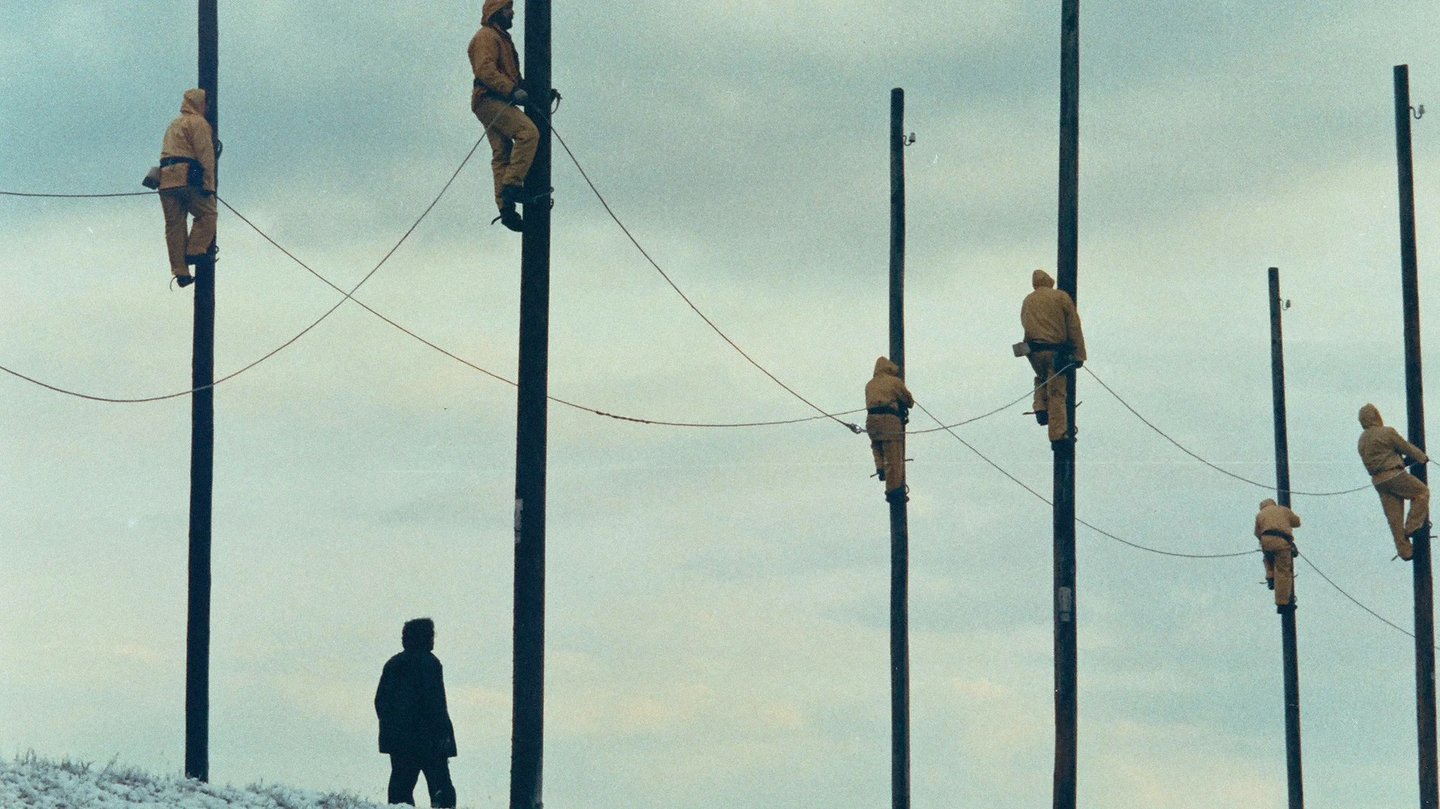
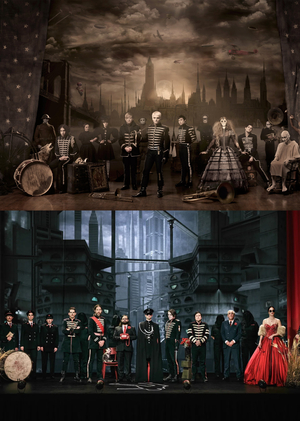
«Interrupted Stork Step» (directed by Theo Angelopoulos, 1991)
Concept
Second-half 20th-century authorial cinema presents a multitude of polar, yet sometimes recurring, approaches to understanding the world—drawing inspiration from contemporary history as well as from fairy tales, myths, and «eternal themes.» One of the directors pursuing this goal was the Greek-born Theo Angelopoulos, the «last great poet of cinema» [2]. His films possess a truly unique character and an inherent system by which space, time, characters, and plot are constructed. Within his system, myths intertwine with the actual history of Greece during the Civil War; the past coexists with the present in a single space, and the characters are both real and archetypal simultaneously.
Angelopoulos’s films speak little and explain almost nothing—the narrative is built entirely upon visual imagery. He moves from one film to the next, constructing a shared dimension—something on the edge of reality, dream, and parable.
The leitmotif of all the director’s works has been the heavy premonition of the decline of Greek civilization. «Greece is dying. We have completed our cycle…» says the driver to the main character in «The Odyssey’s Gaze.» The unbearable weight of a grand past and the destructive wars of the twentieth century seem to have emptied the country, leaving people only with the memory of what once was.The return to the past and the eternal search (for oneself? home? homeland?) became a burden for Angelopoulos’s characters. Thus, the director repeatedly returns to the story of Odysseus—Ulysses—who can never go home. This narrative is yet another piece of the worldview system of his films, perhaps the most important part.
In my research, I aim to explore the visual narratives that help construct this mytho-real world and tell the same story through multiple voices.
I have divided my narrative into five chapters—the main motifs in Angelopoulos’s films. Each one plays a role in creating the aforementioned myth of Odysseus.Space is arguably the element that most affects the viewer, pressing on them with its monotony and infinity—it reflects the director’s «internal landscape,» in his own words [1]. Space is connected to time, and sometimes they form one whole. Time itself is nonlinear: it repeats, moves in circles, or freezes. The individual in his world is always solitary and lost—yet, he represents not so much a personality as a reflection of the entire populace. This is evident in Angelopoulos’s films and the occurrences that blur the boundaries between our reality and fiction (a theatrical performance, a dream, or the inner world of one of the characters). Finally, the motif of endless wandering threads through all the films, returning us to Ulysses.In this study, I will examine eight of the most famous films shot between 1975 and 2004.
Contents:
Space
Time
General and Particular
Myth and Reality
«No Harbor»
Space
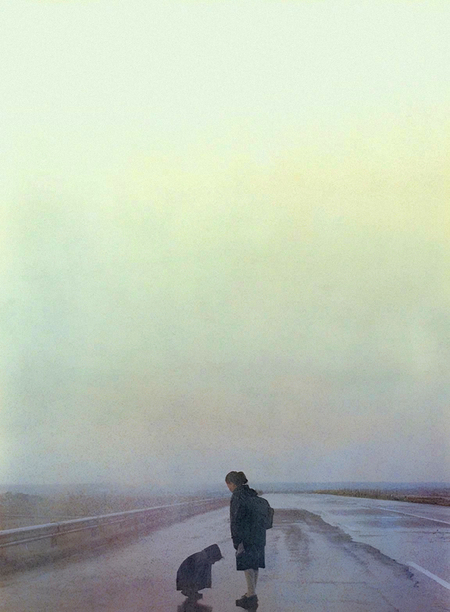
«Trilogy: The Weeping Meadow» (dir. Theo Angelopoulos, 2004)
The space in Theo Angelopoulos’s films is what researcher Natalia Samutina calls the «iconography of the Greek winter» [3]. Indeed, there is nothing left of the usual sunny, warm landscapes of Greece—in Angelopoulos’s world, a winter without beginning or end reigns, and the sun appears only in the memories of the old Alexander from «Eternity and a Day.»The landscape itself is monotonous and empty; underfoot, there is always viscous mud, and rain or wet snow could fall from the sky at any moment.
Left — «Landscape in Fog» (Director: Theo Angelopoulos, 1988) Center — «Interrupted Stride of the Stork» (Director: Theo Angelopoulos, 1991) Right — «Odysseus’s Gaze» (Director: Theo Angelopoulos, 1995)
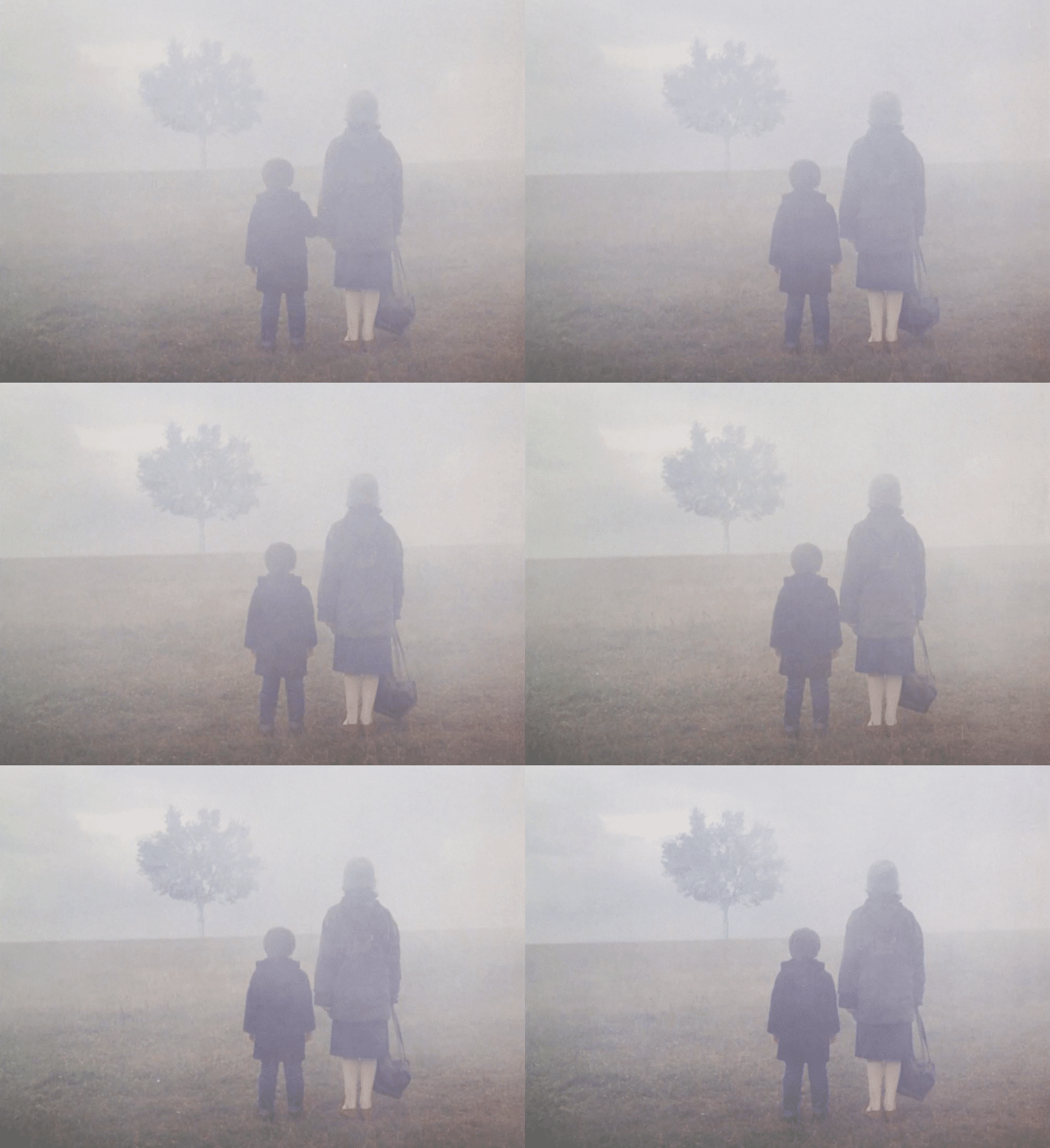
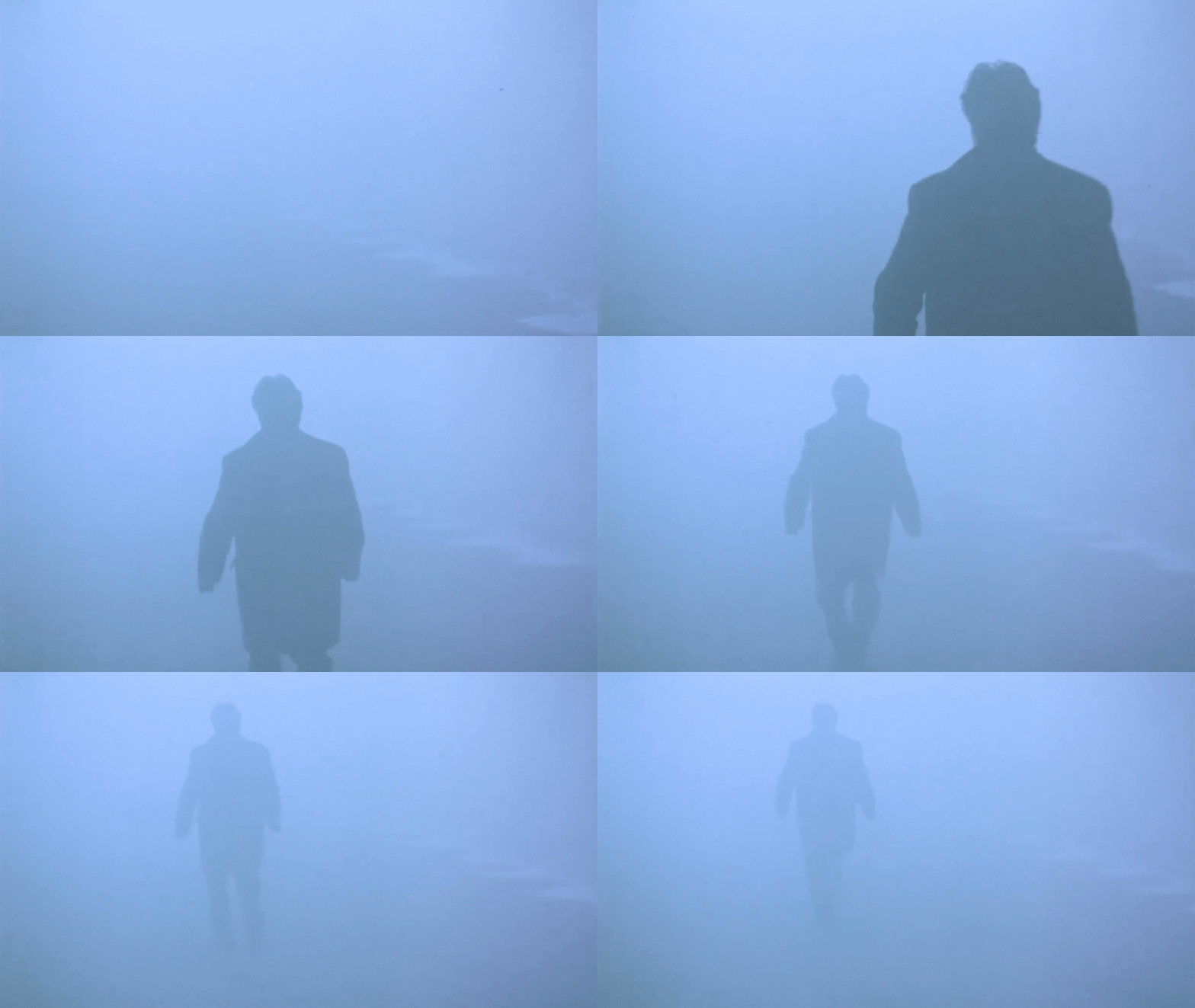
Left — «Landscape in Fog» (Dir. Theo Angelopoulos, 1988) Right — «Odysseus' Gaze» (Dir. Theo Angelopoulos, 1995)
Left — «Journey to Kythera» (dir. Theo Angelopoulos, 1984) Right — «Landscape in the Mist» (dir. Theo Angelopoulos, 1988)
The most frequent state of space in Angelopoulos' paintings is a dense, impenetrable fog. It seems to erase the boundary between sky and earth, leaving the characters suspended in a void, looking into and walking toward the unknown. Even when the fog recedes, the sky still merges with the sea or the snow, causing the human figure to become ungrounded once again.
Here, the fog might conceal a murder («Odysseus' Gaze») or dissipate, offering a spectral hope («Landscape in Fog»). It is this fog that bridges space and time, transforming the landscape into a memory of itself.
Left — «Trilogy: Weeping Meadow» (dir. Theo Angelopoulos, 2004) Right — «Odysseus’ Gaze» (dir. Theo Angelopoulos, 1995)
Despite the boundless scope of the world in the director’s films, there inevitably comes a moment of confrontation with a boundary. This is expressed both in the visual narrative (characters are separated by a river, a road, or a window frame) and in the plot itself—in «The Interrupted Stork’s Step,» the action takes place on the Greek-Turkish border in a refugee camp, and in «Landscape in Fog,» children cross a border in search of their father.
«Our home is your home. Our home… We crossed borders, and we are still here. How many more borders do we have to cross to get to our own home?»
Из «Прерванного шага аиста»
Left—“The Interrupted Step of the Stork» (dir. Theo Angelopoulos, 1991) Center—“Eternity and One Day» (dir. Theo Angelopoulos, 1998) Right—“Trilogy: Crying Meadow» (dir. Theo Angelopoulos, 2004)
Left—"Journey to Kythera» (Dir. Theo Angelopoulos, 1984) Center—"The Beekeeper» (Dir. Theo Angelopoulos, 1986) Right—"Trilogy: The Weeping Meadow» (Dir. Theo Angelopoulos, 2004)
On the left is «The Interrupted Stride of the Stork» (directed by Theo Angelopoulos, 1991). On the right is «Eternity and a Day» (directed by Theo Angelopoulos, 1998).
The image of the sea or a wide river frequently appears—a special boundary between villages, countries, and between the worlds of the living and the dead. Alexis from «The Trilogy…» travels to America by ship, from which he will never return alive. In «The Journey…», Spiros and his wife drift on a raft to mythical Kythera, on their final voyage. Water, like fog, «builds a bridge» between space and time—for it essentially embodies the flow of time.
Left — «Comedians» (directed by Theo Angelopoulos, 1975) Center — «Journey to Itea» (directed by Theo Angelopoulos, 1984) Right — «Eternity and a Day» (directed by Theo Angelopoulos, 1998)
Time
«The past doesn’t go away. For me, the three dimensions of time—past, present, future—don’t exist. The past has only passed in time; in reality, in our consciousness, the past continues to exist, ” says the director [1]. Indeed, time in Angelopoulos’s films seems to flow according to its own laws. Black-and-white photography comes alive, and a nineteenth-century romantic poet travels on a train with characters from the twentieth century. Flags with the „swastika“ instantly give way to the sickle and hammer, while the characters themselves do not age, suspended between the present and the past.
«Odysseus’ Gaze» (Dir. Theo Angelopoulos, 1995)
«Eternity and a Day» (directed by Theo Angelopoulos, 1998)
As I mentioned, all of the director’s films seem to take place in a single dimension, echoing each other in unexpected places.The troupe of wandering actors from «The Comedians,» now aged, appears in «Landscape in Fog,» and they are all performing the same pastoral play. The characters' names repeat from film to film: Eleni, Alexander, Vula, Spiros. The settings also recur: a cold beach, a pier with a Greek flag and a food van, a road with a car emerging from the fog…This repetition simultaneously references the very «eternal plot"—the Ulysses—and the very real history of the 20th century, where one war followed another, and the Greek winter never ended.
Left — «Comedians» (Dir. Theo Angelopoulos, 1975) Right — «Landscape in Fog» (Dir. Theo Angelopoulos, 1988)