Navigation
Introduction
[1] The Heian Era: Yamato-e and Mono no Aware
[2] Traditional Elements in Textile and Costume
[3] Contemporary Fashion: Silhouette, Cut, and Color
[4] Prints and Visual Similarities
Conclusion
Sources
Introduction
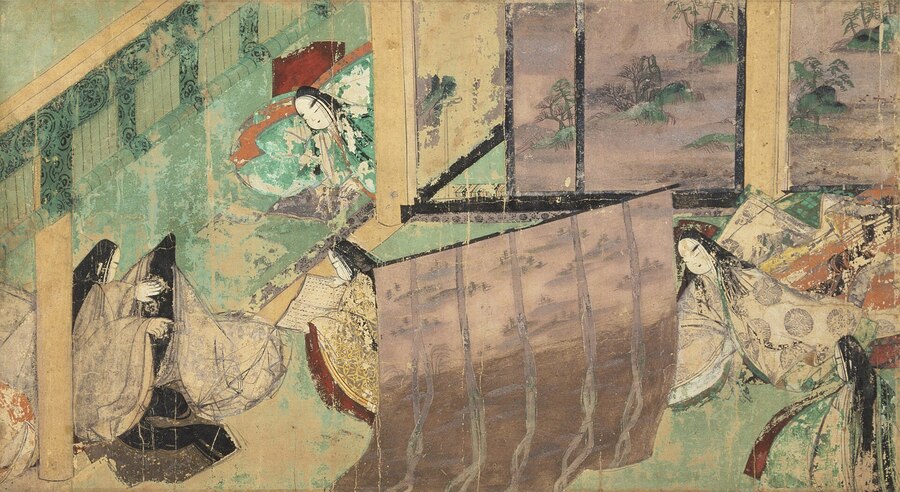
Fragment from the scroll «Tale of Genji, ” 12th century.
The Heian Period (794–1185) marked a turning point in Japanese illustration. It was during this era that many traditions, techniques, and themes were established, which subsequently developed over the following centuries.
At first glance, the art of the Heian period seems far removed from modern fashion. The stylized facial representations, the layered garments with detailed prints, and the conventional forms—yet these very visual principles are recognizable in contemporary fashion. This is precisely what makes the theme so compelling for visual research.
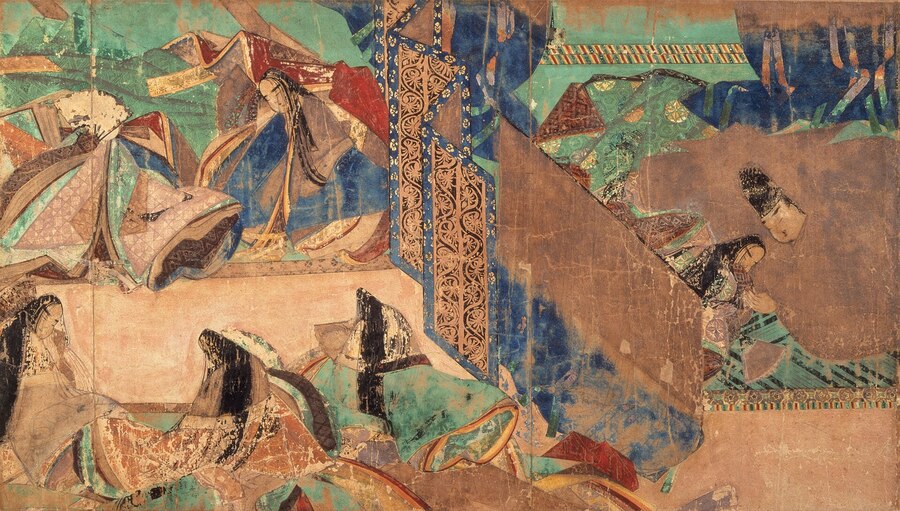
Fragment from the «Tale of Genji» scroll, 12th century.
In contemporary fashion, designers draw inspiration not only from visual arts, but also from literary works, such as Murasaki Shikibu’s «Tale of Genji.»
Illustrated scroll «Tale of Genji» 12th century
It is worth noting that many contemporary interpretations of Heian-era imagery are not derived directly from actual historical costume and art of the 12th century, but rather through later reinterpretations. For instance, fashion often features echoes of Yamato-e painting and the Rinpa school, Ukiyo-e prints, Kabuki theater, traditional kimono, as well as book illustration, anime, manga, and cinema.
All art has evolved and adapted to modernity over time, but its roots trace back to an earlier era.
«Genji’s Poetic Duel”—created by an unknown artist in the first half of the 16th century
The choice of topic is driven by the fact that the Heian era remains a significant source of visual imagery in contemporary fashion. Its aesthetic is regularly echoed in collections, prints, and so on, yet each time it is interpreted in a new way. Therefore, Heian can be viewed not as an immutable historical style, but as a flexible system of visual perspectives through which modern fashion constructs its own understanding of beauty, cultural memory, craftsmanship, and the past.
The central question of the research is how the visual principles of 12th-century Japanese art—Yamato-e and mono no aware—manifest in contemporary fashion and prints.
The research hypothesis is that the aesthetics of twelfth-century Japanese art, manifested in the «Yamato-e» style and the concept of «mono no aware,» are actively transforming and integrating into contemporary fashion, enriching its prints, silhouettes, and color palettes, thereby making a significant contribution to the global world of fashion.
[1] The Heian Era: Yamato-e and Mono no aware
During the Heian period (794–1192), a cohesive artistic milieu developed at the imperial court of Japan, where fine arts, poetry, calligraphy, fashion, and imagery were perceived as elements of a single cultural language. It was here that concepts of beauty arose—concepts rooted in an attention to the changing seasons, the subtlety of emotion, and the poetic perception of the world.
Yamato-e, or «Japanese painting, ” developed as a style of courtly art. Artists depicted scenes of court life, legends, landscapes, seasonal changes in nature, and themes from national literature. Although Yamato-e borrowed certain techniques from Chinese painting, it gradually developed its own visual language: decorative flatness, bright opaque colors, stylized figures, and conventional landscapes. In contrast to the Chinese tradition, narrative quality, ornamentation, and the emotional atmosphere of the scene gained greater importance here.
«Heavenly Princess on the Uzui Bridge» (Hashihime) from The Tale of Genji
«Ivy-Covered Trees» (Yadorigi) III, from «Tale of Genji»
One of the most important forms of Yamato-e was emakimono—a horizontal illustrated scroll. These were unrolled gradually, causing the imagery to be perceived as a moving narrative that created a continuous visual story. In such scrolls, interiors were often depicted from a bird’s-eye view, as if the roof of the building were missing. This technique allowed the simultaneous viewing of architecture, landscape, furniture, and characters, transforming the space into a decorative stage. Figures were portrayed in a generalized manner, with delicate lines defining the eyes and nose.
Nezamэ Monogatari Emaki (First Scroll Scene) 12th Century
Nedzame Monogatari Emaki (Third Scene of the Scroll), 12th Century
The primary literary and visual source of the era was The Tale of Genji by Murasaki Shikibu, written around 1000.
The novel recounts the life of the court aristocrat Genji—his romantic entanglements, familial conflicts, losses, and his quest for harmony. As early as the 12th century, «The Tale of Genji» was illustrated in the emakimono format. These scrolls became one of the most significant works of yamato-e.
In Heian culture, the concept of mono no aware—the «pathos of things» or the «melancholy charm of impermanence”—played a special role. It is connected to the realization that beauty is fleeting: a flower wilts, snow melts, the moon changes phase, love ends, and a person is left entirely alone. Mono no aware is not reducible to sadness; it is rather an experience concerning the fragility and value of a moment.
Flowering cherry blossoms in Yoshino, from Hokusai Katsushika’s series «Snow, Moon, and Flowers,» circa 1833.