Concept
When we look at Byzantine mosaics or early icons, the first thing that strikes us is the gold. In antiquity, gold was associated with God and the sun. It is everywhere: behind the saints, in the halos, in the air. At first glance, it seems like a mere decorative technique meant to look «beautiful» and «rich.» But if you look more closely, you realize that the gold here is not about opulence. Gold carries a deep sacred meaning. It is an attempt to depict a light that has no discernible source—a light that doesn’t fall from a window and doesn’t cast shadows, because it is everywhere and from nowhere. This is how artists of antiquity and the Middle Ages envisioned divine presence: not as something visible, but as something felt.
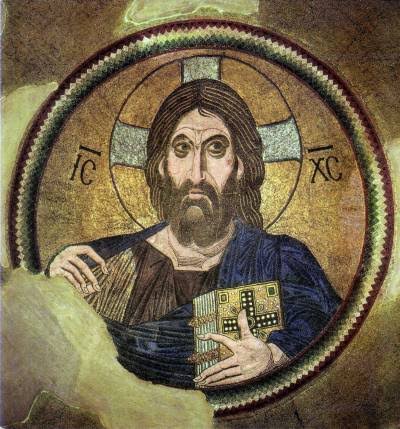
Christ Pantocrator from Daphni, 1100.
In this project, I want to trace how this flat light evolved—from early Christian mosaics in Ravenna to the works of Fra Angelico and the Ghent Altarpiece. Between them lies a chasm: from strict, almost abstract faces with enormous eyes to tender, realistic scenes where light begins to fall upon grass and glass. It seems that painting gradually learned to depict God not only through symbol but also through matter—through landscape, architecture, and the human body.
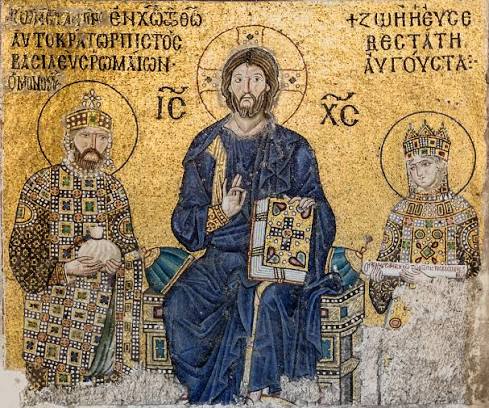
Empress Zoe, mosaic, Hagia Sophia, Istanbul, 1028–1034
In my project, I want to demonstrate that the gold background is not merely a backdrop but an entire language. It transforms as our perception of the world changes—moving from Byzantine hierarchy and symbolism to a more intimate, human experience of faith. It is important for me to understand at what point artists began to abandon gold in favor of chiaroscuro and perspective, and how that transition occurred.
The study will be built around contrast: the flat light of mosaics versus the emerging perspective of frescoes and altars. I want to trace how the same fundamental problem was addressed—conveying the presence of the invisible. This is not merely art historical analysis; it is an attempt to understand how the visual language of religion evolved alongside humanity’s worldview.
Gold as Heaven: Early Mosaics and Encaustic (5th–6th Centuries)
Here, the gold is the medium. The light has no source and casts no shadows—it is the direct language of divine presence.
Mosaics of the Mausoleum of Gallus Placidus, Ravenna, 5th century.
San Vitale Mosaics, Ravenna, 6th century.
The gold in the mosaics of the Basilica of San Vitale in Ravenna symbolizes divine light, an otherworldly reality, and Christ’s eternal kingdom.
«The Mother of God Enthroned with Saints Theodore and George, ” Sinai, 6th century.
Gold as Hierarchy: The Byzantine System (9th–12th Centuries)
Gold becomes a symbol of power and order: the dome, symmetry, a gaze beyond the viewer. Gold ceases to be a medium and becomes a hierarchy. It separates the sacred zone from the earthly.
Christ Pantocrator from Daphni, 1100.
A massive face is depicted in the dome, with a gold background resembling the sky.
Empress Zoe, mosaic, Hagia Sophia, Istanbul, 1028–1034
«Khludovskaya Psalter, ” miniature „Triumph of Orthodoxy, ” Constantinople, 9th century.
Gold and Weight: Proto-Renaissance
(13th–early 14th Century)
Gold gradually begins to fill the space, transitioning from a primitive background to a three-dimensional volume. The figures feel more alive; the drapery seems to breathe. Gold ceases to be mandatory. If it remains, it is «engraved”—it steps back before the volume. Light begins to fall upon the objects for the first time.
«Madonna on the Throne,» Chimaube, Uffizi, circa 1280.
«Madonna and Child, ” Duccio di Buoninsegna, c. 1290–1300
The light fills the image with a living human emotion; gold reflects off the surfaces and scatters through the space.
«The Lamentation of Christ, ” Giotto, circa 1305.
Gold is used in the traditional halos surrounding the heads of Jesus Christ, the Theotokos, apostles, angels, and saints. The painting depicts sorrow and heavy drama, and the gold serves as a reminder of eternity and divine presence.
«Maesta, ” Simone Martini, Palazzo Pubblico, Siena, 1315.
Gold as Medium: The Sienese and Florentine School (14th Century)
Gold emerges from the environment as an accent. It marks the sacred without filling the entire plane. A floor, a wall, a room—that is, a space where light can fall—begins to appear.
«Allegory of Good Government, ” Ambrogio Lorenzetti, Palazzo Pubblico, Siena, 1338–1339.