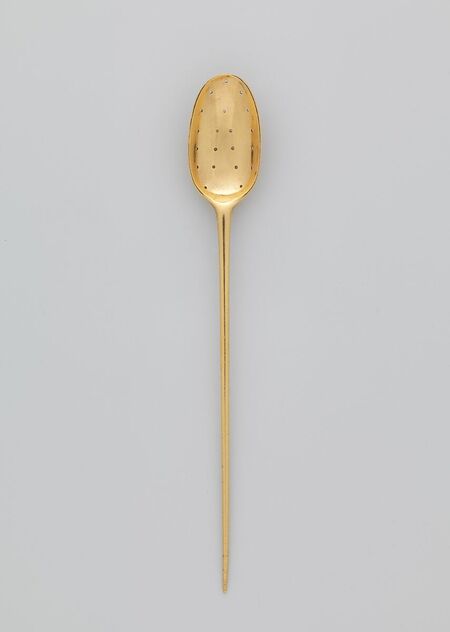
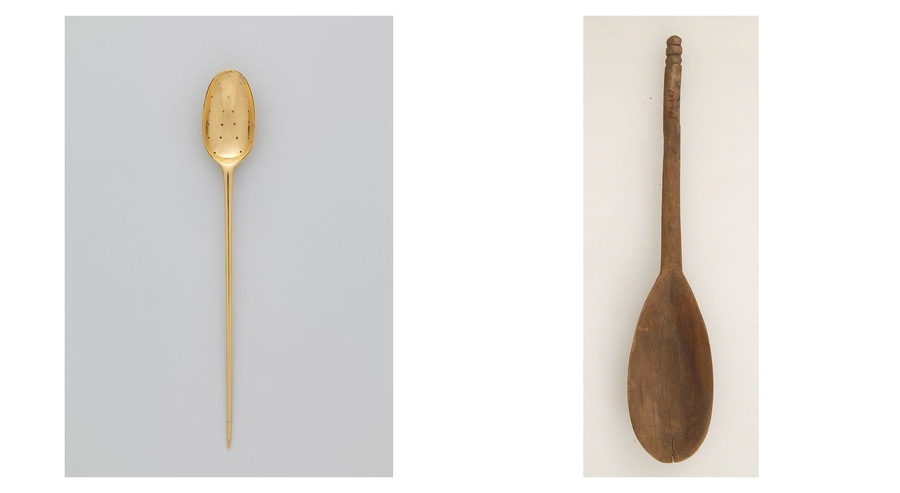
Gold tea scoop, Dublin, c. 1730–1735. Wooden spoon, Fife, 580–640. The Met.
Gold on top, wood on the bottom. In this spread, the gaze moves in opposite directions: from the gleam to the slender rod, and from the carved handle to the broad bowl.
Which of these spoons would you like to examine more closely?
In the display case, the spoon is visible in its entirety. In the kitchen, it is often visible only halfway up the handle—the rest disappears among the dishes. It turns out that such a simple object has at least two appearances. One emerges when an object is presented, and another we notice when it is in use. I wanted to understand whether what I admire about an object in a photograph matches what I might choose for a specific task.In Plato’s Hippias Major, Hippias proposes gold as the answer to the question of beauty. Socrates counters this with two examples. If gold is suitable for decorating everything, why did Phidias choose different materials for different parts of the Parthenon? And if we have a clay pot with porridge, which ladle is more appropriate—one made of gold or one carved from boxwood? Socrates chooses wood for that specific purpose. The interlocutors then separately ask whether a suitable object makes something seem beautiful or makes it beautiful (289d–291c, 293e–294e).My question goes beyond Socrates' inquiry: what changes in the assessment of an object when I first see its surface, then its form as a whole, and then try to understand what it was made for? My hypothesis is that shine draws attention, the combination of materials alters the perception of the object, and suitability is evident in individual details. These bases might align. For instance, the holes in a gold spoon for tea leaves simultaneously create a pattern and enable its particular function. However, agreement in a single object does not establish a general rule.
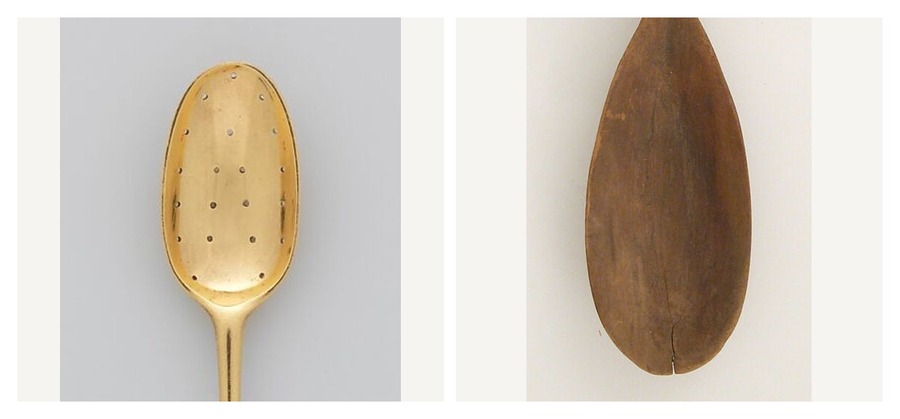
Left: golden spoon bowl for tea leaves, Dublin, circa 1730–1735. Right: edge of a wooden spoon, Phive, 580–640. Image fragments from The Met.
Close-up shots reveal various marks. The holes in the metal are intentional. The crack on the wooden bowl speaks to the object’s condition, and the catalog does not specify when it appeared.
I am comparing museum photographs of spoons, ladles, and vessels. I focus on shots where the rim, the interior surface of the bowl, the transition point to the handle, and any openings or spouts are discernible. The objects were made in different locations and at different times. I place them side-by-side as examples of form, not as scenes of a grand historical narrative or a Platonic reconstruction. I do not assume that two similar silhouettes served the same purpose. Where the function is known from the museum description, I state it plainly. Where it is suggested only by the form, I leave it to my observation.
A photograph cannot reveal how heavy a spoon feels in the hand, how water pours, or how comfortable the object is for daily use. Therefore, I do not evaluate practical usability; instead, I examine what traces of action become discernible in the image. I use an excerpt about pitchers as a foundation, then return to discuss suitability and fitness. I draw dating, material, dimension, and usage information from the Metropolitan Museum’s catalog. The workflow mirrors the movement of the eye: surface, proximity, the object’s structure, a counter-argument, and yet another look at the beginning.
01. What You See First
Tea strainer. Possibly Francis Williamson. Dublin, circa 1730–1735. Gold. The Metropolitan Museum of Art, 27.27.5. https://www.metmuseum.org/art/collection/search/195724
Golden tea set, Dublin, 18th century. A 1749 tea spoon is part of this set. The Met, 27.27.11.
Golden Teaspoon, circulation. Dublin, 1749. The Met, 27.27.11.
Close-up of the same spoon. A highlight on the convex side of the bowl. The Met, 27.27.11.
Look where the highlight ends. The bright strip cuts off before the edge, even though the surface of the spoon continues.
In the color frame, the metal is immediately recognizable. On the black-and-white reverse, the color disappears, but the highlight remains. Here, the photograph separates two characteristics that we usually notice simultaneously.
A wooden spoon with two sides. Phive, 580–640. The Met, 14.1.467.
Left: Spoon holes, Dublin, c. 1730–1735. Right: Fiber and crack from a wooden spoon, Phive, 580–640. The Met.
Spoon of gilded brass. Britain, 16th century. The Met, 13.42.88.
John Ladymen. Gold teaspoon from a set. Dublin, 1711/12. The Met.
The bowl and handle of the Ladyment spoon differ in width almost as clearly as the wooden spoon at the beginning. The silhouette itself still says little about the material.
In the black-and-white photograph, the gold can no longer be identified by color. A bright glare remains on the bowl, and signs are visible on the handle. The gaze moves differently along the wooden spoon: following the grain, toward the crack near the edge. The surfaces are immediately distinguishable, but I determine the material of the object based on the museum catalog.
02. When the thing is fitting
Left: Cypriot terracotta pitcher with a spout, 310–150 BCE. Right: Eastern Greek terracotta pitcher, 4th century BCE. The Met.
Two Cypriot terracotta jars: the one on the left dates to approximately 1450–1200 BCE, and the one on the right dates to 310–150 BCE. The Met.
The pitchers placed side-by-side demonstrate the diverse ways the handle, neck, and body can be joined. The finish takes a secondary role here.
Left: A teapot in the style of Thomas Willden, Staffordshire, circa 1750–1770. Right: A gold tea strainer, Dublin, circa 1730–1735. The Met. Objects from different sets.
On the Cypriot jug to the left, the spout protrudes beyond the body’s line. On the Eastern Greek vase, the rim on the right is nearly circular. In the first case, the viewer can anticipate the point from which the stream will flow; in the second, there is no such indication. I perceive how the form suggests motion, but I do not see the motion itself. Yet, this changes the perception of the object: the spout is no longer easily considered just an ornament.In the case of the Socrates pot, the vessel is filled with porridge, and the two ladles have a specific task. This task is absent in the museum photograph. One can compare the materials and proportions, but it is impossible to determine from the image which ladle would be easier to stir with or which would be too heavy.
Spoon in hand
Shixart1985. A wooden spoon in hand over a pot. Wikimedia Commons, CC BY 2.0.
At the rim of the pot, the wooden spoon is almost disappearing. The long handle becomes the most prominent part of the object.
Shixart1985. Spoon in a pot with tomato sauce, 2024. Wikimedia Commons, CC BY 2.0.