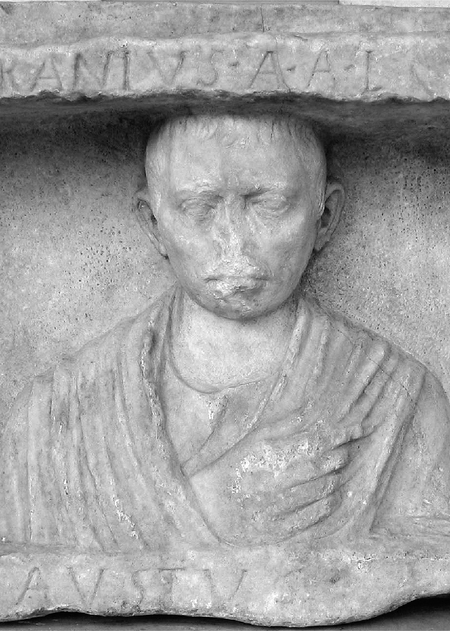
Roman Funerary Sculpture and the Images of the Dead: 1st Century BCE — 2nd Century CE
Navigation
- Concept
- Burial Traditions of Ancient Rome
- Tomb Monuments
- Individuality of Face and Pose
- Hand Gestures and Body Posture
- Clothing, Attributes, and Inscriptions
- Family Memory and Public Image
- Conclusions
- Sources
Concept
The research topic, «The Depiction of the Deceased in Roman Funerary Sculpture, ” was selected due to an interest in how ancient Romans portrayed individuals after death and how sculptural monuments preserved their memory. Funerary reliefs and gravestones allow for an examination not only of the artistic characteristics of Roman sculpture but also of society’s attitude toward death, family, individuality, and social status.
It is particularly interesting to analyze the comparison between funerary sculptures and public portraits. How crucial was it to convey the deceased’s real features, what artistic conventions were used, and how the posthumous image was constructed through clothing, pose, and composition.
The key question is: how did Roman funerary sculpture form the posthumous image of a person, and how did this image differ from the public representation of personality in Roman portrait sculpture?
The hypothesis is that Roman funerary sculpture formed the posthumous image of a person less through the display of their individual qualities and social status or personal idealization, and more through a socially recognizable image intended to preserve the memory of the deceased.
The source material was selected based on the principle of diversity in representing individual and familial imagery—including busts, framed portraits, funerary altars, and reliefs.
2. Funerary Traditions of Ancient Rome
In Ancient Rome, a person’s death did not signify the complete erasure of their presence from the life of their family and society. Funeral rites were aimed not only at bidding farewell to the deceased but also at preserving the memory of them. Key elements of the burial included the preparation of the body, the funeral procession, cremation or interment, as well as the erection of a monument.
Tomb Altar of Minucius Sawa. Mid-1st Century CE. Material: Italian Marble. Rome, National Museum of Rome, Palazzo Massimo alle Terme.
Funeral traditions involved a complex set of actions in which relatives and other members of Roman society participated. V. O. Yakovlev’s article emphasizes the link between burial rites and familial memory and ancestor veneration. The author writes of an «indissoluble connection with ancestors» as one of the factors that shaped the Romans' attitudes toward burial [3, p. 63]. This allows us to view the tombstone not merely as a marker of a burial site, but as an intangible continuation of the deceased’s memory.
«Thus, the ancestral tombs became, quite literally, temples for these deities, before which altars for sacrifices were often set up» [3, p. 64]
In Ancient Rome, the type of tombstone depended on the wealth, social status, and era (Republic or Empire) of the deceased, and they were divided into several types: cippus (a small stone pillar), stelae and altars, sarcophagi, chamber tombs and columbaria, monumental tombs and towers, and cenotaphs. Most of the funerary reliefs described below belong to a specific subtype—architectural funerary portrait reliefs.
The location of the burial structures was also a significant aspect. Tombstones became visible signs of the deceased’s presence in the space of the living. They could contain portraits, names, information about the person’s origins, and social standing.
Some of these were not standalone stelae set into the ground but were integrated into the facades of chamber (above-ground) tombs along Roman roads (such as the funerary relief of the Rabirii Tomb).
Thus, the monument served several functions simultaneously: it marked the burial site, preserved the individual image, and informed those around it about who the deceased was.
Tomb Relief of the Rabirius Tomb Located on the ancient Appian Way in Rome
3. The Tombstone as a Means of Immortalizing Personality
«Of all types of Roman sculptural portraiture, depictions on tombstones were the most conservative» [1, p. 32].
Funerary sculpture aimed to preserve the recognizable and lifelike image of the deceased. However, portrait likeness was only one part of the whole. The monument could communicate family relationships, social status, affiliation with a particular social group, and the person’s achievements.A telling example is the tombstone of the Furii, erected in the last third of the 1st century BCE. It features five busts—three female and two male. The figures are positioned almost frontally, and their faces display individual characteristics. Britova, Losev, and Sidorov note: «The faces are individual» [1, p. 33]. The authors also point out differences in the interpretation of male and female portraits: the male heads retain features of the Republican tradition, while the female ones demonstrate the influence of the Augustan era, particularly in their hairstyles [1, p. 33].
Tomb of Furii. Marble. Late 1st century BCE. Rome, Vatican Museums, Vatican Museums.
9. Sources
Britova N. N., Loseva N. M., Sidorova N. A. Roman Sculptural Portrait. — Moscow: Iskusstvo, 1975. — 98 p.
Thompson N. L. Roman Art: A Resource for Educators. — New York: The Metropolitan Museum of Art, 2007.
Yakovlev V. O. Roman Necropolis and Epigraphy of the New Testament Period: The Cenotaph of Centurion Marcus Celius, Who Died in the Battle of the Teutoburg Forest // Works and Translations. — 2019. — No. 1 (2). — pp. 60–90.
Ragulina A. A. On the Features of Iconography and the Comparative Method of Studying Roman Dionysian Sarcophagi Reliefs (Based on the Uvarov Sarcophagus in the Collection of the Pushkin State Museum of Fine Arts) // News of the Herzen Russian State Pedagogical University. — 2009. — No. 101. — pp. 249–252.
Funerary Practices of Ancient Rome [Electronic Resource]. — URL: https://ritual.msk.ru/stati/pogrebalnaya-praktika-drevnego-rima/ (Accessed: 12.11.2026).
Burial Traditions in Ancient Rome [Electronic Resource]. — URL: https://funeral-ritual.ru/dopolnitelno/tradicii-pohoron-v-drevnem-rime/ (Accessed: 12.11.2026).
Funerary Art of Ancient Rome [Electronic Resource]. — URL: https://magisteria.ru/art-of-ancient-rome/roman-funerary-art (Accessed: 12.11.2026).
Funerary Monument of the Furii [Electronic Resource]. — URL: https://ancientrome.ru/art/artwork/img.htm?id=761 (Accessed: 12.11.2026).
Monument of the Gessii. Fausta Gessia [Electronic Resource]. — URL: https://ancientrome.ru/art/artwork/img.htm?id=3596 (Accessed: 12.11.2026).
Funerary Relief of Aulus Turrianus Faustus, a Freedmen [Electronic Resource]. — URL: https://ancientrome.ru/art/artwork/img.htm?id=4461 (Accessed: 12.11.2026).
Funerary Altar of Minucia Suavis [Electronic Resource]. — URL: https://ancientrome.ru/art/artwork/img.htm?id=4462 (Accessed: 12.11.2026).
Funerary Relief of the Gemini [Electronic Resource]. — URL: https://ancientrome.ru/art/artwork/img.htm?id=3016 (Accessed: 12.11.2026).
Funerary Relief of Lucius Antistius Sarculanus and his wife Antistia Plutia [Electronic Resource]. — URL: https://ancientrome.ru/art/artwork/img.htm?id=5041 (Accessed: 12.11.2026).
Roman Funerary Family Relief. The Metropolitan Museum of Art [Electronic Resource]. — URL: https://ancientrome.ru/art/artwork/img.htm?id=2827 (Accessed: 12.11.2026).