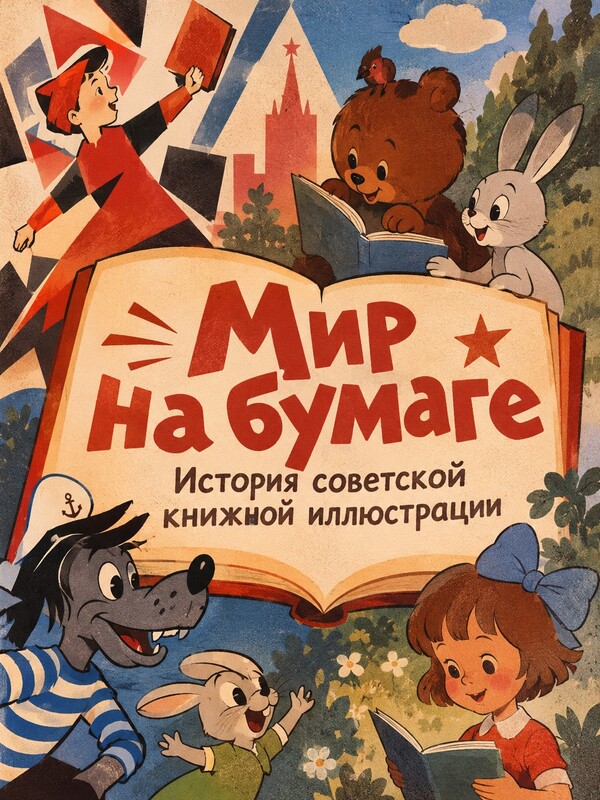
THE WORLD ON PAPER
The History of Soviet Book Illustration: 1920s–1980s
Soviet book illustration evolved from experimental graphics and bold formal decisions of the 1920s into a diverse artistic system where realistic depiction, decorative elements, humor, and individual authorial style formed the foundation of the visual image of childhood.
I. ENTERING THE WORLD OF BOOKS (Concept)
A book is more than just a carrier of text; it is an independent visual space where an image can tell a story, set a mood, and create a unique world. This characteristic was especially vivid in Soviet children’s books of the 20th century. Illustration became not merely an addition to a literary work, but an essential part of its artistic content.
The visual study, «World on Paper,» is dedicated to the development of Soviet book illustration from the 1920s through the 1980s. The focus is on the evolution of artistic language—composition, color, character plasticity, and the interaction between the image and the text. Through the works of artists from different generations, the study demonstrates how the concept of the children’s book changed and what visual means were employed to construct the image of childhood.
In the 1920s, book illustration developed amidst an atmosphere of artistic experimentation. Avant-garde movements, Constructivism, and new principles of graphic design influenced book layout. Artists actively worked with geometry, contrast, rhythm, large color fields, and expressive typography. The book was perceived as a cohesive work of art where the cover, text, illustration, and page composition interacted with one another.In the following decades, book illustration became more diverse. Alongside graphic experimentation, narrative illustration, decorative stylization, fairy-tale imagery, and realistic depictions of the surrounding world developed. Artists sought their own way to communicate with young readers: some created concise and dynamic compositions, while others turned to fine detail work, folk motifs, humor, and observation of nature.
Artists who defined the aesthetic of Soviet children’s literature—Vladimir Lebedev, Vladimir Konashevich, Evgeny Charushen, Yuri Vasnetsov, Vladimir Suteev, Anatoly Eliseev, and other masters—occupy a special place in this study. Their work demonstrates the sheer variety in how the same world could be depicted. Geometric abstraction coexists with the lively plasticity of animals, decorative fantasy is juxtaposed with observant realism, and concise graphics are presented alongside rich, multi-figure compositions.Particular attention is paid to the technical aspects of book production. Advances in color printing, techniques for reproducing drawings, and publishing design directly influenced the expressive tools available to artists. Book format, paper quality, color constraints, and the specifics of the printing process became integral parts of the visual solution.
The central hypothesis of this research is that Soviet book illustration did not develop as a singular, immutable style. On the contrary, it represented a dynamic artistic milieu where historical circumstances, pedagogical concepts, technologies, and the personal explorations of artists constantly interacted. It was this diversity of authorial approaches that allowed the distinct culture of Soviet children’s books to form.
The study is structured chronologically and is augmented by a comparative analysis of artistic techniques. The visual material is organized by period, style, technique, and imaging characteristics. Comparing covers, spreads, characters, color schemes, and compositional techniques allows one to trace not only the changing appearance of the book but also the evolution of the principle of visual narration itself.
Thus, Soviet children’s illustration is examined as a distinct phenomenon in the history of art and graphic design. It is the story of how artists transformed the printed page into a space of imagination, creating images that continued to live in the memories of generations of readers.
Book as an independent world
«A children’s book is a space where the image becomes an extension of the story. The artist doesn’t just show a character; they create their personality, environment, and emotional world.»
What do we explore?
Four areas of focus:
- Character design and personality.
- Composition and page organization.
- Color and graphic technique.
- Interaction between image and text.
II. THE BIRTH OF A NEW CHILDREN’S BOOK
A new era — a new reader
Following the 1917 Revolution in Russia, sweeping changes occurred in social and cultural life. New educational programs were developed, the publishing system was reorganized, and the book was viewed as a vital tool for enlightenment and shaping new reading experiences.
Children’s literature gained special significance: it was expected to be accessible, visual, and able to speak to the child in an understandable language. In these circumstances, the artist became not merely an illuminator of the text, but a participant in creating a new visual image of childhood.
Books as a Tool for Knowledge Acquisition
In the 1920s, children’s books increasingly turned to the world surrounding the child. Everyday objects, transportation, professions, animals, and daily activities became the foundation of plots that helped them master the structure of the modern world.
The image served an educational purpose while retaining its playful appeal. The artists strove for clear silhouette, expressive action, and a page organization that allowed a child to examine the depiction independently and establish connections between objects.
Art transcends conventional boundaries
In the early 20th century, the artistic avant-garde radically transformed perceptions of composition and the nature of representation. Artists experimented with geometric forms, scale, color, flatness, and the abandonment of traditional perspective, striving to discover a new visual language for modernity.
These explorations influenced the design of books and periodicals. The page ceased to be perceived as a neutral surface for placing text—it became an independent structure in which every element adhered to a specific rhythm and compositional intent.
Constructivism and the New Organization of the Page
The Constructivist approach was based on the clear organization of form and the functional use of visual elements. In book graphics, this manifested through active typography, geometric compositions, asymmetry, contrasting color blocks, and unusual text placement.
One significant example of a new approach to the book is El Lissitzky’s 1923 publication, «For the Voice, ” featuring texts by Vladimir Mayakovsky. It demonstrates how typography, page sequencing, and geometric organization can form a unified visual work, transforming reading into a spatial and rhythmic experience.
III. ARTISTS WHO TRANSFORMED THE CHILDREN’S BOOK
[No text provided to translate.]
Vladimir Lebedev. The Art of Exact Form
Vladimir Vasilyevich Lebedev (1891–1967) was one of the key masters who shaped the development of Soviet children’s book illustration in the first half of the 20th century. His artistic language was formed under the influence of early 20th-century graphic experiments, poster art, magazine illustration, and new principles of visual organization.
ppp