Concept
When I was a child studying at a music school and playing the violin, I was always fascinated by the unusual appearance and variety of shapes of string instruments. I dreamed of owning a violin like those someday, but unfortunately, that never happened, though I still admire their designs. I decided to dedicate my visual research to this topic—but applied to a different instrument.
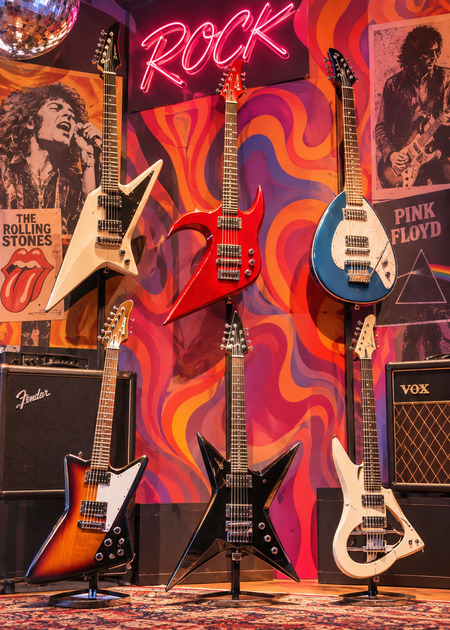
This visual study explores the evolution of futuristic electric guitar design from the 1950s to the 1970s. During that time, industrial design was heavily experimental, as new technologies, coupled with advances in aviation and space exploration, profoundly influenced the aesthetics of everyday objects. Visions of the future manifested in fluid shapes, unconventional geometry, vibrant colors, and the incorporation of modern materials.
At the start of this study, we delve into the history of futuristic electric guitar design. This evolution is linked to the post-war period, the influence of space travel, science fiction, as well as automotive and industrial design. We will examine in detail how these factors shaped the aesthetic vision of musical instrument manufacturers.
Next, we will trace the gradual shift away from traditional electric guitar body shapes toward bolder experimentation. The research will detail changes in silhouette, the emergence of asymmetry, sharp geometric lines, and fluid curves. Particular attention will be paid to materials, color palettes, finishes, and metal hardware—elements that helped forge the instrument’s unique character.
Furthermore, this study will examine specific manufacturers and their work. Using examples from Vox, Burns, and Eko, we will explore diverse approaches to futuristic design, comparing the structural characteristics and visual appearance of the electric guitars. Among the models discussed are the Vox Phantom, Vox Mark VI, and Burns Bison, which vividly illustrate the design experiments of that era.
Additionally, this paper explores how unconventional design impacted music and culture as a whole. I investigate how the electric guitar became a vital component of a musician’s stage persona, and what role advertising, photography, and the performances of rock stars played in promoting new instrument models. We will look at the relationship between an instrument’s appearance and the formation of a performer’s distinctive style.
Finally, I analyze the subsequent trajectory of these futuristic design solutions. We will see which forms became iconic and endure to this day, how the experiments of the 1950s–1970s influenced the development of electric guitars, and how their aesthetic continues to be utilized by contemporary manufacturers.
Thus, the research demonstrates how the electric guitar has evolved from a simple musical instrument into a complete object of industrial design. It reflects technological innovations, cultural shifts, and societal perspectives on the future.
Section 1. Historical Context
Electric Guitar to Futurism
The first electric guitars appeared long before the 1950s. In the 1930s, manufacturers began experimenting with electric amplification, and in the following decades, instruments with solid bodies emerged.By the mid-20th century, the electric guitar had become a popular musical instrument. Models like the «Fender Telecaster» and «Gibson Les Paul» solidified the fundamental design principles that manufacturers continued to use.
Fender Vintera '50s Tele Electric Guitar in Sonic Blue
Gibson Les Paul Standard 1959
The Post-War World and New Technologies

Following World War II, industry began to develop rapidly. Technologies improved, mass production expanded, and new appliances and gadgets appeared for the home. People increasingly saw objects that looked modern and technological. This influenced the design of furniture, automobiles, consumer electronics, and gradually, the appearance of musical instruments.
The Start of the Space Race
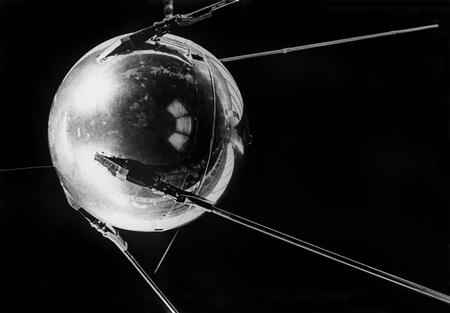
In 1957, the Soviet Union launched the first artificial satellite of the Earth, «Sputnik-1.» This event marked the beginning of a new phase in the space race between the USSR and the USA. Space became a central theme in mass culture. Rockets, satellites, and spacecraft inspired designers to create items that looked futuristic—as if from the future.
Space Age Aesthetics

In the 1950s and 1960s, the «Space Age» aesthetic emerged—an aesthetic connected to space and the future. It was characterized by rounded forms, smooth surfaces, plastic, vibrant colors, and unconventional designs.These ideas manifested in furniture, household items, architecture, and transportation. Musical instruments also became part of this visual culture.
The Influence of Automotive Design
In the 1950s, automotive design was quite distinctive: cars featured characterful shapes, numerous chrome details, and ornamentation reminiscent of wings and rockets.
Cars at the time were not merely viewed as a means of transportation but as symbols of speed, progress, and forward momentum. Similar ideas emerged in electric guitar design during the 1960s, which also incorporated unusual protrusions, metal components, and sharp geometric forms.
Rear view of a pink classic Cadillac.
GM-X Stiletto, 1964
Science Fiction and Visions of the Future
Science fiction demonstrated what future technologies might look like. Books, films, and paintings featured extraordinary machines, spacecraft, and other imaginative devices.
These images inspired designers. For instance, electroguitars with unusual designs could resemble objects from science fiction movies and differ from conventional guitars.
Section 2. Forming a New Electric Guitar Design
Classic electric guitar form
In the 1950s, the core principles of electric guitar design were established. The bodies of the «Fender Telecaster,» «Stratocaster,» and «Gibson Les Paul» differed from one another but maintained a discernible structure: a elongated neck, a symmetrical or near-symmetrical arrangement of key components, and a body with smooth contours.These models served as the starting point for subsequent experimentation. Manufacturers began seeking ways to make the instrument more recognizable.
Fender Electric Guitars
Why Manufacturers Needed New Forms
As the popularity of electric guitars grew, so did the number of manufacturers and models. Companies competed against each other, striving to offer musicians something unique. One way to stand out was through the guitar body shape. If the focus used to be primarily on playability and tone, the instrument’s aesthetics increasingly became a crucial part of its appeal.
Emergence of experimental studios
In the early 1960s, electric guitars began to appear in unusual shapes. The instruments looked distinctive even compared to other models of the time. The experiments concerned not only decorative details but the entire body construction.