Navigation
Introduction. Can art create reality?
Chapter 1. Strong, healthy, beautiful—what the art of the future envisioned about humanity
1.1. The Soviet Citizen: Strength, Health, and Youth 1.2. The Ideal Body in Nazi Germany 1.3. The World-Changing Person: Mexican MuralismChapter 2. Ideal Labor: Humanity as the Creator of a New World
2.1. Building the Future: The Soviet Worker 2.2. Collective Labor: The Field as an Image of a Shared Purpose 2.3. Man and Machine: Diego Rivera’s Industrial World 2.4. Production as an Ideal System: Nazi GermanyChapter 3. The Ideal Society: A Life Everything Settled Right
3.1. The Festival as Proof of Well-being 3.2. Abundance in Detail: Bread as a Symbol of Plenty 3.3. Happiness Returning Home 3.4. Rest as Part of the State System 3.5. The Future Society: Not a Celebration, But a Struggle for ChangeChapter 4. The Ideal Family: Motherhood, Childhood, and the Next Generation
4.1. Motherhood: A Personal Feeling and a Social Ideal 4.2. Mother and State: To Whom Does the Child’s Future Belong? 4.3. Childhood as a Promise of the Future 4.4. Family as Memory and the Link Between Generations 4.5. Diverse Views on the Next GenerationConclusion. How Artists Reinterpreted the Visual Language of Propaganda
Can art create reality?
Art not only reflects reality, but also shapes our perception of what it ought to be. During the 1930s–1980s, painting, sculpture, posters, and monumental murals became instruments of ideological influence, creating images of the ideal individual, labor, society, and family.
Art is not a trend
These images can be seen in various works of art: from Vera Mukhina’s «Worker and Kolkhoz Woman» (1937), which embodies the image of the new person, to Arkady Plastov’s «Haymaker» (1945), which presents labor as the foundation of collective life; from Diego Rivera’s monumental cycle «History of Mexico» (1929–1935), in which the image of society is revealed through national history and social struggle, to the Nazi propaganda poster by the Mutter und Kind organization (c. 1935), which portrays motherhood as a state value.
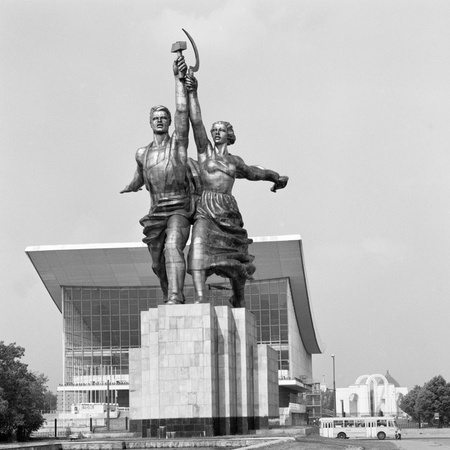
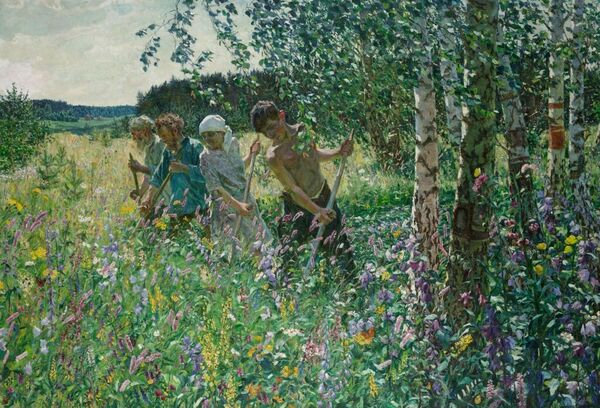
1. Vera Muchina. «Worker and Kolkhoz Woman.» 1937. Stainless steel, chrome-nickel steel. Moscow 2. Arkady Plastov. «Haymaking.» 1945. Canvas, oil. 197 × 293.5 cm. State Tretyakov Gallery
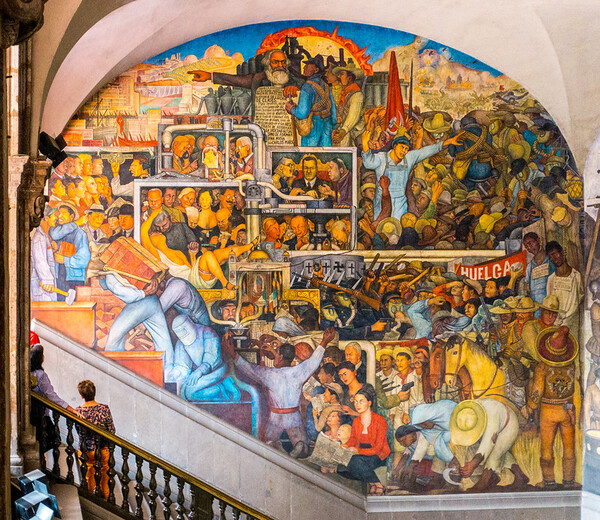
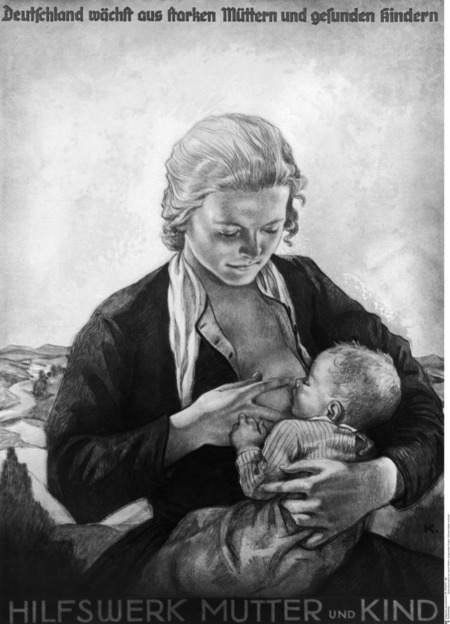
1. Diego Rivera. «Mexico Today and Tomorrow.» 1934–1935. Fresco. National Palace, Mexico City 2. Propaganda Poster by the Mother and Child Relief Agency (1935), published in: German History in Documents and Images
Beneath outwardly attractive imagery lay diverse political goals and differing views on the proper organization of life. Later, the language of official art itself became the subject of reinterpretation and critique in the works of social art artists.
Strong, healthy, beautiful—how art proposed to envision the person of the future
In the art of the 1930s, the human figure was rarely portrayed as random or ordinary. The body became a kind of evidence that an ideal world either already exists—or is certain to come. The heroes of paintings and sculptures were physically strong, brimming with energy, and gazed confidently forward. They did not doubt, did not tire, and did not age. Their appearance spoke of health, discipline, youth, and readiness to serve a greater cause.
Yet, behind these similar images lay varied conceptions of the ideal human being. In the Soviet Union, this was primarily the builder of a new society—the worker, the athlete, the collective farm member, the pilot. In Nazi Germany, the body transformed into a symbol of racial norms. In Fascist Italy, it referenced the ancient ideals of strength and national greatness.
The Soviet Person: Strength, Health, and Youth
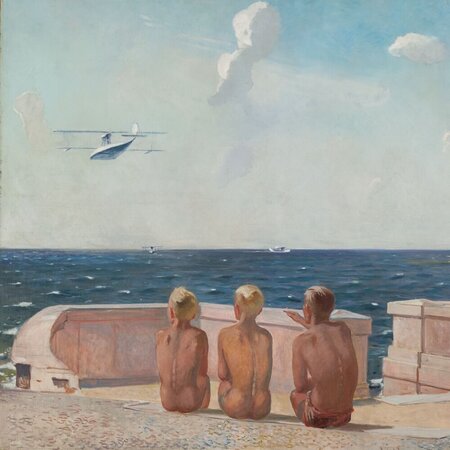
In Soviet art of the 1930s, an image of a person begins to form—someone who seems to belong not to the present, but to the future. This figure is young, athletic, and energetic. Their body is not merely an external characteristic, but a reflection of an inner readiness to participate in building a new society.In the works of Alexander Deineka, this image is particularly pronounced in pieces such as «Future Pilots» and «Over the Expanses of Moscow Area Construction Sites.» In the first painting, teens lie by the water’s edge, observing airplanes. They have not yet become pilots, but their gaze is already fixed on the future. The airplane here is not just a piece of technology, but a promise of the opportunities opening up to the new generation.[Alexander Deineka. «Future Pilots.» 1938. Canvas, oil. State Tretyakov Gallery]
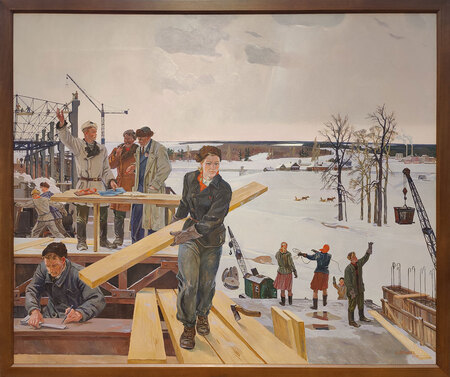
In the painting «On the Expanses of Moscow Region Construction Sites, ” Deineka addresses the image of a person already engaged in the process of creation. The central focus is a construction worker—a young woman—walking along wooden walkways at a great height with a heavy board tucked under her arm. Against the backdrop of the massive construction site, her figure appears small, but she becomes the composition’s main subject. Ordinary physical labor takes on the significance of participating in the transformation of the country. Furthermore, the artist depicts the woman not in the traditional role of an observer or assistant, but as an independent participant in the construction.
[Alexander Deineka. „On the Expanses of Moscow Region Construction Sites.“ 1949. Canvas, oil. 250 × 300 cm. State Tretyakov Gallery]
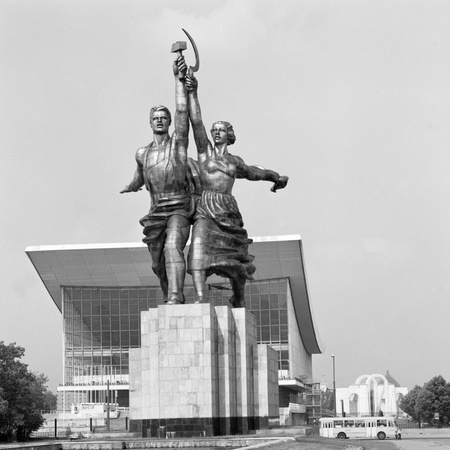
In Vera Muchina’s sculpture, «Worker and Kolkhoz Woman, ” the ideal human is presented through two powerful, almost monumental figures. The worker and the kolkhoz woman move forward, raising the sickle and hammer above their heads. Their figures are unified by a common impulse—they are not two separate people, but a single image of a nation confidently looking toward the future.It is important not only how the heroes are depicted, but also how they are depicted: enlarged proportions, tense musculature, broad gestures, and dynamic movement transform the ordinary person into a symbol of the era.[Vera Muchina. „Worker and Kolkhoz Woman.“ 1937. Stainless Steel. Moscow, VDNKh]
The Ideal Body in Nazi Germany
In Nazi Germany, the image of the ideal person was constructed upon different foundations. Here, physical beauty was linked to racial ideology: the state asserted a concept of the «proper» body, one that was meant to embody health, youth, strength, and belonging to the race ideal proclaimed by the regime. One of the most well-known examples is Adolf Ziegler’s triptych, «The Four Elements.» Four nude female figures are depicted with almost sculptural precision. Their bodies are smooth, symmetrical, and devoid of individual characteristics. These are not portraits of specific women, but a generalized image of normative beauty. The painting became one of the most recognizable works of art from the Nazi period and was widely reproduced in print.
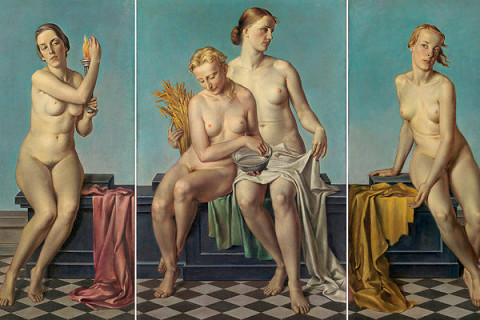
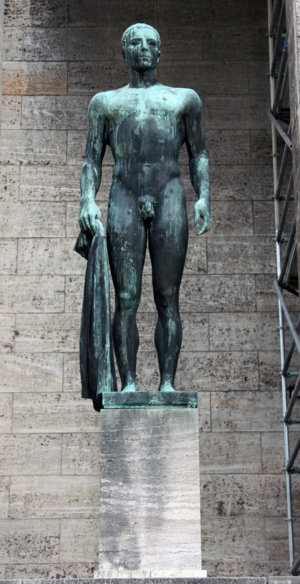
1. Adolf Ziegler. «The Four Elements.» Before 1937. Triptych, canvas, oil. 2. Arno Breker, «Ten Fighter» (Zehnkämpfer, 1936)
In Arno Breker’s sculpture, «Decathlete,» the ancient tradition converges with the physique of a modern athlete. The muscular figure, tense posture, and monumental scale create the image of a person who has seemingly overcome their own physical limits. Breker became one of the most renowned sculptors who worked in the service of the Nazi regime.
It is telling that in 1937, two exhibitions with opposing goals opened simultaneously in Munich. The «Great German Art Exhibition» showcased art approved by the regime, while the «Degenerate Art» exhibition mocked and condemned modernist works. Distorted form, abstraction, and deviation from academic beauty were declared signs of cultural decay. Thus, the image of the ideal body became another instrument of exclusion: anything that did not conform to the established norm was deemed incorrect.
The World-Changing Human: Mexican Muralism
David Alfaro Siqueiros. «New Democracy.» 1944–1945. Fresco, Palace of Fine Arts, Mexico City
The portrayal of the human figure is entirely different in Mexican muralism. Here, the body too becomes a symbol of strength, but this strength is not connected to racial norms or state discipline—rather, it is tied to liberation, social struggle, and societal transformation.
In the central part of David Alfaro Siqueiros’ triptych, «New Democracy, ” a nude figure is depicted breaking chains. She combines masculine and feminine features, and on her head is a Phrygian cap—a symbol of freedom. The body here does not embody serene perfection; it is taut, in motion, literally tearing itself free from bonds. This is the image of a person who is freeing themselves from oppression and actively participating in the creation of a new order.
Jose Clemente Orozco. «Prometheus.» 1930. Fresco, Pomona College, California
Another example is José Clemente Orozco’s fresco «Prometheus» at Pomona College in California. The mythological titan offers fire to humanity, symbolizing knowledge and the dawn of civilization. His body dominates the central part of the composition, around which the dramatic reaction of the crowd unfolds. Here, humanity is presented not as a perfected ideal, but as a force capable of bringing change—even if society does not immediately embrace it.
Mexican artists approach the monumental figure much like European artists of the time, but the meaning of this image is different. At the center is not an impeccable representative of the established order, but a person capable of fighting, thinking, and altering the existing structure.
Ideal Labor: Humanity as the Creator of a New World
In an ideal world, labor should not appear heavy or exhausting. It should become a source of pride, creation, and progress. The worker is not simply completing a task—they are participating in the transformation of the country. Factory floors, construction sites, fields, and machines become the scenery of a new world, and the production process itself acquires an almost heroic scale.
However, art portrays labor in diverse ways. In some works, the human being is subjugated to the rhythm of a massive machine; in others, they become the protagonist of industrial progress. Somewhere, collective labor is depicted as harmonious unity, while elsewhere, beneath the external triumph of productivity, one can discern the tension and contradictions of the era.
Building the Future: The Soviet Worker
In Soviet art, labor became one of the primary proofs that the country was changing. Industrialization and the construction of factories demanded not only new production capacities but also a new societal image—a person who participated in the nation’s transformation through their work.
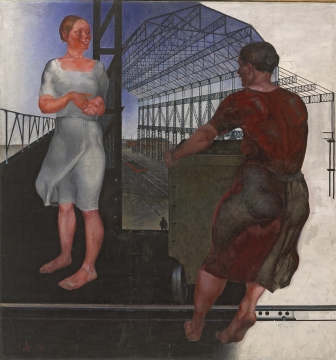
Alexander Deineka addressed this theme as early as the 1920s. In the painting «On the Construction Site of New Workshops,» the figures of the workers are set against the backdrop of massive metal structures of an industrial building. The human figure is not separate from production here; they are situated within the space of the construction site, among beams, ceilings, and building frameworks. Yet, the workers do not become lost in the industrial landscape—rather, they become the main protagonists of the changes taking place.
[Alexander Deineka. «On the Construction Site of New Workshops.» 1926. Canvas, oil. 209×200 cm. State Tretyakov Gallery]