Concept
My research topic is «Art as a Means for the Primitive Person to Understand the World.» I chose this topic because prehistoric art allows us to see the earliest stages of the formation of artistic thought. I was interested in how early humans, without established artistic traditions, created the first models of the world through imagery. Paleolithic art reflects how people learned to differentiate objects, understand animal behavior, and interpret natural phenomena, gradually moving from recording isolated observations to creating complex structures and symbolic images. Studying this process reveals how human understanding of the world was born through visual forms.
Key research question: How did the primitive person, lacking established artistic traditions, use art to comprehend, analyze, and structure the surrounding world, and how did their creativity evolve alongside their expanding worldview and understanding of the environment?
Research hypothesis: The evolution of prehistoric human creativity reflects the gradual complication of their perception, analytical skills, and ability to structure the surrounding reality. In this work, I aim to trace this connection and to examine how early humans depicted their world without formed artistic conventions.
For this study, I am selecting visual material that illustrates how the methods of perceiving and understanding the world have evolved in primitive art. The selection includes only works that fall into figurative forms (painting, graphic arts, sculpture, or relief).
The primary selection criterion for the material is the object’s capacity to demonstrate a specific stage in the development of human artistic thought—moving from simple outline drawings to more complex scenes and compositions. The material in the work is structured on the principle of «from simple to complex» to illustrate how, as human perception of the surrounding world grew more intricate, their methods of depiction became more complex, and artistic forms became more detailed, compositionally thoughtful, and rich.
The work consists of three parts, each reflecting a specific stage in the development of early human artistic thought.
- The first part examines simple objects that demonstrate humans' initial observations of the world around them.
- The second part displays more complex scenes and group imagery, which illustrate the systematization of knowledge, and the interaction between people and their environment, and among themselves.
- The third part explores more elaborate signs and petroglyphic systems, the emergence of detailed scenes featuring humans and animals, as well as figurines and ceramics that reflect new social and ritualistic concepts of humanity.
Part 1.
Symbols
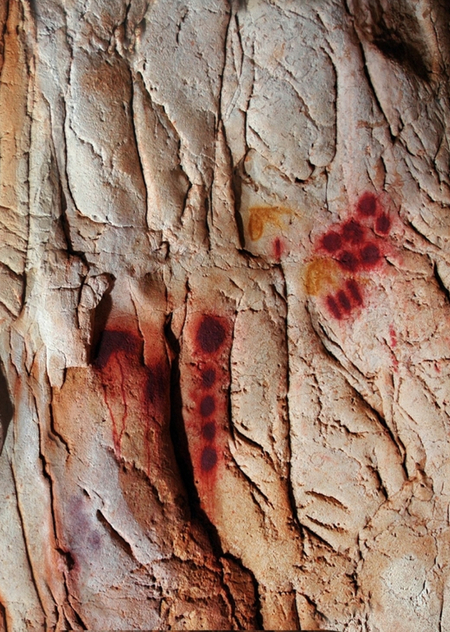
In the earliest stages, early humans used creativity as a tool for understanding the world around them. Without writing or established artistic conventions, they recorded individual objects—their form, movement, and behavior. Such images allowed them to analyze their surroundings, systematize knowledge, and form concepts of animals, humans, and natural objects. The depiction of abstract symbols was the first thing early humans began to draw on cave walls. These appeared long before depictions of animals. For example, a reddish-ochre disk dating back about 39,000 years was found in the El Castillo Cave (Spain), and most basic forms (lines, dots, angles) were recorded at the very beginning of the Upper Paleolithic.


These symbols can be viewed not as decoration, but as an early form of communication. They were also part of ritual.
Inscriptions in the La Pasiega cave (Spain)
The most common symbols were handprints and dots. Handprints were created in two ways: either the palm was pressed against a rock and paint was sprayed around it, resulting in a «negative» silhouette, or the palm itself was coated with colored pigment and pressed onto the surface, leaving a «positive» imprint. These markings can be considered the first self-portraits of humans, created to document their existence, and perhaps as a form of communication with future generations.
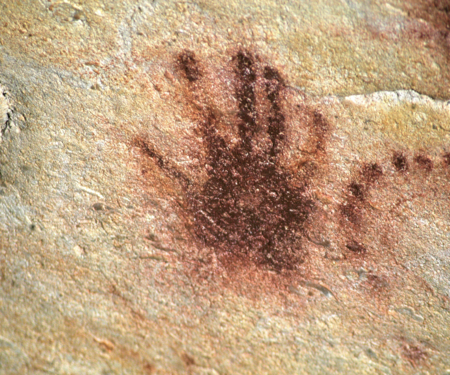
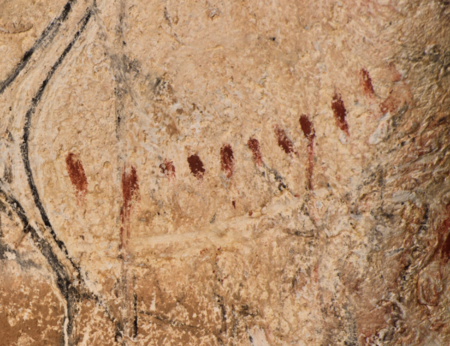
Hand and finger prints in the Chauvet Cave (France)
Handprints. Cuevas de las Manos Cave (Argentina)
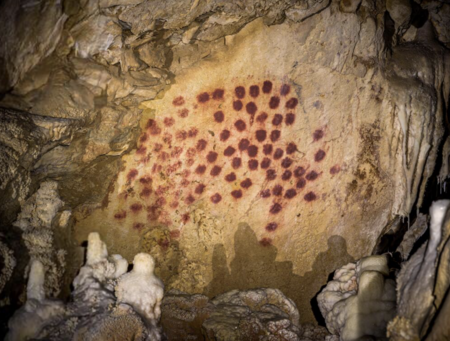
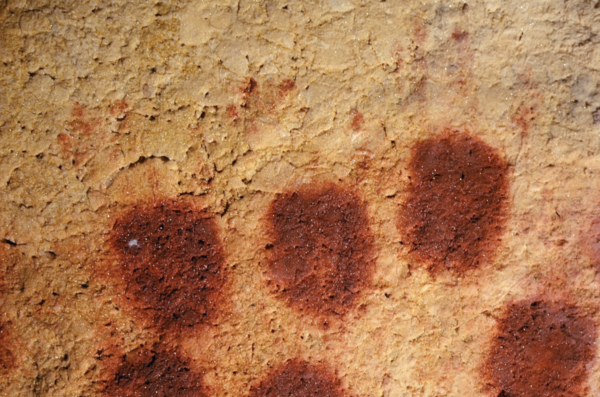
Handprints in the Chauvet Cave (France)
Handprint and Footprint. Grotto Cosque (France)
The caves also feature grooves, or «macaroni lines”—lines scraped into the soft cave surface with fingers. These grooves were often superimposed over depictions of animals or over scratches left by giant bears centuries earlier. Creating these grooves was both a ritual and a symbol. It documented human presence in the cave and illustrated its interaction with dangerous animals.
Furrows on the ceiling of Altamira. Detailing.
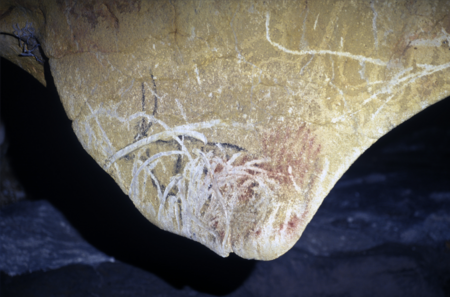
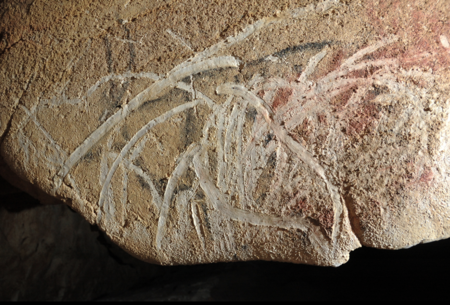
Handprints over the image of an animal. Chauvet Cave (France)
Animals
Animals were the most common subject matter at the time. This was not coincidental: they occupied a central place in human life, supplying all necessary resources.
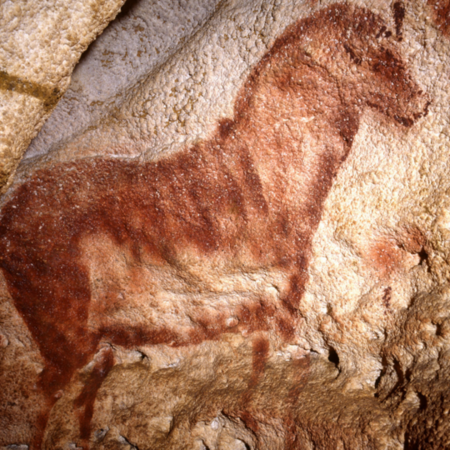
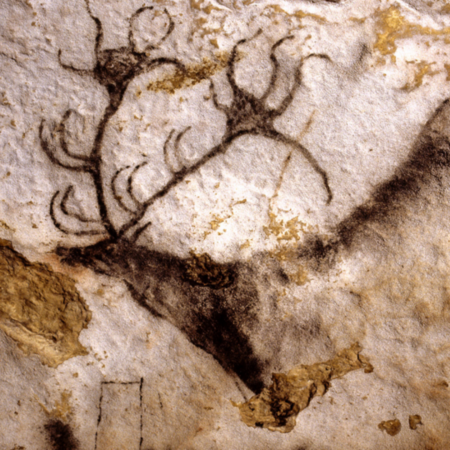
Images of a horse and a reindeer in the Lascaux Cave (France)
Image of a cow and a horse. Lascaux Cave (France)
Early humans observed animals with intense focus: they studied anatomy, movement, and behavior. Then, with just a few lines and spots, the artist depicted them, conveying the plasticity and external characteristics. For example, in the cave paintings of Lascaux, the shape of the antlers on the deer and the cow was rendered with particular care, as they are the animal’s primary distinguishing feature.
Cow image. Lascaux Cave (France)
Human
While animals in early art are often depicted with observation and expression, the human figures from the initial stages appear much more simplified. One of the most striking examples of how ancient humans attempted to comprehend their own bodies and their role in the surrounding world is the so-called «Paleolithic Venus”—small figurines made from stone, bone, or mammoth ivory. The oldest of these is the Venus of Hohle Fels (approximately 40,000 BCE), discovered in the Hohle Fels Cave in Swabia. It is considered the oldest depiction of the human body in world history.
Venus from Höhlefels (Swabia)
This figure, despite its miniature size, features distinctly pronounced female forms—an emphasis on the breasts, abdomen, and hips. This characteristic is also evident in other statuettes from the early and middle Paleolithic periods.