Как рассказывают миниатюры Библии Моргана
Одни и те же сюжеты в трёх французских рукописях XIII века
Concept
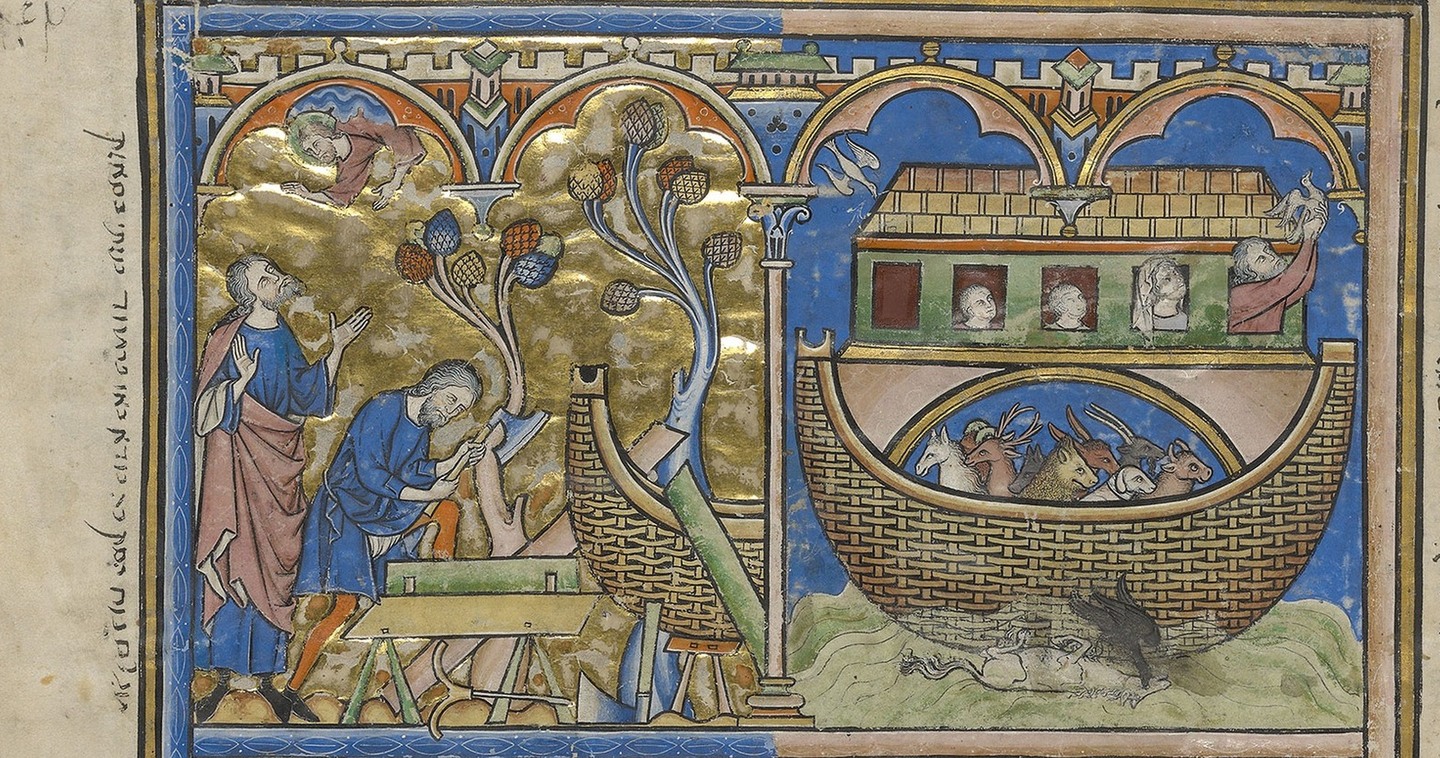
Why This TopicMorgan Noah’s work appears several times on one sheet of the Morgan Bible. First, he constructs the ark, then he is inside and releases the birds. The eye moves from one figure to another, and the static miniatures coalesce into a narrative. In the Psalter of Louis Saint, the same episode is arranged differently. There, you first notice the ark itself, and you find Noah’s hand gesture as the dove. Comparing the same subject across different books allows us to see exactly what changes the order in which the viewer perceives the figures, objects, and actions.
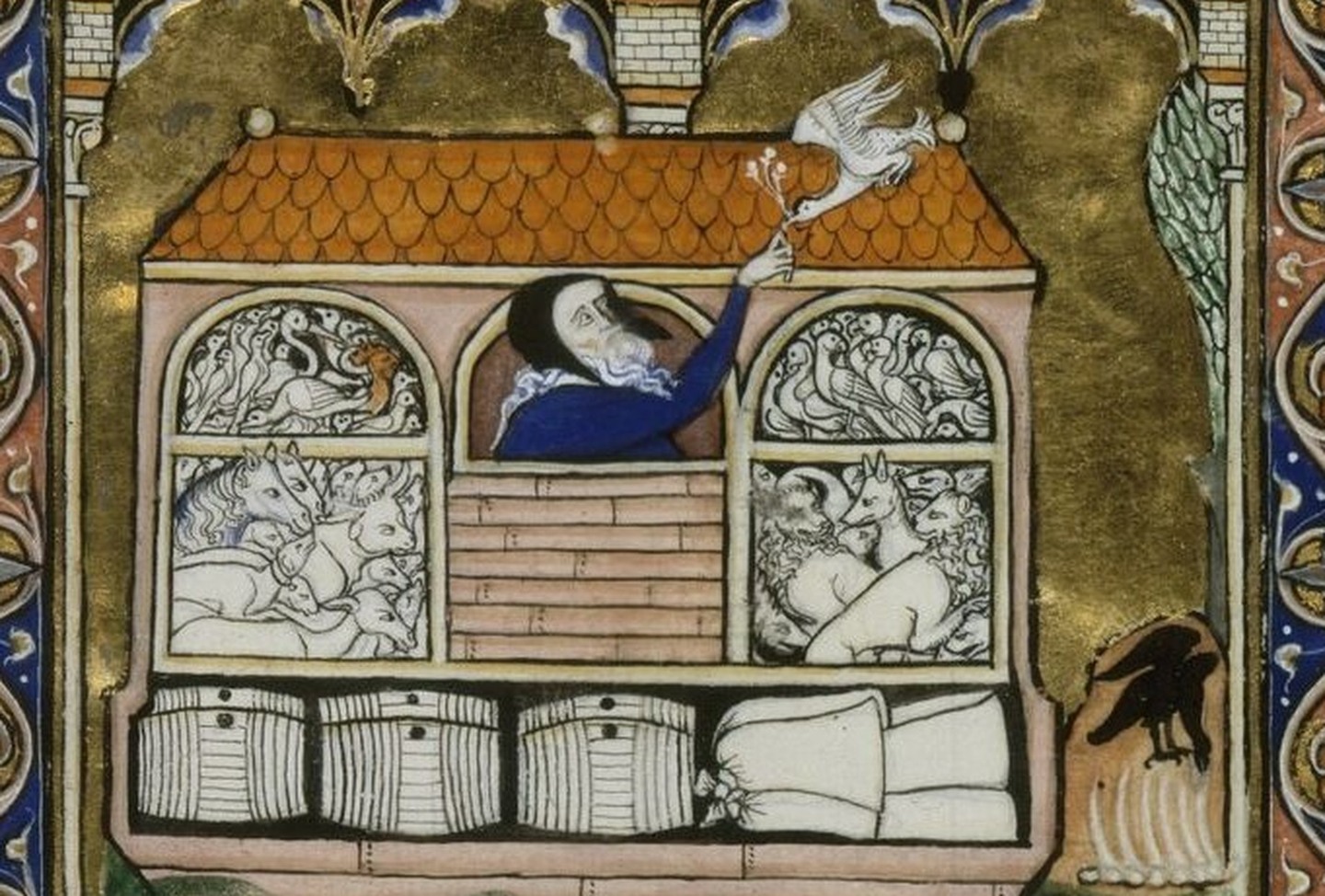
Key Question and HypothesisHow does the composition of a miniature help us understand what is happening now versus what happened previously? The hypothesis is that in Morgan’s Bible, the sequence of events is particularly clearly readable through the repetition of figures within a row. In the Psalter, adjacent actions may be separated by arches or leaf boundaries. In the Oxford Bible, the border of the medallion gathers figures and objects around a single action. To test this premise, in each scene, we can trace where the gaze stops first, where poses and gestures lead it, and how it transitions to the next episode.Noah with the Dove. Psalter of Louis of Saint, f. 3v.
How the Thumbnails Were Selected
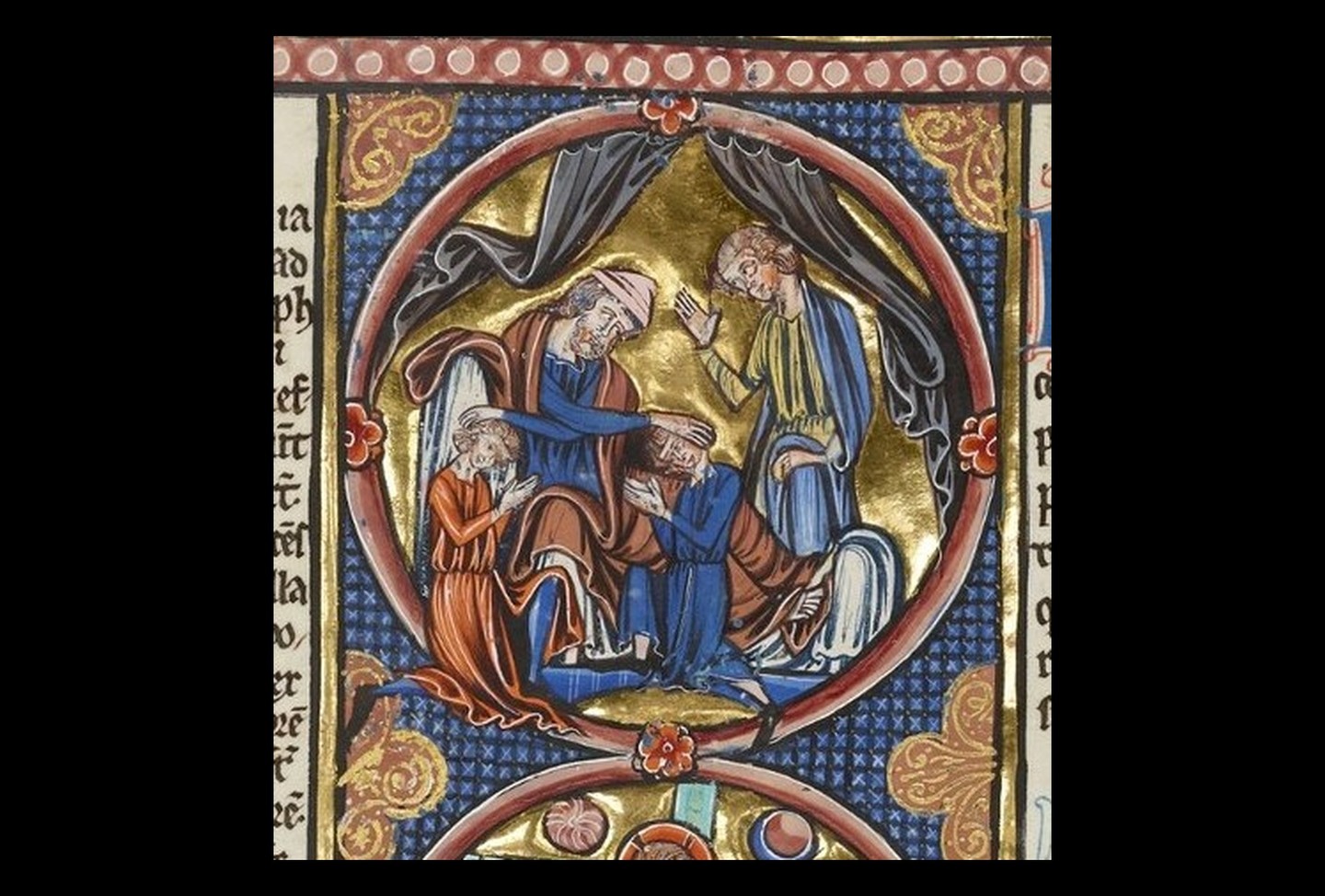
The study centers on three 13th-century French manuscripts. Episodes were selected for comparison if they could be identified in at least two of the manuscripts by characters, objects, or action. The blessing of Jacob’s grandchildren, Moses meeting the burning bush, and the fall of Dagon are presented in all three books. Full pages show the placement of the scene on the folio and what it is adjacent to. Enlarged fragments allow for easier comparison of details—for instance, in the medallion with Jacob, one can examine the crossed arms, the positioning of the grandchildren, and how the figures are arranged within the circle.
Jacob blesses his grandchildren. Oxford Moralized Bible, folio 34r.
How the Long Read is StructuredThe first section gathers early stories of Being, from Cain and Abel to Jacob’s wrestling match with the angel. The second section traces Joseph’s story across several episodes, from the well to his family’s meeting with Pharaoh. The third section presents three versions of each plot. All sections use the same viewing order. First, you can locate the central figure or object, then trace the direction of gestures and gazes, and finally, observe where the scene boundaries lie. This order helps compare individual details and understand how they function within the composition of the entire page.
From left to right: Morgan Bible, fol. 2v (c. 1244–1254) · Psalter of St. Louis, fol. 3v (c. 1270) · Oxford Moralized Bible, fol. 34r (c. 1233).
How Textual Sources Were Utilized
In library catalogs, the folio numbers, dates, and episode titles are cross-referenced. Plot descriptions help verify who is depicted and to what point in the narrative the scene belongs. For context, the bibliography includes studies by Harvey Stahl on the Psalter of St. Louis and John Lowden on the Moralized Bibles. The images themselves are compared based on features visible in the reproductions—for instance, whether a character is repeated within a single folio, where the artist places a significant object, and which figures are highlighted with color. Catalog references are gathered at the end of the work so that a complete folio can be opened to correlate observations with the image.
The First Stories of Being
Cain and Abel
On the left is Morgan’s Bible, folio 2r. On the right is St. Louis’ Psalter, folios 1v and 2r.In the scene of the offering, the brothers stand on either side of the altar. In the scene of the killing, everything changes: Cain’s hand and Abel’s body form a sharp diagonal. These moments are separated across different leaves in the Psalter. In Morgan’s Bible, the transition from the tranquil scene to the blow is visible in a single row.
Noah and the dove
Morgan’s Bible, 2v · The Psalter of Saint Louis, 3v.On the left, the ark resembles a vessel floating on water. On the right, it resembles a cutaway house, showing the roof, tiers, and animals inside. It is easier to spot the dove by following Noah’s outstretched arm. In the Psalter, the artist placed the ark in the center, giving more space to what is happening inside.
Noah’s Intoxication
Morgan’s Bible, fol. 3r · The Psalter of St. Louis, fol. 4r.On the left, the gaze moves from the grapevine toward the reclining Noah. On the right, people are clustered more tightly around Noah, and a light fabric is immediately visible against the blue and gold background. From the fabric’s drape, one can trace the movement of arms and understand that Noah is being covered.
Abraham and Melchizedek
Morgan Bible, fol. 3v · Psalter of Louis IX, fol. 6r.In the Morgan Bible, horses and spears take up a significant portion of the space. A kneeling figure stands out among them, and the gaze rests on the encounter with Melchizedek. In the Psalter, the meeting occurs nearly in the center, between the arches. Here, it is easier to notice due to the hands and the offering.
Lot’s Flight from Sodom
Morgan Bible, fol. 4r · Psalter of Louis IX, fol. 9v.The leaning buildings help reveal the moment of destruction in both versions. In the Morgan Bible, the city and the receding family are visible in the same row. In the Psalter, the pillar between the arches divides the image in half. On the left, light-colored buildings fall, while on the right, the figures remain together and depart.
The Sacrifice of Isaac
Morgan Bible, fol. 3r · Psalter of Louis IX, fol. 10r.In the Morgan Bible, there is more space around the figures, which allows the approach to the altar to be seen. In the Psalter, the gaze is immediately drawn to the bright altar. There, the raised hand of Abraham and the hand of an angel meet. These two gestures show that a blow is about to occur, but it is being stopped.
Jacob’s Dream