Concept
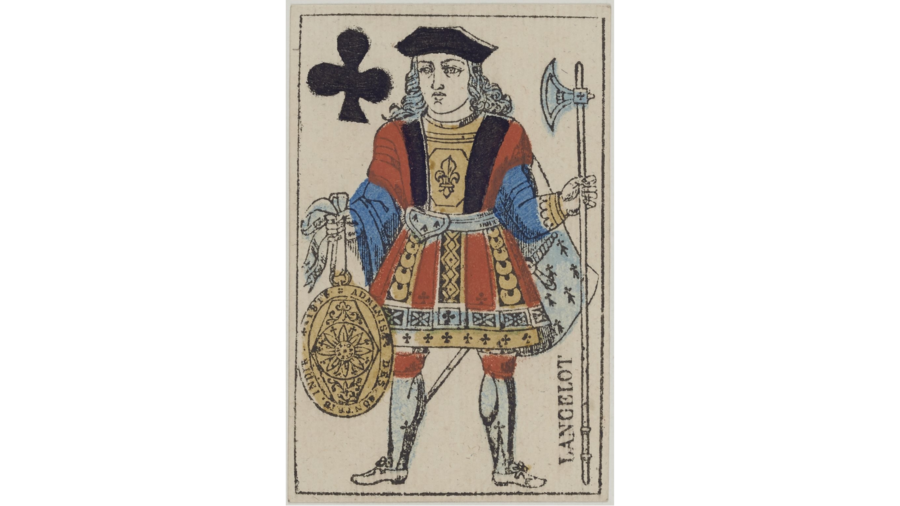
Clubs Jack from the official portrait deck, 1816 / Nicolas-Marie Gattó
The valet holds a locket inscribed with «1816 · Administ. des Contrib. Indir.”—“Administration of Indirect Taxes, 1816, ” and on his chest is the Bourbon lily. The object of leisure bears the inscription of the tax authority and the coat of arms of the ruling dynasty. Why they ended up here and what remains of them—that is the question of the entire project.
The valet holds a locket inscribed with «1816 · Administ. des Contrib. Indir.» — «Administration of Indirect Taxes, 1816”—and on his chest is the fleur-de-lis of the Bourbons. The object of leisure bears the signature of a tax office and the coat of arms of the ruling dynasty. Why they ended up here and what remains of them is the question of the entire work. The answer lies not only in the history of the style but also in the history of money: in who owned the deck’s design and who profited from it.In France, playing cards have been almost continuously taxed since the 1580s [3; 5]. In art history, they are more often viewed as an example of popular engraving or as a carrier of political iconography, such as revolutionary propaganda [1]. Much less frequently are the cards' appearance linked to the economic model of production: to who commissioned the design, who protected it from counterfeiting, and who earned the revenue. This perspective allows one to see how the socio-political context is transformed into form on a single small object. The question of who owns the image of a mass-produced item remains relevant today, in debates over mandatory labeling, design rights, and brand counterfeiting.
Following Osterwalder and Pine, the business model is understood as the logic by which an organization creates, delivers, and captures value [10]. Applied to this deck, this translates into three questions: who owns the design, who pays, and who receives the revenue. In the French tradition, a stable design for the deck figures is referred to as a «portrait, ” and the artisan who creates it is called a „cartier.“ There are three protagonists in this narrative: the treasury, the owner of the design, and the player. Since the tax is levied only on sold decks, the treasury’s income depends on whether the player chooses to purchase it.
The research structure is organized as follows:
1. Purchase Right. The deck owned by the treasury (pre-1791)
2. Patent. The deck owned by the author (1791–1797)
3. Monopoly. The deck designed by the state (1797–1810)
4. Compromise. The deck chosen by the player (1811–1827)
5. Conclusion
Each card is read as three layers. The game layer is what the player needs: the suit and the recognizable figure. The fiscal layer is what the treasury needs: the stamp, the paper, the department mark. The authorial layer is what the drawing owner needs: the signature, the patent, the style. In each section, it is traced which layer takes precedence and why. Images are paired, for example, David’s card and his historical paintings, while patent inscriptions, the deck wrapping, and the pendant on the case are shown in large fragments. The study is built in a cycle—it begins and ends with the trump jack.
The study includes standard mass-market decks and their production documents: print sheets for figures, advertising sheets, designs, and packaging; David’s paintings are used for comparison. Gift and divination decks are not examined. Only items that show a visible trace of a business model are selected. The images are primarily sourced from the collections of the National Library of France, the Victoria and Albert Museum, the Lyon Archive, and the Louvre.
The sources are divided into three groups. The first consists of the specialized history of French playing cards: the catalog of the «Maps of the Revolution» exhibition at the French Museum of Playing Cards [1] and the work by A.-R. d’Allemand [2]. The second group is fiscal history: E. Belme’s book on card games in France during the early Modern period [3], M.-L. Legge’s article on card levies [4], and a review of the 1890 card legislation [5]. The third group comprises descriptions of specific items in museum databases and dedicated articles about them [6–9]; these are used to verify the dating and attribution of each image. Individual facts are further clarified using reference materials and collectors' websites [11–19]. French texts are provided with a reference to the original.
Key question: How did the shift in card manufacturing business models in France between 1791 and 1827 change the appearance of the deck of playing cards?
Hypothesis: each shift in the business model redrew the deck, but only the image chosen by the player proved stable—and ultimately, the state maintained power not over the design itself, but over its carrier.
1. Tax Farming: a deck of cards owned by the treasury (prior to 1791)
Under the Old Regime, the state did not draw or produce maps. It sold the right to collect taxes: in the 18th century, tax collection from packs transitioned from a private concession to state management [3], and the monarch transferred a portion of the revenue to support the Military School [4]. Cartier was a guild master who worked only in authorized cities and printed on paper with the department’s seal [5]. The drawing of a pack did not belong to any single person; it was a collective tradition codified by the tax regulations across districts. This section shows that the fiscal layer is already present in the map, but only as a marker indicating the place and method of production.
Ill. 2. Maps of the Parisian Portrait, 1719–1746 / Jean Chalume, cartier
This is that Parisian portrait that will triumph over David’s project nearly a century later. The forms are simple: woodcut, stencil coloring, yet each can be recognized at a glance. The gameplay layer is paramount here: the player requires recognizability, not elegance. The selection is drawn from the collection of A.-R. d’Allemand, author of the classic history of French maps [2].
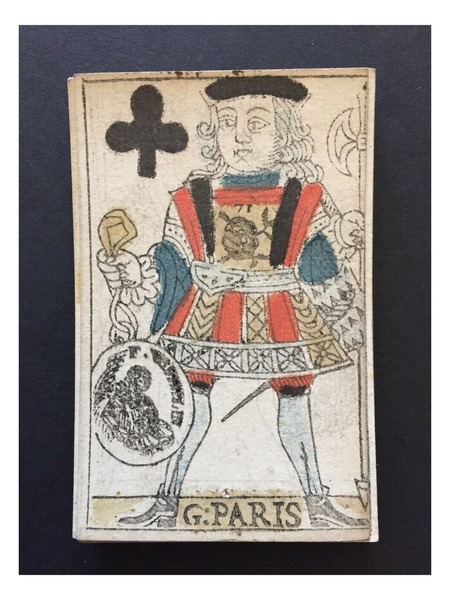
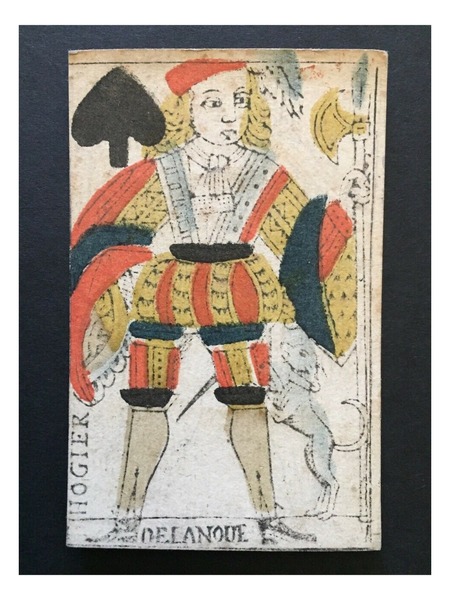
Ill. 2a. Clover Jack marked «G. PARIS» and a spade jack bearing the master’s name, circa 1750 / Cartier Delanu, Paris
At the bottom of the club pip is the marking «G. PARIS, ” which indicates the „Parisian General Directorate”—a tax district [11], and on the point pip is the master’s name, „Delanoue.“ Through these markings, the treasury learns where the deck was made, who is responsible for it, and where it was paid for. This is not the signature of the author, but the payer’s address. It is also important which card bears the marking: on the club pip—the very card onto which the empire will place the medallion of its tax authority six decades later (Fig. 16a).
Fig. 3. Cards from the Provençal Portrait Deck, 18th Century / unknown master, Avignon
Since 1701, each of France’s nine regional card districts was assigned an approved pattern of figures so that tax officials could identify the origin of the deck [15]. Therefore, the difference between the Parisian and Provençal figures is not a matter of workshop style, but of tax geography. The regulation transforms the design into a document: the figure indicates not «who drew it, ” but „where the tax was paid.“ It is telling that the Provençal pattern was also printed in Avignon, which belonged to the Pope until 1791—the approved design became a common language throughout the entire region.
Fig. 4. Impression of an approved printing block for figures, September 30, 1711 / Lyon master-carvers
Each figure bears the marking «G. D. Lyon N. 4, ” which stands for „Lyon’s guild system.“ The inscription on the sheet notes that the city’s master craftsmen would begin printing maps with this block in the „form bureau“ starting September 30, 1711 [12]. Such impressions were kept for quality control [12]. The earliest tax decrees introduced an „official form“ and casings that Cartier paid for himself [5]. The design is registered to the institution, and the master is not permitted to alter it.
Fig. 4a. Inscription about the «bureau of form.» Fragment from the same sheet, 1711 / Lyon master-carters
In one line converge the masters, the figure drawing, and the institution where they are reproduced. The form of the figure here is part of the surveillance. This is the state’s first move into the image: it is not yet painting, but it is already affirming.
Fig. 5. Parisian Portrait Cards, 1770–1808 / Workshops of Charles Iber and Guillaume Mandre
From the 1770s to the 1800s, the workshops of Ybert and Mandrou produced the same Parisian portrait [13]. The masters' names appear directly on the cards: «Ybert» on the queen of hearts, «Mandrou» on the king of clubs. This consistency benefited both parties: the treasury found it easier to verify a familiar design, and the player could use a customary deck. Later, these cards were found alongside the official 1816 portrait in a set at the National Library (Fig. 18).
In summary, in the redemption model, the treasury owns not the image itself, but the right to collection. The fiscal layer manifests in the markings: round shape, approved form, paper, packaging. The gaming layer defines the figures themselves and is almost static. There is no authorial layer: the Cartier name is a manufacturer’s mark, not an artist’s signature.
2. Patent: A deck owned by the author (1791–1797)
On March 2, 1791, card collection taxes were abolished [5]. In the same year, patent laws replaced royal privileges, and the design of a deck could for the first time become the private property of an individual [6]. The business model was shifting: revenue was no longer generated by tax but by the sale of novel ideas protected by a patent. Numerous revolutionary decks emerged in the market, and each publisher offered its own. In this section, the authorship layer takes center stage, but the gameplay does not disappear; rather, the fiscal element is embedded in the paper itself.
Ill. 6. Advertisement Sheet «New Maps of the French Republic, ” 1793 / Jean-Domesfens Duguerc, Urban Jom
This isn’t a deck of cards; it’s an advertisement for it. Kings, queens, and knaves have been replaced by Geniuses, Freedom, and Equality, and above them, according to the publishers' vision, stands only the Law [18]. The deck was offered as a «textbook of revolution, ” and the publishers thoroughly explained the meaning of each attribute to the buyer [18]. The very fact that it was an advertisement indicates a new model: the image now needs to be sold, not approved.