Concept
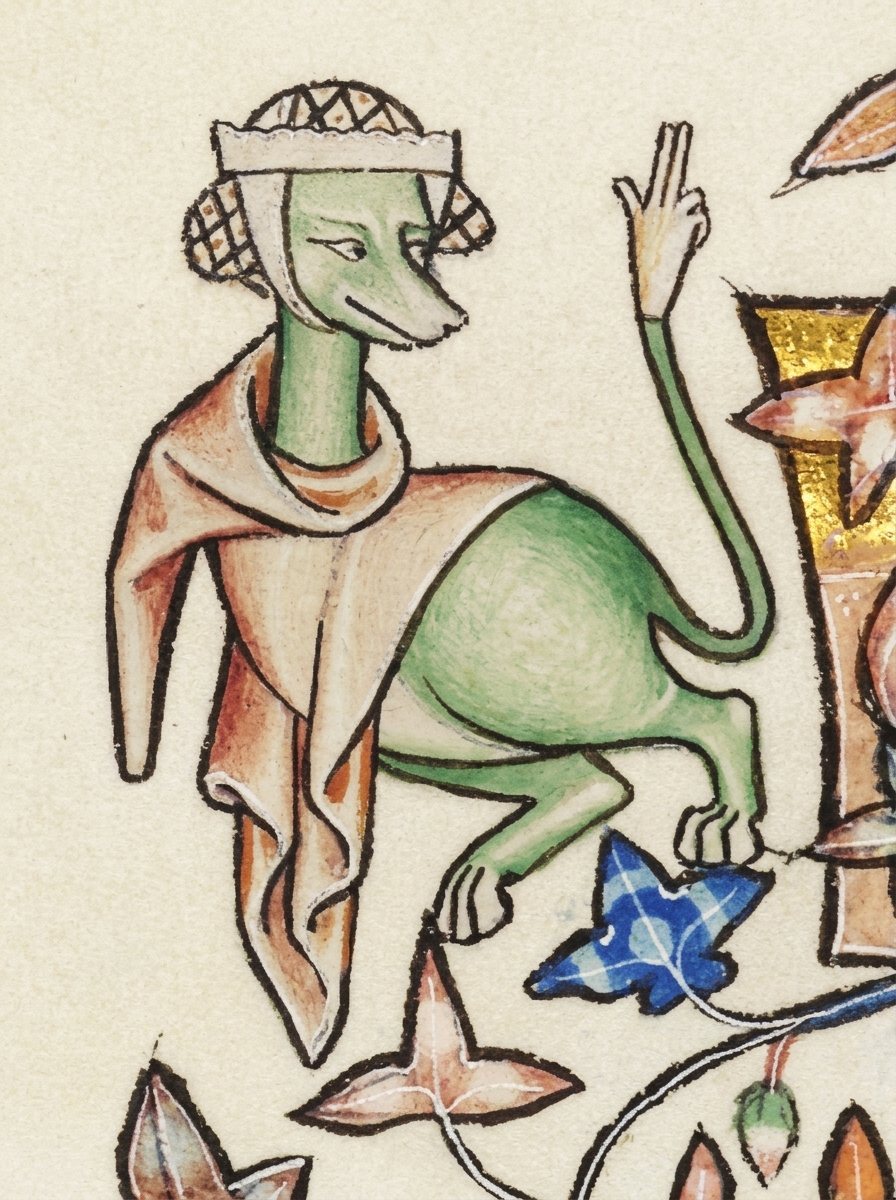
The illuminated manuscript from the 13th–14th centuries was not merely a text carrier; it was a genuine work of art. The letters, initials, borders, miniatures, and marginal drawings coalesced into a unified page composition. The margins often featured figures with animal heads, beasts dressed in human attire, various hybrids, and musicians riding the most incredible creatures. Scenes with role-swapping and performances using recognizable props frequently unfolded alongside them. Such illustrations are known as marginalia. Their placement at the edge does not render them accidental; the form of each figure is dependent on the frame, adjacent lines, and the size of the sheet.
Manuscript margins are typically perceived as a secondary area adjacent to the main text and primary miniatures, while marginalia is seen as a collection of whimsical illustrations. In reality, the margins allowed the masters to do things that the main miniatures did not permit: alter scale, connect incompatible forms, and construct a scene from multiple frames. Therefore, by analyzing how these images are structured, we see not only their narratives but also how artists engaged with the page’s space.
Manuscript margins are typically perceived as a secondary area adjacent to the text and main miniatures, while marginalia is viewed as a collection of curious drawings. In reality, the margins allowed the master to do things that the main miniature did not permit: shifting scale, combining incompatible forms, or building a scene from multiple frames. Therefore, by examining how these images are constructed, we see not only their narratives but also how the artists engaged with the page’s space.
The primary sources are the manuscripts themselves in digitized form, their descriptions in the catalogs of the British and Bodleian Libraries, as well as the Fitzwilliam Museum. For scholarly literature, I rely on M. Kamil’s book Image on the Edge (1992), L. Randall’s works on marginalia and the snail motif (1962, 1966), K. Varty’s article on the fox in the Smithfield decretals (1963), and E. Chartrand’s article on the «knight and snail» motif (2023). I treat the researchers' conclusions as interpretations and verify them against specific folios.
The research question reads: what artistic means did the masters use to create comic and grotesque imagery in the margins, and how is this imagery integrated into the page’s composition? To answer this, I analyze every leaf using the same parameters: where the figure is positioned (bottom margin, side border, initial); how it relates to the frame (leans on it, grows out of it, crosses it); its scale in relation to the text; line and color; and what technique is employed (hybridization, inversion, exaggeration, series). The iconographic method is only necessary to understand the subject matter and to compare recurring motifs—such as the fox, the snail, or the musician. I only adopt social or satirical interpretations when the leaf’s composition itself confirms them.
The work is divided into four sections. They proceed from how a field relates to the page to what primary technique is employed within it. The first section describes the structure of the field and compares solutions across three psalters. The second is dedicated to hybrids, where silhouette and attribute are important. The third covers inversions and role switching. The fourth focuses on narrative series that extend across multiple pages. This progression moves from the overall page structure to individual techniques, culminating in the most complex case—a story spread across several pages.
The hypothesis consists of two parts. The first is that marginalia is not a random collection of decorations, but rather an organized artistic layer of the book, subordinate to the frame of the page. The second is that the method of scene construction depends on the format and type of the book. In small Psalters, the field is designed for a single completed scene, whereas in large Decratoria, it is designed for a series that spans multiple leaves.
Field as a Space for Artistic Play
The form of the marginalia always depends on the page: on the available space, the border contour, the proximity of the text, or the continuation of a decorative line. Therefore, the analysis of the figure begins with the overall structure of the sheet. The bottom field may transform into a scene, while the side may become a branch where birds and animals are perched. Sometimes the figure grows directly out of a letter or presses against an ornament.
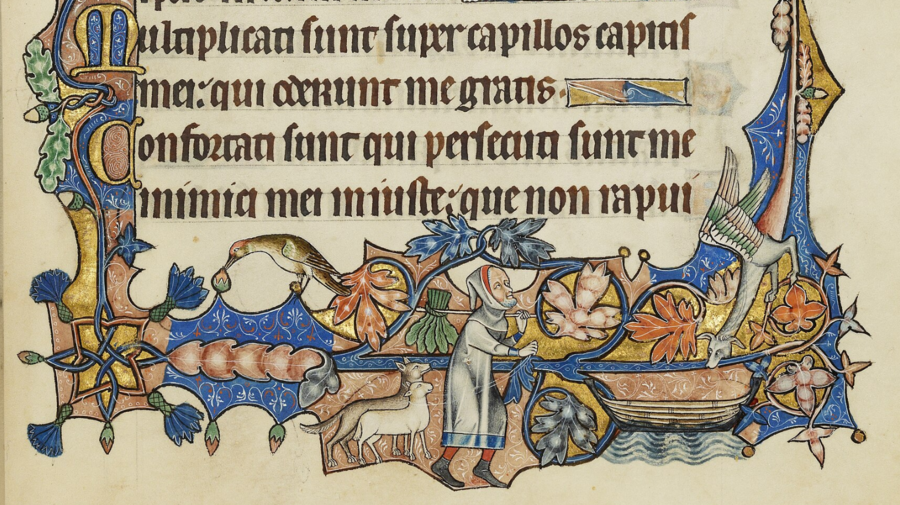
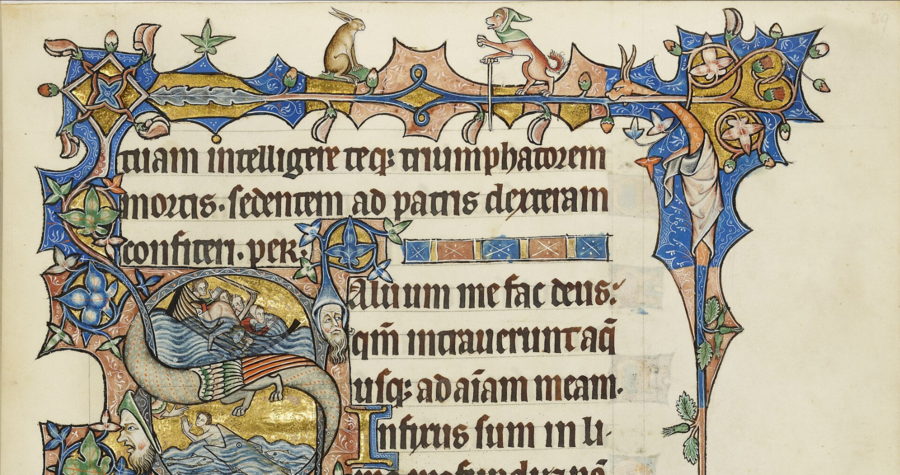
Unknown artist. Sheet with Psalm 68 (69) and a scene in the lower field. Ormsby Psalter. 1250–1330.
In Ormsby’s Psalter, the lower section of one leaf features a scene with a person, animals, and a boat. The psalm text is centered, and the figures at the bottom are arranged horizontally along the line separating land and water. The expressive power here relies not on complex anatomy or a rich background, but on the clarity of the actions. The wolf, goat, and cabbage being ferried across the river form a recognizable sequence—the viewer completes the narrative in their mind. The artist breaks the subject into several large elements, allowing the scene to be immediately legible despite its small size. The humor arises from the contrast between the mundane task and the psalm text, but seeing it as a mockery of the psalm would be too hasty.
In the Macclesfield Psalter, the layout is quite different. The text is enclosed within a frame on a gilded background, which is decorated with foliage, birds, animals, knots, nude figures, and hybrids. The lower margins of almost every page are occupied by a separate scene or character. The frame here does more than just contain the text: its lines create a space into which the figures and their movements are inscribed. The golden background emphasizes the decorative unity, while the small figures animate the rigid geometry of the book block.
On page 107 of the Gorlston Psalter, a depiction of Christ’s face is featured above a group of musicians, while a horizontal row of performers with various instruments is arranged below. Repeating figures and gestures establish a rhythm that balances the upper portion of the page. On page 8r, the initial letter, scenes of a hunt, and David’s duel with Goliath coalesce into a unified visual sequence.
So, three psalters with similar illustration programs yield three distinct field solutions: one featuring horizontal action in Ormsby, a gold border with small embedded figures in Macklesfield, and a rhythmic row of repeating shapes in Gorlston. In all three instances, the field is structured by and subservient to the frame.
Impossible Body: Hybrids
The hybrids in these manuscripts are arranged according to a simple scheme: a recognizable attribute is placed on an impossible foundation. This is clearly visible in the first example. In the Macclesfield Psalter, on folio 9r, a large initial transitions into a frame, and the lower field is occupied by a combat scene. The figures include a hybrid musician, a warrior, and a griffin. The figures are small, but their movement is directed: the weapons and bodies form diagonals that disrupt the calm rhythm of the frame. The lower field transforms into a small arena.
On page 130 of the same manuscript, a musician with a shawm and a drum sits astride a hybrid creature. The two instruments set the rhythm through gestures, while the rider’s figure structures the entire composition diagonally. Color emphasizes body parts and attributes, but the silhouette remains unified. The absurdity arises from the combination of a familiar activity (playing an instrument) and a fantastical mode of transport.
On plate 140r, Saint Dunstan clamps the devil’s nose with blacksmith’s tongs. Dunstan was both a bishop and a skilled blacksmith, so the attribute is immediately recognizable. The contrast is built upon behavior: the saint is confident and serene, while the devil is contorted. The tongs lend the scene a resemblance to craftwork and become its primary compositional accent. The devil’s face was intentionally erased later (according to the Fitzwilliam Museum), so we can only judge its form by the surviving details.
In these examples, anatomical accuracy is not necessary for the artist. What is important is the silhouette and the clarity of the transformation. A familiar object—a tool, a weapon, tongs—remains recognizable but functions within a new combination. This is what makes the impossible body legible. On pages 164 and 183, the same scheme yields different variations: a hybrid with two heads and a nude figure riding a donkey backward.
Inside Out: Inversion and Role Reversal
The comedic effect is often created by reversing familiar roles. An animal is given clothing, a profession, or a symbol of authority, while a human finds themselves in a situation where the animals become the central figures. This technique is called visual inversion. It is understood without explanation: the viewer recognizes an attribute (a mitre, a staff, a weapon, a tool) and immediately notices that the owner does not match the expected role. However, not every such scene can be considered satire. Interpretation requires considering the context, the sequence of episodes, and the literary narratives.
One of the most striking examples is the Smithfield Psalter. Reynard the Fox, dressed as a bishop, preaches to the birds. He carries a staff and wears a mitre, and geese and other birds gather before him. The posture precisely replicates a gesture of public oration: the figure is turned toward the listeners, the staff emphasizes his status, and the birds form an attentive audience. On the same leaf (49v), a woman beats the fox with a spinning wheel, and he flees with a goose in his mouth. On neighboring leaves of the cycle, geese drag the fox, and then hang him. The composition is structured around a vertical tree with a hanging figure, and the birds along the lower edge guide the viewer’s gaze toward the center. The predator, who is usually portrayed as a cunning deceiver, is punished by those he himself pursued.
In the Lattrell Psalter (folio 70v), a mermaid and a hunter are depicted in the lower register, with a dog attacking the hunter. The figures belong to disparate worlds: the mermaid has a human torso and a fish tail, while the male figure is shown through his clothing and posture. The juxtaposition of the mundane and the fantastical creates a striking contrast. In medieval art, mermaids were associated with temptation and peril, but the specific meaning of this scene cannot be reduced to such a formula. Visually, another element is more apparent: the scaly tail sharply contrasts with the man’s clothing and gear, and the horizontal layout unites the characters in a brief episode.
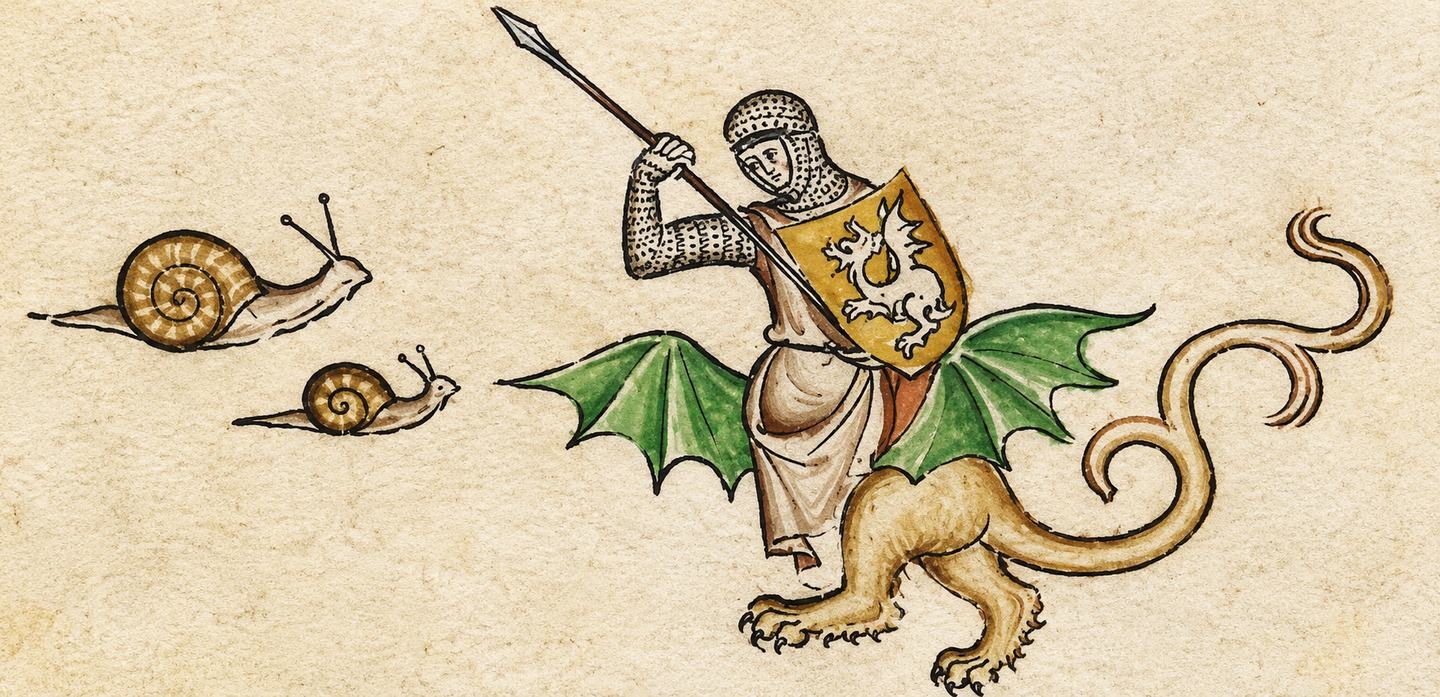
The knight versus snail duel (for example, Smithfield Dretalii, fol. 107r) is built on the shift in scale and status. Lillian Randall counted about seventy snail images across twenty-nine manuscripts and linked the motif to a satire of the moneylenders, who were considered cowardly usurers. Other researchers view this as an image of resurrection or a manifestation of the «upside-down world.»
Emily Chartrand suggested considering the snail’s position relative to the horizon line or the curvature of the border. Randall also notes that the motif is usually not related to adjacent text, but it often appears where the fields are based on inversion. For artistic analysis, the most important element is the contrast between the knight’s heroic pose and the deliberately disproportionate opponent: the difference in size makes the serious pose comical. The humor in marginalia is based not only on costuming animals but also on unexpected changes in scale and status.
Inversion is particularly effective because of its conciseness: just a few objects and gestures are enough to signify a social role and immediately show its transgression. The joke relies on a recognizable image, not on complex facial expressions. The fox in the mitre can be seen as a parody of the clergy, but it also alludes to the literary cycle about Renard. Therefore, where there is no additional evidence, the interpretation is based on iconographic tradition and the form of the image, rather than assuming a political statement.
Little Stories in the Margins
Some marginalia are structured not as a single figure, but as a sequence of actions. The lower panel transforms into a narrow stage that the viewer reads over time: the direction of gestures, figure rotations, and repetitions indicate the order of events.