Navigator
1. Research Concept— Relevance and rationale for topic selection — Research question — Principles for selecting works — Sources and chronological scope2. Polyphemus and Odysseus— Early depictions of Polyphemus in Greek art — Odysseus’s escape from the Cyclops’ cave — The scene of blinding Polyphemus — Anatomical features of the Cyclops figure — Composition and artistic devices in the depiction — Juxtaposition of mythological narratives: Polyphemus and other heroes — Chapter conclusion3. Polyphemus and Galatea— Polyphemus and the nymph Galatea: the meeting scene — Polyphemus and Galatea in a pastoral landscape — The pastoral world and the Cyclops' surroundings — Character interaction — The loving embrace: Polyphemus and Galatea — Comparison of anatomy and bodily plasticity — Chapter conclusion4. Polyphemus in Ancient Sculpture— The human and the monstrous in the image of Polyphemus — Polyphemus in Roman sculpture — The sculptural group from Sperlonga: the multi-figure composition — Space and scale in sculpture — Various ways of portraying Polyphemus — Chapter conclusion5. Conclusion6. Bibliography7. Image Sources
Rationale for Topic Selection
The Cyclops figure holds a special place in ancient mythology. Polyphemus is interesting because his appearance combines human features with unusual anatomy. In the story of Odysseus, he appears as a dangerous monster; however, in the myth of Galateia, he is presented in a different light—as a devoted giant in love. I am interested in how artists depicted this character and what visual techniques they used to emphasize his non-human nature or, conversely, to show his more human side.
Research Question
Polyphemus’s visual image is not static. His perception is shaped not only by his distinct anatomical features but also by his body’s plasticity, posture, facial expression, and interaction with other characters. In confrontation scenes with Odysseus, artists emphasize the Cyclops’s physical power and monstrous nature, whereas in depictions of the romantic plot with Galatea, his image can be perceived as more human.
Principles of Selection
The work will utilize scholarly publications on the history of ancient art and mythological iconography, museum catalogs, archaeological descriptions, and studies of specific monuments.The artworks themselves will be the primary material for analysis. Written sources and academic literature will be used to establish context, dating, attribution, and the interpretation of the depicted subjects.
Chronological Framework
For this study, works of ancient Greek and Roman art featuring Polyphemus in various mythological narratives were selected.The foundation is built upon Greek vase painting and sculpture, while Roman frescoes and sculptural groups are used as comparative material.
Polipem and Odysseus
This is one of the earliest known depictions of Polyphemus’s blinding episode in Greek art. The scene is situated on the narrow neck of an amphora: the Cyclops is at the center of the composition, while Odysseus and his companions drive a sharpened stake into his eye. Polyphemus holds a bowl of wine in his hand.
A clear contrast in scale is particularly noticeable in the composition. Polyphemus occupies the central position and is depicted significantly larger than the other characters. His massive figure is contrasted with the smaller human bodies of Odysseus and his companions. This ratio emphasizes the Cyclops’s physical superiority, yet it simultaneously shows that the heroes can overcome him through collective action. The organization of the scene is also interesting: several characters are gathered around a single focal point—Polyphemus’s eye. The viewer’s attention is directed straight to the action that determines the outcome of the confrontation.
Visual observation: already in early vase painting, the image of the monster is constructed not only on its unusual appearance but also on the contrast of its size with human figures.
Odysseus’s Escape from Polyphemus’s Cave
Unlike the previous piece, this one presents a different moment in the story. Odysseus leaves the cave, hiding beneath a ram’s belly. His companions also escape, concealed under the animals, but the vessel depicts specifically Odysseus’s flight.
Black-figure kylix depicting the flight of Odysseus. 550–525 BCE. Museum of Paul and Alexandra Kanellopoulos, Athens, Inv. Δ 2496.
It is important to note here that Polyphus himself is not depicted in the image. Therefore, the click does not allow for analysis of his appearance or body posture. However, it does show how the artists selected specific episodes from the myth and conveyed them through the actions of the main character.Particular significance is given to the silhouette of the ram and the figure of Odysseus positioned beneath its body. The technique of concealing a person under an animal conveys the hero’s principal cunning and allows the viewer to understand the plot without seeing the cyclops himself.
Visual Observation: The myth of Polyphemus could have been depicted not only through the monstrous figure but also through Odysseus’s actions. The absence of the Cyclops does not prevent the viewer from understanding which episode the scene belongs to.
The One-Eyed Giant: Polypem at the Cave Entrance
The vessel depicts the moment of Odysseus’s escape. Polyphemus, blinded, lies at the cave entrance, leaning on one hand and trying to feel the passing animals. Odysseus saves himself by holding onto the sheep’s belly.
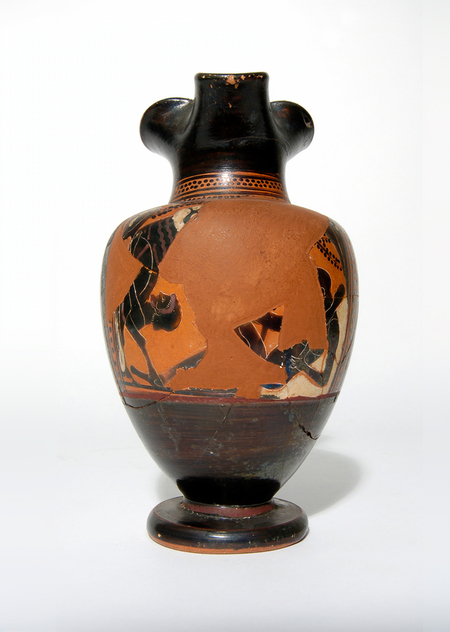
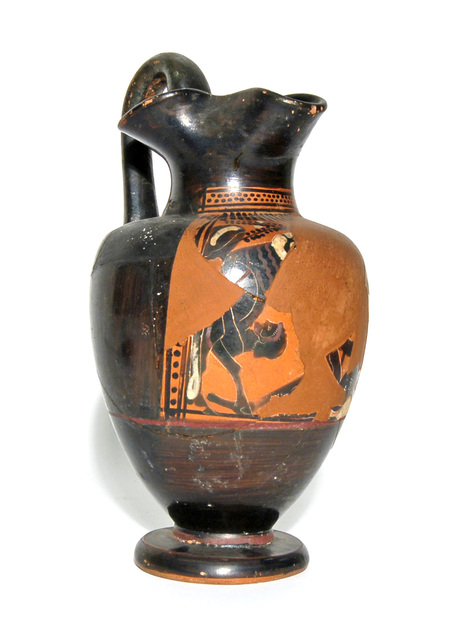
Black-figure aryballos depicting Odysseus and Polyphemus. Circa 500 BCE. British Museum, London, Inv. 1894.11-1.289. Attributed to the Athena workshop.
It is interesting to examine the posture of the Cyclops. Unlike the seated figure on the Amphora of Eleusis, Polyphemus is depicted lying down. His body takes up a significant portion of the composition and is positioned next to the figure of the ram, under which Odysseus is concealed.
The club emphasizes the Cyclops' physical strength and danger. However, his position simultaneously reveals vulnerability: he cannot see the man who is right beside him.
Visual Observation: The cyclops’s body becomes an important part of the composition. Its size and placement help convey both the character’s physical strength and vulnerability simultaneously.
Scene of Polyphemus' blinding in a Proto-Argive crater fragment
The fragment depicts Odysseus and his companions aiming weapons at the Cyclops. Polyphemus is shown in profile, so the visible eye is positioned to the side of his face. Based on this single image, it is impossible to definitively determine whether the artist intended the Cyclops to be one-eyed or simply employed a standard profile depiction of a human figure.
This is an important departure from the common modern perception of the cyclops. The artist was not necessarily aiming to accurately render the anatomy of a fantastic creature. Instead, they could employ familiar methods of depicting a human face while still maintaining the recognizable quality of the mythological narrative.
Visual observation: the depiction of the eye is influenced not only by the mythological concept of the Cyclops but also by the artistic conventions of the era. The profile view does not allow us to determine the number of eyes the character possesses.