«You should have taken the girl by request, not by force.» Publius Ovidius Naso. «Metamorphoses, ” Book V, Line 416; translated by Sergei Shervinsky.
This quote signifies the central conflict of the abduction motif—the collision with the desire to possess another’s will. In art, this becomes visible through the contrast between restraining and repelling gestures, the resistance of characters, the tension of bodies, and the opposition of directions. Ovid’s words set the starting point for the study: how sculptors transform violent capture into expressive plastic composition, and how they romanticize coercion, fear, and resistance behind the beauty of form.
Navigation
I. Concept II. How to Recognize Abduction III. Who Manages the Support IV. How the Body Resists V. Conclusion VI. List of References
I. Concept
The research topic is the plastic methods of depicting abduction in sculpture from the early 16th to the late 17th century. The focus is on the moment when one character restrains and moves another, encountering resistance. The choice of this topic stems from the desire to investigate the contradiction posed by examining specific works: the bodies can form a visually coherent composition, even though the depicted action is based on conflict. The study examines how the sculptural group simultaneously maintains formal unity while illustrating the dissonance of its participants' wills. In most such scenes, the victim is a woman, and the abductor is a man or a powerful creature; therefore, any discussion of form inevitably touches upon how the art of that era represented power over the female body.
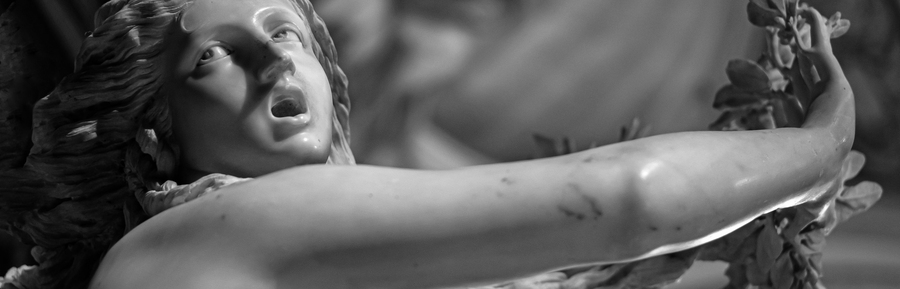
The hypothesis posits that the motif of abduction is structured through the conflict between the group’s overall cohesion and the characters’ divergent actions. Testing this hypothesis requires seeking both confirmation and limitations. If the hypothesized sign of resistance proves indistinguishable from another perspective or appears in a context of different meaning, its significance will require further clarification. The ultimate outcome of this research should be an explanation of how the arrangement of sculptural form allows one to perceive coercion and resistance, and where naming and knowledge of the narrative are necessary for such an interpretation.
II. How to Recognize an Abduction
Let’s start by asking: as viewers, how do we understand that what we are seeing is abduction, rather than a struggle, a dance, or an embrace? Sculpture lacks the visual cues that painting possesses—there is no landscape to explain the action, no architectural backdrop, no frame, no color. Only the bodies, their supports, arms, and movement remain.
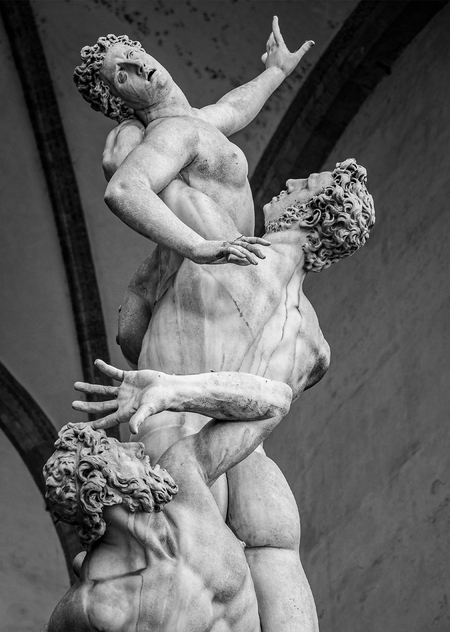
The best starting point here is Jamboloni’s sculptural composition, «The Abduction of Sabinyan.» His initial concepts were realized in the bronze group of 1579 for Duke Farnese; this work unites three figures whose psychological connection is conveyed through the direction of their gazes, their emotions, and the positioning of their limbs and bodies relative to one another, along with the dynamism of their poses.
Lambofonja. «The Abduction of Sabinya.» 1581–83, marble, height 410 cm (Loggia dei Lanci, Florence)
Gambolonia is a typical Mannerist. In his works, beauty exists for its own sake: to exert a particularly strong influence on the viewer, the sculptor depicts figures defined by serpentine lines, graceful curves, exaggerated poses, and the softness of the human body.The composition theme, «The Rape of Sabina, ” is dramatic and has roots in the history of Ancient Rome. The reference to this plot relates to a key episode in early Roman history. According to Livy and Plutarch, shortly after the founding of Rome in 753 BCE, there was a severe shortage of women in the city, which threatened its demographic reproduction and the preservation of its lineage. Attempts to form dynastic alliances with neighboring Sabines were unsuccessful, and they were rejected. Following this, the Romans resorted to force: during a summer festival, they began kidnapping Sabine women.
The illustration of the composition’s «growth» helps instantly understand the narrative and assign roles to the characters, from aggressor to victim.
Lamb of God. «The Abduction of Sabinyan.» 1581–83, marble, height 410 cm (Loggia dei Lanci, Florence)
The composition rises from the bottom upward—it is a depiction of defeat, struggle, and supplication. The lower figure is crushed, the middle one fights, and the upper one is turned upward with a raised arm. The emotional message seems to rise along with the spiral, culminating in the unanswered gesture of the female hand. She is calling out, but there is no listener: the viewer sees and hears this call, but the intended recipient is outside the group. This might be the sculpture’s most powerful emotional move—the impossibility of help. The «call without answer» becomes the foundation of the sculpture’s interpretation.
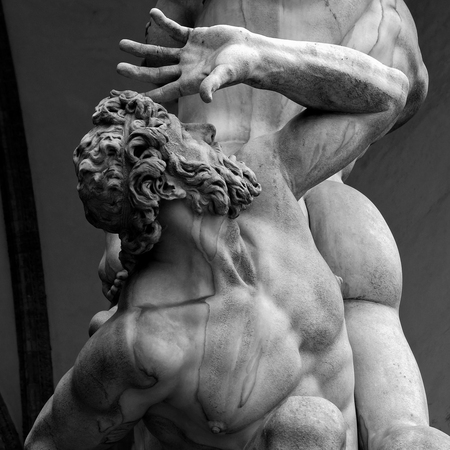
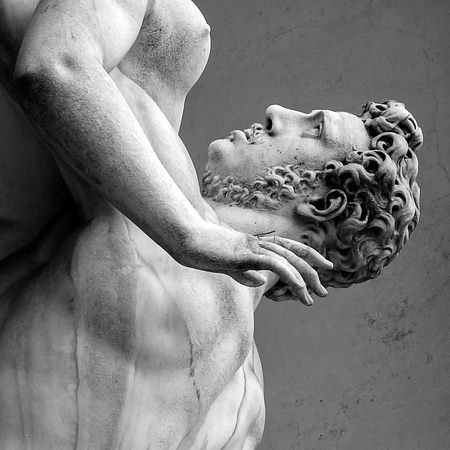
Lambdoni. «The Abduction of Sabinya,» fragments. 1581–1583, marble, height 410 cm (Loggia dei Lanci, Florence)
The female figure is simultaneously the center of the composition and the object of fascination. Only her emotion is directed outward—toward the space and the viewer. The figure lifted above another loses its support: the body is arched, the face is turned away, and the arm is thrown upward. This gesture can be read as an attempt to distance oneself, to find support, or to call for help from someone outside the scene.The lower figure, the Sabine man, embodies defeat: his hand near his face and his tense body express instinctive defense. The fear written on his face is the foundation of the emotional narrative.
Gaspar Marci. «Boreas Abducting Orphée.» 1687, Louvre (France)
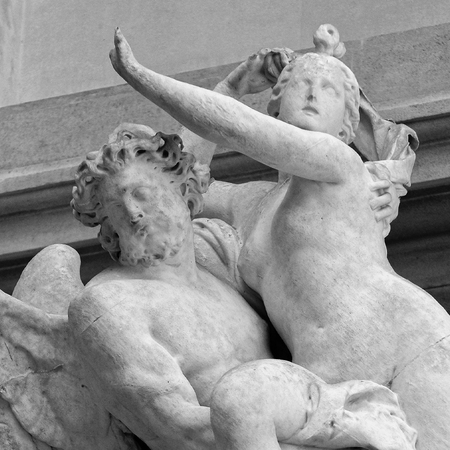
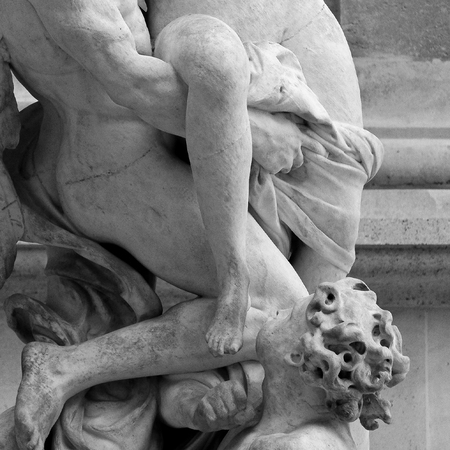
Gaspar Marci. «Boreas Abducting Orphée, ” Fragments. 1687, Louvre (France)
The sculpture was part of a series on the elements, embodying air: Boreas was the god of wind. The winged god of the north wind, Boreas, abducts the daughter of the Athenian king Erechtheus, Orphyia, to take her to his kingdom in Thrace. The abduction is simultaneously a myth and an allegory of natural power. The wind takes what does not belong to it. The dynamism again forces us to observe the scene from below to above; the spiral composition is built upon the contrast of three figures: the mighty winged Boreas easily lifts the resisting Orphyia skyward, trampling the defeated elder who lies spread out at the base of the pedestal.
Giovanni Lorenzo Bernini. «The Rape of Proserpina.» 1621–1622, Borghese Gallery (Rome, Italy)
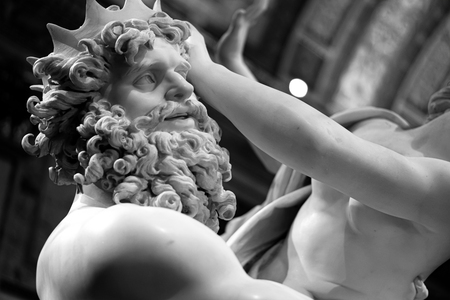
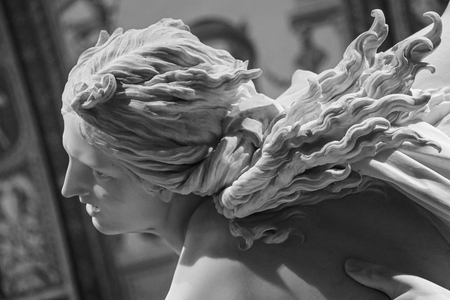
Giovanni Lorenzo Bernini. «Rape of Proserpina, ” fragments. 1621–1622, Borghese Gallery (Rome, Italy)
In «The Abduction of Proserpina,» brutality is revealed through the stark contrast between the experiences of two characters. While the male figure in these compositions most often displays a neutral or tense expression, Pluto’s gaze is different—in the context of a violent seizure based on personal whim rather than necessity—this expression can only be read as carnal satisfaction in possession. Proserpina’s suffering does not deter him. Her face, conversely, conveys terror: her brows are furrowed, her lips parted, and a tear streaks down her cheek. She turns away and shoves his head. What becomes the fulfillment of desire for Pluto is a moment of fear and disgust for Proserpina. This emotional incompatibility allows the kidnapping to be recognized even without knowledge of the myth.
The professionally carved soft body intensifies the sense of anxiety when viewing the sculptural group.
Gian Lorenzo Bernini. «The Rape of Proserpina,» fragment. 1621–1622, Borghese Gallery (Rome, Italy)
The contradiction between the surface beauty and the scene’s content is particularly unsettling. The polished marble appears as living, silken skin; as viewers, we can almost physically sense its warmth and softness. This illusion inspires admiration for Bernini’s mastery while simultaneously making the violence more palpable. The very surface one wants to admire reveals a body experiencing pain and coercion. The indentations beneath the fingers become genuinely frightening precisely because the stone seems like actual flesh.
Capture or Embrace: The Direction of Touch
The close proximity of bodies does not yet allow one to distinguish a scene of violence from an image of intimacy. In both cases, figures may be intertwined, and hands may grasp another’s body. For our research, what matters more is the reciprocity of movement: whether both characters are striving to maintain contact or if one is restraining the other against their attempt to pull away.