Concept
Death is one of the most ancient and universal phenomena of human culture. Although it has accompanied people throughout all of history, the perception of it has constantly changed. Different civilizations have attempted to explain what happens to a person after death—whether life continues and how one can maintain a connection with the deceased. These beliefs were reflected in religion, philosophy, funerary rites, and, of course, art.
This research topic was chosen because the depiction of death allows us to trace not only the development of artistic techniques but also the evolution of human worldviews. Through these images, we can see what people of different eras feared, what they believed, how they envisioned the afterlife, and what significance they attached to the memory of the dead. Examining the period before the 14th century is particularly interesting, as this is when the fundamental visual archetypes of death began to form, which later became widely disseminated in European art.
The artworks selected for this study were created under diverse cultural and historical conditions: ancient Egyptian funerary paintings and papyri, classical Greek vase painting, Etruscan tombs, Roman sarcophagi, early Christian catacombs, Byzantine mosaics and frescoes, as well as Western European medieval manuscripts and sculptural compositions. The main principle for selection was not only chronological diversity but also the presence of a specific concept of death within the works. The study includes images that depict the deceased person, the farewell process, the soul’s transition to another world, the posthumous judgment, resurrection, and the symbolic triumph over death.
The material is structured chronologically and by cultural tradition. This organization allows us first to examine ancient perceptions of death, where afterlife was viewed as a continuation of earthly existence; then, to turn to classical art, where death was frequently depicted through mythological narratives and transitional imagery; and finally, to trace the influence of Christianity on the formation of medieval iconography. Within each section, the artworks are discussed in sequence, and some are compared against each other. This comparison reveals how the same narrative motif adopted different visual forms.
When analyzing textual sources, we utilize scholarly publications, museum catalogs, and materials from historical and art historical research. Priority is given to sources that allow us to establish the artwork’s origin, dating, cultural context, and original purpose.
The core research question is: how did the depiction of death change in art before the 14th century, and what do these changes reveal about human conceptions of life, death, and existence after it?
The research hypothesis is that throughout the period under consideration, death gradually ceased to be perceived solely as a transition to another world or a continuation of earthly existence, increasingly becoming part of a complex religious system of imagery associated with sin, judgment, salvation, and resurrection. Furthermore, these changes occurred unevenly: ancient symbols persisted, were reinterpreted, and incorporated into new artistic traditions.
Ancient Egypt
In Ancient Egypt, death was not perceived as the final disappearance of a person. There was a concept of continued existence after physical death. To achieve this, it was necessary to preserve the body, provide the deceased with everything necessary, and undergo a special afterlife judgment.
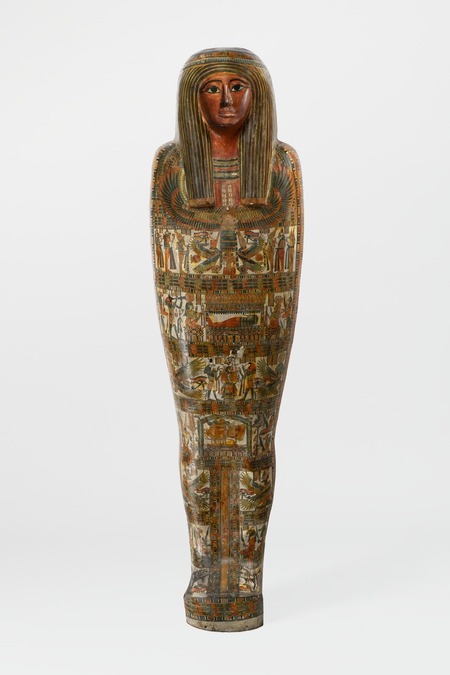
Ancient Egyptian anthropoid sarcophagus. New Kingdom — Third Intermediate Period, 2nd–1st millennium BCE.
In Egyptian art, the deceased was often depicted as a mummy, or a portrait of them was placed on a sarcophagus. Preserving the person’s physical appearance was of special significance: the body remained an important part of the afterlife.
Paintings of Egyptian burial tombs. New Kingdom, circa 16th–11th centuries BCE.
The walls of the tombs depicted daily life: meals, hunting, music, offerings, and the work of servants. These scenes were not merely recollections of the past—they were intended to ensure the deceased could continue their accustomed life in the afterlife.
«Book of the Dead» Ancient Egypt, various periods, 2nd–1st millennium BCE
«Book of the Dead» was a collection of texts and images intended to aid the deceased on their afterlife journey. The illustrations depicted gods, spirits, protective symbols, and the trials a person would face.
«The Judgment of Osiris, ” Papyrus of Hunefru. c. 1275 BCE. British Museum, London.
One of the most iconic images in Egyptian art is the weighing of the deceased’s heart. The god Anubis weighs the heart on scales, comparing it to the Feather of Ma’at, a symbol of truth and justice. Thoth, the god who records the result, is present nearby. Osiris awaits the deceased in the afterlife.
Unlike a simple depiction of death, this scene introduces the idea of a moral evaluation of human life. A person’s fate after death depends on how they lived.
A fragment of the heart-weighing scene from the Book of the Dead. Ancient Egypt.
The composition is important not only for the figure of the deceased but also for its system of symbols. The scales become the image of justice, the feather—the measure of truth, and the monstrous Ammit—the possibility of ultimate loss of the afterlife.
The ancient Egyptian depiction of death already contains the concept of a judgment after death, yet it differs from the later Christian Last Judgment. Here, an individual ritual of testing the deceased is portrayed, not the universal culmination of human history.
«The Book of the Dead of Nauni.» Circa 1050 BCE. Metropolitan Museum of Art, New York.
The papyrus depicts Anunet, a participant in the judgment rite after death. The composition shows her before the gods and the scales. After a favorable outcome, she is granted the opportunity to continue her existence in Osiris’s world. A key feature of the depiction is that the deceased remains the central figure of the narrative. They are not concealed or replaced by an abstract symbol; they are present in the afterlife as a full-fledged individual.
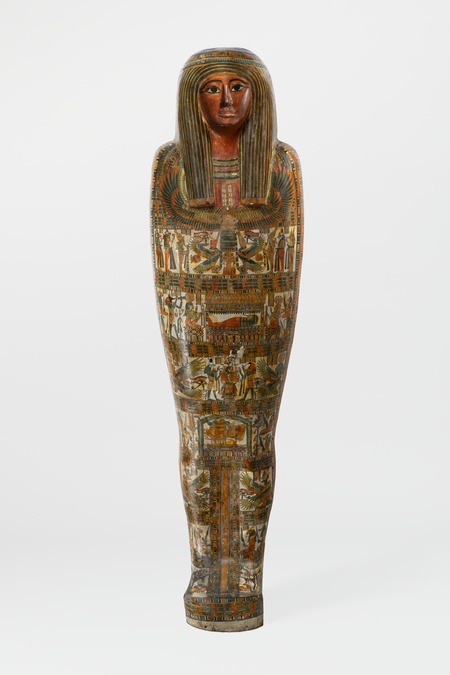
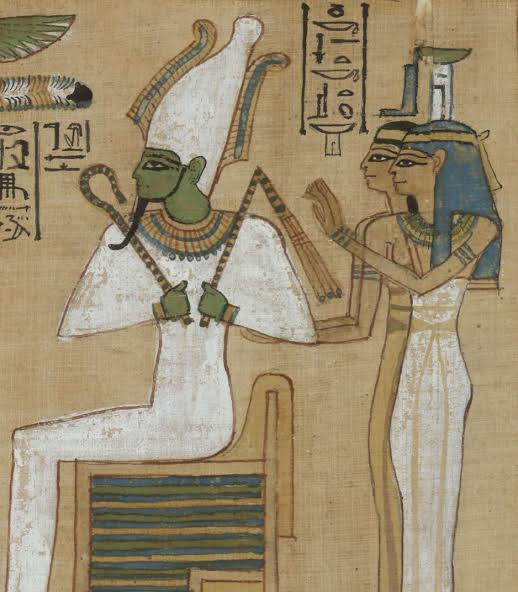
Ancient Egyptian anthropoid sarcophagus. New Kingdom — Third Intermediate Period, 2nd–1st millennium BCE. // «Judgment of Osiris, ” Papyrus of Khunefer. c. 1275 BCE. British Museum, London.
Both objects serve a similar function: they help preserve the person after physical death. But one acts through the physical body, while the other acts through text and image.
In Ancient Egypt, death was depicted as the beginning of a new phase. Its visual language was built upon enduring symbols: mummies, sarcophagi, gods, scales, and scenes of offerings. The imagery
did not so much show the moment of death as it represented
life beyond it.
The Ancient World
In ancient art, representations of death become more varied. Not only the afterlife, but also the memory of the living concerning the deceased takes on an important place. People are depicted on tombstones, funerary vessels, and reliefs.
Ancient Greek funerary stele. 5th century BCE.
Ancient Greek funerary monuments often depicted the deceased in their familiar setting. Instead of a frightening or dramatic moment of death, the viewer observed a calm scene of farewell. This allowed the individual’s likeness to be preserved and to serve as a remembrance for succeeding generations.
«Marble Funerary Stele of a Woman.» 425–400 BCE. Boeotia, Metropolitan Museum.
The deceased is depicted on the relief sitting on a chair with objects related to daily life. She appears calm and natural. Here, death is conveyed through the absence of movement and the special solemnity of the composition. The monument does not recount how the person died, but preserves their image for the living.
Leukythos, attributed to the Achilles vase painter. 445–435 BCE. Metropolitan Museum of Art.
Bell-shaped lekythoi were used in funeral rites and were often decorated with scenes at the grave. This vessel depicts a deceased youth and a woman meeting him by the tombstone. A small winged figure represents the deceased’s soul. It is interesting that death here is shown not through the body, but through the image of a soul that maintains a connection with the world of the living.