Комические сцены в готическом искусстве: Рукописи и рельефы XIII–XIV веков
Concept
In the margins of Gothic manuscripts, we find armed hares, riders before snails, and animals with musical instruments. Familiar actions persist, but the participants are unexpected. Because of this disparity, the scenes can be perceived as comical. However, the strange appearance alone does not explain the meaning of the image. This research examines the means by which the impression of humor is created and where the boundary lies between the comic and the fantastic.
The research material includes drawings from the margins of three British Library manuscripts and stone reliefs from the portal of the Rouen Cathedral Librarians. The core of the study consists of miniatures from the Breviary of Renaud de Bar, which were created in Metz between 1302 and 1303. For comparison, the Book of Hours by Brunetto Latini and the Maastricht Hours of the first quarter of the 14th century were utilized. The Rouen reliefs date to the turn of the 13th and 14th centuries. This selection was made because it allows for a comparison of contemporaneous imagery found in both books and architecture.
Humor most frequently arises when the familiar relationship between characters is disrupted. For example, a weapon can equate a rabbit with a human, while a snail takes the place of a knight’s adversary. The animal gains the ability to act, and the strength of an armed human is no longer a guarantee of absolute victory, security, or power. This comparison relates to Vladislav Darkevich’s observation of the interchanges between the human and animal, the high and the low, in medieval parody.
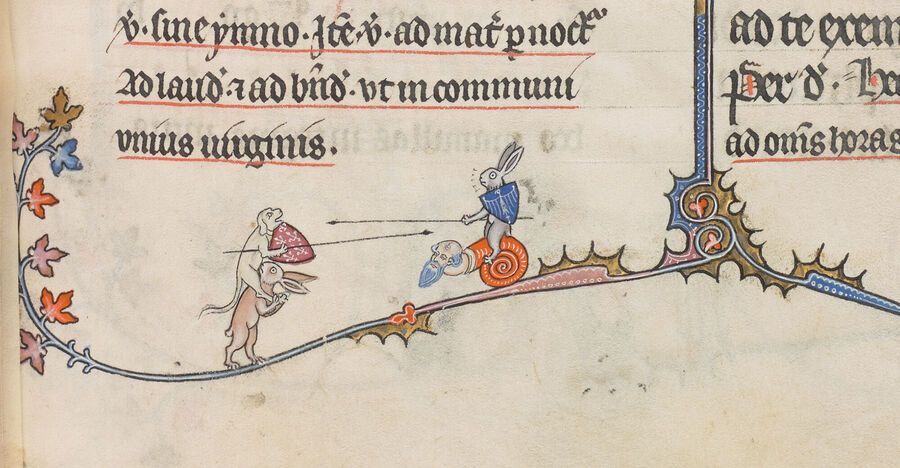
Renault de Barra Breviary. Metz, 1302–1303. British Library, Yates Thompson MS 8, fol. 294r. Fragment.
The analysis is based on comparing poses, dimensions, gestures, and objects. It is crucial to track which details help identify human action and what changes occur after substituting a character. The images are grouped by theme: unusual adversaries, animals in human roles, musicians, and composite beings. Standard human figures are included for comparison, as this helps clarify what familiar situation the fantastic scene is echoing.
However, fantasy and humor are not the same. Aron Gurevich emphasizes that «grotesque is by no means equivalent to comedy.» The parodic effect is more convincing where there is a clear contradiction between the action and the performer. An unusual body requires further explanation: the combination of human and animal traits can evoke surprise or unease, not just laughter.
Book illustrations are compared to the stone reliefs of Rouen Cathedral, which also feature figures with human and animal characteristics. Franck Tennard-Duivie suggests that such images might have served as warnings about vices: a person succumbing to bad deeds seems to transform into a beast. However, this explanation does not apply to all the figures. This comparison will help understand how similar motifs are employed on book pages and in the cathedral’s decoration.
Unexpected Opponent
Bruno Latino. Book of Treasures. Picardy, early 14th century. British Library, Yates Thompson MS 19, fol. 65r. Fragment.
The knightly feat loses its grandeur when the adversary is a snail. This scene can be read as a mockery of martial valor, though this motif has other interpretations as well.
Renault de Bara Breviary. Metz, 1302–1303. British Library, Yates Thompson MS 8, fol. 321r. Fragment.
Weaponry usually emphasizes human strength, but here it provides no obvious advantage. The humor arises from the contradiction between the warrior’s appearance and the unexpected opponent.
Renaissance Manuscript. Metz, 1302–1303. British Library, Yates Thompson MS 8, fol. 307r. Fragment.
Weaponry ceases to be a convincing symbol of human superiority. An unexpected opponent allows the familiar heroic narrative to be read as a comedy.
Renault de Bara Breviary. Metz, 1302–1303. British Library, Yates Thompson MS 8, f. 24v. Fragment.
The intervention of birds strips the duel of its solemnity: armed individuals lose control of what is happening. This casts doubt on the warrior’s invincibility.
Animals in Human Roles
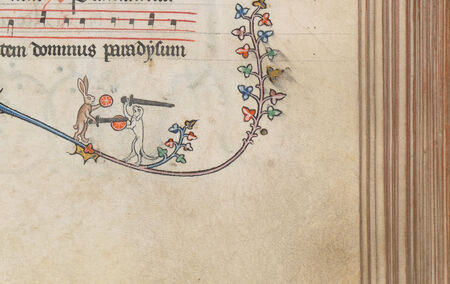
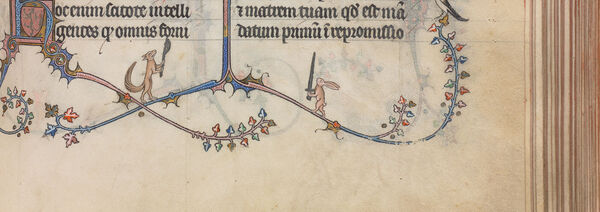
1. Breviary of Renaud de Barra. Metz, 1302–1303. British Library, Yates Thompson MS 8, f. 181r. Fragment. 2. Breviary of Renaud de Barra. Metz, 1302–1303. British Library, Yates Thompson MS 8, f. 171r. Fragment.
The rules of human combat level the playing field between natural adversaries. Therefore, the scene resembles a parody of the pursuer’s conventional dominance.
The pursuit transforms into an open confrontation. A different dynamic emerges where the accustomed prey is capable of responding to the threat.
Chronicle of Renaud de Barra. Metz, 1302–1303. British Library, Yates Thompson MS 8, f. 185r. Fragment.
The human position relative to the animal overturns the notion of human supremacy. The participants' behavior allows one to see the fox as a figure of power, even though its exterior appearance remains that of an animal.
Brevary of Renaud de Bara. Metz, 1302–1303. British Library, Yates Thompson MS 8, f. 269r. Fragment.
Human faces in the basket disrupt the established power dynamic between human and animal. This shift in roles can induce anxiety, so the scene’s meaning is not limited to humor.
Renault de Barra Breviary. Metz, 1302–1303. British Library, Yates Thompson MS 8, fol. 294r. Fragment.
Parody arises from the rearrangement of familiar roles. The rules of a knightly duel are transposed into the animal kingdom, where the prey gains the opportunity to confront the pursuer.
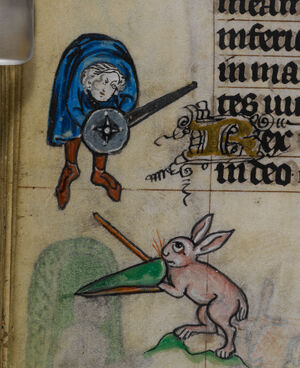
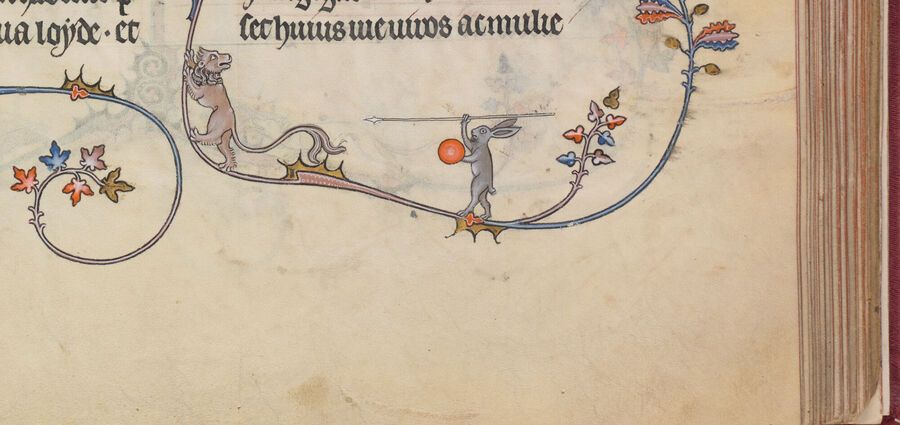
1. Maastricht Hours. Liège, early 14th century. British Library, Stowe MS 17, fol. 240v. Fragment. 2. Breviary of Renaud de Bar. Metz, 1302–1303. British Library, Yates Thompson MS 8, fol. 283r. Fragment.