Research Concept
Animals are the first heroes in the history of art. The oldest images created by humans are not portraits or landscapes, but beasts: the lions and horses of the Chauvet cave were drawn over thirty thousand years before the first written word. Moreover, the image of the animal is unique in its continuity—it lives in art from cave paintings to a 15th-century altar, changing not so much its outward appearance as its function. This is the justification for choosing the theme: in the same subject matter, one can trace how human perception of the world and of itself has evolved. The topic is intentionally narrowed to the function of the image: we are not describing all animals in art consecutively, but rather investigating what purpose the animal serves in each era and what it does within the artwork.
Key research question: How and why has the function of the animal image changed in art—from Paleolithic caves to the Ghent Altarpiece?
Hypothesis: The image of the animal did not have a single sequence of roles where one function succeeded another. Symbolic, cultic, narrative, emblematic, and decorative functions coexisted in every era; their proportion changed, as did the balance between naturalistic observation and artistic convention. The Paleolithic artist depicted the beast larger and more intently than the human; the Ancient Eastern master collected it according to the formula of power and immediately, in the image of a dying lioness, achieved peak naturalism; the medieval animal became a sign that was read like text, yet attention to nature also appeared in the pages of bestiaries. In the 15th century, nature and symbol converged in a single image—a confluence that defined the era.
Prologue
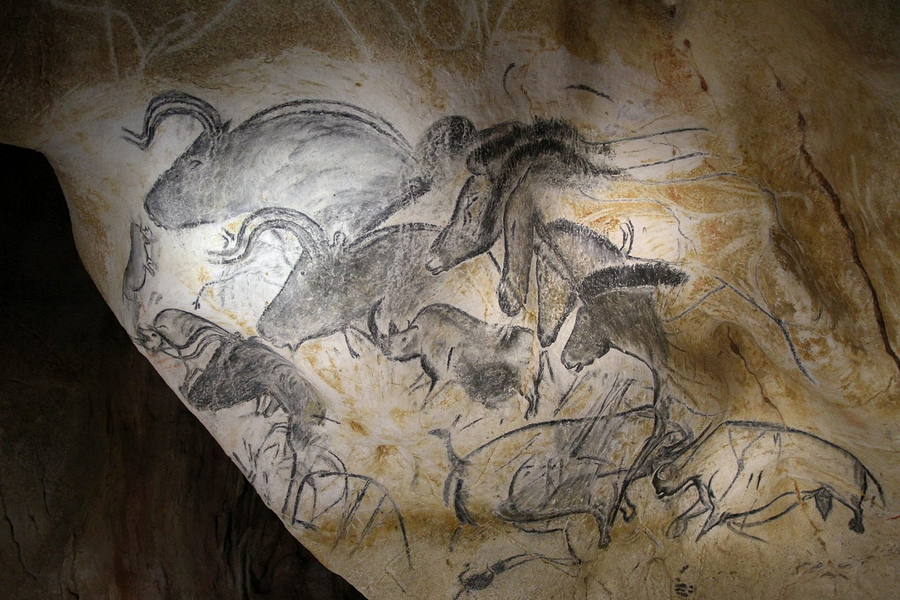
Panel of Horses. Chauvet Cave, Ardèche, France, c. 36,000–30,000 years ago.
Introduction (Lead)
The first work of art created by a human was neither a self-portrait nor a portrait of a loved one. It was an animal. Thirty thousand years before the first written line, people were drawing bulls and lions with charcoal on cave walls. Since then, the animal has not left the walls, canvases, and pages: sometimes it is scrutinized with hunting precision, sometimes it is distilled into a formula, and sometimes it is transformed into a symbol that is read like a word. This is an investigation into how the balance between nature and symbol has changed in the animal image, and what that balance reveals about humanity itself.
Framing the Question
Horse. Chauvet Cave, c. 36,000–30,000 years ago.
What exactly are we investigating? Not every animal, nor the entire history of their depiction. We are interested in two things simultaneously: the function of the image (why the era needed this creature and what it does within the artwork) and the method of depiction (where the artist stares directly at the animal, and where they assemble it using a formula or draw it from a textbook description). The visual material is addressed with one central question: how has the relationship between nature and symbol in the animal image changed from the Paleolithic period to the 15th century? We seek the answer by analyzing and comparing around forty-five artifacts: rock paintings, sculpture, frescoes, mosaics, and miniatures.
Thesis
The core argument of this research is that the animal image never possessed a single set of roles. Symbol, attribute, mythological character, guardian, or neighbor—all these elements coexisted across every era. What changed was different: the relationship between these functions and the balance between observing nature and artistic convention. Therefore, instead of retelling epochs, we compare the images—how the animal is depicted, what it does within the composition, and how its form relates to its meaning.How the Research is Structured
The research is structured chronologically: each chapter is dedicated to a specific era. Within the chapters, the material is broken down by the functions of the image (cult, power, metaphor, genre, symbol, morality), and each function is demonstrated across several artifacts. All key images are analyzed according to three recurring questions: how the animal is depicted, what role it plays in the composition, and how the image relates to its meaning. Individual sections are built as direct visual comparisons—two or three images are placed side-by-side, allowing the differences between eras to be seen without words. Each chapter concludes with a brief summary.
Chapter I. The Cave: The Animal as a Central Image
Chapter I. The Cave. Paleolithic Era, 36–12 thousand years ago. Here, the animal is the central and almost sole subject.
Chauvet Cave: The Lion Panel
Chauvet Cave in southern France, around 36–30 thousand years ago: one of humanity’s oldest known «galleries.» Hundreds of animals are depicted on its walls, and most of them were not prey. Hunters here primarily targeted deer and horses, but they painted lions, rhinoceroses, bears, and mammoths. For our topic, this is the first serious finding: the Paleolithic artist is depicting not a menu or a household, but power. The animal embodies qualities that humans lack: speed, might, hearing, and sight in the dark.
Image Analysis:
Depiction: Charcoal and ochre; the contour is scratched in; the lions overlap one another, capturing moments within a single motion.Role in Composition: The panel occupies an entire niche; the animals are larger than life-size and move within a unified current.
Form and Meaning: The precision of the details (snouts, whiskers, paws) indicates prolonged observation; the beast here is not prey, but a vessel of power.
Schove Technique: Drawing as Action
The Schove artists drew with charcoal and ochre, rubbing the pigment, scratching the contour, and most importantly, incorporating the texture of the wall into the image: the protrusion of a rock became the body and flank of the beast. The depiction is not pasted onto the world—it grows from it. It is already clear here that drawing is not illustration, but an action, almost a ritual, in which the wall, the torchlight, and the movement of the hand participate.
Chauvet Cave, circa 36,000–30,000 years ago.
Photo Display: Shove Rhinos
The rhino panel in the Shove niche: several dozen animals are layered on top of one another, like frames from a single motion.
Rhinoceroses. Chauvet Cave, c. 36,000–30,000 years ago.
Lascaux: The Bull Rotunda
The Lascaux Cave, circa 17,000 years ago. In the so-called Bull Rotunda, bulls are depicted over several meters long, larger than any real animal from that region. Scale functions as a language of hierarchy: the beast is larger than the human for a reason. Humans are almost absent in Paleolithic art, and when they appear, they look like stick figures. Animals, conversely, are depicted with precise knowledge of anatomy, movement, and habits—the artist clearly spent years observing the animal and conveyed not just its form, but also its manner of movement.
Lascaux Cave Paintings, Dordogne, France, circa 17,000 years ago.
Pech-Merle: Spotted Horses
The Pech-Merle cave in southwestern France, approximately 25,000 years ago. The famous panel of spotted horses: the outline of one of them is dictated by the rock itself; the artist merely completed what they saw in the relief. The dots on the horses’ bodies were applied with a tampon and still spark debate: were they breed markings, symbolic signs, or traces of a ritual? Near the horses are impressions of human palms. This coexistence is striking: the image of the beast and the mark of humanity live on the same wall, yet the beast is large, detailed, and colored, while the human mark is only the negative impression of a palm.
Panel of spotted horses with handprints. Pech-Merl Cave, Lou, France, c. 25,000 years ago.
Altamira: The Ceiling with Bison
Altamira, Spain, approximately 15–13 thousand years ago: the famous ceiling featuring bison. The artist pushed the use of natural relief to its limit—the bumps on the ceiling became the bodies of curled and standing bison, and the polychromy (black outline, red ochre, shading) creates an almost sculptural volume. When Altamira was discovered in 1879, science refused to believe it was the work of «savages»; the paintings were declared a forgery because they were too masterful. This disbelief itself is illustrative: the very notion of the «primitiveness» of ancient art was born in the nineteenth century, not in the cave.
Polychrome ceiling with bison. Altamira Cave, Cantabria, Spain, c. 15,000–13,000 years ago. The photo shows a replica in the National Museum and Altamira Research Center.
Image Analysis:
Depicted as: Polychromy over a ceiling relief; the mounds of the rock have been transformed into bison bodies.Role in the Composition: The ceiling reads as a herd—lying and standing unevenly, without a single line.
Form and Meaning: The natural volume is amplified by the painting; the image functions as the presence of the beast, not a description of it.
Cave Scene: The First «Narrative»
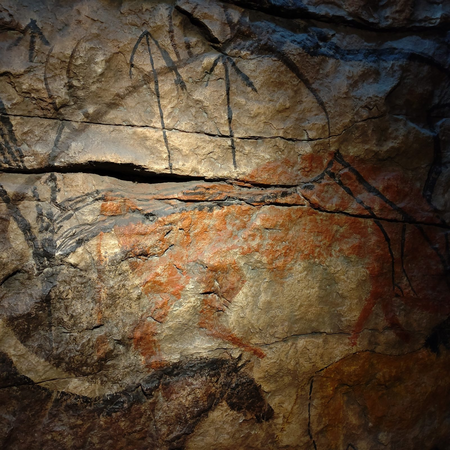
The deep pit of Laskovo, «The Mine, ” preserves a scene nearly unique to the Paleolithic era: a prone human with a bird’s head, a wounded bison spilling its entrails, a rhinoceros moving away, and a bird on a stick. This is one of the earliest narrative depictions in history. What it tells is still debated (hunting failure, shamanic trance, myth?), but something more important is that for the first time, the animal, the human, and the symbol are brought together in a single event. The animal here is no longer just a creature, but a participant in a meaningful action.
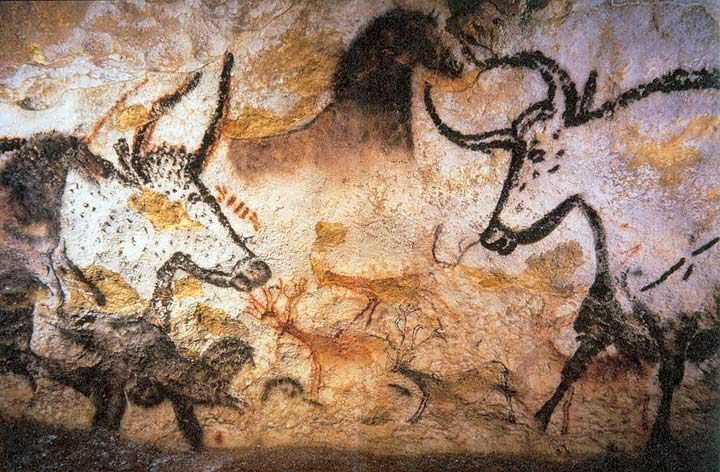
Реплика росписей Ласко (музей Ласко IV).
Ротонда быков. Пещера Ласко, ок. 17 000 лет назад.