Navigation Menu
I. Concept II. Where: From Cave to Barn and Ruins III. Who Came to the Manger? IV. Light: Night, the Infant, and the Star V. Winter and Hearth: The Calendar of Times VI. Conclusion VII. Bibliography VIII. Image Sources
Concept
A wooden stable, a cow and a donkey, Mary kneeling, a shining Infant, a star above the roof—we recognize this set of details at first glance. Yet, in the Gospel narrative of the Nativity, only the manger is mentioned; the artists added almost everything else. In this study, I want to trace how the visual imagery of Christmas develops in book illustration from the 15th to the first half of the 16th century, and note which motifs recur from one book to another.The primary source of imagery will be prayer books (Book of Hours). The prayer book was a devotional text for laypeople and the most common illustrated book of the Late Middle Ages. Dukes and townspeople commissioned them, and from the late 15th century, prayer books began to be printed. Each prayer book contains a Christmas cycle: the Nativity, the Annunciation to the Shepherds, and the Adoration of the Magi. Therefore, the same scene was repeated in thousands of books—convenient material for observing which details become conventional.
Key Question: What motifs are repeated in Christmas imagery in book illustrations from the 15th to the first half of the 16th century, and how do they form the recognizable image of the holiday?
Hypothesis The depiction of the Nativity in books of this period is constructed from a limited set of recurring motifs: the setting (stable, ruins), the characters (ox and donkey, Joseph, shepherds, Magi), the light (the shining Infant, the star), and the winter life depicted in liturgical calendars. The horarium, where the Christmas cycle and the calendar were mandatory, solidified these motifs as established formulas. Many of these motifs are recognizable in later images as well.Material Selection Principle The foundation is drawn from miniatures found in French and Dutch horaria and prayer books from approximately 1400–1550. These are supplemented with printed editions and engravings from the same era. For comparison, Byzantine miniatures and Russian icons, as well as later examples—paintings by Brueghel and Burne-Jones, and postcards from the late 19th to early 20th centuries—were included.Categorization Principle The sections are organized by motif, not by chronology. Each section addresses a simple question about the image: where the action takes place, who came to the manger, where the light originates, and what season is outside the window. Within each section, the images are ordered from earliest to latest.Textual Source Selection and Analysis Principle The research relies on iconography reference works (J. Hall, G. Schiller), studies on horaria and the medieval calendar (R. Wick, B. Henisch), and manuscript descriptions found on museum and library websites, which were used to verify dates and authors. The texts are necessary for fact-checking and interpreting specific details, but the images themselves remain the primary material.
Where: From the Cave to the Barn and the Ruins
In the Eastern tradition, Christmas takes place in a cave. In the West, by the 15th century, this is superseded by a structure: a simple shelter, a humble shed, and nearby—the ruins of a stone building. This schema quickly becomes typical in iconographic depictions.
Nativity of Christ. Miniature from the Menologion of Basil II. Constantinople, circa 1000. Vatican, Apostolic Library (Vat. gr. 1613)
Andrei Rublev (attributed). The Nativity of Christ. 1405. Icon of the Feast Day of the Annunciation Cathedral of the Moscow Kremlin
The same Eastern scheme in Rus': a cave, the Mother of God on the couch, midwives washing the Infant, and Joseph sitting aside.
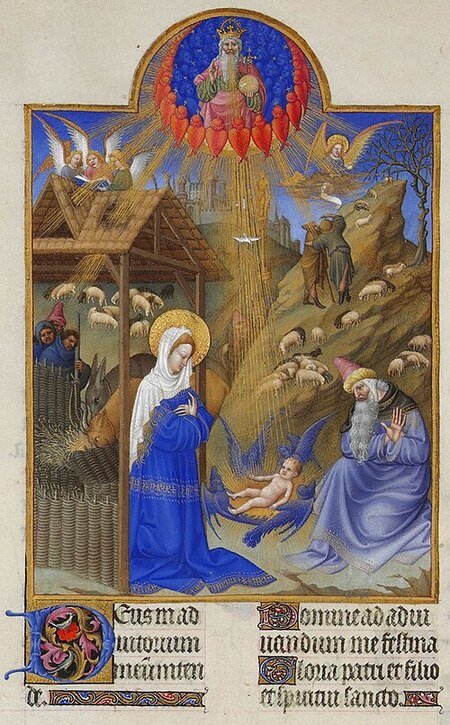
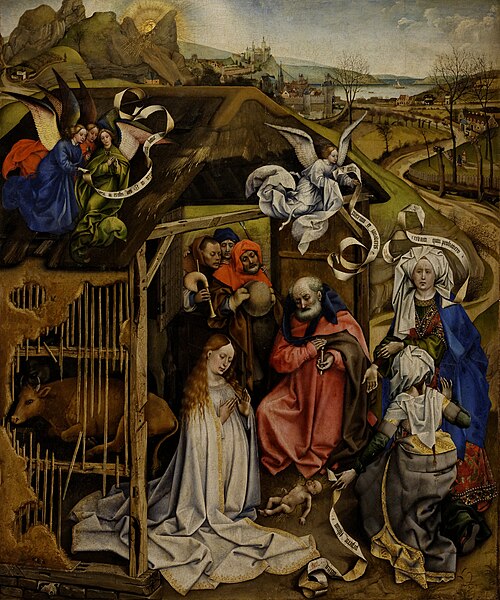
Limburg Brothers. Nativity. «The Magnificent Chronology of Duke Berry, ” leaf 44 verso. c. 1411–1416. Châlons, Musée Condé (Ms. 65)/Robert Campin. Nativity. c. 1420. Dijon, Musée des Beaux-Arts
Rogier van der Weyden. The Bladelin Triptych (Middleburg Altarpiece). c. 1445–1450. Berlin, Gemäldegalerie
A shed is attached to the ruins of a stone building with a column. These ruins will become a permanent element of the northern nativity scene.
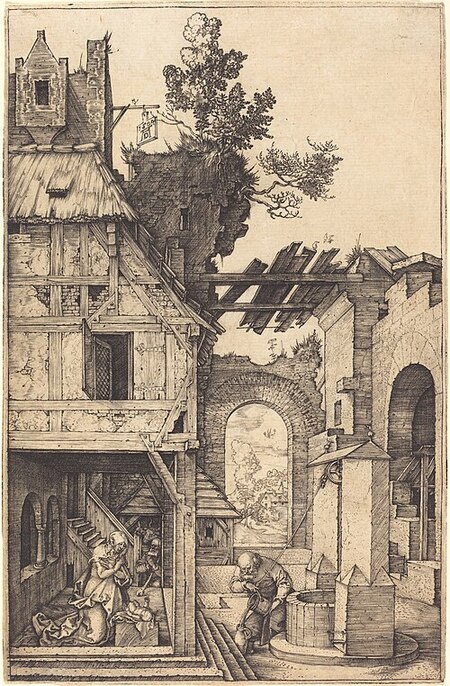
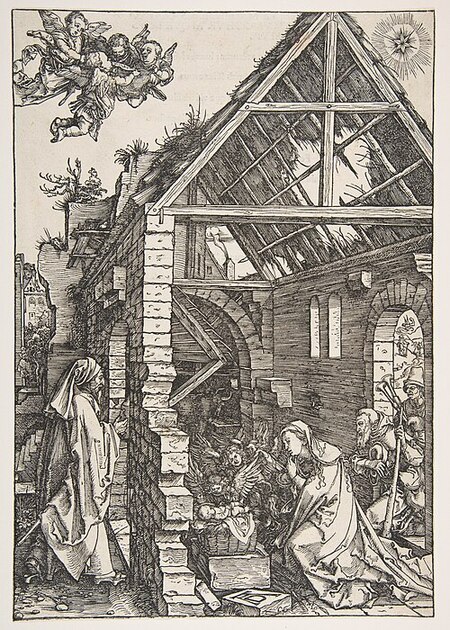
Albrecht Dürer. The Nativity. 1504. Engraving on copper. National Gallery of Art, Washington. / Albrecht Dürer. The Nativity. Folio from the book «Life of Mary.» Woodcut, c. 1502–1504; 1511 edition. Metropolitan Museum of Art, New York.
Book engraving: the series was released as a standalone book in 1511. The barn is again amidst weathered walls, and the printing makes the schema accessible to many.
Simon Benning. Nativity. Book of Hours of Cardinal Albrecht of Brandenburg, c. 19th century. c. 1525–1530. Los Angeles, Getty Museum (Ms. Ludwig IX 19)
Christmas is present in almost every time frame—both manuscript and printed. Six leaves by various masters over sixty years: the setting and the cast of characters remain unchanged.
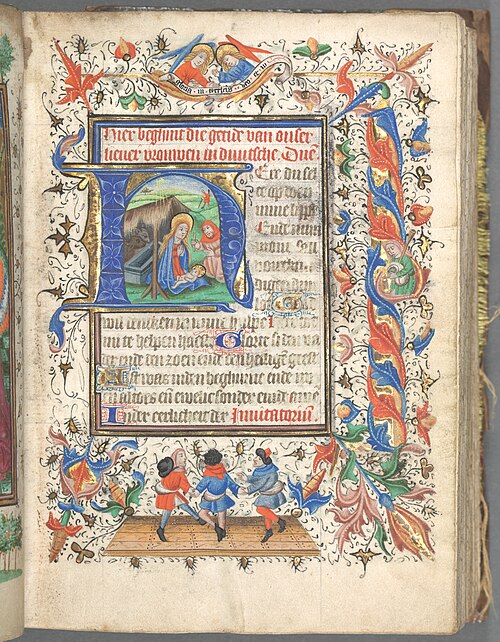
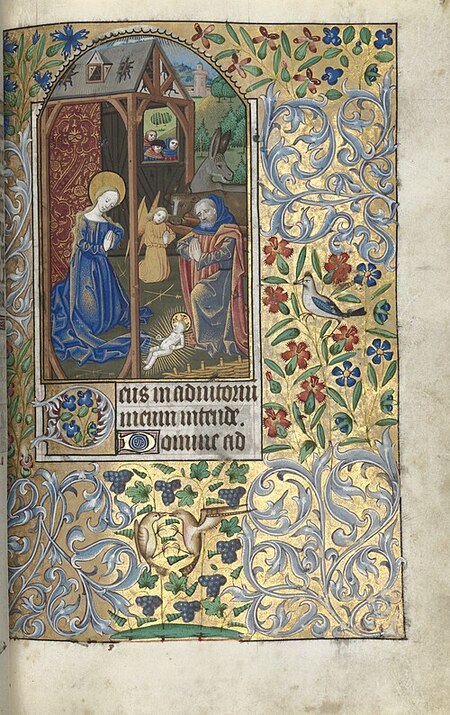
Master Geysbrech van Brederode. Initial with Christmas. Hours book, fol. 14. c. 1460. Cleveland Museum of Art. / Master of Geneva Latin. Nativity with shepherds. Hours book, fol. 56. 1465. Cleveland Museum of Art.
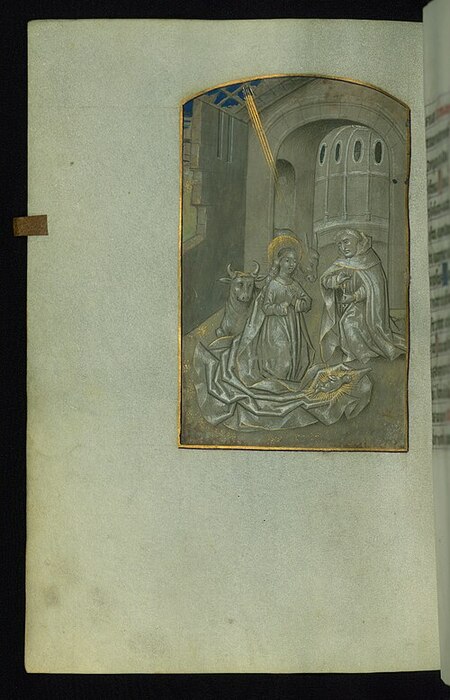
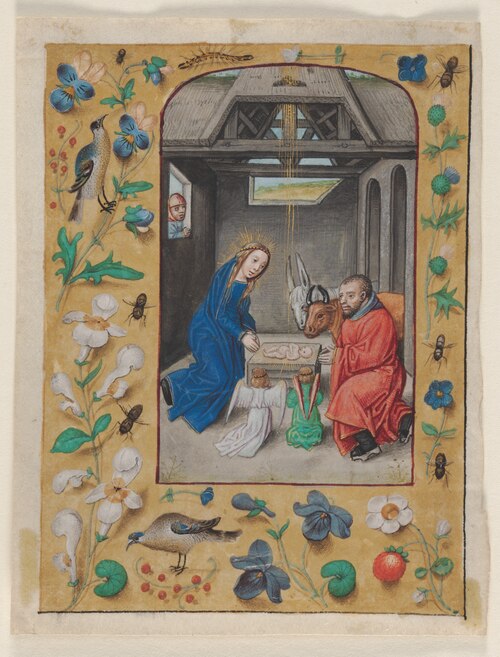
Circle Master Simon Marmion. Nativity. Hours, fol. 43r. c. 1470–1480. Baltimore, Walters Art Museum (W.194)/Master of the First Psalter of Maximilian. Nativity. Folio from a Book of Hours. c. 1480. Cleveland Museum of Art
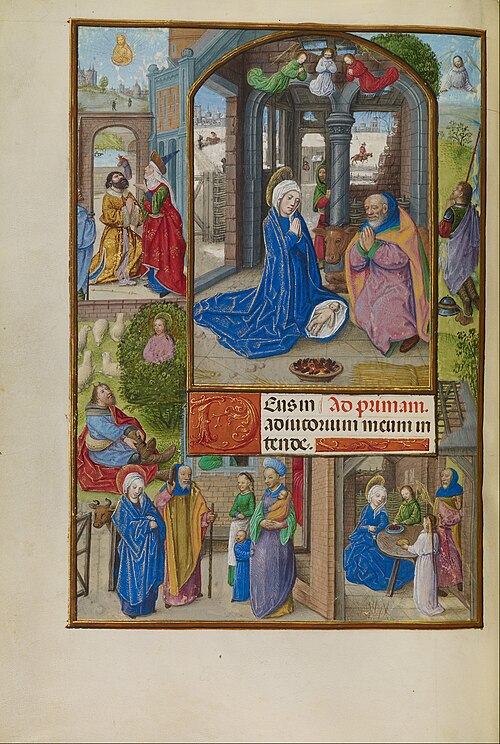
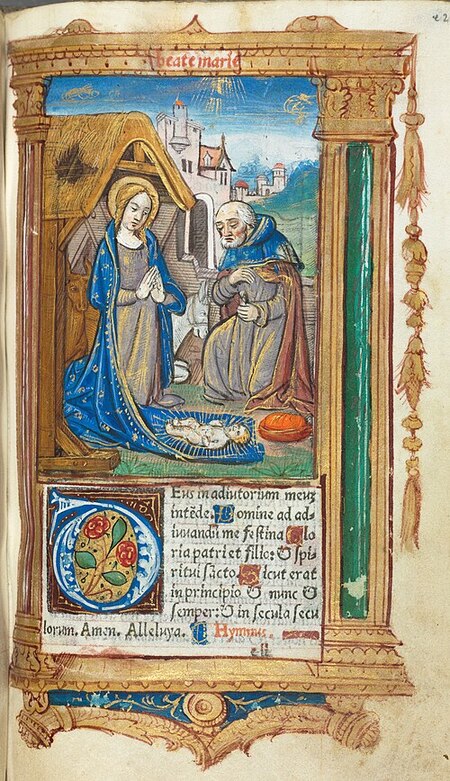
Master of the Dresden Prayer Book. Christmas. Spinoza’s Horarium, fol. 119 r. c. c. 1510–1520. Los Angeles, Getty Museum / Christmas. Printed Horarium, edition of Guillaume Le Rouge, fol. 34. 1510. Cleveland Museum of Art.
Who came to the nursery?
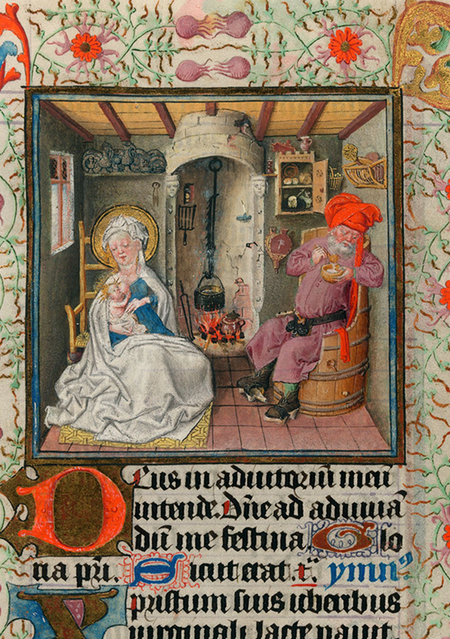
In the previous chapter, during the Nativity scene, we saw the aged Joseph always standing nearby. However, in the illustrations presented below, Joseph transforms from a thoughtful elder on the periphery into an active participant: he is blowing on the fire and holding the candle.
Konrad von Zost. Nativity. Wing of the Wildungen Altarpiece. 1403. Bad Wildungen, City Church
Iosif is kneeling, stoking the fire to cook food. Domestic details appear in the sacred scene.
Catherine Klevskaya’s Masterpiece. The Holy Family at Work. Catherine Klevskaya’s Hours. Circa 1440. New York, Morgan Library & Museum (MS M.917)
The Holy Family in Everyday Life: Joseph crafts, Mary weaves, and Jesus learns to walk with a walker. A sacred story told through domestic life.
The scene with shepherds opens the third hour and almost always accompanies Christmas in the hour-by-hour readings.
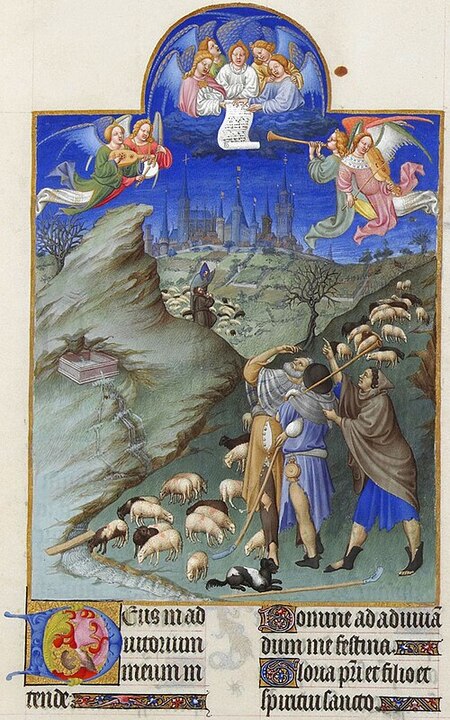
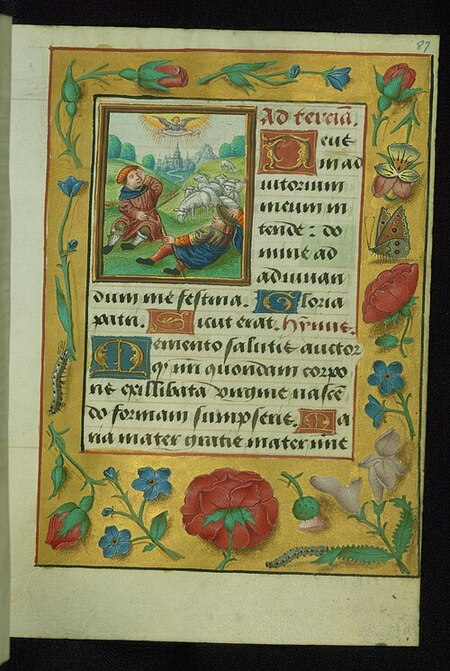
Limburg Brothers. The Annunciation to the Shepherds. «Great Hours of Duke Berry,» folio 48. c. 1411–1416. Chantilly, Condé Museum / Follower of the Prayer Book Master c. 1500. The Annunciation to the Shepherds. Hours of the de la Port family, folio 87. 1510. Baltimore, Walters Art Museum (W.433)
Hugo van der Goes. Portinari Altarpiece, central panel. c. 1475–1478. Florence, Uffizi Gallery