Navigation
- Concept
- Context: Malta and Burett, their people, and their objects
- Atlas: Eight figures as eight statements
- Comparison: Scale, age, clothing, and contact
- Hypotheses: Why, how, and why
- What the figures reveal about the people
- Conclusion and sources
Concept
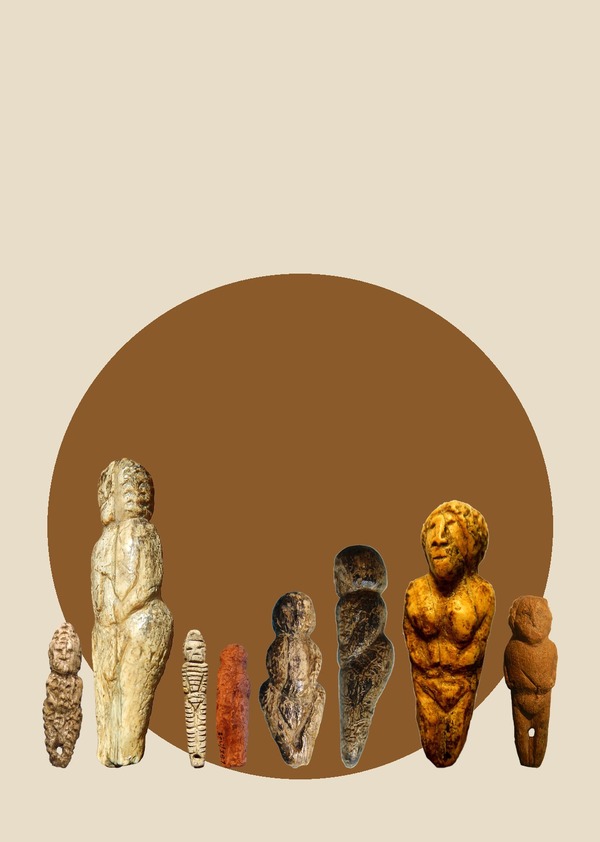
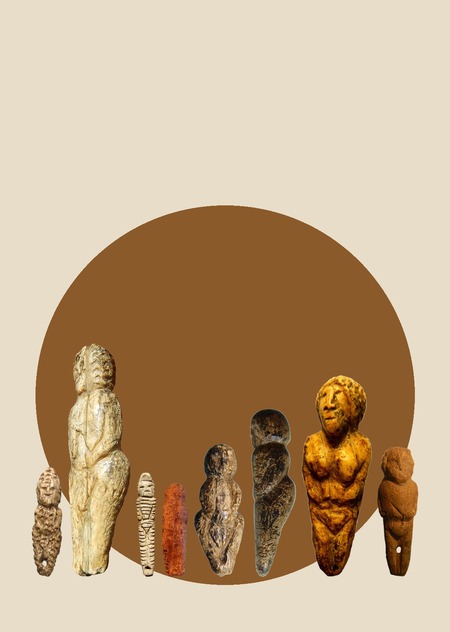
The very term «Paleolithic Venus» suggests how to interpret these figurines: as a symbol of the female body, beauty, or fertility. Such a label functions as a framework for reading, posing questions even before the viewer examines the object. The word was coined in the 19th century and remains conventional, as these figurines do not depict any goddess of love. The discoveries from the Alta and Burety sites in Siberia are difficult to fit into such a framework. A notable feature of the figurines is their depiction in fur clothing—in jumpsuits and mantles, complete with hoods, belts, ties, and bracelets. Traces of red, blue, and green pigment have been found on some objects. Some of the images are classified as children’s, and there are also male figurines.
When choosing a theme, the author started from the premise that the Mauldin figurines belong to among the earliest materials upon which communication can be studied without writing. These objects possess a common code (repeating signs), master craftspeople who reproduce it, and users who interact with the object. For the «Management in Creative Industries» program, this theme is relevant because it clearly demonstrates how an object encodes a message: the material, size, shape, and way the object is handled all function as elements of communication. These principles are also applicable to modern objects, from museum exhibits to product design.
What were these objects communicating, to whom, through what code, and via which channel? Hypothesis: the maltine figurine functions as a personal mediator between the individual and the small community.
This question replaces the conventional query: «To which deity were they worshipping?» The working hypothesis assumes that the figurine encoded information about the individual (age, gender, status, affiliation), was maintained through physical interaction, and was interpreted according to a shared canon. Religious and protective meanings are not excluded, but are considered secondary. Twelve other explanations, drawn from literature or derived from the theoretical framework, are also being tested.
The subject of this study is the anthropomorphic figurines from the Malta and Burety sites (Irkutsk Oblast, dating back approximately 23,000–18,000 years ago). The core of this work involves exploring the possible meanings and reasons for the creation of these figures, which are examined as communicative artifacts. The objective is to propose a coherent explanation in the published material: why the Maltese-Burety community created human representations, why they appear in this specific manner, and what this reveals about those who crafted and utilized them. The specific tasks are to describe the context, analyze the eight figurines, compare them on a unified scale, test hypotheses, formulate a conclusion, and define its limitations.
Context: Malta and Burett, their people, and their belongings
The Malta site is located on the left bank of the Belya River, a tributary of the Angara, in the Usolsky District of the Irkutsk Oblast. Burety is located on the Angara, approximately twenty kilometers from it. Main text: excavations at Malta began in 1928 by M. M. Gerasimov. The excavation area is 1,427 m², comprising at least 15 dwellings, one child burial, dumps, and work sites. The «classic» collection dates from the interval of 23 to 18 thousand years ago (more commonly referred to as 23 to 20); The stone and bone artifacts from Malta and Burety are so closely related that they are typically studied together as the Maltine-Burety culture. According to the catalog, 14 cultural deposit levels are identified at Malta, dated between 43 and 12 thousand years ago; the «classic» collection originates from two lithological layers. Out of several thousand items, approximately 850 represent unique works of primitive art: figurines, plaques, and ornaments (pendants, beads, bracelets, diadems).
Why is the frame so narrow?
The first reason is that this is where the main and most famous collection of Siberian Paleolithic sculpture originates. The second reason is that the «classic» Maltese layer dates to a narrow time frame, so objects from the same community are compared, not items from different eras. The third reason is that within this framework, there is no need to determine the degree to which Siberian finds are related to European ones; the question of the figurines' meaning is examined using their own material. European Venus figures have been deliberately excluded from the study.
Terms and Conditions
The environment is reconstructed as a cold and dry tundra steppe from the early or middle Sartonian period. Housing varied: there were lightweight structures such as chums, semi-subterranean dwellings, and above-ground houses. The lower parts, made of stone slabs and large bones, have survived. The bones and bone artifacts were preserved thanks to the permafrost. The Maltinsk people hunted reindeer, mammoths, and woolly rhinos. Mammoth ivory served as the main material for figurines. In the artistic world of the Maltinsk, birds and animals are constantly present alongside humans: according to Gerasimov’s description, sculptural figures of ducks, geese, swans, and a rhino, as well as engraved depictions of mammoths and snakes, have been found.
The artifact is a fragment of a mammoth tusk that was split. The shape was formed using a carving knife and a gouge. Details were applied with a chisel and carving tool. Holes were made with a drill. The ornament was composed of a small set of elements: pits, straight lines, semi-lunar signs, and jagged lines. The processing resembled a relatively stable serial production: there existed a technological canon that different artisans followed (L.V. Lbova and others).
Atlas: Eight Figurines as Eight Statements
Kids sculpture in a jumpsuit. Mammoth tusk, 19–23 thousand years BP. The Hermitage Museum, 370/752. Source: malta.artemiris.org (accessed 11.19.2026). Length: 43.8 mm.
The head occupies about 37% of the figurine’s length, while the remaining atlas figurines range from 23% to 25%. The catalog describes the head as disproportionately large. This is an iconic sign of age: childhood is indicated by similarity to the real proportions of the human body. The torso is covered with C-shaped symbols; these are likened to kerkes, the fur clothing of children and women among the Koryaks. The artisan conveys not the cut, but the texture of the fur—that is, warmth. There are three incised lines on the neck. The face is rendered with the chisel with the greatest care, and the face’s priority supersedes the body’s priority.
Children’s sculpture in a jumpsuit: head, torso, lower body in enlargement. Hermitage, 370/752. Source: malta.artemiris.org (accessed 11/19/2026)
No signs of wear were found, and the hole is located in the lower part of the leg. The 2.98 mm hole was made with a double-drilled awl; it is wider on the back side. Since the figurine suspended through it would hang head-down, fastening with a string or sewing is more likely. The absence of wear allows for three explanations: the item was new, it was stored carefully, or it was intended for an event, such as a burial.
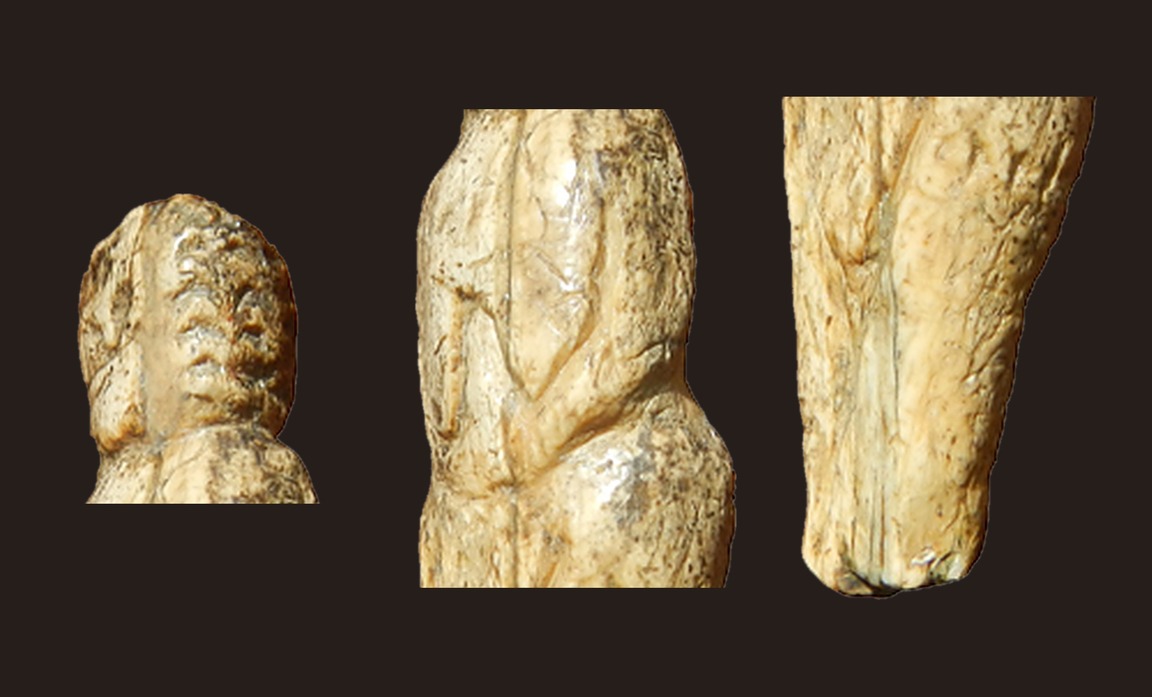
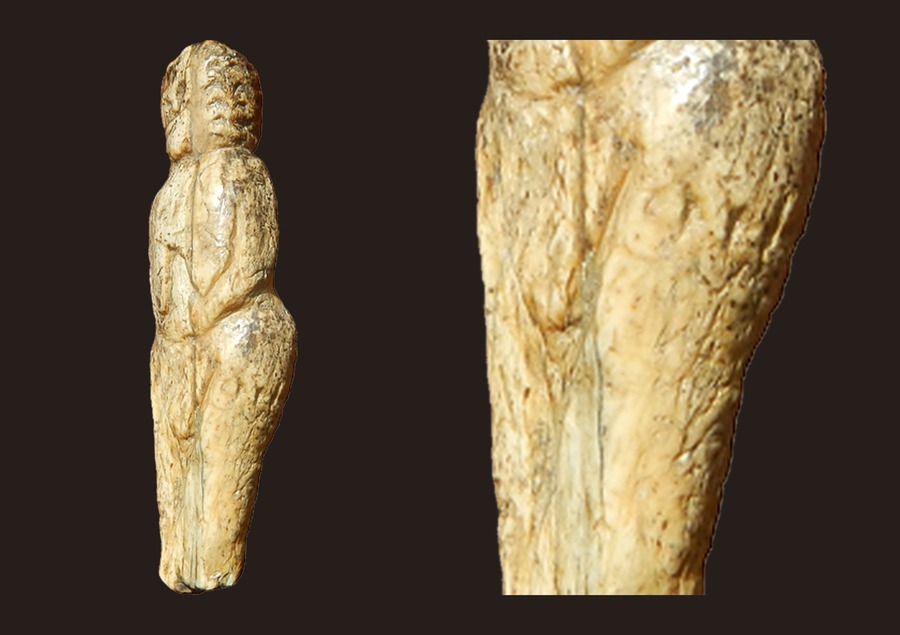
Female sculpture in a dress. Mammoth tusk, 19–23 thousand years B.C. Hermitage, 370/748. Source: malta.artemiris.org (accessed 11.19.2026) Length 93.2 mm.
A line of seven indentations runs around the hips, indicating the hemline of the upper garment. Main Text: The largest figure in the atlas (93 mm). The catalog describes flat, sagging breasts, a wide pelvis, narrow sloping shoulders, thin arms, and a massive chin: the combination of these features reads as the image of a mature woman. The head is covered with nine vertical rows of C-shaped markings (a hood). The indentations encircle the figure from the sides and back at a distance of 33.4–42.2 mm from the shoulders. The master is showing not texture, but boundary: where the jacket ends. According to Barthes, this is an element of «descriptive clothing»: a sign that conveys a rule.
The front is rendered roughly, while the lines of the dimples and the face are meticulously detailed.
The contrast illustrates a hierarchy of attention: the edge of the garment is organized, and the texture of the hood is applied loosely. A straight and cutting knife and a chisel were used. The catalog does not note signs of wear or holes; for the 93 mm figure, this is logical: it would not have fit discreetly in a pouch, so it was likely kept visible or stored. The referential function dominates: «here is a woman of this age in this clothing.» According to Goffman, the boundary of clothing is part of the «façade, ” showing group affiliation.
What exactly the dimples represent (hem, seam, or decoration) is unknown.
Miniature sculpture of a teenager in a jumpsuit. Mammoth tusk, 19–23 thousand years B.C. The Hermitage, 370/753. Source: malta.artemiris.org (accessed 19.11.2026). Length 41.8 mm.
The markings on the front and back sides match, suggesting the figure was designed to be two-sided. The main text: at a length of 41.8 mm, it has a thickness of about 5 mm, which is why it is closer to the plate. The body is covered with 26 transverse ring lines; on the chest, V-shaped lines separate the arms from the body, and below, triangles separate the body from the legs, both on the front and back. The «teen» age is based on the catalog; indicators of age are proportions, specifically the elongated form and small size. I hypothesize that the V-shaped lines represent straps and the triangle represents the waist, but this needs verification on other specimens. A single knife was used.
Miniature sculpture of a teen in a jumpsuit: head, torso, lower body in enlargement. Hermitage, 370/753. Source: malta.artemiris.org (accessed 11/19/2026)
The 1.8 mm hole was enlarged only on the front side; the cord exited through the «face.» The catalog does not record signs of wear; the polishing covers the entire surface, but this could be attributed to final sanding rather than use. Due to its small size, the hole, and its two front-facing sides, the figurine is suitable as a mobile charm that can be attached to clothing or a belt. According to Van Genneyp, adolescence—the threshold between childhood and adulthood—might have required specific markings; in such a case, the figurine would have served as a marker of age status. This is a hypothesis based on the presence of categories for children’s and teens' imagery in the catalog.
Female sculpture wearing a fur hat. Mammoth tusk, 19–23 thousand years BP. Hermitage, 370/757. Source: malta.artemiris.org (accessed 11.19.2026). Length: 37.5 mm.
The catalog describes it as miniature and unfinished: the front side is unclear, but the back features all the elements. A helmet-like hood covers the chin, cheeks, forehead, back, and shoulders, and a belt is visible under the right arm. The back is more detailed than the face. If this is not due to poor surface preservation, the artisan likely started with the identifying features of the dressed figure (hood, back) and left the face for later. Hair ornamentation had already begun; the catalog notes a «attempt to adorn the hair.» The reddish-brown color may be a remnant of dye or a storage mark, but this cannot be determined from the photograph.
Female Sculpture in a Fur Hat: Head, Torso, and Lower Section in Detail. The Hermitage Museum, 370/757. Source: malta.artemiris.org (accessed November 19, 2026)