PART I. INTRODUCTION
Toothpaste advertising traditionally appealed to consumers through the image of a perfect smile and a professional dentist’s recommendation. White teeth demonstrated the desired outcome, while the specialist helped convince the viewer of the product’s benefits.
However, advertisements gradually began to feature characters whose appeal was not tied to perfect aesthetics, but to relatable situations and personal experiences. Instead of flawless smiles, brands started showcasing ordinary people—their emotions and everyday struggles.
Research Question and Hypothesis
How has the visual representation of people in Colgate and Sensodyne toothpaste advertisements changed from the 2000s to the 2020s?The hypothesis is that advertising is gradually shifting its focus from idealized results and external authority to personal experiences in which the consumer can see themselves. At the same time, professional advice and the aesthetics of a beautiful smile have not disappeared; rather, they continue to coexist alongside more natural imagery.To test this hypothesis, specific campaigns from both brands over three decades are examined.
PART II. THE 2000S: AN APPEALING SMILE AND THE SPECIALIST’S AUTHORITY
Colgate Total Advanced Clean, 2007
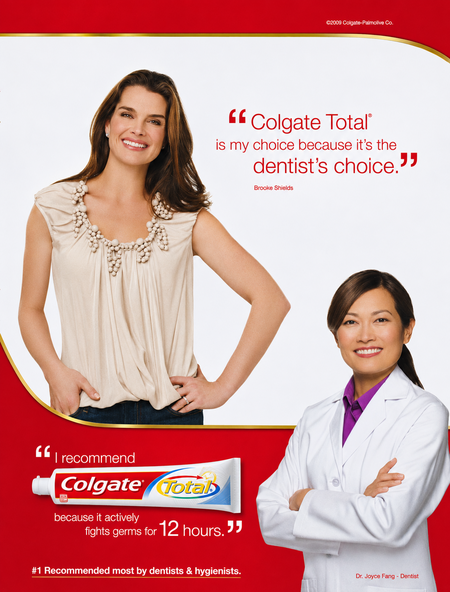
In 2007, Colgate introduced the Total Advanced Clean toothpaste campaign featuring actress and model Brooke Shields. Her public image was associated with beauty and a successful career, so having a celebrity involved helped give the everyday product added appeal. At the same time, the advertisement appealed not only to the actress’s appearance but also to her personal role as a mother. Thus, Colgate aimed to connect an aesthetically appealing image with a relatable consumer theme—caring for health.
Brooke Shields is presented as a confident, polished woman whose appearance aligns with conventional standards of commercial advertising. Her recognizability allows the brand to capture attention, and her personal story makes the message feel less detached.
However, the celebrity’s status remains the primary source of trust. The viewer sees a well-known person representing the product, supporting its appeal through her own image.
In toothpaste advertising, the smile traditionally fulfills two functions: demonstrating the intended result of using the product and emphasizing the attractiveness of the advertising star.
In the campaign with Brooke Shields, the celebrity’s appearance helps create a positive impression of Colgate. At the same time, the star herself is presented as a trustworthy individual—due to her fame and public persona—rather than merely a model with beautiful teeth.
Health care as a personal recommendation
Colgate Total Advanced Clean was marketed as a comprehensive care paste, so the advertising message was not limited to aesthetic results. The image of the mother allowed the functional benefits of the product to be linked to self-care and the care of loved ones.In this way, the brand utilized familiar consumer motivation but delivered it through celebrity. Personal experience was already becoming part of the communication, even if it wasn’t yet its primary source of persuasion.
The Role of Professional Trust
The promotion of Colgate Total was supported by professional programs and the distribution of product samples among dentists. Thus, the public image of Brooke Shields was complemented by the medical aspect of the marketing strategy. These approaches served different functions: the celebrity made the product recognizable and appealing, while professional support helped build trust in its functional benefits.
Case Conclusion
In the 2007 Colgate advertisement, appeal and trust are established primarily through a carefully selected protagonist. Brooke Shields simultaneously presents an aesthetic ideal and a family-caring individual.
This example demonstrates that appeals to personal experience existed in the 2000s, but they were associated with a famous figure rather than the daily life of the average consumer.
Colgate Total Advanced Clean utilized celebrity as an intermediary between the product and the audience. Her attractive appearance supported the brand’s image, while her personal role made the recommendation more accessible.
At the same time, the communication maintained a certain distance: the consumer saw a person with a distinct public status and was presented with the proposition to trust their selection.
Sensodyne Total Care Extra Fresh, 2007
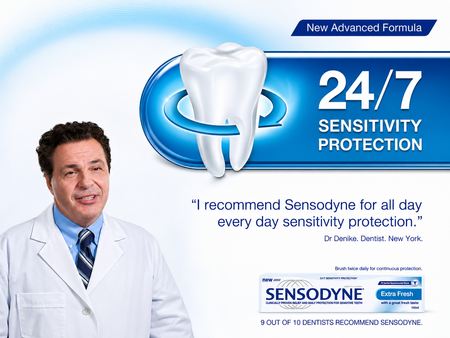
In the 2007 advertisement for Sensodyne Total Care Extra Fresh, a dentist served as the main character. Unlike the Colgate campaign, the conviction in this ad was not built upon public fame or attractive appearance, but rather on the professional status of the specialist. This approach aligned with Sensodyne’s product objective: to explain the necessity of specialized care for sensitive teeth and to reinforce confidence in choosing the toothpaste.
Why Doctors Are Trusted
The depiction of the dentist, the indication of qualifications, and the restrained presentation of the product all conveyed an impression of medical credibility. The advertising message relied on visual cues of expert consultation rather than the consumer’s emotional narrative.The viewer was invited to trust a specialist possessing the knowledge necessary to assess the paste’s benefits.Tooth sensitivity is linked to discomfort, the causes of which are not always clear to the buyer. Therefore, the dentist’s recommendation helps reduce uncertainty—the specialist acts as someone capable of explaining the problem and offering a solution.In this model, the consumer remains the recipient of professional advice. Their own experience is important as a reason for purchase, but it does not become the central content of the advertising imagery.
The 2000s Wrap-up
Two Ways to Present Toothpaste
Colgate and Sensodyne campaigns from the same period utilize different archetypes of a person. Colgate leverages the appeal and fame of Brooke Shields, while Sensodyne focuses on the competence of a dentist. However, both strategies share a common principle: the persuasiveness of the advertisement is shaped by the character’s specific status. The brand prompts the consumer to trust an individual who possesses either public acclaim or professional expertise.
Where is the average consumer?
In the campaigns reviewed, the average person generally remains outside the primary advertising image. They are encouraged to follow an appealing archetype or an expert opinion, but their own lived experiences are not yet the central subject of the advertisement. However, the seeds of future changes are already visible: the personal role of Brooke Shields suggests that brands are beginning to seek a closer, more relatable way to communicate with their audience.
PART III. THE 2010S: FROM EXAMPLE TO PERSONAL EXPERIENCE
Colgate Optic White Express White — The Smile Show, 2015
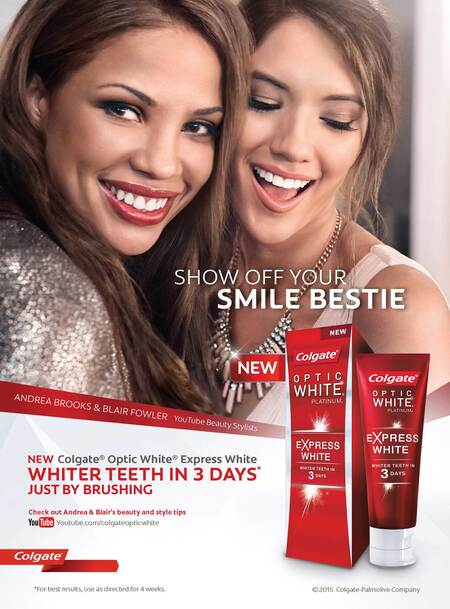
In 2015, Colgate launched The Smile Show project to promote its Optic White Express White whitening toothpaste. The featured personalities were beauty bloggers Andrea Brooks and Blair Fowler, who gained recognition through their YouTube channels. Unlike traditional celebrities, their popularity stems from consistent engagement with their audience. This allowed the brand to utilize a more personal endorsement format, keeping the product closely tied to the beauty industry.
Beauty bloggers address their audience through the familiar format of video advice, sharing tips on self-care and cosmetic routines. Their persuasive power stems not only from their attractive appearance but also from the feeling of a familiar individual whose recommendations the audience is accustomed to trusting. Thus, the advertising persona becomes more relatable to the viewer, even though the aesthetic ideal of a bright, white smile remains an important part of the message.
In-content advertising
The Smile Show was a series of YouTube videos in which the product was integrated into conversations about beauty, style, and skincare. Unlike traditional commercials, this format targeted an audience already interested in the content of specific creators.
Toothpaste became part of a regular beauty routine, and the advertisement took on the character of a personal recommendation.
The beauty video format involves direct address to the camera, product demonstration, and a more informal tone of communication. Because of this, the advertising message aligns with the user-generated content that viewers regularly encounter in the digital environment.
At the same time, professionally organized filming and a focus on an attractive smile are maintained, so the new presentation does not mean abandoning cosmetic standards.
From Brook Shields to Beauty Bloggers