Concept
The research topic was chosen because Paleolithic depictions are typically viewed as flat reproductions: photographs of isolated animals or panels detached from the rock surface and the space in which they exist. While this presentation method allows for the study of the drawing, it obscures the unique characteristics of the artwork itself—the natural protrusions and indentations, the arrangement of figures on the walls and ceiling, the distances between the images, and the conditions of their illumination. Yet, it is precisely these qualities that distinguish cave art from images on a uniformly flat surface. Therefore, this study does not focus on what Paleolithic people depicted, but rather on how the image could have been perceived inside the cave.
The title, «Cave as a First Screen, ” functions as a research metaphor, not as a definitive statement about the invention of cinema in antiquity. It serves to test whether a static image can evoke the impression of change, volume, or motion through the characteristics of its environment. The relevance of this approach stems from the modern viewer’s habit of consuming works via photographs; comparing a reproduction with the image’s actual spatial placement reveals which properties of art are lost when transposed onto a flat frame. This visual focus allows for a discussion of specific artistic techniques and observable viewing effects, rather than the biographies of ancient artists or hypothesized ritualistic meanings.
Research Rubric Principle
The study includes monuments that allow for a comparison not just of different subject matters, but of various relationships between the drawing and its spatial medium. Chauve and Lasco provide material for analyzing recurring and intersecting contours, the rhythm of figures, and the distribution of images across rooms. Altamira is important as an example of the interaction between the drawn animal body and the natural convexity of the ceiling. Pech-Merl allows us to examine the connection between silhouette, stain, imprint, and surface texture; Font-de-Gom presents a combination of painting and engraving; Nio and Ruffignac explore the role of an extended route and individual viewing zones. These monuments do not form a line of direct influence—they have been selected as diverse visual solutions to a shared question.
Principle of Selection and Analysis of Textual Sources
Textual sources are used as a means to verify visual material, not as the basis for recounting the history of the cave paintings. Priority is given to official materials from the French Ministry of Culture, the Altamira Museum, relevant centers and organizations that document specific monuments, as well as museum descriptions of the works by McCall and Terrell. These sources help to clarify the attribution, location of the composition, technique, nature of the reproduction, and the status of the image—whether it is the original, a museum reconstruction, a historical rendering, or a modern photograph. Research publications, including the article by Mark Azem and Florian River concerning presumed animation techniques in Paleolithic art, are treated separately from official documentation: their interpretations help formulate the problem but are not accepted as established proof of the intent of the ancient artists.
Key Question and Hypothesis
Key Question: How does the perception of an image change when it exists not on a flat plane, but on the walls and ceiling of a dark cave, and the viewer encounters it while moving through the space under limited, shifting light? Hypothesis: The sense of movement in cave art arises not only from the posture of the depicted animal or repeated contours but also from the interaction of the drawing with the stone’s relief, the sequence of viewing points, and the distribution of light. Therefore, «movement» here must be considered in two distinct senses: as artistic depiction of movement within the image and as a change in the image itself for the observer as they move.
Testing the hypothesis requires comparing groups of images, rather than searching for a single striking example. If the relief alters the visible volume of the figure, superimposed lines create a sense of rhythm, and sections of the panel become discernible from different points, then cave art can be described as a spatio-temporal visual experience. However, this does not prove that the creators intended to produce animation or that every viewer saw the same thing—relics alone are insufficient for such conclusions. The presumed outcome of this research is to demonstrate that the metaphor of the «first screen» is productive precisely when it signifies the active role of space, the viewer’s body, and light, rather than the literal existence of prehistoric cinema.
Chapter 1. Relief. The Stone is Not the Background: When the Wall Becomes a Body
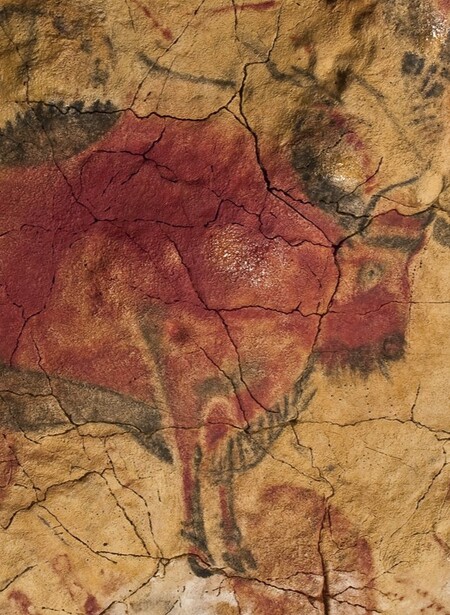
In Altamira, the bison is not placed against a random background. The large, natural convexities of the Polychromy Hall’s ceiling help create the roundness of the body—the paint, the dark contour, and the existing volume work together. Fundamentally, this image is not merely reduced to pictorial modeling using light and shadow. Here, the stone partially dictates the form even before any pigment is applied. In the ceiling photograph, this physical volume often transforms into a patch of color, so the research requires attention to both the overall composition and the close-up figure. The Altamira Museum explicitly describes the use of protrusions, cracks, and the natural color of the stone.
Author unknown. «Polychrome Bison, Altamira Cave.» Upper Paleolithic, Magdalenian, approximately 15–14 thousand years ago. Photographer: D. Rodríguez; source and copyright holder of the photographic material — Museo de Altamira.
Author of the reconstruction is not specified. «Reproduction of the polychrome vault of Altamira.» Museum reconstruction: manufacturing date is unestablished; photograph from 2005. Photographs: MatthiasKabel; panoramic assembly: Nachosan (reconstruction shots, 2005).
In Pesch-Merl, the relationship between wall and line is structured differently. The outlines of the figures on the «spotted horses» unevenly engage with the properties of the stone; the shape of the head of the right horse relates to the natural contour of the rock face. Dots extend beyond the boundaries of both animals, and negative handprints are placed nearby. Therefore, this is not an illustration of a single running animal, but a composite field of silhouettes, signs, and traces of gesture. If one only looks at the image of the horses within an isolated rectangular frame, the principle of the entire group’s composition is lost.
Unknown artist. «Spotted Horses, Pesh-Merl Cave.» Upper Paleolithic, estimated around 29,000 years ago; the exact date of any single figure has not been established. Photographer: Céréales Killer (author’s pseudonym on Wikimedia Commons, 2024).
In «Show,» there is a different approach to surface treatment: figures conform to the projections, the edges of the niches, and the bends of individual panels. In «Lasco,» movement along the vaults of the Bull Hall reveals monumental figures gradually and not all at the same height. Consequently, the relief can be natural, or it can be emphasized or created through graphic intervention.
Unknown author. «Spotted Predators, Chauvet Cave.» Upper Paleolithic, approximately 37–30 thousand years ago; the exact dating of the individual figure is undetermined. Photographer: not specified.
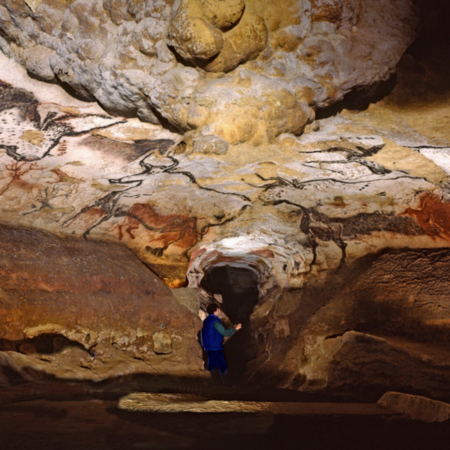
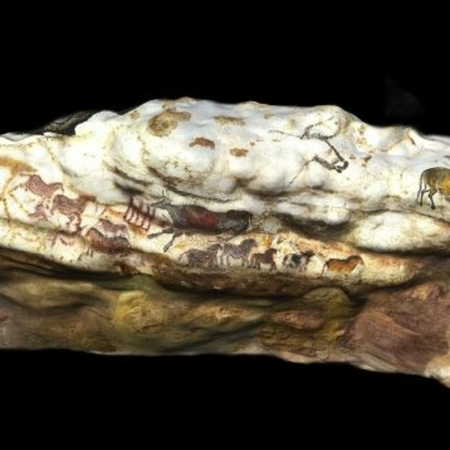
1. Artist unknown. «Bull Chamber (general view), Lascaux Cave.» Upper Paleolithic, approximately 21.5–21 thousand years ago; precise dating of an individual figure is undetermined. 2. Artist unknown. «Right Wall of the Axial Branch, Lascaux Cave.» Upper Paleolithic, approximately 21.5–21 thousand years ago; precise dating of an individual figure is undetermined. Photographers: not specified.
Chapter conclusion: The «screen» of a cave is not a neutral plane. It already possesses indentations, light facets, and convexities, and the artist can utilize these as part of the animal’s body. The most convincing visual connection is between Altamira and Pech-Merl: in the former, a pre-existing protrusion enhances volume, whereas in the latter, the image is composed of lines, spots, and a form already outlined by the rock itself.
Chapter 2. Movement. Bringing Life Without Frames: Overlay, Repetition, and Rhythm
On the horse panel by Schove, several heads form a directional sequence; on the lion panel, the contours of the bodies and muzzles intersect, creating a dense vector of movement. However, it is important to distinguish between the repetition of different animals and the multiple phases of a single animal’s movement. One photograph cannot prove that four heads must be perceived as four moments of a single animation. A more reliable observation is how the composition organizes the movement of the gaze itself: we compare the tilts of the necks, the direction of the muzzles, the scale, and the repeating arcs.
Author unknown. «Horses Panel, Chauvet Cave.» Upper Paleolithic, approximately 37–30 thousand years ago; the precise dating of individual figures has not been established. Photographer: not specified.
Lasco proposes a similar principle, albeit on a different scale. In the friezes, silhouettes can overlap one another, forcing the eye to discern a figure from the surrounding lines. Here, the «movement» resides in the process of reading: one boundary unexpectedly transforms into part of another figure. The presence of multiple legs, horns, or contours does not inherently prove frame-by-frame animation; it may be explained by repeated depictions, the overlay of different painting stages, or the compositional connection between figures. Researchers Marc Azema and Florent Rivière have proposed an interpretation of certain Paleolithic images as sequential phases of movement, but this remains a hypothesis, not a universal key to all the panels.
Artist unknown. «Red Cow and Calf, Lascaux Cave.» Upper Paleolithic, circa 21.5–21 thousand years ago; the precise dating of individual figures is undetermined. Photographer: not specified.
Font-de-Gom helps reveal a third possibility. Here, the repetitions of bison and mammoths along the wall create a rhythm that does not require the assumption that one animal «transforms» into another. In the so-called Bison Cabinet, about a dozen animals are distributed across a small, domed space. The images change their orientation relative to the viewer along with the wall: when one turns their head, the group can be perceived alternately as individual bodies or as a mass. In the Black Room, the animals are often depicted without a horizon line; it appears as if the figures are suspended from the wall. This is a characteristic of the drawing, amplified by the lighting conditions, and not evidence of actual flight or animation.
Author unknown. «Panorama of Five Bison, Font-de-Gomme Cave.» Photographer: not specified.
Chapter Conclusion: It is necessary to distinguish between the movement of the depicted body, the movement of the gaze across the composition, and the viewer’s movement in front of the wall. These mechanisms sometimes coincide but are not identical. Therefore, the «first screen» is not an analog of a film strip, but a visual experience in which line and repetition compel the viewer to constantly reassemble the whole.
Chapter 3.
Route. Not a single frame, but a series of encounters: the viewer’s body in a cave
The cavern does not reveal the entire ensemble at once. The Bulls Hall of Lasco, the lateral Osseous branch, the Nef, and the Well occupy different spatial positions. The Well scene is not simply the «next picture» in a unified gallery; a different area and different accessibility alter the scale and sequence of encounter. The plan is needed here not to recount the archaeology, but to explain why the arrangement of the figures itself includes distance, rotation, and the threshold between zones.
Creator not specified. «Laskovo Cave Plan.» Modern diagram; date of creation is unknown. Diagram author: not specified.