Navigation
Concept
- City on the Border of Worlds
- Two Realities — Two Visual Languages
- Light, Shadow, and the Unseen
- Between Human and Entity
- The Color Language of the Supernatural
Conclusion
Concept
The film Constantine: Darkness Devil (2005), directed by Francis Lawrence, depicts a world where familiar reality coexists with the supernatural. Angels, demons, and other entities exist alongside humans but remain invisible to most. Furthermore, this otherworldly realm is not separate from the earthly one; rather, it seems hidden within it. This characteristic became the starting point for my research.
I was interested in how cinema can represent what people typically do not see. In Constantine, the supernatural is created not only through fantastic creatures and special effects. Lighting, color, architecture, frame composition, sound, and editing also play a vital role. It is the combination of these elements that allows the viewer to feel the presence of another world, even in scenes where nothing extraordinary is happening.
The central question of my research is: how does the film Constantine, through cinematic techniques, construct the image of a supernatural world and demonstrate its connection to human reality?
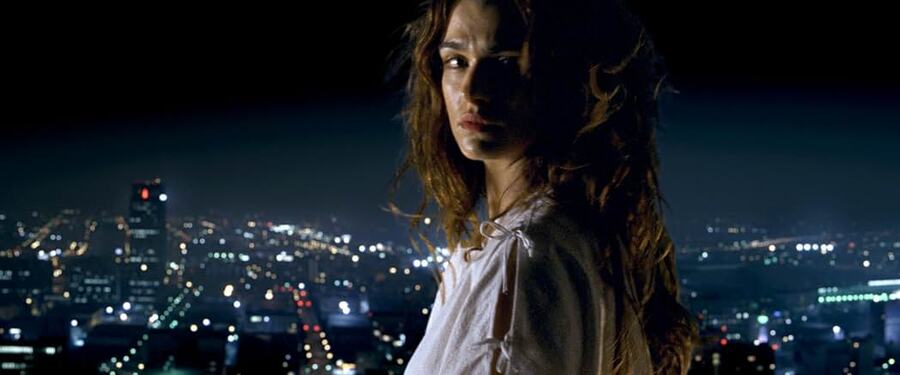
I suspect the film features an entire visual system that helps the viewer distinguish between two worlds and understand their interaction. Moreover, the boundary between them is not always obvious. Sometimes it is emphasized by a sharp shift in color, lighting, and space, and other times the supernatural manifests through small details, unusual character behavior, or specific framing choices.
The depiction of the city is one of the film’s key features. Los Angeles is presented as a recognizable contemporary space, but its architecture, dark streets, interiors, and lighting create an unsettling atmosphere. It is particularly interesting that hell is not portrayed as an entirely separate location, but rather as a ruined and distorted version of the earthly city. This allows the two worlds to be perceived as interconnected realities.
I want to focus specifically on the use of light and color. The film frequently employs high-contrast lighting, deep shadows, muted tones, and bright light sources. These choices help to direct the viewer’s attention, build tension, and highlight the supernatural elements within the ordinary space. Color also becomes a method of showing the differences between the worlds and altering the perception of what is happening.
Character and prop design plays an equally important role. Angels, demons, and other creatures possess unique visual characteristics revealed through costumes, makeup, movement, and physical details. Religious symbols and objects in the film take on an unusual form, blending traditional mystical iconography with the aesthetics of the modern city and the action genre.
Beyond depicting individual objects, I am also interested in the method of scene construction itself. Camera movement, editing, sound effects, and spatial shifts convey the transition between worlds and illustrate events that cannot be explained by the laws of ordinary reality. These techniques work in concert to create a sense that another world constantly exists just beyond the visible one.
The foundation of this research will be the visual analysis of the film. I will compare individual shots and sequences, paying close attention to composition, color, light, textures, design, and cinematographic effects. The images will be arranged so that the viewer can independently observe patterns, and brief commentary will help explain their significance.
Through this, I aim to demonstrate that the supernatural elements in «Constantine» are created not solely through fantastic imagery, but also through a cohesive visual and sonic language. The film transforms a familiar urban setting into a space where the real and the ethereal constantly intersect. By analyzing these directorial choices, one can understand how cinematic tools shape the perception of a fictional world and make the invisible part of the screen’s reality.
City on the boundary of worlds
«Konstantin, ” 2005. Night panorama of the city, urban transition plans.
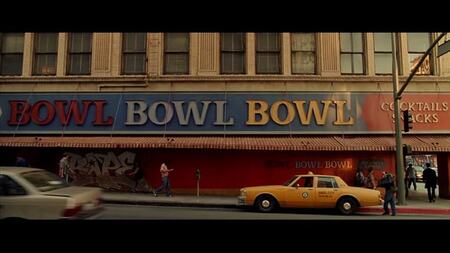
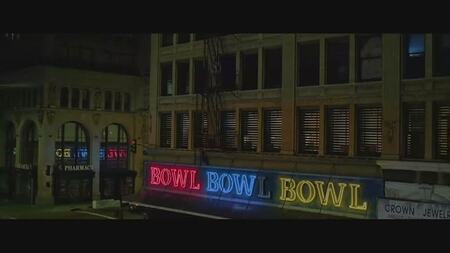
«Konstantin, ” 2005. Bowling alley facade, daytime and nighttime views.
The same city changes its character depending on the time of day and the lighting.
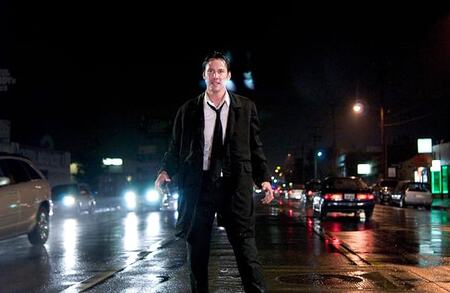
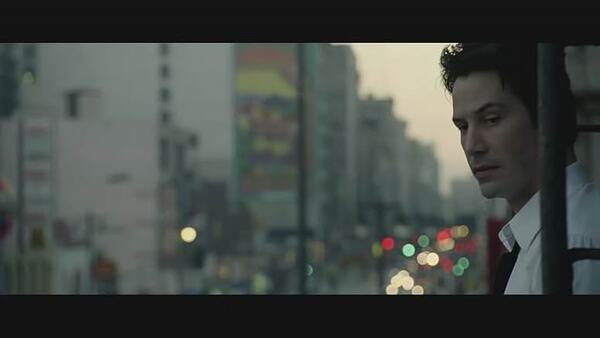
«Konstantin,» 2005. Konstantin against the backdrop of a city street; a nocturnal scene on the roadway.
Los Angeles is presented as a recognizable contemporary space. However, the nighttime lighting, empty street sections, and the placement of the person relative to the city gradually alter its perception. The familiar environment begins to feel unsettling.
«Konstantin, ” 2005. Night street with police cars;
«Konstantin, ” 2005. Overhead view of a closed urban courtyard.
The bird’s-eye view transforms the city into a system of constrained spaces.
«Konstantin, ” 2005. Lobby of a residential building, from the start of the film.
«Konstantin, ” 2005. Hospital corridor, hospital scenes.
A city consists not only of streets but also of a sequence of internal transitions.
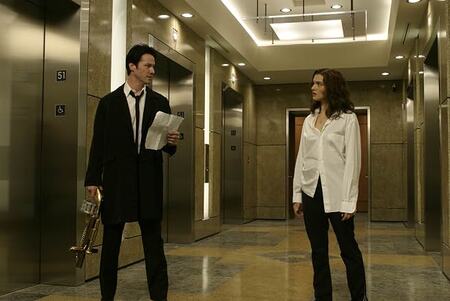
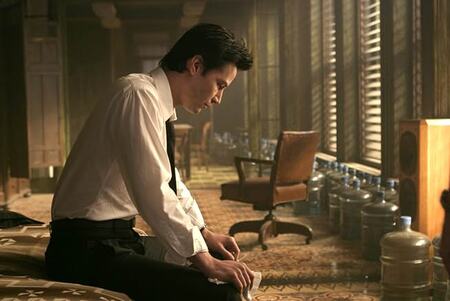
«Konstantin, ” 2005. Elevator lobby with Angela; interior of Konstantin’s residence.
As one moves from streets to interiors, the city unfolds as a system of discrete spaces. Doors, hallways, and staircases restrict the view, and movement between rooms helps to create a sense of the unknown.
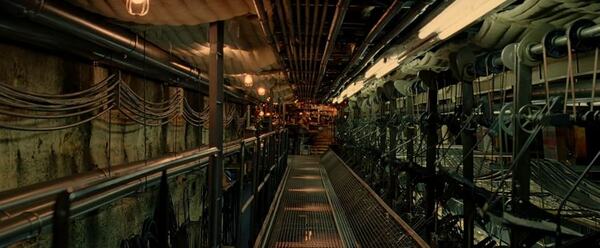
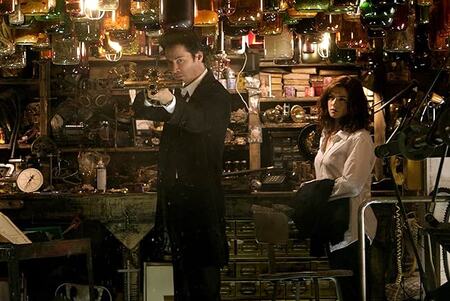
«Konstantin, ” 2005. Technical passage; room with equipment and weapons.
Behind familiar city interiors lies a complex technical infrastructure.
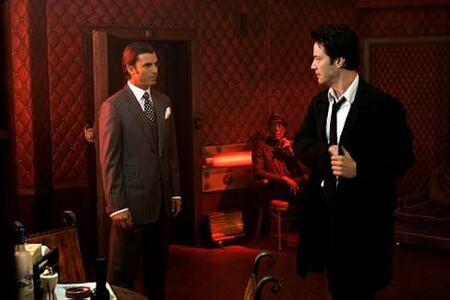
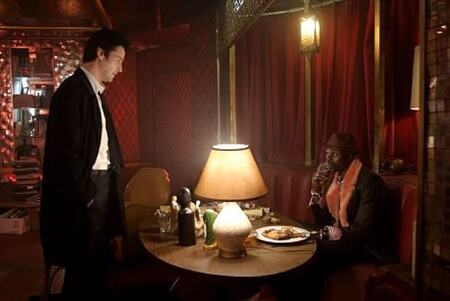
«Constantine,» 2005. The Club of Papa Midnight, scenes of encounters and conversations.
Within an ordinary city exist places that are not accessible to everyone and are governed by special rules.
«Konstantin, ” 2005. Angela against the backdrop of the city at night.