Hidden Imagery: The Interaction Between External and Internal Decoration on Attic-Style Kylikes from the 6th–5th Centuries BCE
Navigation Menu
- Introduction
- Relevance and Rationale for Topic Selection
- Areas of Study
- Chronology and Geography of the Research
- Research Objective
- Research Question
- Hypothesis
- Research Tasks
- History and Characteristics of the Eye-Shaped Kylix
- Outer Eyes as a Depiction of the Face and the Motif of Gaze
- Gorgoneion Within: The Repetition of the Gaze Motif
- Internal Images Without Direct Relation to Outer Eyes
- Diversity of External and Internal Composition
- The Internal Image as a Hidden Symbol
- The Eye-Shaped Kylix and Symposium: Interaction Between Object and Viewer
- Comparative Analysis of Selected Artifacts
- Research Methodology
- Conclusion
- Principle of Material Selection
- Principle of Material Categorization
- Principle of Textual Source Selection
- List of Images Used
- List of Textual Sources Used
Introduction
Ceramic vessels played a significant role in the daily and ritual life of Ancient Greece. They were used for storing, preparing, serving, and consuming food and beverages, yet they simultaneously functioned as objects of artistic decoration and carriers of imagery related to mythology, religious beliefs, and social life. One of the most characteristic vessels for wine consumption was the kylix—a wide, shallow cup with two horizontal handles and a stem. Its form provided artists with the opportunity to work across multiple surfaces: the exterior wall, the interior base, and the area around the handles. As a result, a single object could feature several independent images, which the viewer perceived based on different orientations of the vessel.
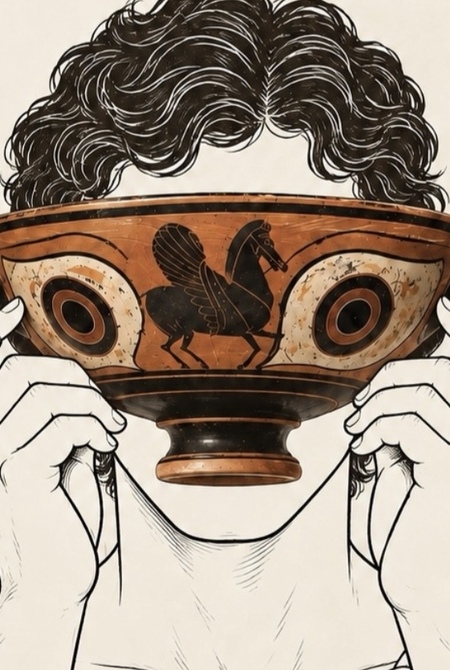
A specific variation of the kylix is the eye-cup, which received its name from the large, stylized eyes depicted on the exterior. Typically, these eyes were placed symmetrically on either side of the cup. Between them, there might be figures of warriors, mythological characters, satyrs, and other creatures. Sometimes the eyes were enhanced with noses, eyebrows, and other details, causing the entire outer composition to resemble a human face or a theatrical mask.However, the exterior surface is not the only area worthy of attention. On the interior base of the kylix, within the central medallion—the tondo—a separate image was frequently found. One common motif was the gorgoneion, meaning a frontal depiction of the Gorgon’s head. Other scenes also appear, including mythological characters, battle scenes, depictions of animals, and individual human figures.
The distinctive feature of the eye-cup chalice is that all of these images cannot be perceived simultaneously. The external eyes are visible when viewing the vessel from the side, while the inner image is revealed when looking down from above. When using the cup, the person would tilt it, bringing it to their lips, and the image on the base would gradually become visible.
Thus, the eye-cup chalice is an object where the image is connected not only to the surface but also to action. The viewer interacts with the vessel, changing its orientation and gradually discovering the various elements of the decoration.
In this study, eye-shaped flutes are examined as objects of visual interaction. The primary focus is on the relationship between the exterior gaze and the internal decoration, as well as the characteristics of image perception during the use of the vessel.
Relevance and Justification for Topic Selection
The relevance of this study lies in the fact that stemmed goblets are not merely beautiful vessels; they are a genuine instrument of visual play that only reveals itself in motion. Unlike monumental architecture or sculptural forms designed for an external gaze, this vessel demands participation. It is designed for the hands, and its meaning emerges the moment a person picks it up from the table.
The main interest here stems from the disconnect between what those around watch and what the drinker actually perceives. To the company seated at the table, the goblet is primarily a pair of vast, vacant-staring eyes. It is a public image, a mask that functions for an external audience. But the instant a person raises the cup to their face to take a sip, the perspective shifts. The observers see only the profile and the hands, while the drinker is suddenly presented with the interior. And there, in the darkness at the base, anything might await them—from a terrifying Gorgon mask to a scene of brutal combat.
This transition from the public to the deeply personal—from the external facade to the hidden depths—is the essence of the symposium’s visual experience. The cyclops-like motif functions as an optical instrument: it directs attention, generates intrigue, and compels the viewer to take a physical action to complete the image. Examining this mechanism allows us to understand how the ancient Greeks conceived of not just pictures, but entire scenarios of interaction with an object. We are not looking at what is depicted, but at how and when that depiction becomes visible.
Area of Study
History of ancient Greek art, Attic black-figure and red-figure vase painting, and the visual culture of the Archaic period.
Chronology and Geography of the Research
The main period of study is the 6th to early 5th century BCE, the time when eye-shaped goblets were at their peak popularity in Attic pottery.Athens was the primary center for the production of the vessels examined. Furthermore, the study takes into account their widespread distribution outside of Greece, particularly in Etruria, where the eye-shaped bowls frequently appeared in burial complexes and may have acquired new, local meanings.
Research Objective
To identify the characteristics of the interaction between external views and the internal decoration of Attic eye-shaped kylikes, determine the frequency with which these images are thematically connected, and examine the role of the drinking process in perceiving the internal imagery.
Research Question
How do the external eyes and the internal image interact within the composition of cyclops eyes, and how does the act of drinking affect the perception of the hidden image?
Hypothesis
It is suggested that the interaction between the external views and the internal decoration of the eye-shaped bowls does not follow a single narrative principle. In some cases, the images may be linked by common mythological motifs and visual associations, while in others, they present independent compositions.
However, the internal images are unified by their placement: they are located at the bottom of the cup and become particularly noticeable when the vessel’s position changes while drinking. If mythological creatures, scenes of violence, or other unusual figures are depicted on the interior surface, their gradual revelation could have amplified the sense of surprise and visual threat.
Thus, it is proposed that the meaning of the internal decoration is determined not only by the content of the depicted subject matter but also by the manner in which the viewer discovers it.
Research Objectives
- Examine the form and characteristics of Attic eye-rimmed kylikes.
- Study the origin and dissemination of this type of vessel.
- Describe the composition of the exterior eyes and the interior decoration on selected artifacts.
- Compare the kylikes with gorgoneion, mythological characters, and narrative scenes.
- Identify instances of semantic, iconographic, and visual connection between the exterior and interior surfaces.
- Consider the specifics of perceiving the interior image as the vessel’s orientation changes.
- Analyze the possible meaning of the monstrous figures, threats, and violence on the interior base of the cup.
- Compare various scholarly interpretations of the external eyes: the motif of a face, a mask, an apotropaic sign, and an independent decorative element.
- Determine whether the gradual revelation of the interior image can be considered a general visual principle of eye-rimmed kylikes.
1. History and Characteristics of Eye-shaped Cups
Eye-cup kraters became popular in Athens in the 6th century BCE. They predominantly belong to black-figure pottery, although red-figure and bilingual variants are also known. This type of vessel reached its peak popularity around 530–500 BCE, although individual examples date to earlier and later periods.
The exterior composition of the eye-cup cups was typically built around two pairs of large eyes. These eyes could feature concentric rings depicting the iris and pupil, and might be supplemented with eyebrows or a nose. Individual figures or small scenes were placed between the eyes. In the space near the handles, there were botanical ornaments, animals, birds, ships, or other decorative elements.
The vessel’s form itself played a significant role. The eyes, handles, and base could give the impression of a human face. Depending on how the cup was held, the handles resembled ears, while the base and lower portion of the vessel could be perceived as a mouth. This led to the interpretation in scholarly literature of the eye-cup krater as a kind of mask.
John Boardman was one of the researchers who developed this interpretation. He noted that when the krater was brought to the drinker’s face, the vessel seemed to transform into a mask, and the external eyes were positioned at the level of the person’s eyes.
However, this explanation is not the only one. Scholarly literature also discusses a possible apotropaic function of the eyes—their capacity to symbolically protect against the evil eye and danger. Furthermore, it is incorrect to automatically assume that all eye motifs function as talismans; their meaning could depend on the specific object, its design, and the context of its use.
A significant contribution to the study of this topic was the article «Athenian Eye Cups in Context» by Sherri Bandrick (2015). The researcher draws attention to the geographic distribution of the cups and shows that they cannot be considered solely within the context of the Athenian symposium. A considerable number of eye-cup kraters have been discovered outside of Athens, notably in Etruria. There, these objects may have taken on additional meanings depending on local customs and ritual practices.
Therefore, eye-cup cups should not be viewed as objects with a singular purpose, but rather as a diverse group of vessels whose visual and functional characteristics could change depending on the context.
2. External Gaze as Facial Image and the Motive of the Gaze
One of the main features of the eye-shaped kylix is the transformation of the decorative motif into a semblance of a human face. The external eyes do not merely fill the surface of the vessel; their placement creates a specific compositional structure that resembles a frontal portrait. In some cases, the eyes are complemented by a nose and eyebrows, which intensifies the anthropomorphic effect. This is particularly evident on the kylix from the Metropolitan Museum, where the eyes are complemented by a nose, and figures of young men are located near the handles. As a result, the external decoration takes on the likeness of a stylized face.
The visual characteristic of these vessels is that they seem to engage the viewer. The eyes are directed outward, and their symmetrical placement creates the impression of a gaze directed at a person.
In this regard, the eye-cup rhyton is interesting not only as a depiction of a face but also as an object that becomes a peculiar subject of the gaze. The person examines the cup, but simultaneously finds themselves confronted by the image of eyes that seem to be looking back at them.
This quality is connected to the problem of visual reflexivity. In the chapter «Sight and Reflexivity: Theorizing Vision in Greek Vase-Painting» (2016), Jonas Gretlein examines images of eyes as a motif capable of drawing the viewer’s attention to the act of seeing itself. In this case, the eye functions not only as a part of the image but also as a reminder that the image is perceived through vision.
This observation is particularly crucial for the eye-cup rhyta. Their exterior decoration does not merely depict eyes—it creates a situation in which the viewer confronts an image of a gaze.
3. The Gorgoneion Inside: Repeating the Motif of the Gaze
3.1. Carpet with a Warrior and Gorgoneion