The Pictures Generation is a conventional name for a circle of American artists that formed in the late 1970s and early 1980s, mainly in New York. It was not a movement with a single program or manifesto. Rather, they were artists shaped by television, advertising, cinema, magazines and mass consumer culture. In their works, the image itself became the main subject of art.
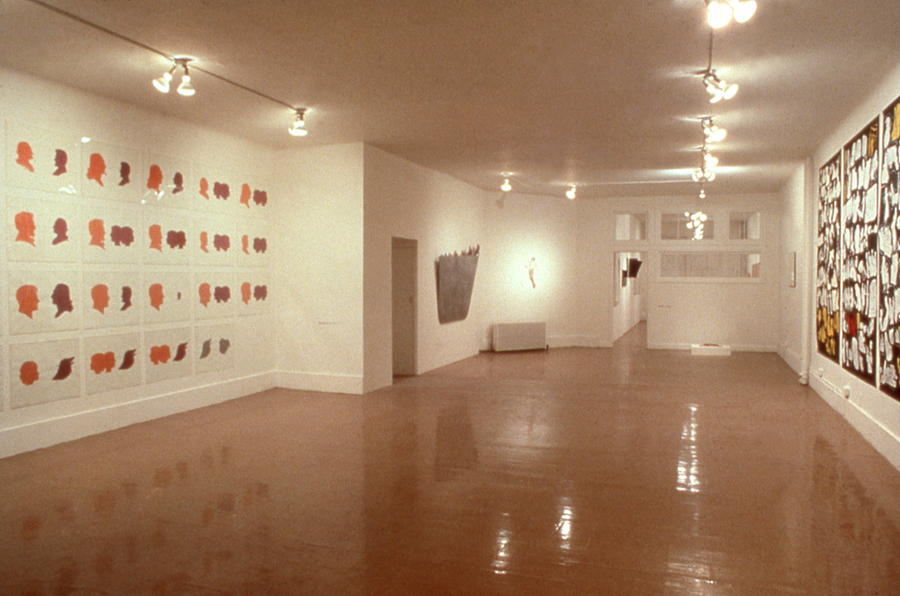
Installation view of the exhibition «Pictures», Artists Space, New York, 1977.
The name is connected with the exhibition «Pictures», organized by Douglas Crimp in 1977 at Artists Space. The exhibition included Troy Brauntuch, Jack Goldstein, Sherrie Levine, Robert Longo and Philip Smith, but later Cindy Sherman, Richard Prince, Laurie Simmons, Louise Lawler, Barbara Kruger and other artists also came to be associated with The Pictures Generation.
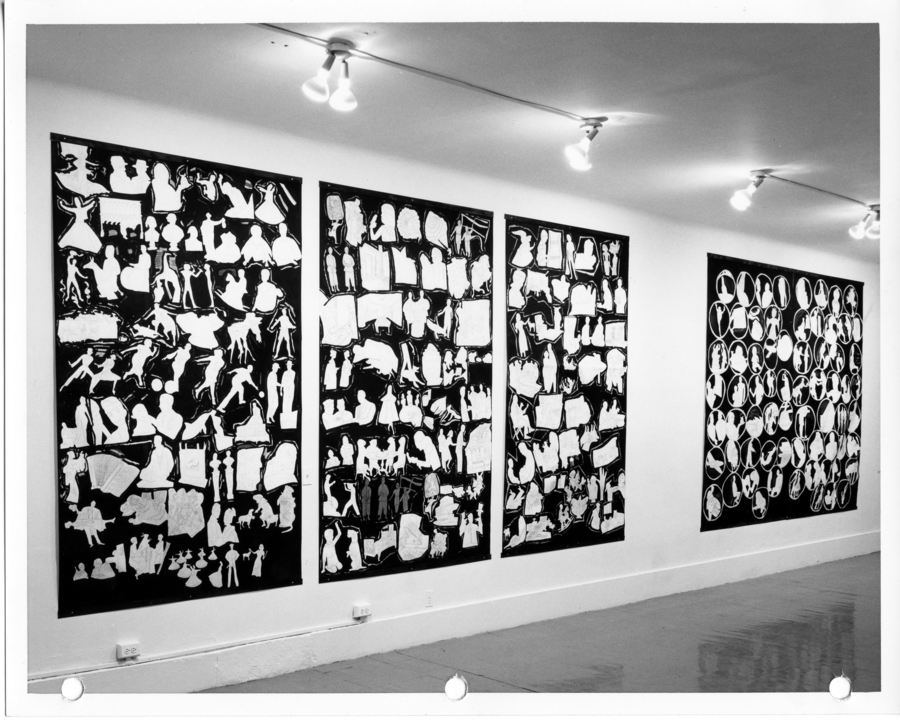
Installation view of the exhibition «Pictures», Artists Space, New York, 1977. Photo: D. James Dee.
The main feature of The Pictures Generation was its work with already existing visual codes. The artists did not try to create an «original» image; instead, they used appropriation, rephotography, staging, montage, quotation and imitation in order to show that the modern perception of reality is formed through media. They were interested in how media images shape desire, identity and ideas of the norm.
Подпись: Richard Prince. «Untitled (four single men with interchangeable backgrounds looking to the right)». 1977.
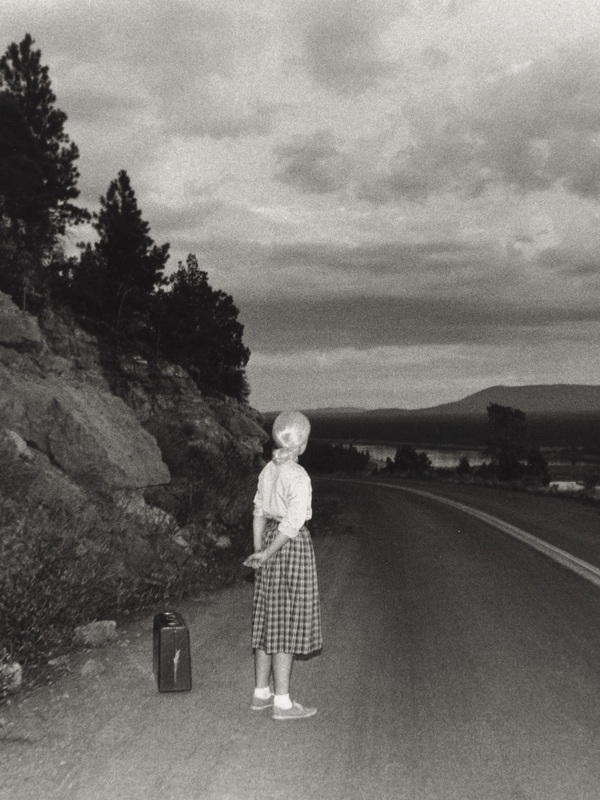
One of the most famous examples is Cindy Sherman’s series «Untitled Film Stills» (1977–1980). In these black-and-white photographs, the artist depicts fictional female characters who resemble heroines from old films. However, these are not stills from real films, but artificially constructed scenes. Sherman shows that female identity in mass culture is often built as a set of recognizable poses, gazes and narrative clichés.
Cindy Sherman. «Untitled Film Still». 1977–1980.
Another important example is Sherrie Levine’s series «After Walker Evans» (1981). Levine rephotographed well-known photographs by Walker Evans from a printed catalogue and presented them as her own works. This gesture questions authorship, authenticity and the status of the «original». Levine’s work is especially important as a critique of the modernist cult of the unique artwork and the male artistic canon.
Sherrie Levine. «After Walker Evans: 4». 1981.
Richard Prince, especially in his «Cowboys» series, analysed the myths of American mass culture. By rephotographing Marlboro advertisements, he showed that the image of the free and masculine cowboy was not reality, but a commercial construction.
Richard Prince. «Untitled (Cowboy)». 1989.
Barbara Kruger, who is closely connected with this circle of artists, combined found magazine images with short aggressive texts, for example in «Untitled (You Are Not Yourself)» (1982). Her works reveal the connection between language, power, consumption and the formation of the subject.
Barbara Kruger. «Untitled (You Are Not Yourself)». 1982.
Among other artists associated with The Pictures Generation are Troy Brauntuch, Jack Goldstein, Philip Smith, Louise Lawler, Laurie Simmons and Sarah Charlesworth. Their practices expand the understanding of this phenomenon: Jack Goldstein, in the film «Metro-Goldwyn-Mayer» (1975), used a ready-made symbol of the film industry — the MGM intro with the roaring lion; Louise Lawler, in the photograph «Pollock and Tureen, Arranged by Mr. and Mrs. Burton Tremaine, Connecticut» (1984), showed how a private interior changes the perception of an artwork; Laurie Simmons, in «Walking House» (1989), turned to artificial models of home, femininity and everyday life; Sarah Charlesworth, in her series «Modern History» (1977–1979), analysed newspaper images and the visual structure of news. These examples show that The Pictures Generation dealt not only with advertising and photography, but also with broader systems of image production: cinema, the press, the museum, the interior and social roles.
Louise Lawler. «Pollock and Tureen, Arranged by Mr. and Mrs. Burton Tremaine, Connecticut». 1984.
The theoretical basis for understanding The Pictures Generation is provided by texts by Douglas Crimp, Roland Barthes, Craig Owens, Rosalind Krauss and Jean Baudrillard. In the essay «Pictures», Crimp described a new artistic situation in which the artist works not with direct experience, but with already existing cultural images. Barthes, in «The Death of the Author», questioned the idea of the author as the only source of meaning. Baudrillard wrote about simulacra and a world in which signs begin to replace reality. Krauss criticized the myth of the originality of the avant-garde, while Owens connected postmodern art with allegory, quotation and the reuse of signs.
Opening reception of the exhibition «Pictures», Artists Space, New York, September 23, 1977. Sherrie Levine and Irving Sandler. Photo: D. James Dee.
The Pictures Generation worked precisely in the space between image, copy and interpretation. For these artists, a photograph, an advertisement or a film still was no longer a transparent reflection of reality. They were perceived as ready-made cultural constructions in which other people’s scenarios of behaviour, desire and identity were already embedded. Therefore, the appropriation of another image by Sherman, Levine, Prince, Kruger or Longo was not a simple quotation, and certainly not plagiarism. It was a way to show that any image is already connected with media, the market, art and power.
Sherrie Levine. «After Walker Evans». 1981.
The formation of The Pictures Generation was influenced by Pop Art, Conceptual Art, Minimalism, feminist criticism, poststructuralism and the development of mass media. Pop Art had already turned to advertising and consumer culture, but the artists of The Pictures Generation took the next step: they considered the media image not simply as a subject, but as a mechanism that shapes perception. In turn, The Pictures Generation influenced appropriation art, postmodern photography, feminist art, institutional critique and later digital remix culture, where copying, quoting and reworking images became everyday practices.
Installation view of the exhibition «Pictures», Artists Space, New York, 1977. Photo: D. James Dee.
The Pictures Generation can be defined as an artistic phenomenon that studies the life of images in a media-saturated culture. It showed that in contemporary culture an image is rarely neutral. An advertising photograph, a film still, a museum photograph or a magazine illustration already gives the viewer a certain way of looking at and understanding what is seen. Therefore, the artists of this circle did not so much create new images as analyse ready-made ones — showing where they came from, how they work and why they seem natural.
Cindy Sherman. «Untitled Film Still». 1977–1980.
Harrison C., Wood P., eds. Art in Theory 1900–1990: An Anthology of Changing Ideas. Oxford: Blackwell, 1992.
Crimp D. Pictures // October. 1979. Vol. 8. P. 75–88.
Barthes R. The Death of the Author // Aspen. 1967. No. 5–6.
Baudrillard J. Simulacra and Simulation / trans. by S. F. Glaser. Ann Arbor: University of Michigan Press, 1994.
Krauss R. The Originality of the Avant-Garde // October. 1981. Vol. 18. P. 47–66.
Owens C. The Allegorical Impulse: Toward a Theory of Postmodernism // October. 1980. Vol. 12. P. 67–86.
The Pictures Generation, 1974–1984 [Электронный ресурс] // The Metropolitan Museum of Art. URL: https://www.metmuseum.org/exhibitions/listings/2009/pictures-generation (дата обращения: 07.06.2026).
The Pictures Generation [Электронный ресурс] // The Metropolitan Museum of Art. URL: https://www.metmuseum.org/essays/the-pictures-generation (дата обращения: 07.06.2026).
«Pictures» [Электронный ресурс] // Artists Space. URL: https://artistsspace.org/exhibitions/pictures (дата обращения: 07.06.2026).
Richard Prince: Untitled (cowboy) [Электронный ресурс] // LACMA. URL: https://www.lacma.org/nah/node/35910 (дата обращения: 07.06.2026).
Sherrie Levine. After All: Werke 1981–2016. Begleitheft [Электронный ресурс] // Neues Museum. Nürnberg, 2016. URL: PDF-файл (дата обращения: 07.06.2026).
«Pictures». Installation view, Artists Space, 1977 [Электронный ресурс] // Artists Space. URL: https://artistsspace.org/exhibitions/pictures (дата обращения: 07.06.2026).
«Pictures». Installation view, Artists Space, 1977. Photo: D. James Dee [Электронный ресурс] // Artists Space. URL: https://artistsspace.org/exhibitions/pictures (дата обращения: 07.06.2026).
«Pictures». Opening Reception, Artists Space, September 23, 1977. Sherrie Levine and Irving Sandler. Photo: D. James Dee [Электронный ресурс] // Artists Space. URL: https://artistsspace.org/exhibitions/pictures (дата обращения: 07.06.2026).
Prince R. Untitled (four single men with interchangeable backgrounds looking to the right). 1977 [Электронный ресурс] // The Metropolitan Museum of Art. URL: https://www.metmuseum.org/art/collection/search/283712 (дата обращения: 07.06.2026).
Sherman C. Untitled Film Still. 1977–1980 [Электронный ресурс] // The Museum of Modern Art. URL: https://www.moma.org/calendar/exhibitions/253 (дата обращения: 07.06.2026).
Levine S. After Walker Evans: 4. 1981 [Электронный ресурс] // Whitney Museum of American Art. URL: https://whitney.org/collection/works/10247 (дата обращения: 07.06.2026).
Prince R. Untitled (Cowboy). 1989 [Электронный ресурс] // WikiArt. URL: https://www.wikiart.org/en/richard-prince/untitled-cowboy-1989 (дата обращения: 07.06.2026).
Richard Prince: Untitled (cowboy) [Электронный ресурс] // LACMA. URL: https://www.lacma.org/nah/node/35910 (дата обращения: 07.06.2026).
Kruger B. Untitled (You Are Not Yourself). 1982 [Электронный ресурс] // Glenstone. URL: https://www.glenstone.org/artworks/untitled-you-are-not-yourself-2 (дата обращения: 07.06.2026).
Lawler L. Pollock and Tureen, Arranged by Mr. and Mrs. Burton Tremaine, Connecticut. 1984 [Электронный ресурс] // The Metropolitan Museum of Art. URL: https://www.metmuseum.org/art/collection/search/284093 (дата обращения: 07.06.2026).
Levine S. After Walker Evans. 1981 [Электронный ресурс] // Neues Museum. Sherrie Levine. After All: Werke 1981–2016. Begleitheft. Nürnberg, 2016. S. 8. URL: PDF-файл (дата обращения: 07.06.2026).