Почему рисунки на коптских тканях говорят о
благополучии чаще, чем о вере
EGYPT III–VI CENTURIES AD
Navigator
1. Abstract
2. Topic Justification
3. Scope of Research
4. Key Question
5. Hypotheses
6. Research Goal
7. Objectives
8. Material Selection Criteria
9. Categorization Principle
10. Structure of the Work
11. Chapter 1: Wine: The Main Motif in Coptic Textiles
12. Chapter 2: Earth and Its Fruits: Abundance Without Gods
13. Chapter 3: What is Absent in These Textiles
14. Chapter 4: What Christianity Brought
15. Conclusions
16. Sources
About the Work
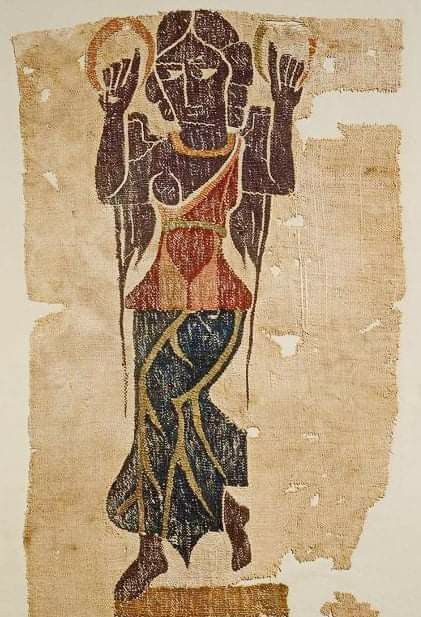
Thousands of ancient textiles with patterns have survived in Egypt. In this study, I attempt to discover what these patterns signify. Initially, I thought they represented religion. However, across fourteen textiles from two museums, grapes, birds, fruit, and celebration are the most frequently observed motifs—while temples, altars, and sacrifices are entirely absent. Even the cross appears alongside birds, seemingly emerging from grape leaves. Therefore, I argue that these designs more often express wishes for a prosperous life than recount religious belief.
Rationale for Topic Selection
Two months ago, I was in Uzbekistan. I went primarily to look at the architecture, but I became interested in the carpet stalls, the Suzani hanging on the walls, the robes, and other embroidered items. In Samarkand, we were told that nothing in a Suzani is drawn by accident. Pomegranates are embroidered to ensure the family has children, and peppers protect against the evil eye. The circle in the center represents the sun. It turns out that an object simply hanging on a wall is actually saying something and wishing something for its owners. This impressed me, and I wanted to understand how people choose patterns for textiles and what they intend to communicate with them.
I couldn’t take Uzbekistan itself for visual research because our course concludes in the 6th century AD. Everything I saw on the trip was from the 18th–19th centuries. Therefore, I left not the country, but a question. I needed an era with many surviving textiles featuring designs. Such an era was found in Egypt: thanks to the arid climate and sandy soil, thousands of fabrics have survived to this day. They are called Coptic. Initially, I was sure I would see religious iconography on them. However, it turned out that most frequently they depicted grapes, harvest, vines, and bunches of grapes. Dionysus also appears, but not in a temple setting—rather, at a celebration. This led me to the conclusion that these designs often express a wish: for a bountiful harvest and for everything to go well.
Areas of Study
I am taking Coptic textiles from two museums: The Metropolitan Museum of Art in New York and the Pushkin Museum in Moscow. In total, I have selected fourteen pieces: squares, medallions, stripes, curtain inserts, and large fabric fragments.
Работа затрагивает темы:
• which drawings most frequently appear on Coptic textiles; • grapes, harvest, and the Dionysian festival; • patterns of abundance that exclude gods: rural life, fruits, and birds; • the medallion and what can be placed within it; • Christian symbols on textiles and their coexistence with older designs; • what museum descriptions can reveal about an object and what they fail to convey.
Key Question
Where did the designs on the textiles of Egyptian 3rd–6th centuries come from, and what are they really telling us?
Hypotheses
Основная гипотеза
Drawings on Coptic textiles speak more of a good life than of faith. The myths depicted on the fabric are primarily joyful: victory, celebration, and harvest. My selection contains no scenes of worshiping the gods. Alongside the myths, fruits, birds, and rural landscapes stand as equals—settings where gods are entirely unnecessary.
Дополнительная гипотеза
When Egypt became Christian, the old drawings did not disappear. Christianity added a new symbol, the cross, but it was placed alongside the old drawings, not in their place.
I am not suggesting that Egyptians did not believe in gods or that religious scenes are absent from textiles. They do exist. My point applies only to this selection.
Research Objective
Show on fourteen items that drawings on Coptic textiles speak more of prosperity than of faith, and that older motifs survived with the advent of Christianity.
Objectives
1. Identify the most frequent motif and analyze how it is depicted: as a scene of worship or as a harvest and celebration. 2. Describe the depictions that lack gods entirely and show their relationship to the mythological themes. 3. Check whether the medallions and squares feature temples, altars, sacrifices, and supplicating figures. 4. Compare the early and late medallions to understand what can be discerned on them. 5. Determine what new elements appear on the textiles with the introduction of Christianity and how this new symbol integrates with the older motifs.
Materials Selection Principle
I drew ten pieces from the Metropolitan Museum of Art and four from the Pushkin Museum. This selection covers the main groups of drawings: wine and Dionysus, rural life, fruits and birds, medallions, and Christian symbols. I present the dates, materials, techniques, and dimensions exactly as indicated by the museum. General thoughts on the culture of that era are drawn from books and articles, cited with the author’s name. Quotes account for no more than twenty percent of the text.
Rubrication Principle
The chapters follow the steps of the argument. The first chapter analyzes the main image—the grape. The second demonstrates that myths are not mandatory; the fruits and birds convey the same meaning. The third searches the fabrics for elements that should not be there, should the hypothesis hold true. The fourth addresses the main objection. In conclusion, I consolidate all the items into one table.
How the Work is Organized
The chapters are arranged not by chronology or by object type, but by the logical steps of the argument. They cannot be rearranged, or the conclusion will fall apart.
• Chapter 1 analyzes the main image, the wine, and demonstrates that what has been chosen from the myth is celebratory, not cultic.
• Chapter 2 shows that myths are not necessary at all: the same meaning can be conveyed by fruit and birds without any gods.
• Chapter 3 tests the hypothesis in reverse. It seeks elements that would necessarily be present in religious garments and finds none. Here, medallions from different eras are compared, and an argument is made using children’s clothing.
• Chapter 4 addresses the objection regarding Christianity, showing that the new symbol was added to an existing sequence, rather than replacing it.
Chapter 1. Wine: The Main Narrative of Coptic Attire
If one views a sequence of Coptic textiles, the first thing that strikes the eye is grapes. The simplest explanation for this is: Dionysus is popular, and people depict their god. In this chapter, I investigate whether this is true.
No. 1. Square with Grape Harvest Scene