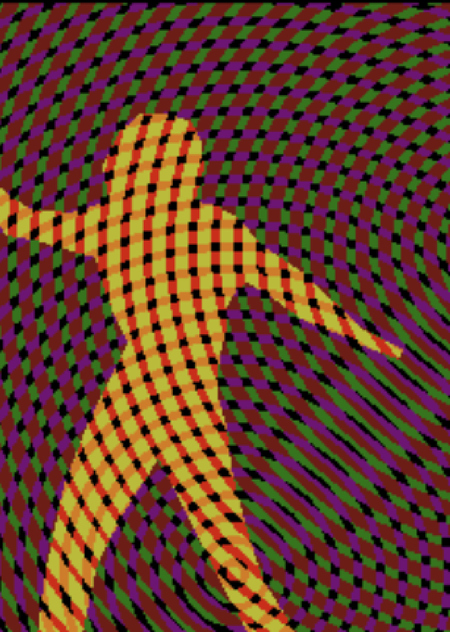
See the music: visual language of demoscene
What does a musical rhythm look like? It can be conveyed through the repetition of forms, color pulsation, camera movement, or abrupt image shifts. However, the relationship between sound and image can extend beyond synchronization with a single beat: visual development is capable of conveying build-up, pause, and climax.
In this study, the demo scene is examined through the relationship between music and image. The focus is on shot composition, color, typography, movement, and transitions between scenes. Using selected demos, we will trace how these elements organize the viewer’s perception over time.
Research Question
How are musical rhythm and compositional development in selected demo music translated into movement, color, form, and scene changes through visual devices?
Hypothesis
It is hypothesized that the connection between image and music in the selected demos operates on two levels: individual visual events emphasize sonic accents, while changes in frame composition, color, scale, and movement support the overall narrative development of the piece. Thus, music can determine both the moment an effect appears and the sequence of visual states.
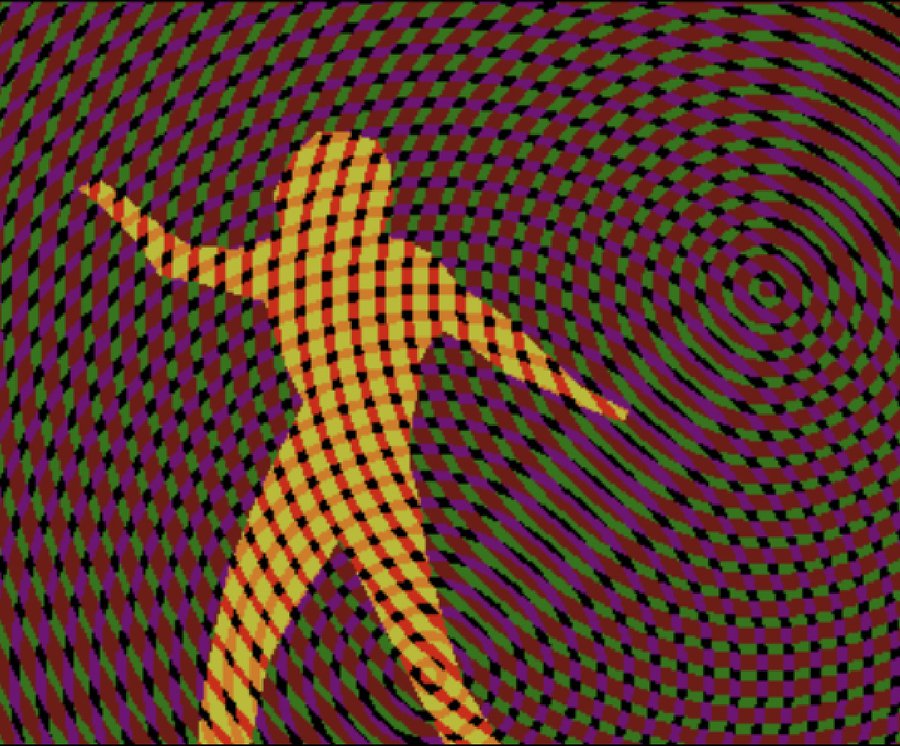
Spaceballs. «State of the Art, ” 1992. Amiga platform. Music by Travolta. Frame from demo. Sources: [3; 9].
What is a demo?
A demo is a computer program that displays an audiovisual work in real-time. Usually, the viewer does not control what is happening—the sequence of scenes is predetermined by the creators.
A demo might resemble a music video or abstract animation. However, video recording plays back finished frames, whereas a demo generates the image during runtime.
We will explore how the composition of the frame, color, movement, and transitions between scenes relate to the music.
Source: [1]
How the Research is Structured
The material will consist of demos featuring various visual approaches: dancing silhouettes, abstract forms, and three-dimensional spaces. This selection is intended for comparing artistic techniques and is not an exhaustive history of the demoscene.
We will examine each selected episode based on three parameters: composition and color; movement and transitions; and the connection between visual changes and musical accents or the development of the work.
The stills will allow for a comparison of the visual solutions, while the video recordings will allow us to trace them over time. Our observations will be supported by timecodes. Information regarding the creators, dates, and platforms will be separated from our own interpretation.
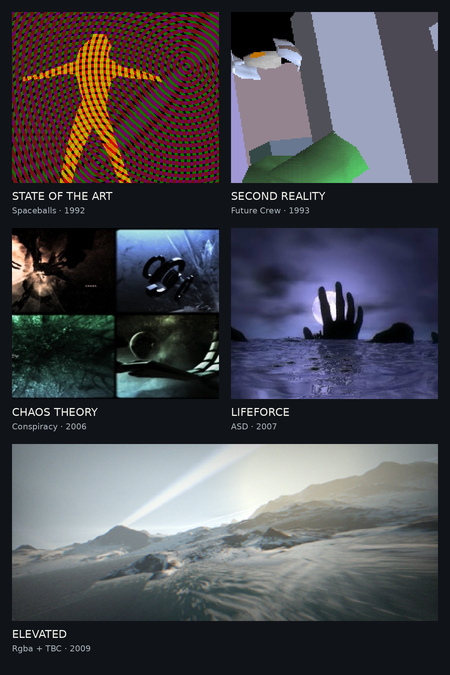
Research MaterialFive works were selected for comparative analysis:«State of the Art», Spaceballs, 1992.«Second Reality», Future Crew, 1993.«Chaos Theory», Conspiracy, 2006.«Lifeforce», Andromeda Software Development, 2007.«Elevated», Rgba + TBC, 2009.This selection allows for a comparison of different methods of image organization: dancing silhouettes, sequences of effects, abstract structures, continuous transitions, and spatial movement. We will test these analytical approaches using specific episodes.Image Sources: [9; 10; 11; 12; 13].
From individual effects to a cohesive presentation
In the late 1980s and early 1990s, megademos were a common format: large, multi-part works demonstrating a group’s capabilities in programming, graphics, and music.
The trackmo format organized these parts into a continuous sequence. For our research, this transition is important as a shift in the organization of time: a discrete effect becomes an episode within a larger audiovisual development.
Therefore, in our analysis, we will consider not only the type of object but also the duration of its appearance, the nature of the transition to the next scene, and the connection of these changes to the music.
Source: [1]
Image sources: [14; 9].
In the left frame, text organizes the composition: the group name, messages, and greetings. The lines establish horizontal levels, and a restricted color palette emphasizes the letters.In the right frame, the human silhouette becomes the primary element. The diagonals of the arms and legs intersect with a concentric pattern; the repetition of colored elements creates an optical vibration.These are two different ways of organizing attention: reading a message versus perceiving a figure against an active background. The comparison illustrates the difference between the two frames but does not prove that one approach has completely supplanted the other.
Rhythm: body, repetition, change of image
«State of the Art»
Spaceballs, 1992. Amiga.
Music — Travolta.
This first analysis focuses on the dancing silhouette. We will trace how body positioning, repetition of figures, and background changes organize the visual rhythm. We will also check which changes coincide with musical accents and which develop over a longer phrase.
Source: [3].
Two Layers of Visual Rhythm
In the segment at 00:58–01:02, two types of movement interact: the dancer changes her body posture, and the circular pattern shifts relative to her silhouette. The figure remains recognizable due to its yellow color, even as the ornament crosses both the body and the surrounding space.
A regular musical pulsation establishes the temporal anchor. Against this backdrop, the change in poses and the movement of the pattern create a complex visual composition within a single scene. The rhythm of the image arises without the need for constant frame changes.
Author’s Analysis. State of the Art, Spaceballs, 1992. Image Source: [15].
Typography as a Rhythmic Element
In the segment from 01:05–01:09, the dancing silhouette is succeeded by large inscriptions. The three-line composition remains, but the words change rapidly, alternating a light background with black.
The transition occurs approximately every 0.1 seconds—faster than the main musical pulsation. Therefore, the text can be perceived not only as a message but also as a series of brief graphic flashes.
Following the continuous motion of the body, a staccato rhythm emerges from the changing screens. The contrast in brightness and the dense masses of letters grant the typography an independent role in the audiovisual development.
Author’s analysis of the video clip «State of the Art, Spaceballs, 1992.» Footage source: [15].
One Motif—Diverse Graphic Interpretations
In three episodes, the dancing figure is presented in different ways: as a filled silhouette against a grainy background, a glowing outline in dark space, and a thin line on a light field.
The color, texture, and scale change, but the human plasticity remains recognizable. This visual variety maintains a unifying core: the viewer consistently returns to the body’s movement.
In our interpretation, the recurring motif links the episodes, while the change in its styling renews the perception of the dance against the music. This reveals another level of organization: rhythm develops through the recurrence of a familiar image in a transformed state.
Author’s Analysis. Timestamps: 01:35, 03:05, 03:35. Footage Source: [15].
From movement within the frame to scene transitions
The examined episodes reveal three ways to organize visual rhythm: the interaction between dance and moving patterns, the rapid switching of typographical screens, and the return of a figure in different graphic treatments.
The first operates within the scene, the second at the boundary of the changing images, and the third connects distant episodes. Therefore, it is useful to examine the relationship between image and music on several scales—from a short flash to the development of a recurring motif.
This example supports the hypothesis of a multi-level connection between music and image, but it is not yet possible to generalize this conclusion to the entire demo scene.
Various scenes—a common thread
«Second Reality»
Future Crew, 1993. MS-DOS Platform.
The following example will allow us to examine how the work is structured to integrate diverse visual episodes. The focus of our analysis is the transitions between them: what is preserved during the graphical change and how the new imagery is incorporated into the musical development.
We will compare the composition, direction of movement, and image density before and after the transition. This will help determine the role music plays in perceiving individual scenes as part of a whole.
Source: [4].
Music as a Bridge Between Scenes
In the clip from 05:36–05:56, the color field gradually loses its saturation and fades away. Following the darkening, a rotating cube appears, adorned with flowing color patterns on its faces.
The organization of the image changes: the surface that occupied a significant portion of the screen yields to a distinct, three-dimensional object against a black background. Color now serves to articulate the rotation and the facets of the form.
The audio track continues during the fading sequence. In our interpretation, the music becomes a temporal bridge—the disappearance of the image is perceived as a transition within an ongoing piece.
Authorial Analysis. The frames and audio signal were extracted from the recording Second Reality, Future Crew, 1993. [16] — Source of frames and audio track
Repetition creates volume
Luminous points coalesce into rings and spatial curves. Overlaps, variations in brightness, and dark projections on the lower plane help perceive depth without a solid surface.
Gradually, the ordered rows lose their legibility; the points disperse, forming a scattered cloud. Not only the arrangement of the elements changes, but also the way the whole is perceived: the gaze shifts from individual lines to the density of the multitude.
A musical pulse accompanies this extended process. The visual development here can be viewed on the scale of an entire episode—from a cohesive structure to its dissolution.
Artist’s Analysis. Second Reality, 06:30–06:50. Source footage: [16].