Topics
1. Representation of Iranian Art in the British Museum
1.1. The Iranian Collection and Exhibit Curation 1.2. Exhibition Organization and Visual Presentation of Works 1.3. Museum Labels and Historical Context2. Representation of Iranian Art in the Victoria and Albert Museum
2.1. Iranian Decorative Arts in the Museum Collection 2.2. Exhibition Space, Lighting, and Display Case Design 2.3. Methods of Presenting Cultural Heritage to Visitors3. Representation of Iranian Art in the Louvre
3.1. Iranian Works in the Museum Collection 3.2. Organization of Exhibition Space 3.3. Visual Presentation and Historical Interpretation of Works4. Comparative Visual Analysis of Three Museums
4.1. Selection of Works and Shaping the Image of Iranian Art 4.2. Comparison of Exhibition and Visual Strategies 4.3. Differences in Presenting Historical and Cultural ContextPresenting Iranian Art at the British Museum
Iranian art holds a significant place in the British Museum’s collection. Through archaeological finds, sculpture, luxury objects, and written monuments, the museum introduces visitors to the history of ancient Iranian states, the development of crafts, and the region’s cultural connections.
The main exhibition of ancient Iranian heritage is located in Gallery 52, known as the Rahim Irvani Gallery. It spans the period from approximately 3000 BCE to 651 CE.
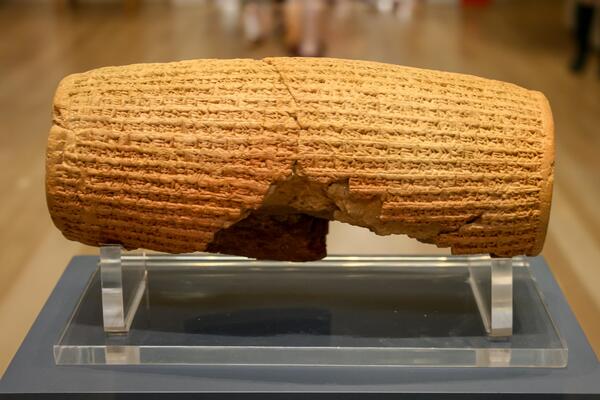
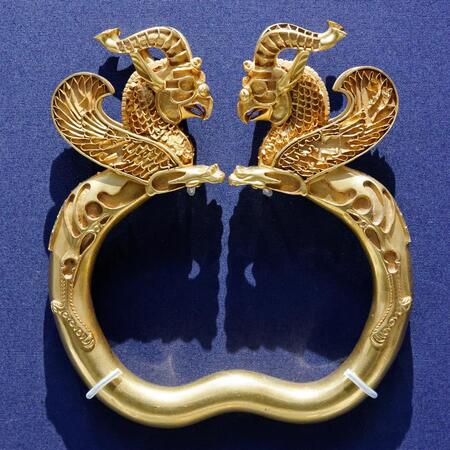
1. Kira Cylinder, c. 539 BCE. Fired clay, cuneiform. 2. Gold bracelet with griffin heads from the Amudarya hoard, 5th–4th centuries BCE.
Among the most renowned pieces in the ancient Iranian collection are Cyrus Cylinder, artifacts from the Amur Darya hoard, and reliefs associated with Persepolis.
The Cyrus Cylinder is particularly compelling for visual study. This small clay object bears a cuneiform inscription and was created by the Persian King Cyrus the Great after the conquest of Babylon in 539 BCE. Its inclusion in the Ancient Iran exhibit demonstrates that the museum examines the heritage of the Persian Empire within the scope of its historical influence, rather than strictly by modern political borders.
The Amur Darya hoard presents another facet of this history. The gold and silver objects allow viewers to examine the artistic traditions connected to the Achaemenid court culture.
This section of the collection particularly features items related to power and high social status. The precious materials, intricate ornamentation, and depictions of court ceremonies help to form an understanding of the wealth and scope of the Persian Empire.
Golden Chariot Model, V–IV century BCE, Takht-i Kuwad.
The selection of such works influences the perception of culture. Visitors are primarily introduced to its monumental and most valuable monuments. Everyday life becomes more apparent in other sections of the exhibit, where pottery, metalwork, and small household items are displayed.
1.2. Exhibition Organization and Visual Presentation of Works
Room 52. A bright space featuring glass display cases and thematically arranged archaeological artifacts.
The hall of Ancient Iran is characterized by light-colored walls, glass display cases, and calm illumination. The space is organized so that visitors can view the artifacts from various angles. Small decorative items, vessels, and metalwork are placed in individual display cases, while architectural reliefs occupy significantly more space. This design helps draw attention to the dimensions, form, and material of the works.
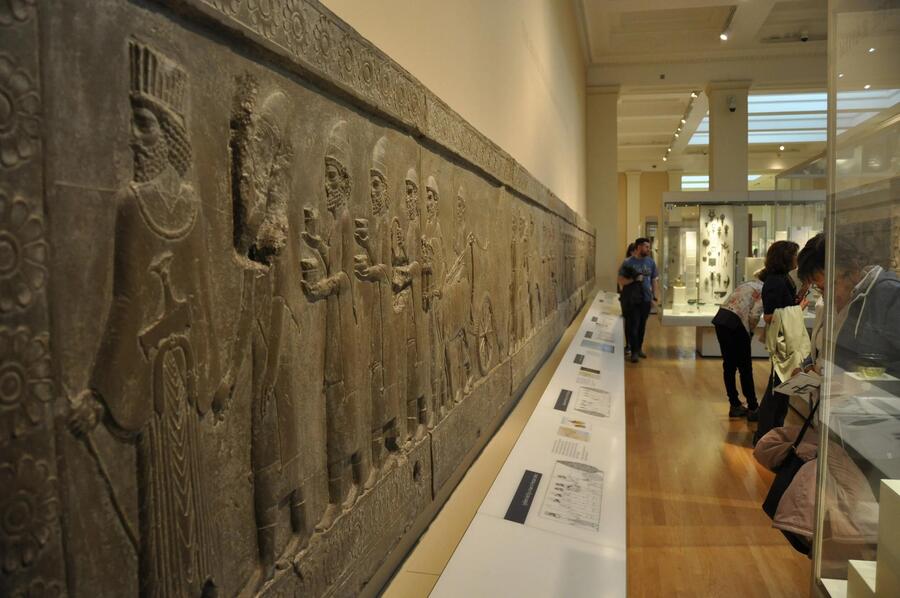
Monumental bas-reliefs of Persepolis along the exhibition wall.
It is particularly interesting to compare the presentation of small archaeological finds and the reliefs of Persepolis. The jewelry and vessels require close examination. The reliefs, conversely, are initially perceived as a single, large-scale composition. Visitors can walk alongside the reliefs, gradually examining the recurring figures of the procession. At the display cases, visitors pause to view individual objects.
Hall 52. Historical and Archaeological Exhibition.
For later works of Iranian art, the museum utilizes a different exhibition space. In the Islamic World Gallery, located in Halls 42–43, there are exhibits of ceramics, metalwork, textiles, book arts, and other objects from the 7th century and subsequent periods.The presentation here looks different. Dark panels, localized lighting, and individual compositions within the display cases create a more intimate atmosphere. Works are grouped not only by time or geographical origin but also by materials, artistic traditions, and cultural connections.
Halls 42–43. Islamic World Gallery.
This division warrants attention. In the Ancient Iran hall, the works primarily narrate the history of states and archaeological cultures. In the Islamic World gallery, Iranian art is viewed as part of a broader artistic tradition that unites diverse countries and regions.
Iranian ceramic dish, 17th century. Safavid period.
1.3. Museum Labels and Historical Context
Museum labels help the viewer connect individual artworks with historical events, places, and cultural traditions. At the British Museum, information is organized on several levels: historical period titles, general explanations for display cases, and captions for individual objects.For example, in the «First Cities» display case, objects are grouped by the theme of the emergence of early urban centers. Ceramic vessels and other archaeological finds are examined in relation to the development of crafts, trade, and daily life.
Exhibition labels and information panels in the Ancient Iran gallery.
This kind of collection helps the visitor perceive objects as artifacts of a specific historical era. Even a simple clay vessel gains meaning through an explanation of where and how it was used.
2. Presentation of Iranian Art at the Victoria and Albert Museum
The Victoria and Albert Museum is best known for its collections of decorative arts and design. Iranian heritage is represented here through carpets, ceramics, tiles, metalwork, textiles, and other objects where materials, ornamentation, and the skill of craftspeople play a crucial role.A significant portion of these works is part of the collection of Islamic art from the Middle East, which comprises over 19,000 pieces from various countries. The main exhibition space is the Jameel Gallery, which reopened after its renovation in 2006. Today, it features approximately 400 works created in regions ranging from Spain to Central Asia.
Tile panel depicting a scene of repose in a garden. Isfahan, Iran, 17th century.
One of the most renowned pieces of Iranian art in the museum is the Ardebil Carpet from the 16th century. It was created for the shrine of Sheikh Safi al-Din in the city of Ardebil, located in northwestern Iran. The carpet belongs to the Safavid period and is considered one of the most important surviving examples of Persian carpet weaving.
The carpet measures over ten meters in length. Almost its entire surface is covered in botanical ornamentation. A large medallion is positioned at the center, encircled by elongated decorative elements. Fine branches, flowers, and leaves extend across the dark blue background.
Detail of a plant ornament and color combination.
When examined up close, the complexity of the rug’s pattern becomes apparent. Numerous small elements coalesce into a unified composition. The impression is created through the precise repetition of forms, the combination of colors, and the density of the knots.
The rest of the collection features glazed ceramic pieces and architectural tiles. The star-shaped and cross-shaped tiles from Kashan of the 13th century are particularly intriguing. These pieces are decorated with floral motifs, depictions of animals, inscriptions, and lusterware painting, which creates a metallic sheen on the glazed surface.