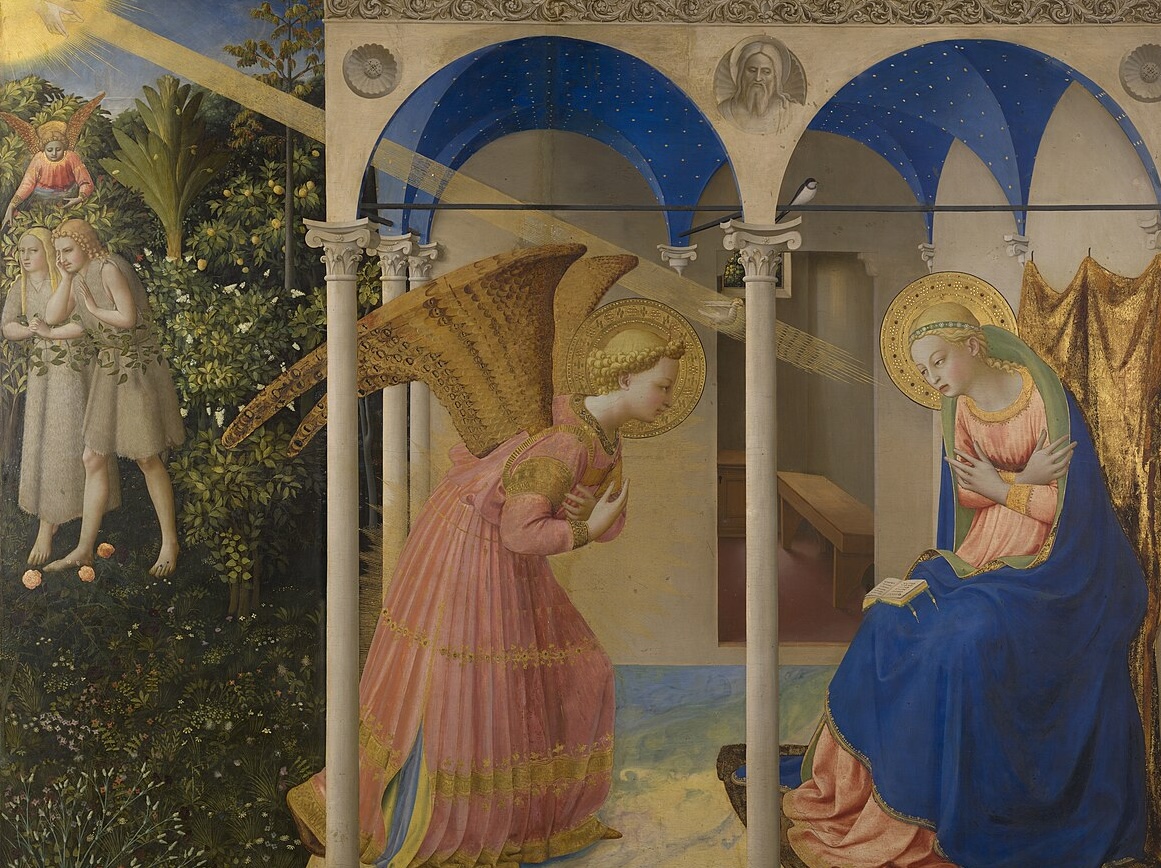
Язык жестов Марии в сценах Благовещения XIII–XV веков
Navigator
1: Concept2: Confusion: Maria’s initial reaction to Gavriil’s appearance3: Reflection: gestures associated with pause and focus4: Questioning: gestures directed toward the angel5: Acceptance: gestures expressing Maria’s assent6: Conclusion7: Bibliography and Image Sources
Concept
In the Annunciation scenes, I am most interested in the gestures of Mary and the angel Gabriel. The narrative is the same, but Mary demonstrates different actions: she is withdrawn, raises her hands, bows her head, or turns toward the angel. I wanted to find out if these gestures alone can convey what the artist intended to communicate in this dialogue. Luke describes Mary’s emotions. Initially, she was embarrassed upon hearing Gabriel, then inquired how the prophesied miracle would actually occur, and finally, at the end of the conversation, she completely submitted to God’s will. It is crucial for the painting to convey this conversation without adhering to the order in which the words are spoken.The period under investigation covers the 13th–15th centuries. During this time, masters from various parts of Europe developed specific visual techniques to help assess how the Virgin Mary perceived the words of the Archangel Gabriel and how she responded with her gestures. The main section will feature works by Italian artists, as well as individual pieces from other European regions for comparative analysis. Painted panels, mosaics, sculptural reliefs, miniature painting, and frescoes will be utilized. When selecting pieces, it is vital that the gestures and postures of the figures are clearly visible so that a comparative analysis can be conducted. I care more about analyzing several different variations of a single gesture than about compiling the maximum number of Annunciation paintings without any thematic coherence between them.
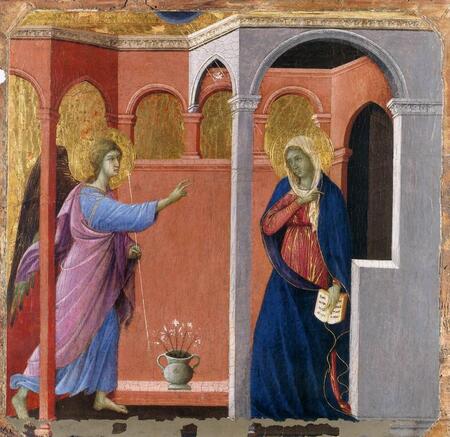
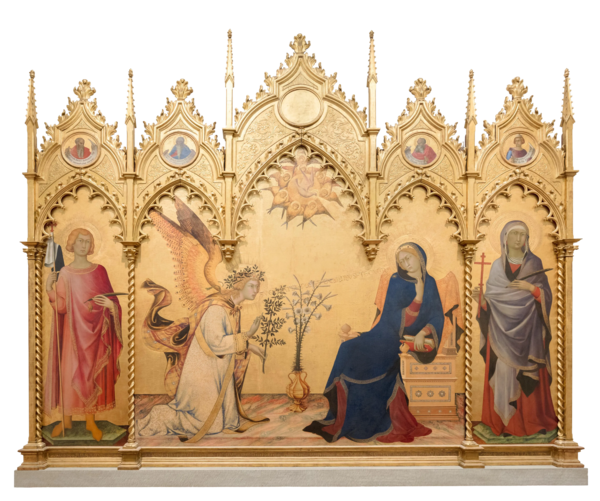
1. Duccio di Buoninsegna. «The Annunciation.» 1307/1308–1311. 2. Simone Martini, Lippo Memmi. «The Annunciation with Saints Ansano and Maxima.» 1333.
My work will be divided into four chapters: «Confusion, ” „Contemplation, ” „Questioning, ” and „Acceptance.“ This structure is dictated by the progression of the dialogue between the angel Gabriel and Maria. The first chapter will examine detachment and raised hands. The second part of the work will study gestures associated with halting a process and reflection. The third chapter will explore gestures used to convey a question or appeal to the angel, and the fourth chapter will focus on gestures of agreement and response to the angel’s word.Body language suggests to the viewer exactly which moment of the narrative the artist has captured. The task ahead is to understand why visually similar movements across different eras can convey sometimes diametrically opposed emotional impulses. I believe that gestures genuinely allow us to distinguish moments of agreement, contemplation, shyness, and questioning, but they cannot always be used in isolation. Sometimes, to understand a gesture, one must see Gabriel’s responding gesture, Marina’s spatial positioning, or the accompanying text. These are the very moments I intend to study using specific artworks.
Chapter 01. Confusion
Depicting the Annunciation, brush masters conveyed Maria’s reception of Gabriel in various ways. At times, she raises her hand. Other times, the virgin turns away or slightly shifts her body, demonstrating sudden embarrassment to the viewer, although such gestures do not always imply that the heroine was truly frightened by the messenger. The poses help to reveal the artist’s intention, because the truth is embedded in how the angel and the Mother of Christ interact.The Gospel of Luke writes that the angel’s greeting startled the Virgin. But the masters created differently. On some canvases, the viewer notices a subtle flick of the fingers, while on others, the entire body of the heroine is engaged in the action. We will understand the meaning of the pose only when we correlate Maria’s posture with Gabriel’s demeanor.
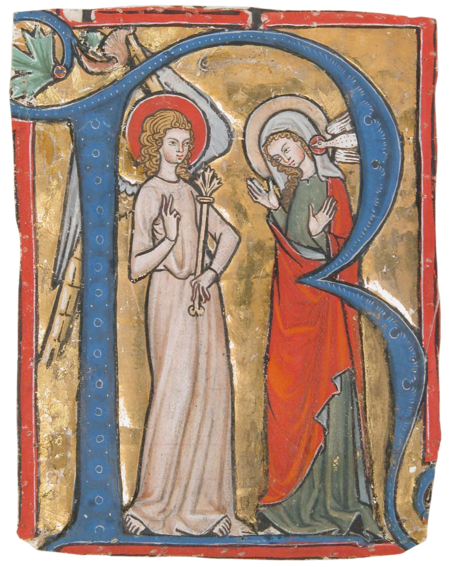
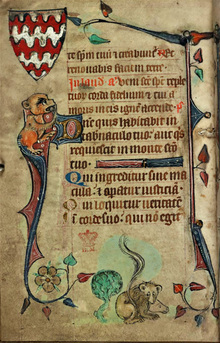
1. Unknown Venetian Master. «The Annunciation.» c. 1280–1300. 2. Unknown Upper Rhine Master. «Annunciation in the Initial R.» c. 1300.
The heroine’s hands in the two miniatures express a response to Gavrilo. The Venetian master depicted a restrained gesture: one raised palm visually connects the woman’s figure with the angel. The Rhenish work is more expressive. In it, Mary raises both hands simultaneously.Energetic wrist movements do not prove that the maiden is greatly distressed. In the miniature from the Upper Rhenish School, a dove hovers near the heroine. This image of the Holy Spirit helps the viewer understand the essence of the sacred plot, but the bird alone does not reveal how Mary feels at that moment. The plasticity of the characters is important. Only if we study the heroes' gestures and their place in space will the painter’s intentions become clear.This example demonstrates that the meaning of a gesture does not depend on how abruptly the hero moves. Sometimes hands emphasize suddenness. Often, artists simply show us the flow of conversation through the plasticity of the hands.
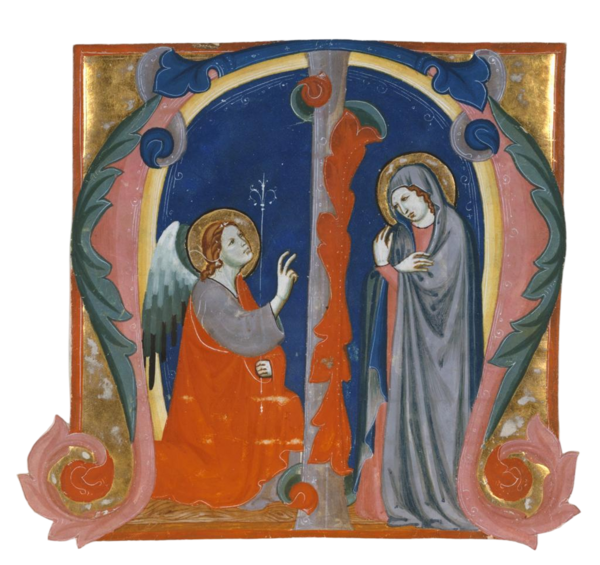
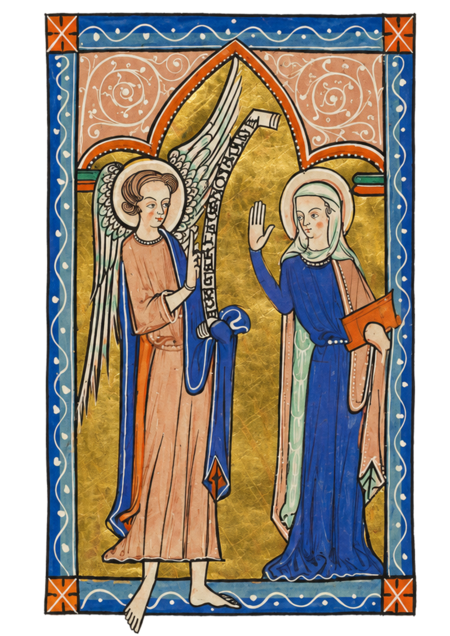
1. Attributed to Master Daddesco. «The Annunciation in the Initial M.» c. 1310–1315. Tempera and gold on vellum. Metropolitan Museum of Art, New York. Inv. 1975.1.2478. 2. Unknown English Master. «The Annunciation.» c. 1250.
The meaning of these miniatures largely conveys how the artist positioned the characters. The letters M separates the figures. Master Dadesco placed the Theotokos and the kneeling angel on opposite sides of this initial.The master from England in the mid-13th century structured the scene differently. Let’s compare this image with a later work. This will clearly show how differently creators arranged their conversational partners in space, depending on whether they were engaged in a long or a brief dialogue with one another.Is it enough to place the characters far apart or turn them toward one another to convey excitement? Hardly. The illustrations confirm a simple idea: the external features of a conversation rarely match how people respond to words emotionally.
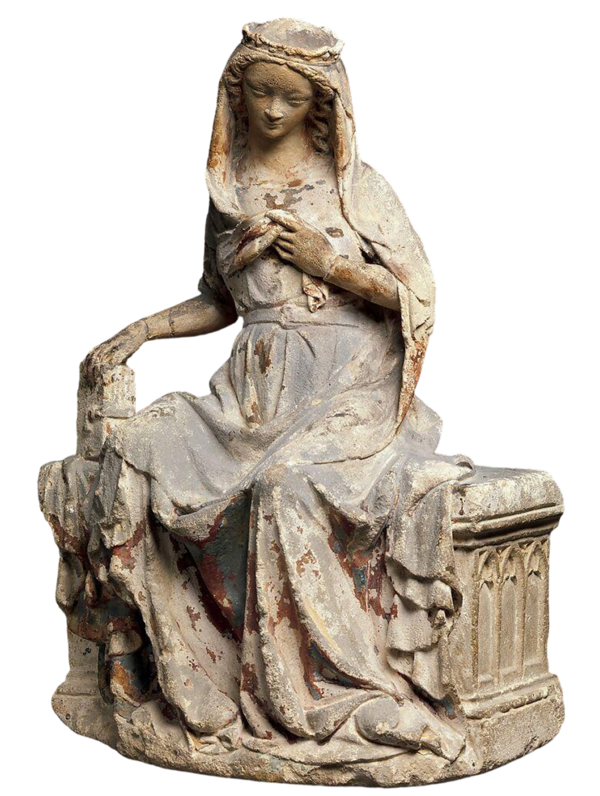
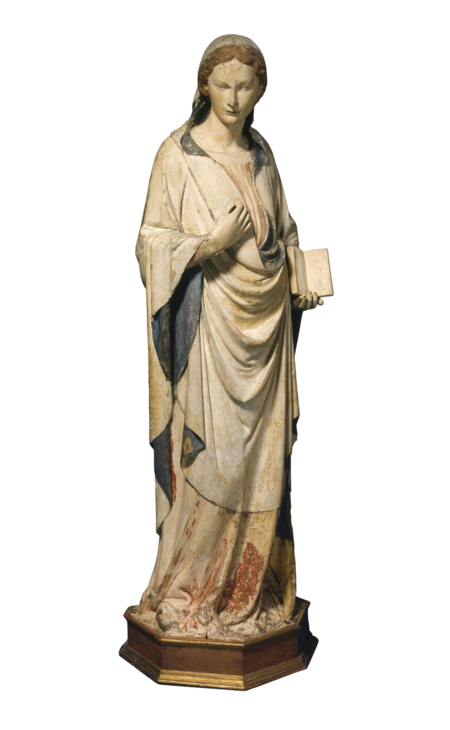
1. Unknown French sculptor. «The Virgin Mary at the Annunciation.» c. 1300–1310. 2. Unknown Pisan master. «The Virgin Mary at the Annunciation.» 1325–1350.
Maria’s pose in the sculpture best conveys her emotions. The French master slightly tilted the figure back and left one hand raised, thereby emphasizing the woman’s troubled state. The author of the Pisan work approached it differently. There, the Virgin Mary stands firmly on the ground, only pressing a palm against her chest.
The sculptors captured a moment of sudden encounter. By comparing the works of masters from different artistic schools, a discerning viewer quickly notices that the external gestures of the characters do not always reveal their true deep anxiety or intense fear. It is difficult to gauge the heroine’s agitation from mere plasticity alone.
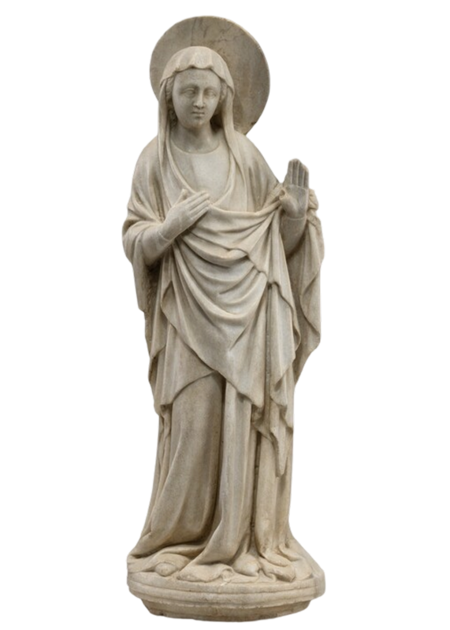
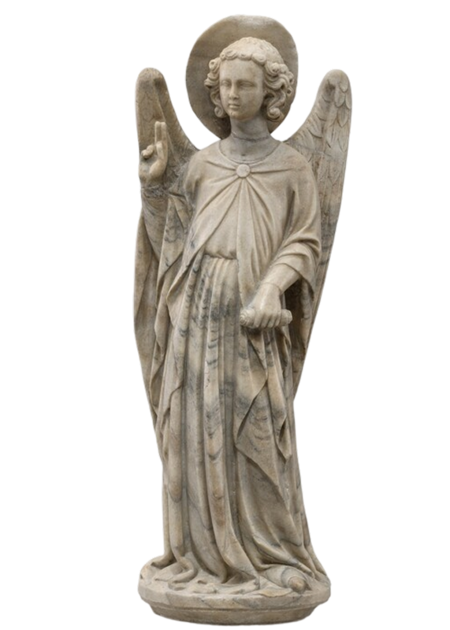
1. Unknown Venetian sculptor. «Virgin Mary in the Annunciation Scene.» Circa 1340. 2. Unknown Venetian sculptor. «Angel of the Annunciation.» Circa 1340.
These two sculptures help teach sign language. Maria raises her left hand in front of her and presses her right hand to her chest. Gavriil mimics this gesture, directing his palm toward the interlocutor to visually reinforce the meaning of his words.Maria and Gavriil communicate using similar gestures. The Angel resolutely extends a hand when proclaiming the news, while the woman raises her palm, as if attempting to ward off the news or express extreme surprise at what she has heard. The similarity in their movements is deceptive.Maria’s palm could easily be mistaken for a sign of fear. However, when the figure is compared to the archangel, it becomes clear that superficial resemblance is insufficient for definitive conclusions. To interpret the scene correctly, the observer must closely track the direction of the palm movement and how the participants in this silent dialogue influence each other at a specific moment.
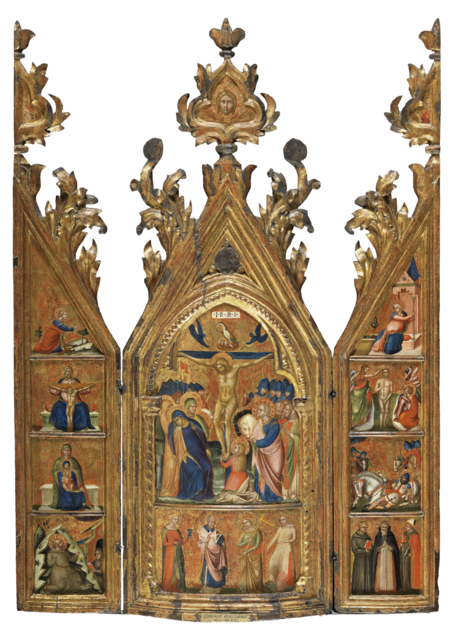
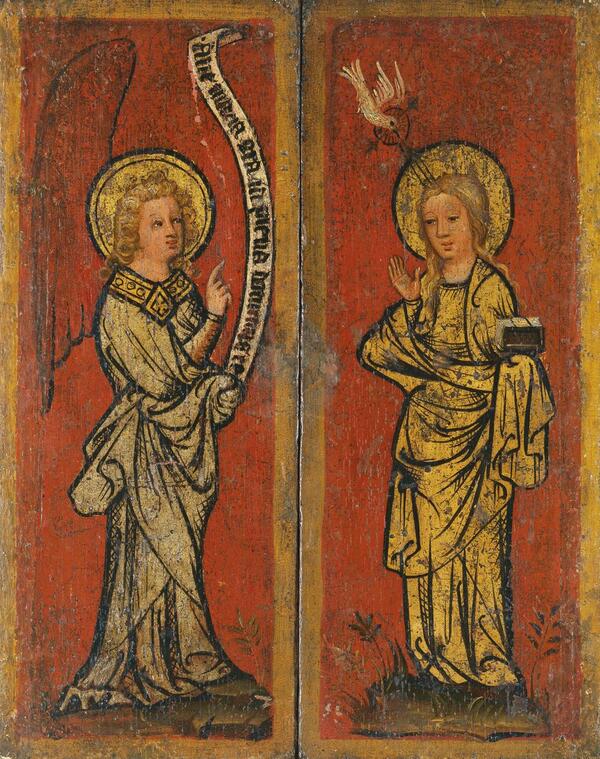
1. Lorenzo Veneziano. «Portable Triptych with the Crucifixion.» c. 1370–1375. 2. Master Bertram. «The Annunciation» (panels of the «Holy Face Triptych»). c. 1390–1400.
Venetian depicted Mary by the column. She tightly grips the cold stone with her hand, trying to maintain her balance, because Archangel Gabriel appeared before her in this room completely unexpectedly. The staff at the Tissene-Bornemisza Museum see fear in this gesture.Master Bertram interprets the scene differently. Although the painter masterfully renders the lines and folds of the fabrics, it is still extremely difficult to understand exactly what the Virgin Mary is feeling in the moment of this dialogue.By comparing both works, we will understand that one precise gesture describes emotional anxiety much more clearly than if we were to judge the heroine’s state based on her overall posture. This is especially noticeable when comparing the two pieces discussed.
Chapter 02. Reflection
The Gospel of Luke states that Mary was troubled by the greeting of Gabriel and contemplated his words. But how can an artist depict contemplation when it occurs within a person?
In the Annunciation scenes, Mary often lowers her gaze, tilts her head, or keeps her hands close to her body. Let’s explore which of these gestures help convey concentration and whether they can be distinguished from humility or acceptance.
Ambrogio Lorenzetti. «The Annunciation.» c. 1334–1336.
Ambrogio Lorenzetti places architectural details between Gabriel and Mary. As the angel bows before the Virgin, she—though looking at him—remains in her own contemplative space.An empty space separates the figures. The viewer clearly perceives a pause. Gabriel has already spoken to Mary, but we do not understand what she will answer, because the master has arranged the characters in such a way that the viewer cannot decipher his true intent. From Mary’s restrained posture, it is difficult to definitively determine what she is feeling in that moment.
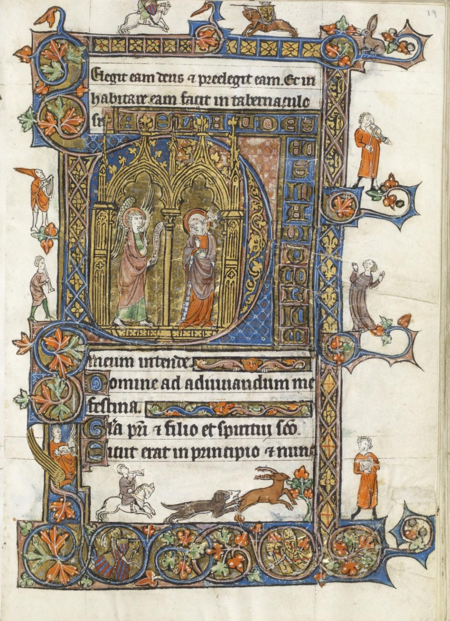
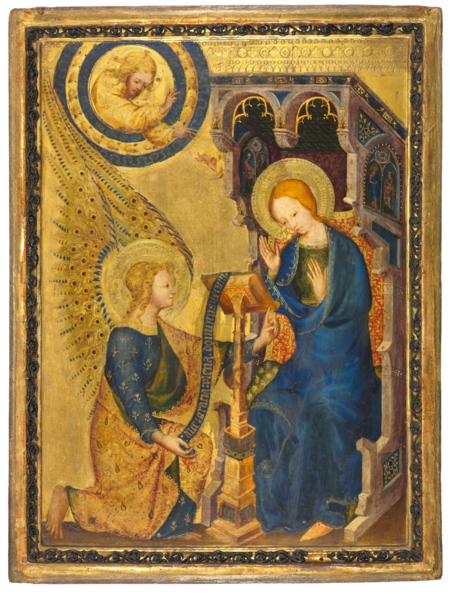
1. Unknown French Master. «Annunciation in the Initial D.» c. 1300–1325. 2. Unknown Master of the Netherlands or France. «Annunciation.» 1380s.
The same encounter is depicted differently in a miniature from the early 14th century and a painting created fifty years later. Mary reads in one. In the later work, she is seated, looking down at the text on a lectern.
Painters often include a book in the Annunciation scene. This allows the viewer to understand that Gabriel interrupted her routine, even though the subject itself does not confirm that the heroine is contemplating the angel’s words.
The meaning lies in the gestures. Mary’s gaze and the way she holds her hands over the pages convey precisely how she is receiving the news: whether she is still reading, listening to the messenger, or has already fallen silent before responding.
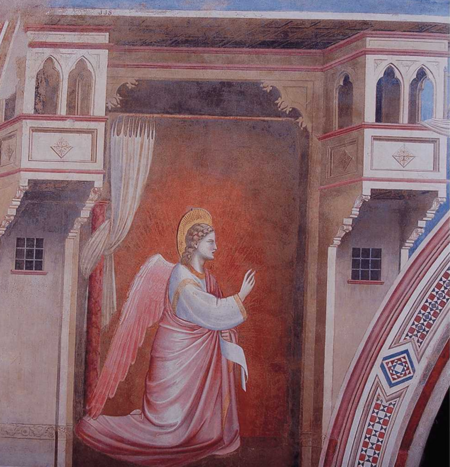
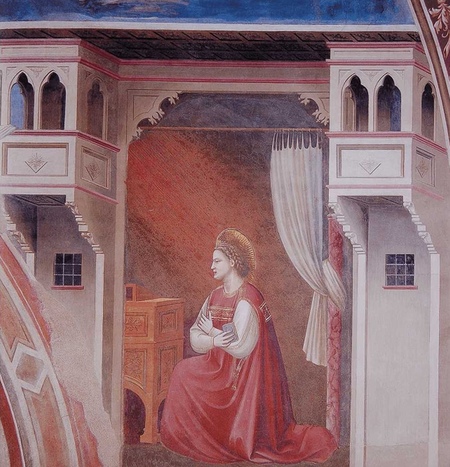
Giotto di Bondone. «The Annunciation.» c. 1303–1305.
On both sides of the arch in Giotto’s Scrovegni Chapel, he placed figures from the Annunciation. Gabriel and Mary stand separately. The artist turned the figures toward each other but maintained a significant space between them—a space that visually emphasizes the importance of their silent dialogue.Mary has knelt. She has her hands folded in front of her. The body’s plasticity lacks the sharp jolts that other masters usually used to convey the maiden’s sudden confusion or deep fright upon seeing the angel. She is frozen. The maiden listens intently to the heavenly messenger.Such tranquility is difficult to explain. Perhaps the heroine’s gestures express a humble will to accept the news obediently, rather than merely her attempt to deliberate on the words of the unexpected visitor. Giotto clearly demonstrated that the outward appearance of a character is often insufficient to fully decipher their true feelings.
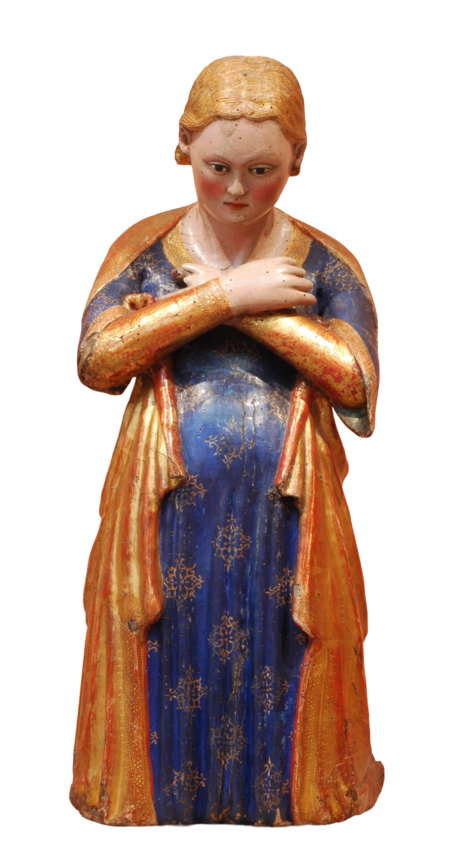
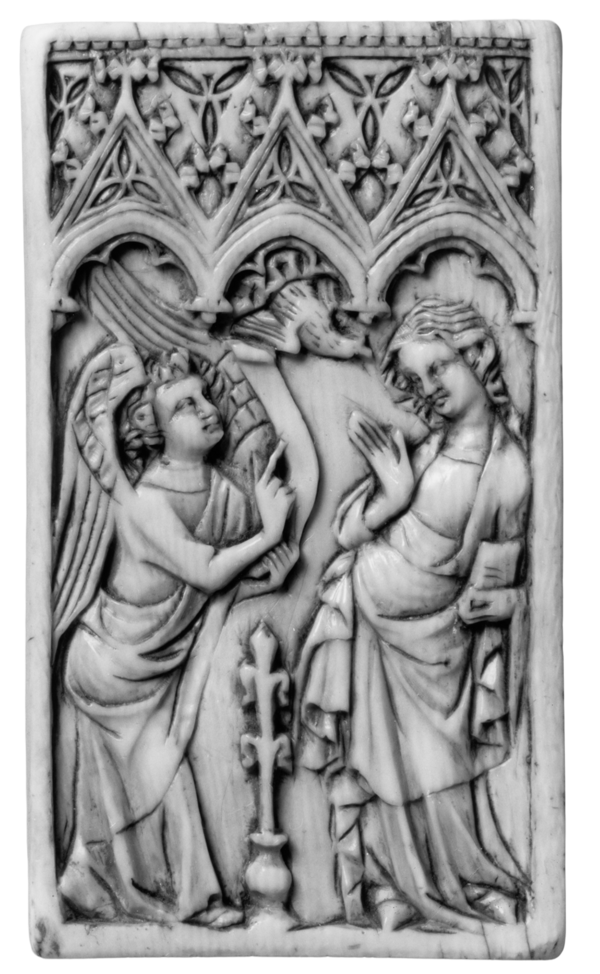
1. Unknown Sienese Master. «Annunciation of the Virgin Mary.» c. 1360–1380. 2. Casket Workshop. «Bottom of a Casket with the Annunciation.» Third quarter of the 14th century.
The Sienese painter depicted the Virgin Mary kneeling. She gazes downward, her arms crossed over her chest, emphasizing how deeply the woman is immersed in her emotions.
In the French relief, the heroine acts differently. Mary raises a hand. In this case, her reaction appears more open.
These works of art vividly demonstrate the diverse ways the plasticity of the body can be employed. A character’s composure often expresses humility. For this reason, one cannot assume a quiet pose is merely a sign of deep contemplation.
Unknown German Master. «Diptych with scenes of the Annunciation, Nativity, Crucifixion, and Resurrection.» 1300–1325.