Figure Poses in Giotto di Bondone’s Frescoes
In Giotto’s frescoes, the characters rarely appear as if they are merely posing for the viewer. They turn toward each other, lean in, gesture with their hands, or sit with their backs to us.
I became curious about how these movements influence the way we perceive the fresco.
Research Question:
How does the placement of figures help Giotto depict space and relationships between characters?
Hypothesis:
I hypothesize that by observing the turns and orientations of figures, one can determine who is closer to the viewer, which characters are related to one another, and where the main action is taking place.
For my research, I selected 11 frescoes from the Cappella Scrovegni in the Italian city of Padua. They date back to the early fourteenth century and are part of Giotto’s cycle of paintings.
The frescoes are arranged in several rows on the chapel walls. Each scene exists independently, but together they form a large narrative about the life of Christ and Mary.
Chapter 1. Figures and Space
The art history textbook notes that Giotto creates a sense of space by positioning figures on the flat wall surface. The characters occupy different locations, even though the fresco’s surface remains planar.
When one figure partially obscures another, we perceive it as being closer. Thus, an artist can depict multiple planes without separating them with lines.
«The Last Supper»
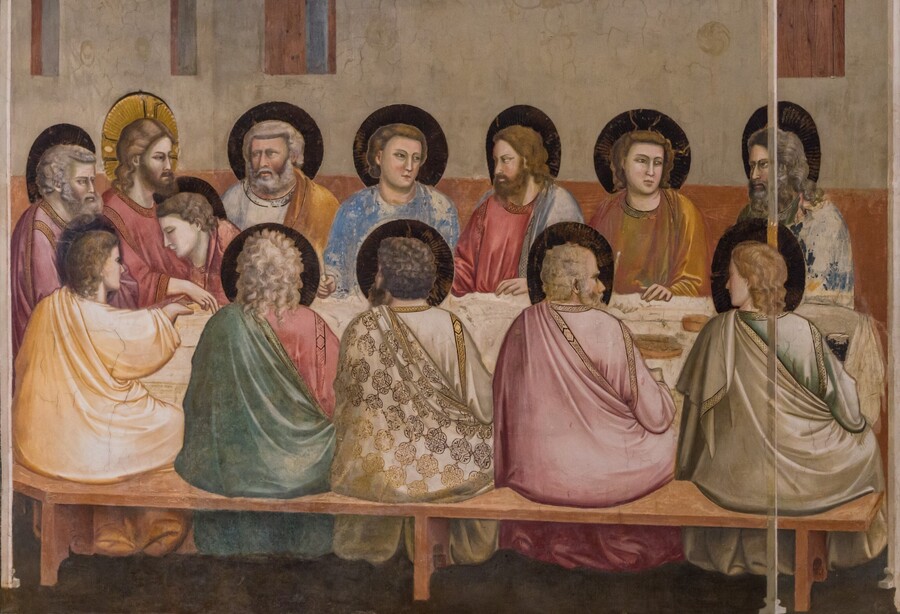
Giotto. «The Last Supper.» Early 14th century. Fresco. Cappella Scrovegni, Padua.
The twelve apostles are seated on both sides of the table. We cannot see the faces of those closest to us, or we only see them partially. The faces of the people across from us are fully visible.The table stands in the center of the room, helping us to understand the apostles' arrangement.The figures in the front row obscure part of the table and the people in front of them. Because of this, it seems as if we are viewing the gathering from the side. The turn of the figures presents them as part of the action while simultaneously defining the foreground.
In Giotto’s fresco, «The Last Supper, ” students are positioned on either side of the table. The figures with their backs to the viewer establish the foreground and help convey the depth of space.
«Marriage in Cana»
Giotto. «Marriage in Cana.» Early 14th century. Fresco. Cappella Scrovegni, Padua.
In «The Wedding at Cana,» the characters are also seated around a communal table. The postures of the figures help reveal the characters' arrangement around it and their relationships with one another. The guests are turned toward their neighbors and the center of the feast, while the figures standing on the right occupy a separate space adjacent to the table. This lends the scene the feeling of a communal gathering.
In this fresco, the angle of each figure helps to understand who is interacting with whom and how close they are to the viewer.
«Foot Washing»
Giotto. «The Washing of the Feet.» Early 14th century. Fresco. Scrovegni Chapel, Padua.
Christ leans toward the student, while the other apostles stand nearby. The figures are closely grouped, making the space feel cramped. Christ’s leaning figure stands out among the seated students and helps draw attention to the main action.Furthermore, the abundance of overlapping figures also creates a sense of confinement.
In «Foot Washing,» the inclinations and turns of the figures group the characters around Christ and help to highlight his action.
«Christ Among Teachers»
Giotto. «Christ Among the Teachers.» Early 14th century. Fresco. Cappella Scrovegni, Padua.
Here, Giotto positions the figure of Christ at the center, with the teachers on either side. Their turns and gestures are directed toward Christ, immediately drawing the viewer’s attention to the central figure. The architecture frames the group and helps illustrate that the characters are within the same space.
Chapter 2. Relationships Between Figures
Figure turns help us understand how characters are connected to one another. They interact with neighbors, gather around a single event, or occupy different sides of the composition. Because of this, individual figures are perceived as participants in a shared scene.
«Lamentation of Christ»
Giotto. «Lamentation of Christ.» Early 14th century. Fresco. Cappella Scrovegni, Padua.
Two women in the lower part of the fresco sit with their backs to the viewer. Their faces are obscured, but the tilt of their bodies indicates that they are facing Christ. These figures are closer to us and partially obscure the characters behind them, helping to create a sense of spatial depth.The rest of the scene’s participants also turn and lean toward Christ. They are all posed differently, but their gazes are directed at Christ.
«The Resurrection of Lazarus»
Giotto. «The Raising of Lazarus.» Early 14th century. Fresco. Scrovegni Chapel, Padua.
Giotto places Christ and Lazarus on opposite sides of the composition. Christ is turned toward Lazarus and extends his hand to him. This gesture connects the two characters and helps the viewer follow the main action.In the foreground, two figures are leaning toward the ground. They partially overlap the characters behind them, helping to convey that the participants are at different distances from the viewer.
The turns of the figures and Christ’s gesture connect the characters on both sides of the fresco, while the overlaps help to convey spatial depth.