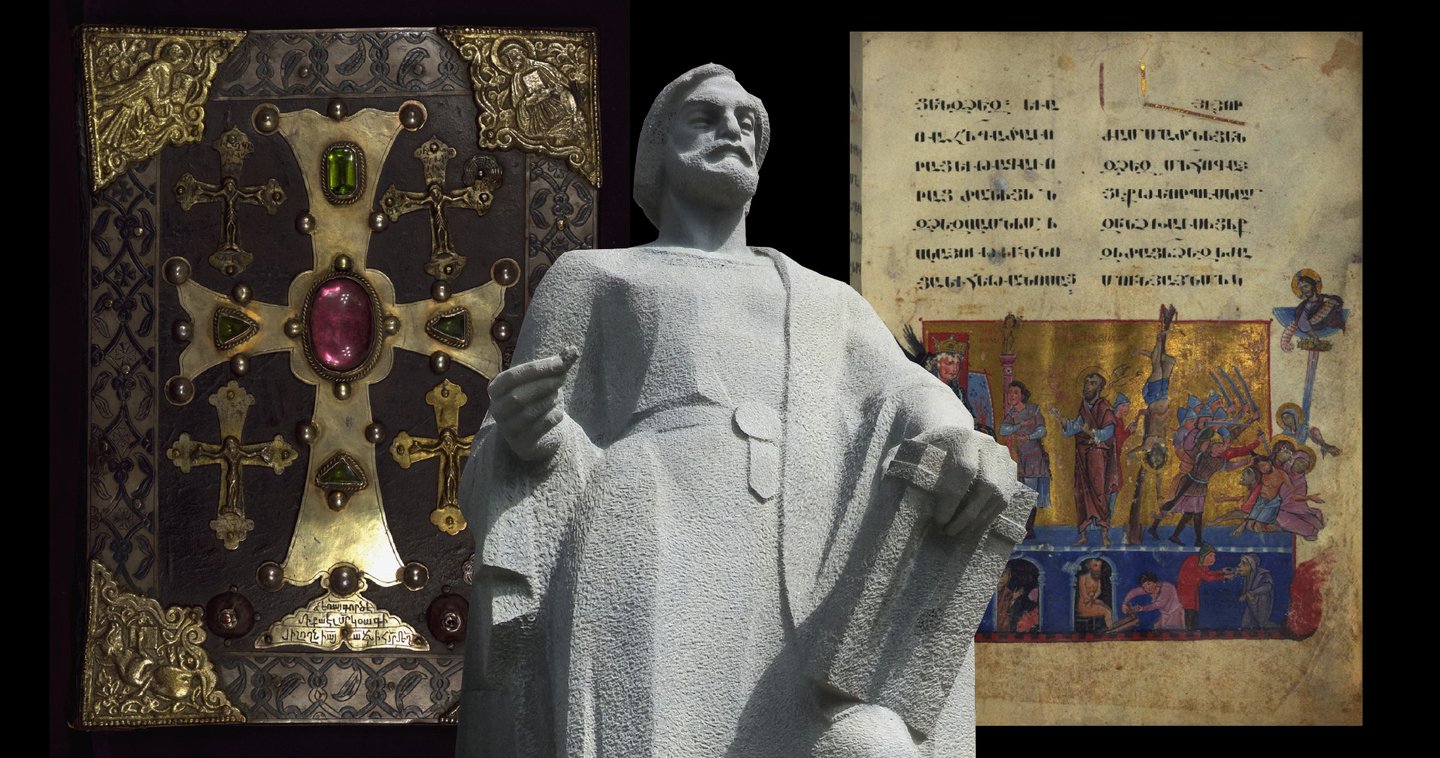
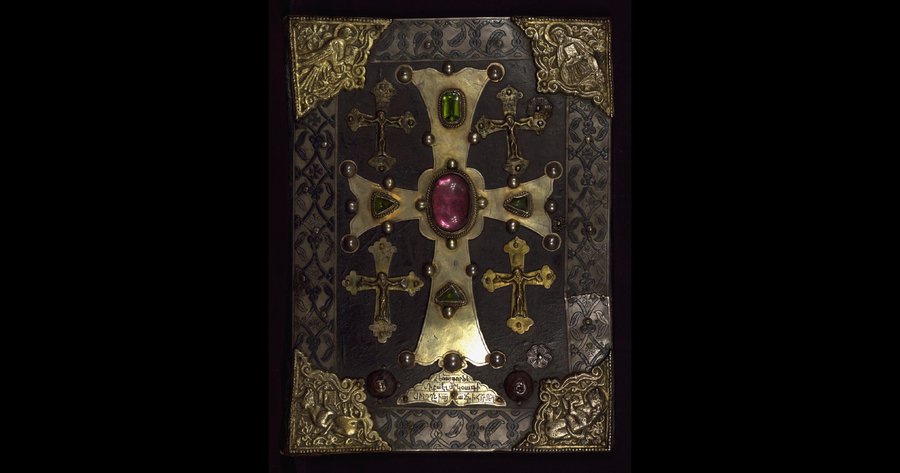
Cover of the Zeitun Gospel, Toros Roslin, 1262
Concept
In the rich and extensive history of Armenia, books and their illustrations hold a special place. Following Mesrop Mashtots' creation of the Armenian alphabet, literature began to flourish. This development was also reflected in illustrations, which improved year by year. Toros Roslin is considered one of the finest miniature artists. This study will trace the journey from early Armenian book miniatures to the works of Toros Roslin.
Unfortunately, many ancient books have not survived; Armenian history is replete with wars and destructions, which made it difficult to preserve numerous artistic masterpieces. However, some of these ancient books have survived and are housed in Matenadaran in Yerevan.
Armenian miniature is far more than a regional art form. It influenced illustrations worldwide. The vibrant colors, initial letters, ornate designs, and decorative painting styles—all of these became widely adopted globally, while Armenian illustrators pioneered many of these techniques and elements.
In this study, I will examine the evolution of Armenian miniature painting and the techniques that have been employed throughout its development.
10th century and earlier
The Adoration of the Magi. Miniature from the Echmiadzin Gospel. 6th–7th centuries
The first miniatures began appearing with the initial translations of religious books, around the fifth century. However, as mentioned, many of the older miniatures were lost, and the most ancient ones that remain intact are four miniatures from the «Echmiadzin Gospel» of 989.
It is worth noting that even at that time, the miniatures exhibited a remarkably high level of craftsmanship, demonstrating that the art of miniature painting had already developed significantly beforehand. Exactly how this occurred, however, will remain a mystery.
Miniatures from this period are typically linear; they are created using simple lines and watercolor washes. There are few characters, and they are depicted standing; illustrations are present within the text.
11th Century
The Baptism. Gospel of Mugni, Ovanes Sandkhavaneitsi, 1060
Starting in the 11th century, the Ani School of illumination became popular. It originated in the center of Bagratid Armenia, in the city of Ani, and subsequently played a significant role in the development of later schools.
The miniatures are characterized by vibrant colors and are executed according to iconographic canons. They share a certain resemblance to frescoes of that era—the compositions echo the manner in which the temples of that time were decorated.
The Annunciation. The Gospel of Erzanka, 11th–12th centuries
In the 11th century, gold and silver became more commonly used in miniatures; furthermore, whereas previously miniatures were written on both sides of a single parchment sheet due to the scarcity of material, illustrators could now afford to dedicate one miniature per sheet of parchment.
The surviving, albeit few, illustrated Armenian manuscripts from the 11th century provide evidence of a diverse and actively developing miniature painting tradition during that period.
The preserved, albeit in small numbers, illustrated Armenian manuscripts from the 11th century provide grounds to assert the existence of a diverse and actively developing miniature painting tradition during that period. (Izmaylova, 1979, p. 224)
12th Century
«Book of Sorrowful Hymns,» Grigor Narekatsi, 1173
Armenian philosopher Anania Narekatsi founded a school at the Narekavank Monastery in the 10th century. Under his guidance, the monastery became a major center for Armenian literature; Gregory Narekatsi was among Anania’s students. Gregory wrote the «Book of Lamentations,» which was later illustrated by a master named Gregory Mlichits.
«Book of Lamentations,» also known as «Narek,» pioneered the Cilician school of miniature painting, which became arguably the most significant in the history of Armenian miniature.
The miniatures from the Nareka codex are renowned for their intricate carpet patterns, initials featuring birds and animals, and delicate calligraphy. Unlike the canonical Gospels, which adhere to a strict iconographic program, the «Book of Lamentations» offered artists the latitude to create new imagery. These manuscripts also feature portraits of the author himself, as well as allegorical and symbolic compositions.
«Book of Lamentations,» Grigor Narekatsi, 1173
As courtly art, miniatures were distinguished by their high elegance. Masters utilized a vibrant yet delicately developed palette, employing abundant gold and lapis lazuli, which harkens back to 11th-century miniatures. In contrast to the more rigid and canonical painting of past centuries, the characters in Cilician miniatures display expressive facial features and natural poses.
13th Century
Zeitun Gospel, Toros Roslin, 1262
The 13th century is considered the golden age of Armenian miniature painting. It was then that the Cilician School and its masters reached their peak, and Toros Roslan is generally regarded as the finest master of that era.