Эволюция европейского портрета в XIV веке
От сакрального знака к автономии человеческого лика
Navigation Menu
- Concept
- Monumental painting—frescoes and book miniature: donors in sacred space.
- Panel painting and the Prague School: the three-quarter turn, the autonomy of the secular figure.
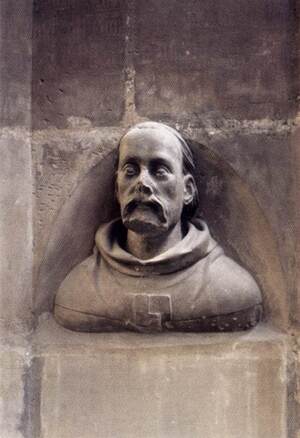
- Monumental sculpture and funerary monuments: posthumous masks, effigies, busts.
- Conclusion
Concept
The fourteenth century—the Trecento period in Italy and the Late Gothic period in Northern and Central Europe—represents a fundamental turning point in the history of European art. This was a time when the portrait gradually liberated itself from its role as a purely conventional, hieratic function or a symbolic marker of status, beginning to transform into an autonomous capture of the individual countenance, plastic physicality, and personal presence.In the fourteenth century, the European portrait evolved from a symbolic inclusion of the donor into a sacred space, where social status and the function of prayer were paramount over the individual’s likeness, to the fixation of genuine physiognomic features and autonomous personal presence. This evolution was prepared by the early Humanist turn and the development of new objectives for painting and plastic language: the three-quarter turn, chiaroscuro modeling, and the introduction of posthumous molds in sculpture.The subject of this research is not the biography of the patrons, but the evolution of the visual and plastic language: perspective, light, scale relationships, materiality, and the relationship between sacred space and earthly presence.
Key question: How, and through what painterly and plastic techniques, did the image of the human being break free from the rigid confines of religious canon to begin acquiring individual portrait likeness?
The principle of the study’s structure follows a problem-chronological method—moving from the general context to specific formal and psychological elements, sequentially revealing the stages of attaining autonomy in portraiture:
To begin, I want to examine the initial system of the 14th century, where the individual exists exclusively as an element of sacred space, subject to strict theological canons and iconographic schemes. Next, I will analyze how the first depictions of real people timidly penetrate this sacred context—the donor figures, who are still timidly or prayerfully pressed near the feet of saints but are beginning to take on individual contours.
Following this, we examine the spatial turn and the issue of achieving corporeality: how Proto-Renaissance masters use linear perspective, chiaroscuro elements, and volume modeling to grant physical density to the face and figure, breaking away from the flat conventions of the Middle Ages. After this, I will explore the phenomenon of psychological and individual character development, when the portrait ceases to be merely a conventional marker of status and begins to capture the subject’s expressions, age characteristics, and manifestations of their inner world.
I wish to conclude the discussion by examining how all these accumulated changes lead to the birth of the autonomous European portrait—one that exists independently of direct dependence on the altar image or religious narrative—and how the system established in the 14th century lays the foundation for the entire subsequent portrait tradition of the Modern Era.
The principle guiding the selection of textual and visual material is based on the chronological slice of the 14th century and the geographical scope of leading artistic centers: Italy (Proto-Renaissance frescoes and panel paintings) and Northern Europe (early Dutch tradition and miniature). The visual basis is formed from the works of masters who established the foundations of new plasticity and psychological depth, as well as early monuments of the autonomous portrait.
Monumental painting—frescoes and book miniature: donors in sacred space
Pietro Cavallini, «Apse: Saint Peter Recommends Bertoldo Stefanski to the Virgin Mary,» 1296–1300
13th-Century Legacy: Humanity as a Conditional Function.
The donor is depicted kneeling before the Theotokos. A strict hierarchical scale is maintained: the human figure is several times smaller than the sacred figures. The donor’s face is typical, schematic, and devoid of age or physiognomic features.
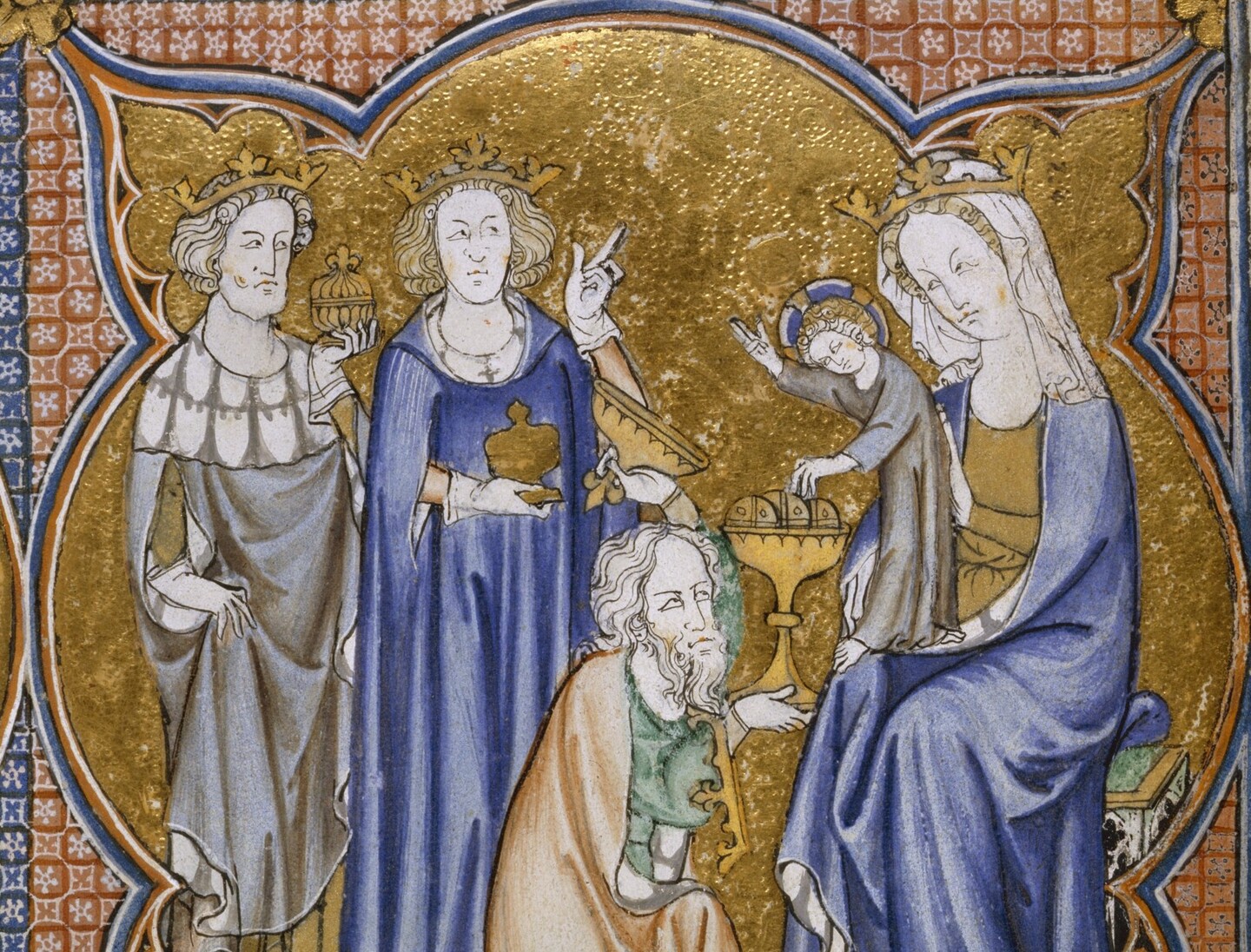
Madonna Master, Robert de Laillande’s Psalter: «Adoration of the Magi,» c. 1310
Medieval book miniature.The donor is presented as a silhouetted figure. The main purpose of the image is to heraldically designate the coat of arms, clothing, and status, rather than achieve individualized portrait accuracy.
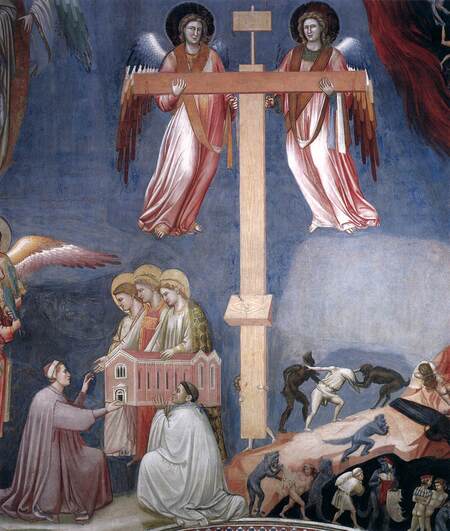
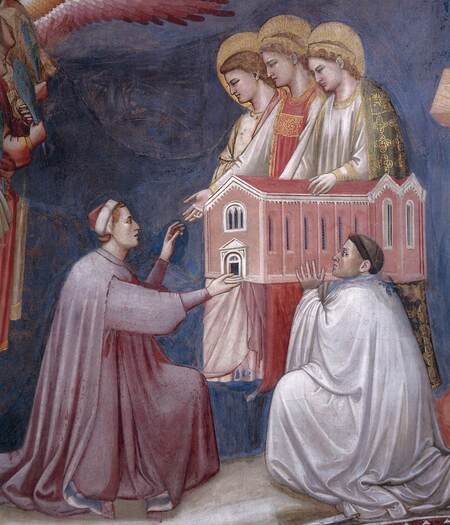
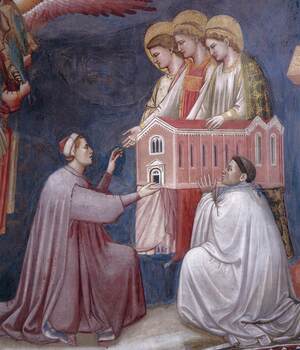
Giotto di Bondone, fragment of the fresco «The Last Judgment, ” c. 1305–1306
Giotto di Bondone’s Breakthrough: Introducing the Real Person into the Sacred Fresco.
Enrico Scrovegni is presented in the Madonna Chapel. While the proportions are still subject to theological hierarchy, Scrovegni’s face is given for the first time a real, volumetric sculpture and plastic conviction.
Visible features include the characteristic hooked nose, double chin, under-eye bags, and a specific fold around the mouth. Giotto individualizes the image while retaining the portrait’s devotional function.
Simone Martini, «Altar of Saint Louis of Toulouse, ” c. 1317
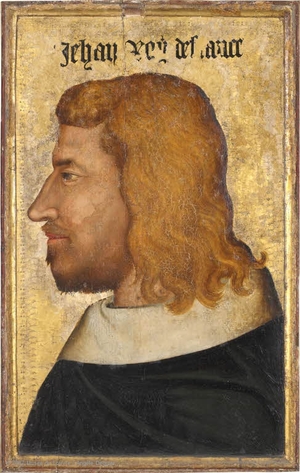
A political and dynastic portrait within a sacred framework. The saint is depicted prominently in the center, yet the actual ruler—Robert of Anjou—is shown in a strict profile on the side, with precise rendering of his royal nose and chin. The religious narrative directly serves as an act of political representation.
Lippo Memmi, fragment of the fresco «Maestro,» 1317
Sienese linear refinement.
The artist utilizes a sharp, silhouetted contour. The profile becomes a means to convey the stature of the donor through the details of his attire, which indicate high social rank. The figure of Nello Ptolemy possesses features that could be described as individual and nearly portrait-like—the character’s profile, his hairstyle, and the concentration hinting at a prayerful fervor—all conveyed by the painter with extreme meticulousness.
The rendering of the body’s volume in the painting directly impacts the sense of portrait conviction in the human face.
Why did the profile view dominate in the first half of the 14th century?
- The profile is easily legible on the surface of a fresco or manuscript.
- Direct connection to the tradition of ancient coins and seals.
- Distancing: the donor looks at the saint but does not engage with the viewer.
Pietro Lorenzetti, «The Entry of Jesus into Jerusalem, ” c. 1320
Group donor portraits.An attempt to place multiple community members in a single row. Individuality is achieved through varying hair color, beard length, and nose shape.Color and attributes in the donor portrait.In the conditional depiction of characters, the heraldic palette of costumes maintains the role of a key distinguishing feature—alongside materials, signet rings, and headwear.
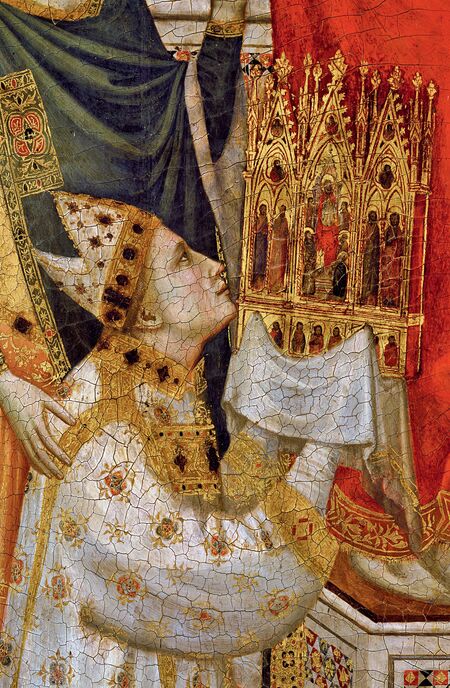
Рим. Джотто ди Бондоне, фрагмент Триптиха Стефанески, ок. 1320
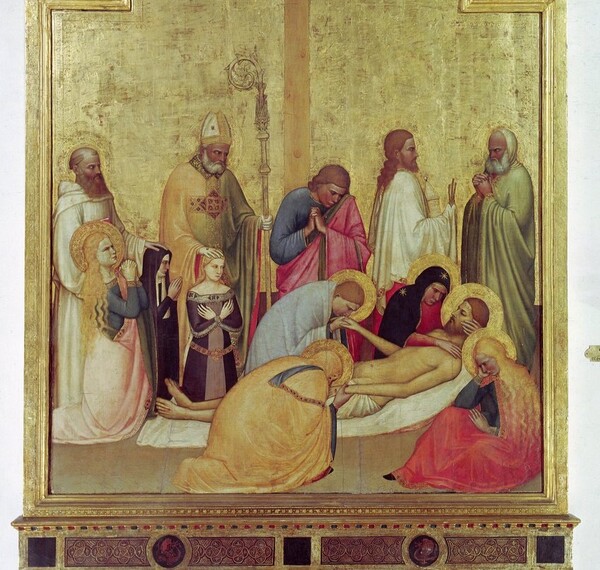
Флоренция. Джотто ди маэстро Стефано, «Оплакивание Христа», ок. 1360–1365
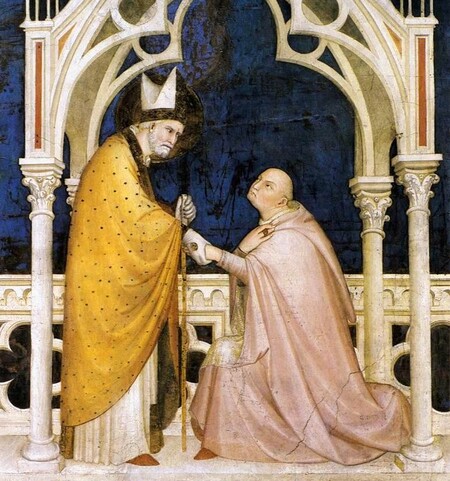
Симоне Мартини, «Освящение часовни», ок. 1321–1325
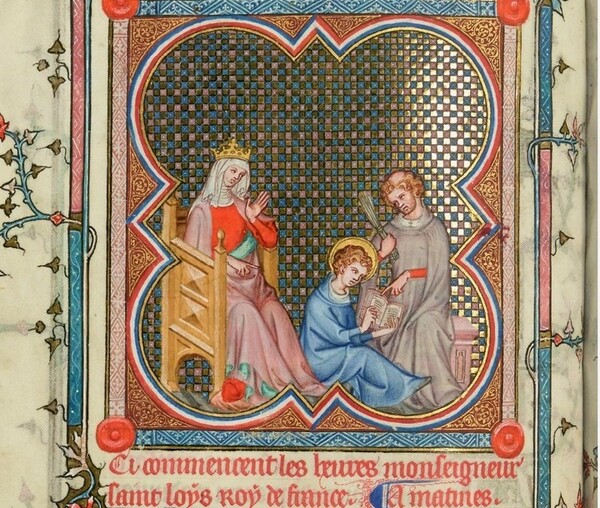
Париж. Жан Ле Нуар, разворот из «Часослова Жанны Наваррской», ок. 1336–1340
Across the regions of Rome, Florence, Siena, and Paris, the figure of the donor maintained a secondary scale relative to the sacred center.The significance of the sacred commission for the development of portraiture.The allegorical function of «eternal prayer» allowed real people to enter into painted panels and frescoes, creating a precedent for fixing the likeness of their contemporaries.In summary: the first half of the 14th century opened the path to portraiture through donor portraits. However, the human face was still subordinated to the religious vertical, hierarchical scale, and profile limitation.
Machine Panel and the Prague School: A Three-Quarter Turn toward the Autonomy of the Secular Face
The Perspective Revolution: The Three-Quarter Turn.
Turning the head three-quarters creates visual disruption. This introduces the possibility to reveal the depth of the eye socket, the structure of the cheekbone, the volume of the cheek, the light-and-shadow modeling of the face, and the natural direction of the gaze.
Altiquero da Zevio, «The Crucifixion, ” 1376–1379
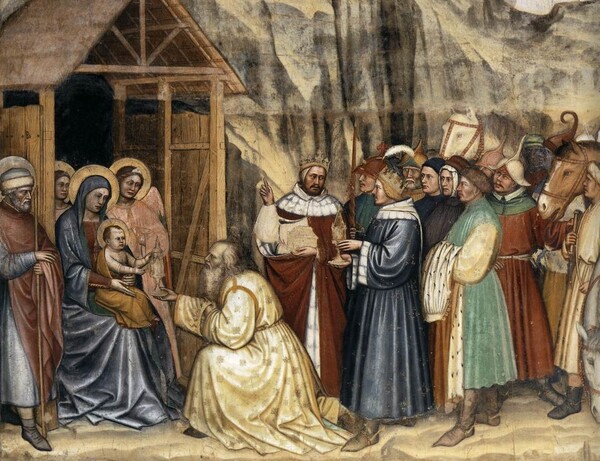
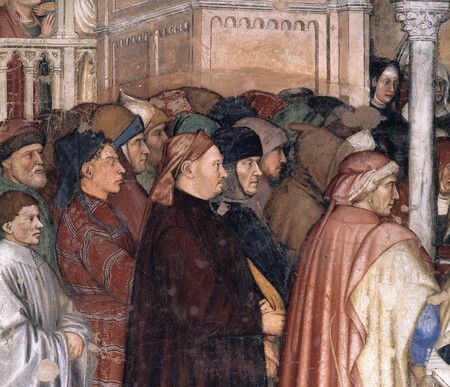
Altiquero da Zevio, fragment of the fresco «Adoration of the Magi, ” 1378–1384 Altiquero da Zevio, fragment of the fresco „Funeral of St. Lucy, ” 1378–1384
Italian Breakthrough: Alticiero da Zevio.
Alticiero further develops the legacy of Giotto. The master enriches this tradition by lending the characters' faces subtle psychological expressiveness and giving them vivid portraiture. The painter also employs the three-quarter view for heads. For the first time, the faces achieve a lively psychological interaction.
The artist meticulously renders facial wrinkles, eyelid asymmetry, the structure of the lips, and skin texture.